dscribe the strucutr eof cone and rods
Rods and cones both consist of an outer segment specialised for transduction, joined to an inner segment (with more normal cellular machinery) by a connecting cilium.
Rod outer segments (ROS) consist of stacked membranous discs containing the visual pigment, and enzymes of the transduction cascade.
Cone outer segments consist of continuous folds of invaginating lamellae.
describe rhodopsin
The visual pigment, rhodopsin is a membrane protein with 7 transmembrane helices embedded in the disk membrane: a prototypical G-protein coupled receptor.
what dies rhodopsiin bind/
Rhodopsin binds a chromophore molecule, 11-cis retinal in a specific binding pocket.
peak absorbtion of 500nm
chromophore in cone cells?
idemnticle chromophore - different charge interactions tuen absorbtion to different wave lengths
descriube Photoisomerisation of the photopigment
Following absorption of a single photon the chromophore isomerises from 11-cis to all-trans retinal.
This photoisomerization leads to a catalytically active form of rhodopsin known as metarhodopsin II, often referred to simply as R*.
describe how R* returns to the R state
After R* has played its role, all-trans retinal dissociates slowly (100-1000 s) from the opsin: rhodopsin is now in its so-called bleached form and must be regenerated before it can be used again.
Regeneration cannot take place within the photoreceptor itself, but instead is performed in the retinal pigment epithelium (RPE), the cells of which encompass the apical processes of the outer segments.
describe the rpocess of photopigment generation
In order to regenerate the photopigment,
- retinal is reduced to all-trans-retinol
- transported out of the photoreceptor into the RPE
- where it is converted back to 11-cis- retinal.
- Finally it is transported back to the photoreceptors, where it rejoins the bleached opsin to form rhodopsin.
- After bright light it can take 30 minutes or more before rhodopsin is fully regenerated.
Retinal is a derivative of vitamin A (11-cis-retinol), and deficiency leads to ….
Retinal is a derivative of vitamin A (11-cis-retinol), and deficiency leads to night blindness.
photopigment regeneration in cones?
An alternative pathway via Müller cells
allows rapid pigment regeneration in cones.
Phototransduction takes place via a
G protein-coupled cascade, which culminates in the ______ of cyclic GMP (a negative internal transmitter).
Phototransduction takes place via a
G protein-coupled cascade, which culminates in the destruction of cyclic GMP (a negative internal transmitter).
describe the process of phototransduction
- R* activates heterotrimeric GTP-binding protein (G protein) called transducin
- Transducin and rhodopsin diffuse freely in the disc membrane, and by random collisions the active rhodopsin can activate >100 transducin molecules.
- Each transducin molecule activates one effector enzyme, a phosphodiesterase: (PDE).
- PDE hydrolyzes cyclic GMP (cGMP), present in high concentrations in the dark, into the inactive 5’GMP.
- The rod plasma membrane contains a high density of cyclic nucleotide gated cation channels which are opened by cGMP and so are continuously open in the dark
- The reduction in the concentration of cGMP results in closure of channels, leading to a hyperpolarizing response.
- Guanylyl cyclase (GC) then resynthesises cGMP to terminate the response.
light results in the cell becoming
hyperpolarised
describe how amplification is used in photoreceptrs
A characteristic feature of such second messenger cascades is the possibility of amplification: a single rhodopsin molecule activates ~150 G proteins s-1, and each molecule of PDE hydrolyzes ~600 cGMP molecules s-1.
The resulting reduction in cGMP concentration (~105 molecules hydrolysed per photon) results in the closure of several hundred channels, (3% of the channels open in the darkness) blocking the entry of ~106 cations.
This explains how a single photon can give rise to a measurable signal in one rod.
what is Retinitis pigmentosa
Hereditary retinitis pigmentosa (RP) is a progressive hereditary retinal degeneration afflicting 1 in 3000 people.
There is a gradual onset of night blindness in adolescence, leading to loss of all peripheral vision by adulthood, and in extreme cases total blindness.
There is no single cause for hereditary RP, but about 5-10% of cases are caused by mutations in the gene for rhodopsin.
Many other molecules of the transduction cascade are affected in other cases of hereditary retinal disease including PDE and the light-sensitive channel.
describe the dark current
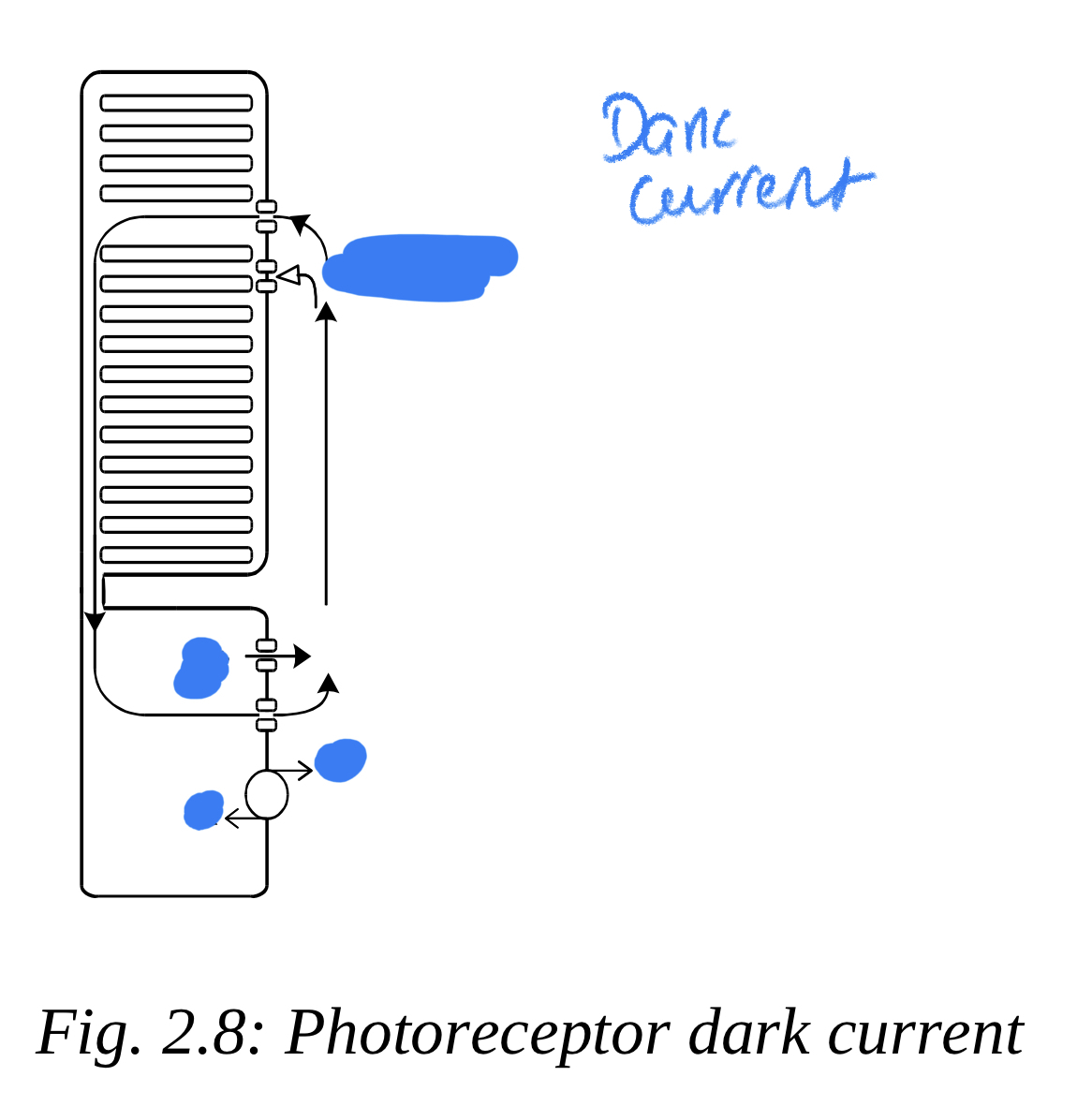
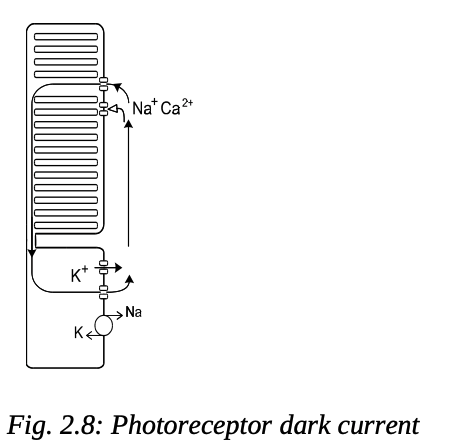
In darkness, when the cGMP concentration is high, many channels are open and there is a continuous circulating dark current consisting of Na+ and Ca2+ ions flowing into the outer segment, depolarizing the cell to around -30 mV.
The circuit is completed by outward current in the inner segment, mainly through K+ channels. When the channels carrying the dark current close during illumination, K+ continues to exit via channels in the inner segment, resulting in a hyperpolarization. A Na/K pump maintains the ionic gradients
describe graded hyperpolarisation?
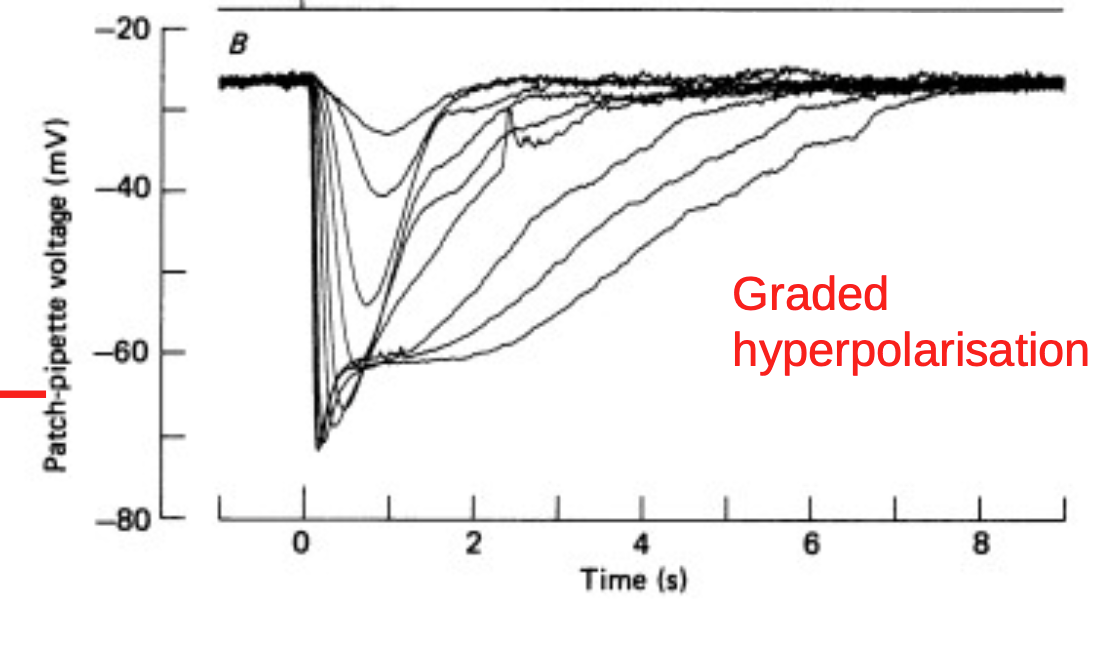
Flashes of increasing intensity close more and more channels causing a graded hyperpolarization, saturating at around - 75 mV when all the cGMP-gated channels are closed.
describe light adaptation?
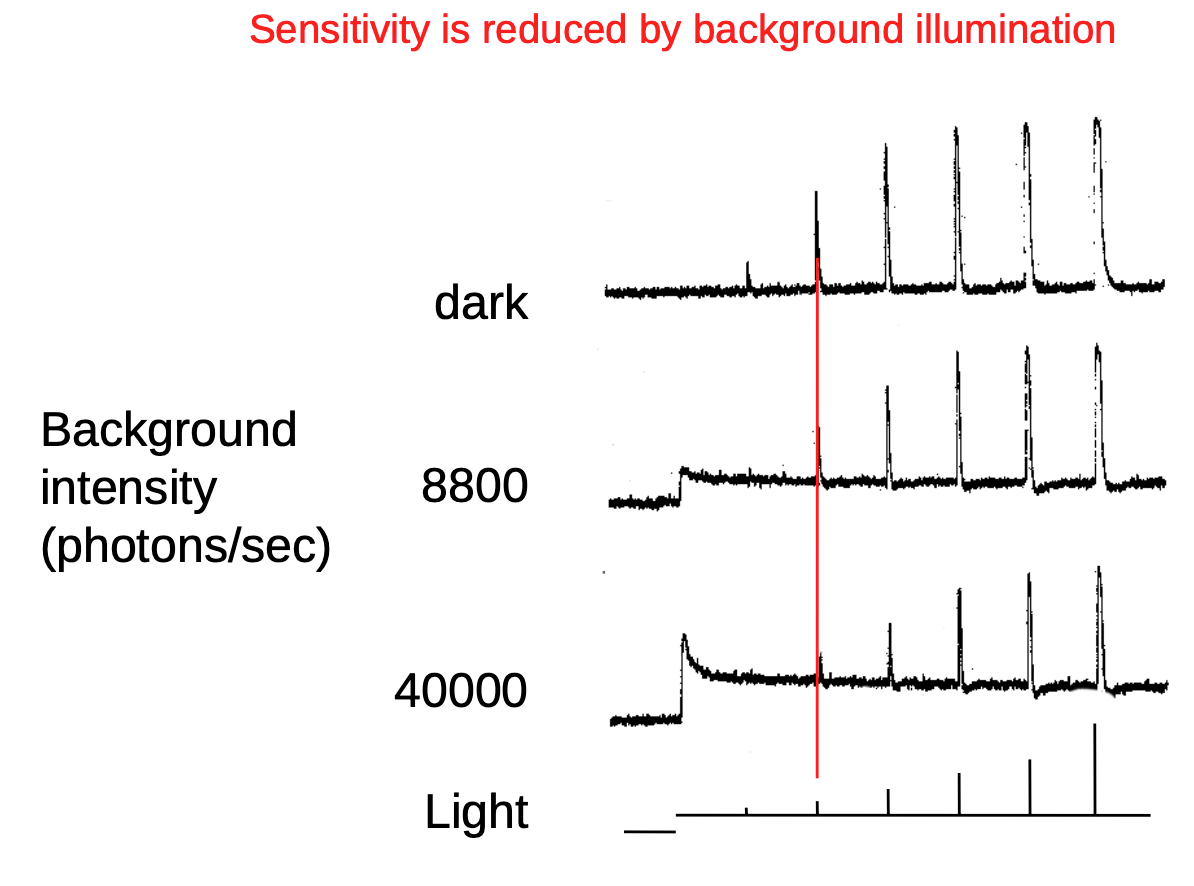
Sensitivity is reduced by background illumination
can the dark current be completely supressed by bright light?
yep
light adapt - defined as a….
light adapt - defined as a reduction in sensitivity as the steady light intensity increases.
Photoreceptor adaptation is believed to be largely mediated by …
Photoreceptor adaptation is believed to be largely mediated by calcium ions.
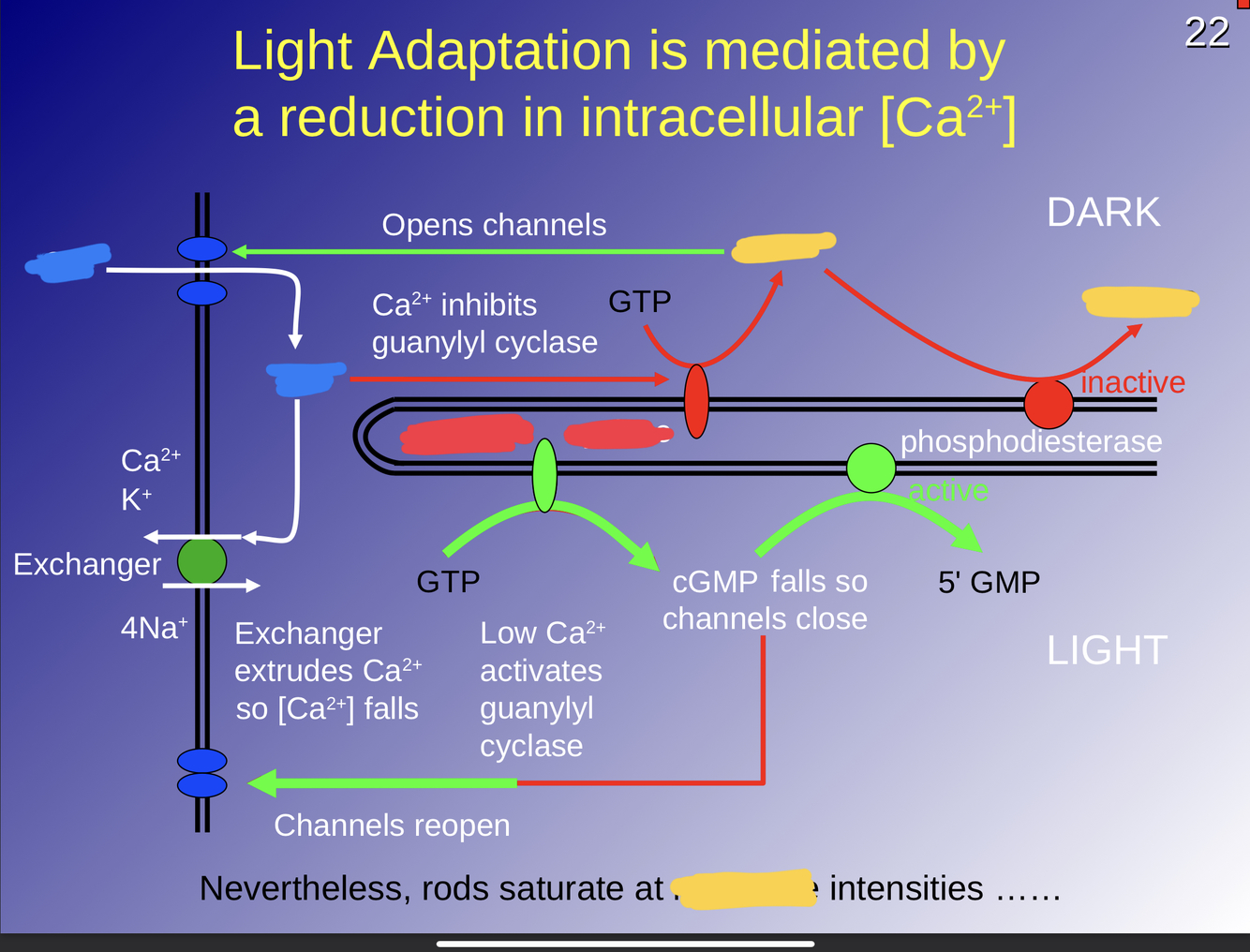
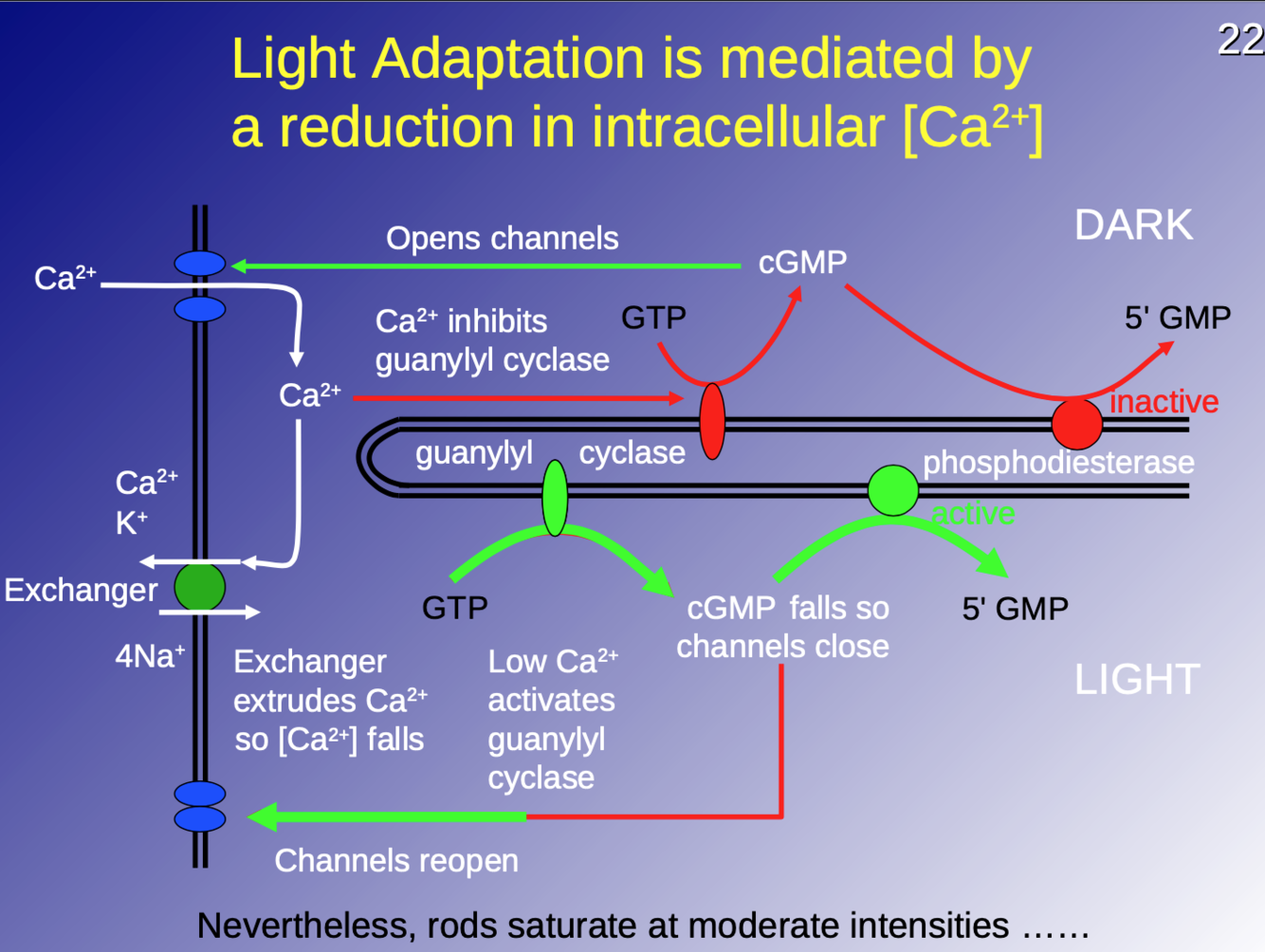
describe the rpocess of photoreceptor adaptation throguh Ca2+ ions
- Photoreceptors saturate when most of the cGMP has been hydrolysed and all of the channels close.
- To prevent this cGMP must be resynthesised via the enzyme guanylyl cyclase (GC), which is inhibited by Ca2+.
- Ca2+ entering by the light-sensitive channels sets up a regulatory feedback loop.
- In darkness Ca2+ enters via the cyclic nucleotide- gated channels, inhibiting GC.
- When cGMP is reduced by light, the channels close, less Ca2+ enters the cell, but continues to be extruded by a Na/Ca/K exchanger.
- The resulting drop in Ca2+ concentration relieves the inhibition of GC so that more cGMP is synthesised to counteract the effect of excitation
The basic processes of transduction and adaptation appear to be the same in rods and cones; however, with important quantitative differences. First, cones are ~___ less sensitive, than rods, and cannot detect single photons.
The basic processes of transduction and adaptation appear to be the same in rods and cones; however, with important quantitative differences. First, cones are ~50x less sensitive, than rods, and cannot detect single photons.


-
Introduction to brain27
-
Introduction to the neurone L138
-
Introduction to the neurone - L242
-
Introduction to the neurone L331
-
Vision L145
-
Vision L236
-
Vision L375
-
Vision L438
-
Vision L524
-
Vision L626
-
Olfaction and taste53
-
Hearing L135
-
Hearing L235
-
Hearing L337
-
Somatosensation and pain L160
-
Somatosensation and Pain L246
-
somatosensation and pain L338
-
Pharmacology of pain58
-
Brain development and repair0
-
Movement L115
-
Movement L2+376
-
Movement L439
-
Movement L537
-
Movement L625
-
Movement L724



