definition of ventricular tachycardia
>3 successive ventricular extrasystoles (broad QRS complexes >120ms) at a rate of >120/min
definition of sustained ventricular tachycardia
Ectopic ventricular rhythm faster than 100 bpm lasting at least 30 seconds or requiring termination earlier due to haemodynamic instability.
definition of non-sustained ventricular tachycardia
Ectopic ventricular rhythm faster than 100 bpm lasting for at least 3 consecutive beats but terminating spontaneously in less than 30 seconds.
aetiology of sustained ventricular tachycardia
ischaemic cardiomyopathy
idiopathic
aetiology of non-sustained ventricular tachycardia
ischemic and non-ischemic heart disease
genetic disorders - long QT syndrome, Brugada syndrome, arrhythmogenic RV cardiomyopathy
congenital heart disease
metabolic problems - drug toxicity or electrolyte imbalance
RF of sustained ventricular tachycardia
CAD
acute MI
LV systolic dysfunction
hypertrophic cardiomyopathy
long QT syndrome
short QT syndrome
brugada syndrome
vent pre-excitation
arrhythmogenic RV cardiomyopathy
electrolyte imbalance
drug toxicity
chagas disease
RF of non-sustained ventricular tachycardia
CAD
L ventricular systolic function
hypertrophic cardiomyopathy
idiopathic dilated cardiomyopathy
long QT syndrome
Brugada’s syndrome
electrolyte imbalance
drug toxicity
chaga’s disease
epidemiology of ventricular tachycardia
approximately 90% of sudden deaths are cardiac - mostly VT or VF
The estimated incidence of non-sustained VT in the general population (both with and without heart disease) is as high as 4% - increases with age
sx of VT
sustained
- dizziness
- light headedness
- chest discomfort
- dyspnoea
non-sustained - asymptomatic
signs of VT
sustained
- tachycardia
- hypotension
- weak pulse
- syncope/pre-syncope
- airway compromise
- impaired consciousness
- diminished responsiveness
non-sustained - tachy
Ix for VT
ECG
electrolytes
trop
creatinine kinase MB
ECG for VT
sustained - wide complex tachycardia (QRS ≥120 msec) at a rate ≥100 bpm.
non-sustained - non-sustained ventricular tachycardia with a single QRS (monomorphic) or changing QRS (polymorphic) morphology at cycle length between 600 and 180 ms
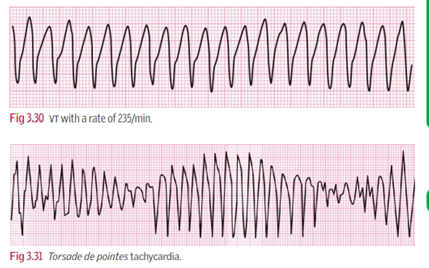
electrolytes in VT
sustained - low K and low Mg frequently associated with torsades de pointes
non-sustained - normal; low or high K, or low Mg
complications of sustained VT
ICD malfunction
V fib
sudden cardiac death
ICD infection
cardiomyopathy
amiodarone induced thyroid dysfunction
complications of non-sustained CT
sudden cardiac death
cardiomyopathy
ICD related infection
ventricular fibrillation
Px of VT
sustained
- idiopathic - good prognosis. not progressive
- pts with left ventricular systolic dysfunction often have re-entrant rhythms around myocardial scars.
- re-entrant circuits can degenerate to ventricular fibrillation - associated with a high mortality rate
non-sustained - dependent on presence and severity of underlying cardiac disease
what is torsades de points
VT
when circuit in action and plane rotates - constantly varying axis
ECG:
- broad complex tachy
- regularly increasing and decreasing amplitudes
Mx of VT
- Attach cardiac monitor and defib
- assess rhythm - Defibrillate once: 150–360 J biphasic, 360 J monophasic. (Ensure no one is touching patient or bed when defibrillating.)
- Resume CPR immediately for 2 min, and then return to 2.
- Administer adrenaline (1 mg IV) after second defibrillation and again every 3–5 min.
- If ‘shockable rhythm’ persists after third shock, administer amiodarone 300mg IV bolus (or lidocaine).
pts at high risk of recurrent VT should have ICD rather than amiodarone
Initial steps in VT management
connect to cardiac monitor, have defib
monitor sats - ox if <90%
correct K adn Mg
check for low CO (clammy, reduced consciousness, BP <90), oliguria, angina, pul oedema
ECG (request CXR) get IV access
Mx if haemodynamically unstable VT
synchronised DC shock
correct low K and Mg
amiodarone - 300mg IV over 10-20min
for refractory cases - procainamide or sotalol
Mx of haemodynamically stable VT
correct low K and Mg
amiodarone - 300mg IV over 20-60mins - avoid long QT via central line
if fails - DC shock
Mx after correction of VT
establish the cause
maintain anti-arrhythmic therapy if needed
if after MI - IV amiodarone infusion for 12-24hr, if <24hr post MI start oral anti-arrhythmic (sotalol if good LV func, amiodarone if not)
prevention - surgical isolation of arrhythmogenic area or ICD
Mx fo torsades de pointes
if form congenital long QT syndromes - B blockers
in acquired:
- stop predisposing drugs
- correct low K
- give magnesium sulfate
things to do in CPR
check electrolytes, paddle positions and contacts
secure airway - ET tube and high flow ox
continuous compressions and breaths
consider - Mg, bicarb and external pacing
stop CPR and check pulse only if change in rhythm or signs of life

-
VT25
-
dyslipidaemia20
-
varicose veins23
-
SVT22
-
AAA14
-
amyloidosis20
-
aortic dissection16
-
aortic regurgitation13
-
aortic stenosis12
-
arterial ulcers8
-
cardiomyopathy18
-
constrictive pericarditis6
-
coronary angio and PCI4
-
coronary artery bypass graft (CABG)4
-
DC cardioversion3
-
DVT13
-
gangrene15
-
heart block24
-
hypertension26
-
infectious endocarditis21
-
implantable cardiac defib3
-
MR10
-
IHD39
-
mitral stenosis12
-
myocarditis16
-
rheumatic fever14
-
pericarditis16
-
Pulmonary HTN9
-
cardiac failure46
-
PVD25
-
venous ulcer16
-
TR6
-
vasovagal syncope7
-
VF12
-
WPW6
-
AF25
-
abdominal aortic aneurysm12
-
acute limb ischemia/PAD17



