Describe how direct reversal of DNA damage works:
- there are three types 1) Light dependent repair: direct repair of thymine dimers by enzyme PHOTOLYASE (= photoreactivation, only in prokaryotes), essentially cleaves cross links after being activated by absorption of blue light) 2) Enzymatic removal of alkyl groups from DNA bases: reverses mutagenic effect of alkylation and reestablishes proper base pairing (by Methyltransferase enzyme), prevents transition mutations 3) Ligation of single-stranded nicks in DNA - if broken DNA strand, ligase can seal nick with phosphodiester bond
Describe how base excision repair works
- BER recognizes and repairs DNA bases damaged bz deamination, alkylation, or oxidation - the specialized DNA glycolyase enzyme recognizes these types of damage, cleaves the phosphodiester bonds 5’ and 3’ of the damaged base by endonuclease and removes deoxyribose sugar, then DNA polymerase fills in the correct nucleotide and ligates the nicked backbone to restore integrity to the DNA chain
How does nucleotide excision work?
- NER acts to remove thymine dimers and other bulky DNA damage (usually pyrimidine) - slightly different mechanisms in prokaryotes and eukaryotes - more proteins used in mammals - mutation of human NER genes causes Xeroderma pigmentosum - enzyme recognizes distortion, DNA is separated and singel/stranded/binding proteins stabilize strand, enzyme cleaves strand on both sides of damage, gap is filled in by DNA polymerase and sealed by ligase
How does mismatch repair work?
- MMR system recognizes mismatched base in newly replicated strand through identification of the hemi-methylated GATC sequence, it compares old and new strands based on methylation status of A (new strand is not methylated yet, parental is) - upon detection an exonuclease removes portion of newly-synthesized strand including the incorrect base and the mismatched sequence - DNA polymerase III fills in the longer gap and DNA ligase seals the nick (this is in prokaryotes but similar mechanism also exists in eukaryotes) - this mechanism happens right after replication
Describe how recombination can repair DNA damage:
- can repair spontaneous or induced DNA double-stranded breaks - two important mechanisms: homologous recombination (HR) and non-homologous end joining (NHEJ)
How does translesion DNA polymerase work to repair DNA damage?
- replicative polymerases copy chromosomal DNA but pyrimidine dimers and other bulky lesions block it and can result in cell death - then, translesion synthesis (TLS) DNA polymerases are recruited to replicate thru DNA damage and bypass the lesion, normal DNA replication by replicative polymerase follows - but TLS is more error prone at the site of the lesion, therefore, it is a last resort, though some of the errors can be fixed by other mechanisms - sloppy because just inserts random nucleotides, leads to mutation (localized mutagenesis)
How does MMR play into genome stability in eukaryotes?
defects in human mismatch repair systems result in mutation accumulation and are directly connected to human cancer (10% of colorectal and endometrial cancers are heritable and caused by mutations in human mismatch repair genes - this increases with age too - therefore, mismatch repair is very important to prevent cancer
How does homologous recombination repair DNA damage?
- often occurs during or after DNA replication - if one sister chromatid has a DSB it can be repaired using the unbroken sister chromatid - therefore, often occurs in S/G2 phase of eukaryotic cell cycle - also ensure proper chromosome separation (dysjunction) during meiosis
How does non-homologous end joining repair DNA damage?
- this mechanism uses different set of proteins - mechanism is available throughout the rest of the eukaryotic cell cycle (rest means in contrast to homologous recombination that occurs during S/G2 phase)
What are DSBs?
= double-stranded breaks, can be lethal to cell
How exactly does recombination repair occur post-replication?
- when leading strand pauses at a bulky lesion (like pyrimidine dimer), a gap in replication can result - if gap not fixed, chromosome broken - the newly-synthesized portion of the leading strand unwinds from the top template strand and pairs w newly-replicated section of lagging strand, which is used as template to proceed past the point were the dimer is located - allows for strand to be fixed and then the pyrimidine dimer can be fixed by mismatch repair or nucleotide excision
What kind of a mechanism is recombination repair really?
- really, it is a bypass mechanism rather than repair
What are the translesion synthesis polymerases in E Coli?
= Pol. IV and V (in eukaryotes there are several TLS polymerases)
What is the bacterial SOS response?
= induced when considerable damage is caused by DNA damaging agents - occurs in E coli - activation of a host of proteins that help with DNA recombination, repair and replication, including TLS polymerase - increases chance of cell survival, but also frequency of errors - but also chance of mutation that helps adapt to environment - eukaryotic cells have similar response mechanism
What are transposons?
= transposable elements are segments of DNA capable of moving from one location in a chromosome to another, or even a different chromosome (“jumping genes”)
Key facts about transposons?
= constitute significant fraction of genome (in humans about 40-44%) - can lead to chromosome breakage and mutations - important in generation of some human diseases when they alter gene function - bacterial transposons can carry antibiotic resistance genes
What are cut-and-paste transposons?
= element that is physically cut out of one site in chromosome or plasmid and pasted into new one - excision and insertion catalyzed by transposase - found in both prokaryotes and eukaryotes
What are replicative transposons?
= element is replicated with one copy inserted at a new site and one remains at original site - requires transposase - only found in prokaryotes!
What are retrotransposons?
= DNA copy of element made by reverse transcription from its RNA and then inserted - so an RNA transposon - reverse transcriptase discovered in 1970: reverse flow of genetic info - RNA to DNA - only found in eukaryotes - two kinds: retrovirus-like and retrosposons
What are the two main types of bacterial transposons?
= cut and paste type (insertion sequences and composite transposons) = replicative transposons (Tn3 elements)
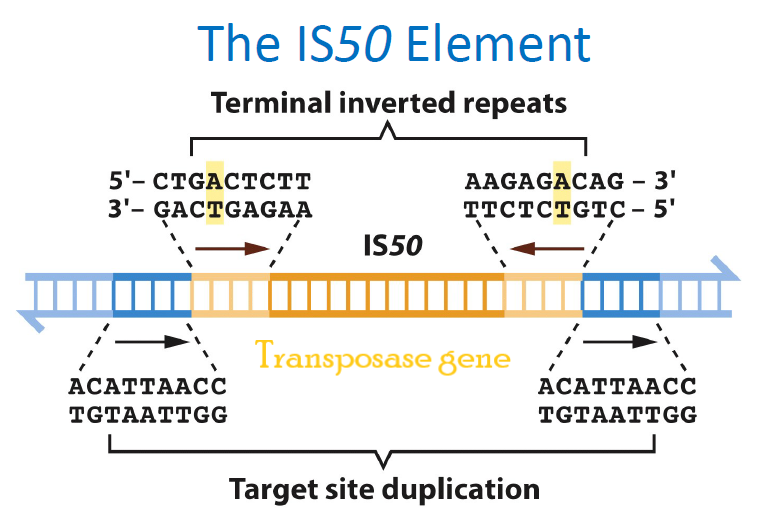
What does the general structure of a cut and paste transposon look like?
- has a gene that encodes transposase - terminal inverted repeats (identical or nearly identical inverted sequences at both ends of element) - target site duplication: short, directly repeated sequences at both ends resulting from staggered cleavage of double-stranded DNA at site of insertion, so after inverted sequence
What is transposase?
= a protein required for transposition (movement of transposons) to occur
What is an insertion sequence?
- and IS element = simplest bacterial transposon - first detected in lac^- mutations of e coli - compactly organized and contain only genes whose products are involved in transposition - inverted terminal repeats are found at the ends - some IS elements encode transposase
What does the structure of the IS50 element look like?