book & VL: Name the three components of employee development
- training 2. performance appraisal 3. career development
book & VL:
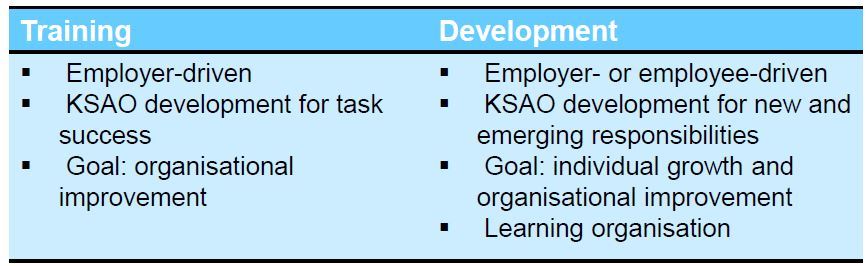
What is the difference between employee training and employee development
Both: develop knowledge, skills & attitudes Employee
Training: train to perform a given task or job successfuly. Final goal is IMPROVING performance in the current job and thus improvement of the organisation’s performance. VL: and guide career development
Employee Development: what is developed is assessed to be NECESSARY for the performance of their NEW or future responsiblities. VL: Should result in employee fullfillment.
book: What is Human Resource Development (HRD)?
Integrated system of training, development and organisational development aimed at developing employees’ full potential in order to ensure individual, group and organisational effectiveness in emerging situations, irrespective of the possibility of their immediate use in the current job. —————————————- The ideal, to develop capabilities in employees as meants to increase work satisfaction, motivation AND meet emerging requirements of the organisation. –> Development of employees full potential irrespective of the possiblity of their immediate use in their current job
book: What is the difference between Training and Education?
Education is much proader, aimed at developing an individual’s full potential by imparting knowledge, skills and attitudes that would enable the person to manage his or her own life in ermerging situations.
book: Name the three training paradigms
- traditional paradigm 2. HRD paradigm 3. learning paradigm
book: What is the learning paradigm?
One step further than the HRD paradigm. Empowers the employee to set an d implement their own learning agenda within the framework of organisational goals, vlaues and resource contraints. Underlying philosophy: learning most effective when initiated by learners themselves.
book:
Name two different purposes of trainings according to their purpose
- Induction Training
- Improvement Training
book:
What is an induction training?
orientation provided to new recruits in order to introduce them to the organisaion’s history, culture, goals, policies…
book:
Which two types of improvement trainings can be distinguished from each other?
- to mitigate identified KSAO deficiencies;
- to prepare the employee for new job responsibilities and requirements
book:
Induction trainings are usually conducted in two parts.
In which two parts?
- Organisational orientation (by HRM)
- Departmental and Job orientation (by department head and immediate supervisor)
book:
What stands ISD for?
Instructional Systems Design
book:
Which are the four phases of ISD?
- needs assessment
- design and development of training programs
- delivery of training
- evaluation of training
book:
Which three levels are covered by the Training Needs Assessment (TNA)
1. organisational
2. job/task
3. individual
TNA is done including formal and informal methods: interviews, questionnaires, observations, focus group, …
book:
Which four levels of evaluation does Kirkpatrick (1983, 1994) propose?
- Reaction (smiley sheet)
- Learning
- Behaviour
- Results
book:
What is the most often used design for Training evaluation and which would be the best one?
- single group post-test only design
- pre-test post-test control group design
book:
Which two costs of a training can be distinguished?
- fixed cost / one-time costs (development of design)
- variable or recurring costs (trainer cost, travel, …)
book:
Name the three stages of learning for ‘consistent tasks’
- acquisition of declarative knowledge
* *knowing the facts** - grouping of facts
* *knowledge compilation** - acquisition of procedural knoledge
* *knowing how**
book:
Training methods can be divided in on- and off-the job training. In which subcategories can the off-the-job training be devided?
- information presentation methods
- simulation methods
book:
Which three forms of training can be distinguished (delivery wise)?
- Team training
- Executive Coaching
- E-Learning
VL
Which two training methods can be distinguished?
- On-the-job
- off-the-job
* presentation & simulation methods*
VL:
Name four format characteristics important in trainings
- individual or group
- distributed or massed practice (time spaced or all in one)
- transfer of training
- maintenance of training
VL:
Learning principles and training methods:
training methods should promote learning at three different levels
- cognitive (understanding)
- affective (passion)
- behavioural (opportunities for practice)
Name one definition of career
- The totality of work one does in a lifetime (Sears, 1982)
- Career = work + leisure (McDaniels, 1989)
- Isaacson and Brown (2000) “a series of paid or unpaid occupations or jobs that one holds throughout his or her life”
- Collin and Young (2000) “the engagement of the individual with society through involvement in the organisation of work” (p.276).
- Savickas (2002) preferred the Oxford English Dictionary definition of “A person’s course or progress through life” (p.382).
- “to move swiftly and in an uncontrolled way in a specified direction” might more aptly describe careers in today’s world of work (Compact Oxford English Dictionary, 2004)
Protean Career Model
earliest proponent was Hall (1976, 2002)
- individual takes responsiblity for their career
- career as life-long process
- incorporates aspect of whole life
- development takes many form + is self-directed
- organisations support but do not drive career



-
Week 6: Leadership30
-
Week 8: Motivation28
-
Week 9: Organizational Conflict & Work Attitudes, Values24
-
Week 11: Training, Learning, ...35
-
Week 10: Stress19
-
Week 9: Work Values and Attitudes43
-
Week 9: Organisational Conflict11
-
Week 7: Organisational Communication14
-
Week 5: Teams31
-
Week 4: Performance Appraisal26
-
Week 3: Recruitment & Selection16
-
Week 2: Job Analysis & Individual Differences31
-
Week 1: Intro3



