What are demand deposits?
Monies on deposit with a financial institution that can be withdrawn without notice or penalty.
What are requirements for financial assets to qualify as a cash equivalents?
Must meet both the convertibility and insignificant risk test.
What are examples of cash equivalents?
- Term deposits
- Guaranteed investment certificates
- Treasury bills (with a relatively short maturity)
- Banker’s acceptances
- Money Market Mutual Funds
What are trade accounts receivable?
Receivables arising from ordinary sales transactions.
More commonly refered to as accounts receivable.
When are accounts receivable recognized?
When the selling party has transferred the risks and rewards of ownership of the goods sold to the purchasing party.
Are short-term accounts receivable measured at their transaction price or at fair value plus transaction costs?
Transaction price.
This is an exception as most financial assets, including receivables, are initially measured at fair value plus transaction costs.
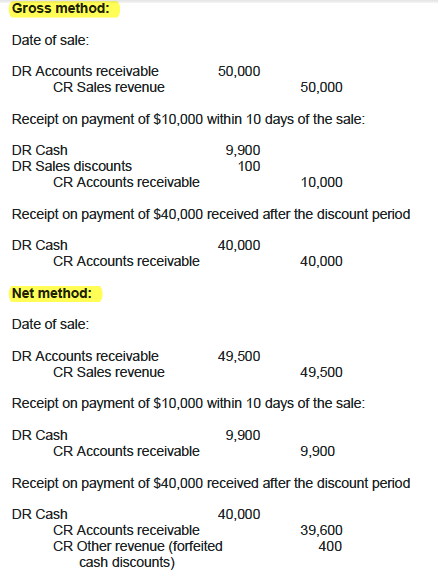
What are the 2 methods for recognizing discounts?
- Gross method
- Net method
The gross method is more commonly used.
From a theoretical perspective the net method should be used.
What is the “lower of cost or net realizable value” approach?
A methodology for valuating receivables where they are valued at their transaction price less an allowance for expected losses.
What are 3 methods for bad debts?
- Direct write-off method
- Income statement approach (%age of credit sales method)
- Balance sheet approach (aging method)
What is the direct write-off method?
An approach for doubtful accounts only when acccounts are known to be uncollectible, rather than estimated to be uncollectible.
- Method generally not appropriate as it does not adjust the AR balance to the lower of cost or net realizable value and it may not match the expense of the write-off to revenue in the period that it is earned (p. 6)
DR Bad Debt
CR Accounts Receivable
Why do we use Allowance for Doubtful Accounts versus updating A/R?
- A/R is like a control account and shouldn’t be changed.
- Also when we think we won’t collect all, we don’t actually know from whom we won’t collect, so we can’t just pick someone. Instead we use AFDA.
What are the 3 types of entries in AFDA?
- Allowance entry (at end of each accounting period): where we estimate bad debt expense.
- DR Bad Debt Expense
- CR AFDA
- DR Bad Debt Expense
- Write-off (when a specific customer is known): Removing receivable for customer.
- DR AFDA
- CR A/AR
- DR AFDA
- Recovery (when customer whose account has been written off has come in to pay):
- DR A/R
- CR AFDA
- DR Cash
- CR A/R
- DR A/R
What is the criteria for A/R derecognition?
- The contractual rights to the cash flows from the receivable has expired, or
- The seller transfers the receivable to the buyer under specific conditions as outlined in IFRS 9.
What are the 3 categories of inventory?
- Raw materials (materials to be used in production or in rendering services)
- Work-in-progress (goods in the process of production)
- Finished goods (goods held for sale in the ordinary course of business)
What are the 2 systems to track inventory costs?
- Perpetual
- Periodic
What is included in the costs of inventory?
All costs of purchase, costs of conversion, and other costs incurred in bringing the inventories to their present location and condition.
What is included in the costs of purchase?
- Purchase price
- Import duties and other non-recoverable taxes
- Transportation in
- Other cost directly attributable to the acquisition of finished goods, materials and services
Less:
- Trade discounts
- Rebates
- Other similar items (such as subsidies)
- Recoverable taxes (e.g., GST, HST)
What is included in the costs of conversion?
- Direct costs (such as direct labour and direct materials).
- An allocation of fixed and variable production overhead that are incurred in converting materials into finished goods.
What is net realizable value?
Estimated selling price in the ordinary course of business less the estimated costs of completion and the estimated costs necessary to make the sale.
Caveats:
- Usually written down on item-by-item basis however a group of similar items may be grouped together
- Net realizable value of the quantity of inventory held to satisfy firm sales or service contracts is based on contract price
- Materials and other supplies held for use in the production of inventories are not written down below cost if the finished products in which they will be incorporated are expected to be sold at or above cost
What are the 2 primary methods for calculating bad debt for the period?
- Income statement approach (%age of credit sales)
- Bad debt expense is a function of credit sales
- You are solving for the bad debt amount
- Balance sheet approach (aging method)
- Focuses on determining the net realizable value of accounts receivable.
- You are solving for the ending AFDA amount
In looking at the journal entries, what is the difference between the income statement and balance sheet approaches for bad debt?
- Income statement approach, you are looking for value for bad debt
- Balance sheet approach, you are looking for the result in AFDA
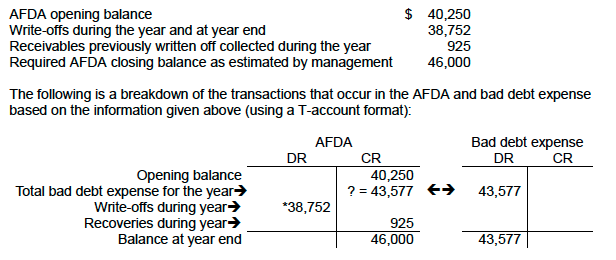
What is the balance sheet approach for bad debt?
In the balance sheet approach the goal is to end up with an AFDA that equals the amount of outstanding accounts receivable expected to be written off.
- Final AFDA is determined by management
- Solve for bad debt expense
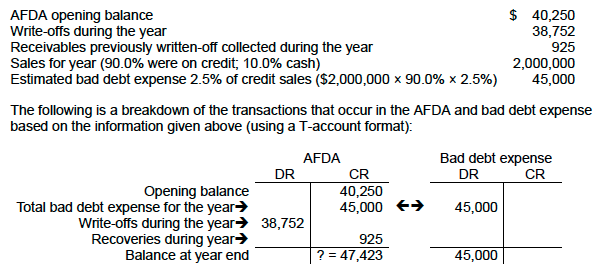
What is the income statement approach for bad debt?
Bad debt is calculated based on a percentage of sales.
What are 3 reasons for derecognizing accounts receivable?
- They are collected in normal course of business
- They are written off
- They are transferred or sold to a 3rd party (factoring)





