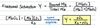
What are the three types of reversible inhibition?
Competitive, uncompetitive, noncompetitive
What is competitive inhibition?
Inhibitor competes with the substrate for the active site
What is uncompetitive inhibition?
Inhibitor binds to the enzyme-substrate, preventing product
What is noncompetitive inhibition?
The inhibitor binds to the allosteric site, changing the active site so the substrate isn’t able to bind
What does it mean for inhibition to be reversible?
The inhibitor binds then releases
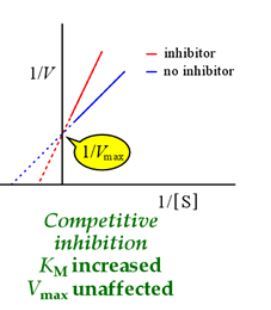
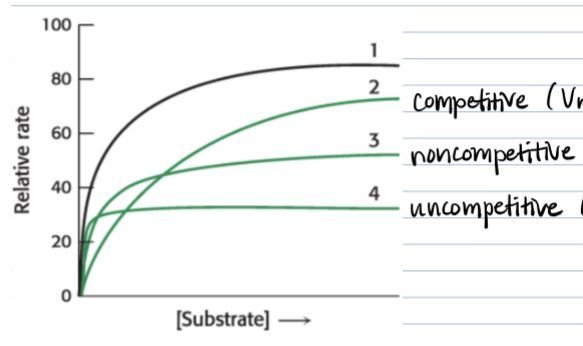
What happens to the Km and Vmax during competitive inhibition?
Km increases, Vmax doesn’t change
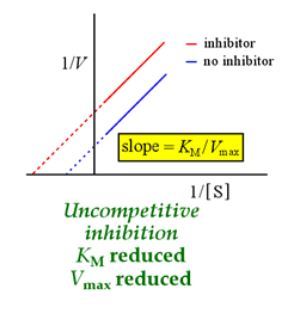
What happens to the Km and Vmax during uncompetitive inhibition?
Km lowers, Vmax lowers
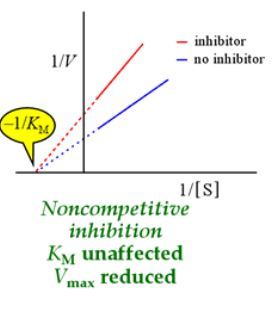
What happens to the Km and Vmax during noncompetitive inhibition?
Km doesn’t change, Vmax lowers
What is the effect of increased Km on binding?
Binding isn’t as good
In what situation is product formed during uncompetitive inhibition?
When the enzyme and substrate are bound, before the inhibitor binds
During non-competitive inhibition, what happens to the Km when the inhibitor molecule binds to the enzyme? When the substrate binds after?
Km increases, substrate binding decreases. Km decreases, substrate binding enhances
What happens when Vmax increases?
Rate of product formation increases
What does the lineweaker-burk plot look like for competitive inhibition?
What does the lineweaker-burk plot look like for uncompetitive inhibition?
What does the lineweaker-burk plot look like for noncompetitive inhibition?
In competitive inhibition, why doesn’t the Vmax change?
It can be overcome by a sufficiently high concentration of substrate
Identify competitive, noncompetitive, and uncompetitive inhibition from the Michaelis-Menten plot
What are the key features of irreversible inhibitors?
- Bind very tightly to active site
- No product forms, shuts the enzyme down
- Elucidates the mechanisms of enzyme action by covalently bonding to the enzyme
- Group-specific reagents react with R groups of specific amino acids
What are the 4 catalytic strategies used by enzymes?
- Covalent catalysis - Active site contains nucleophile that covalently binds
- Acid-base - Molecule other than H2O donates or accepts a proton
- Metal Ion - Funciton in several ways, serves as an electrophilic catalyst
- Approximation and orientation - Brings two substrates together in an orientation that facilitates catalysis
Enzyme activity can be modulated by?
Temperature, pH, and inhibitory molecules
Explain the chymotrpsin mechanism
- Lower barrier H-bond stabilizes His so that it can deprotonate Ser.
- Once H+ is removed, Ser can act as a stronger nucleophile to attack electrophilic amide C.
- Tetrahedral oxyanion is stabilized by H-bonding interactions with the oxyanion hole
- Collapse of the tetrahedral intermediate and H+ transfer from His leads to the cleavage of the C-N bond. The N-terminal peptide is bound through acyl linkage to Ser
- A water molecule binds to the active site and attacks the acyl ester carbonyl
- The resulting 2nd oxyanion intermediate tetrahedral is stabilized via enthalpic interations with the oxyanion hole
- The N-terminal fragment is released and returns to its initial state
What is the purpose of the oxyanion hole?
Stabilizes the negative charge of oxygen atom by making H-bond w/ amine side chaines of ser & gly
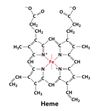
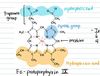
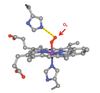
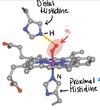
What are the key features of myoglobin?
- 8 subunits
- Globular tertiary structure
- Hydrophobic part of heme buried in the center of the protein
- Hydrophilic part of heme exposed to the surface
What are the key features of the catalytic triad?
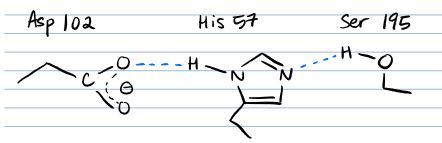
- Asp 102 stabilizes His
- His 57 pulls H from Ser
- Ser 195 acts as a nucleophile