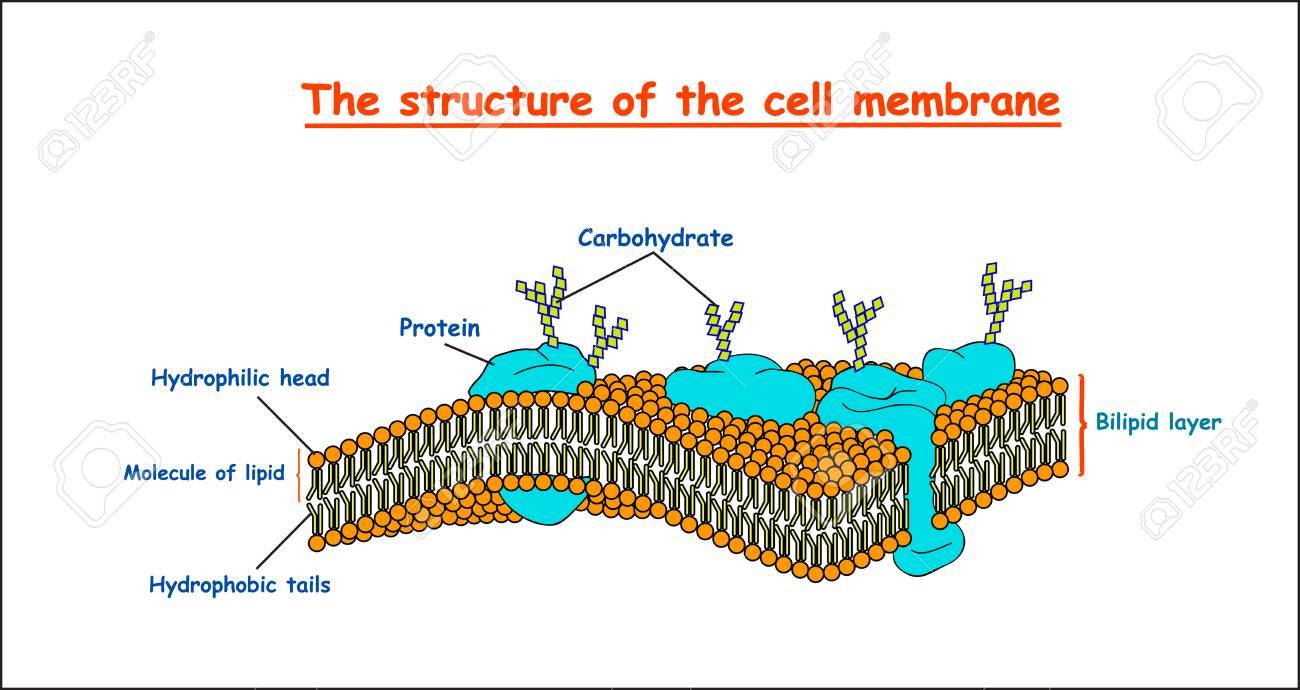
Why is cholesterol important in a cell?
Cholesterol is important for merane integrity
Cholesterol sits next to an unsaturate fatty acid
A source for the production of hormones, bile acids and vitamin D
How does fluidity effect a membrane?
Fluidity-Flexibilty maintained so that the membrane can fucniton properly
What happens if a membrane is too fluid?
The membrane will be leaky
What happens is a membrane is not fluid enough?
No movement or solute passage
What effect does heat have on a membrane?
HEAT = lipids move more, arranging/rearranging; more fluid membrane
How does cold effect membrane fluidity?
COLD = lipids laterally orders.organisaes, lipid chains pack togehter tightly
What other factors effect a memrbanes fluidity?
- Fatty acid length
- Long= stiff
- Short = less stiff
- Double bonds
- Satureated = more stiff
- Unsaturated = less stiff
*
How does cholesterol dampen the effect of temperature?
- Cholesterol and heat = stabilizes the membrane and raises its melting point
- Cholestoer and cold = intercolated between phospholopids; prevents clusterind and stiffening
What are teh different types of membrane transport?
- Dissusion
- Facilitated diffusion
- Active transport
- Secondary active transport
What are the two different types of diffusion? And waht are their differences?
- Simple diffusion through the phopholipid bilayer
- E.g. O2 and CO2 and lipid-soluble substances cross membrane by simple diffusion
- Molecules move b engaging in random collisions with other like molecules
- From high conc to low conc - Factilitated diffusion through channel porteins or carrier proteins
- Facilitated diffusion requires teh transported molecuels to bind to a specific carrier protein
- Energy is not required
How can water pass through into and out of a cells?
Aquaporins
- Aquaporins are channel proteins
- Water molecules move in a single file through a hydrophilic cahnnel
- Water passively pours through aquaporins by osmosis, moving from low to high concentrations
- This is facilitated diffusion (part of passive)
What are symporters and antiporters?
They are ‘coupled transporters’ because tehy move two substances at once
Symporters = simultaneously transport a sugar (or amino acid) and an ion (usually Na+ of H+ ion) across a membrane. E.g.Na+/glucose symporter: couples transmembrane movement of 1 glucose molecule to teh transport of 2 Na+ ions.
Antiporters = Transport one solute in one direction while transporting a second solute in the opposite direction. Exchange of one solute for another, and one is expelled at the expense of the import of one. E.g. Na+/Ca+ antiporter.
What is active transport? And what are the different types and example?
Transporters that use energy.
- Energy concentrates the compound on one sidde of the membrane
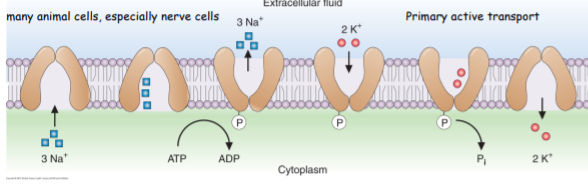
1. [rimary active transport = energy applied to teh transporter (e.g. ATP hydrolysis by Na, K-ATPase; and Ca2+-ATPase) ATPase is an enzyme that catalyze hydrolysis of ATP to yield ADP and inorganic phosphate with release of free energy
2. Secondary active transport = energy establishes ion gradient (e.g. teh Na+ gradient), ad the gradient is used to concentrate another compound
How does the Sodium/potassium ATPase (Na/K-ATPase) pump work?
Energy from ATP hydrolysis phosphorylates an internal domaina nd cahnge the transporter’s conformation.
Na+ are released to the outsie, and two external K+ bind adn trigger hydrolysis of the bound phosphate group and a reture to teh original conforation, accompanied by release of K + inside the cell.
Cells can maintain a much lower intracellular [Na+] anc much higher intracellular [K+] than present in serum.
How does secondary active transport work?
A sodium symporter brings molecules into cells
Sodium moves down its gradient and this drives teh uphill transport of a cotransporter substrate (glucose)
Does not hydrolyze ATP but depends on maintenace of the sodium gradient by the sodium/potassium pump.
How does glucose get into cells?
Not sufficiently lipid soluble to enter cells by passive diffusion (from intesting to cell)
Dietary glucose enters the intestinal mucosal cells mainly by sodium co-transport
Uptake of glucose from blood or intersitital fluid into cells occurs by facilitated diffusion e.g. GLUT2
What is the role of digoxin in heart disease?
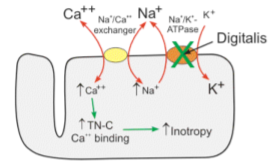
Drugs digoxin increase the force of heart muscle contraction (ionotropy) and are used in teh treatment of congestive heart failure.
Digoxin inhibits the Na/K-ATPase; and raises teh intracellular [Na+] and lower intracellular [K+]
The Na+/Ca2+ antiporter functions less efficiently with a lower Na+ gradient, fewer Ca2+ ions are exported and the intracellular Ca2+ concentration increases
This increase causes the muscle to contract more strongly.
- Digoxim sensitizes Troponin-C (TN-C)
A cardiac muscle protein
More Ca2+ binds
What occurs in cystic fibrosis?
Mutation causing the absence of a single phenylalanine in the portein. Many organs are affected. Lungs most often affected. Dilute fluids become viscus and form a mucus
Prone to infection.
CFTR:Cl- ion cnahhel is mutant. Does not move chloride ions ausing sticky mucus to build up on the outside of the cell
What occurs in cholera?
CFTR has a role in cholera
Cholera is an acute diarrhoeal infection caused by bacterium vibrio cholera
Cholera bacteria produces toxins taht activate CFTR and pump Cl- ions inot the small intestine.
Accumulation of Cl- ions int he gut creates an electric potential that attracts sodium, pulling it into the lumen, apparently across tight functions
Creates an osmotic gradient across teh tight junction and water is drawn into the lumen
Osmosis cna pull up to 6 L of water/day, creating the massive amounts of disarohea
Dehydration and death can result
Oral and intravenous rehydration is the preferred treatment
How do large molecule get into cells?
Macromolecules enter through 3 types of endocytosis:
- Phagocytosis = cellular eating large particles: macrophages and neutrophils do this
- Pinocytosis (cell drinking) = smaller dissolived substances e.g. proteins or fluids. Secreory cells use pinocytosis to retrieve the membrane material
- Receptor-mediated endocytosis; mediated by cell surface molecules e.g. LDL
- The palsma membrane invaginated (folds inward), forming a small pockt around materials from teh environemnt
- THe pocket deepends, forming vesicle
This vesicle separates from the plasam membrane and migrates with its contents to teh cell’s interior
What is phagocytosis?
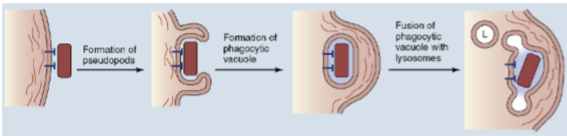
- Particle binds to components of the cell surface
- Cytoplasm flows around the particle by a mechanism tha tinvolves the polymerization and depolymerization of actin myofilaments, forming a phagocytic vacuole
- Fusion with lysosomes and digestion of the engulfd partile by lysosomal enzymes
- IN the human body, these processes are limites to macrophages, neutrophls and dendritic cells
- These professional phagoctes protect the body by eating aberrant cells and microbial invaders
What is endocytosis?
- Mechanism for the selective uptake of soluble proteins and other high-molecular0weight materials
- Binding followed by clustering of receptor-ligand complexrs ont he cell surface and the formation of an endocytic vessicle
- Depends on receptor proteins (integral) located on cell surface of the palsma membrane
- These membrane regions are called coated pits and their cytoplasmic surfaces are coated by toher proteins, such as clathrin
- THe coated pit invaginates and forms a coated vesicle around the bound macomolecule and carries the macromolecule away fromt the plasma membrane and into the cytoplasm
- The vessicle losses its clathrin coat and may fise with a lysosome, where the engulfed material is digested and the produts released into the cytoplasm
Draw a cell membrane and label teh major components?