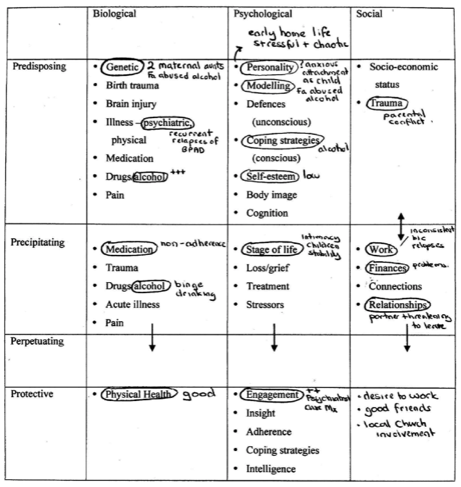
What is Case Formulation/Conceptualisation?
- A way to make sense of the information gained about a client
- Written attempt at understanding a patient; ‘why does this patient suffer from (these) problem(s) at this point in time?’
- When shared with client – can be revised in collaboration and used to reach a shared understanding of the problem
- Use to guide treatment
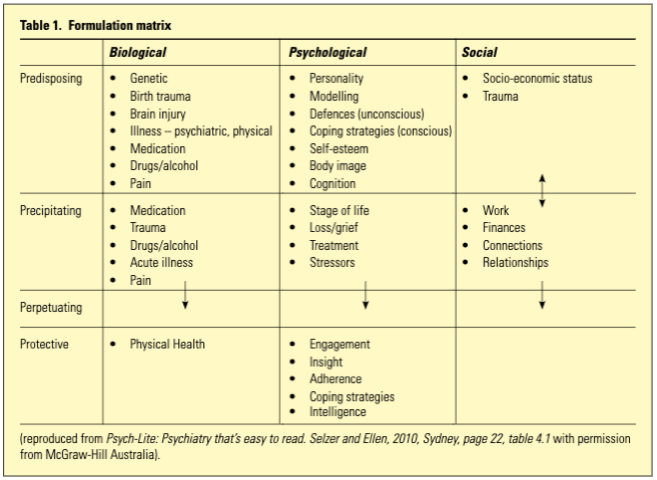
5 “Ps” of case formulation
Presenting Problem(s)
Predisposing
Precipitating
Perpetuating
Protective Factors
Presenting Problem(s)
What is/are the issue(s)?
Predisposing
Factors that make a person vulnerable to developing a problem (e.g., genetics, life events/circumstances, stage of life, coping style [are they an internaliser], SES, the extent to which they are under financial pressure and can afford help or tools to help them etc)
Precipitating
Recent factors, what brought them to you today events/situations that triggered the problem (e.g., trauma, illness, accident, stressors, work, relationships, finances etc)
Perpetuating
More distal factors, Factors that maintain the problem once it has started, can overlap with precipitating (e.g., trauma, illness, stressors, work, relationships, finances etc)
Protective Factors
Things that help you to work with a client and reduce risk. A person’s strengths or factors that reduce the severity of a problem (e.g., physical health, knowledge, coping style, sense of humour, social supports etc)
Common Misconceptions of Formulations
- is useful only for psychotherapy patients
- is only for trainees and not experienced psychiatrists
- will make treatment inflexible
- doesn’t need to be written
- needs to be overly inclusive, elaborate and time consuming
Tips for Writing Formulations
- Keep formulations broad, and use theories that are useful to understand the patient.
- Sometimes biological reasons will be predominate and in others psychodynamic factors may be emphasised.
- It’s no longer a debate of nature vs nurture, but rather how nature and nurture interact
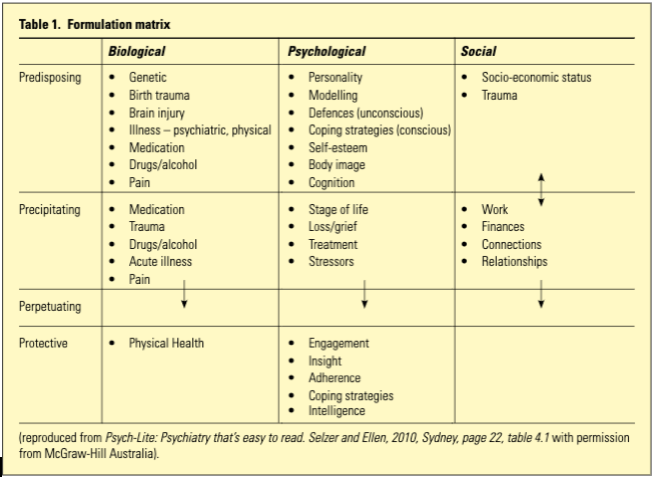
Formulation Matrix
Written using the biopsychosocial model
Predisposing -> Precipitating -> Perpetuating -> Protective
How to write the formulation
1) Write a summary paragraph – a brief description that encapsulated the patient and their issues, may include some key findings.
2) Identify obvious aetiological data – the formulation uses data both past and present to develop a hypothesis about the patient current presentation. What stands out in their history, what’s the obvious data?
3) Use the formulation matrix to structure the data. If it’s difficult deciding into which box data should go, ask yourself, ‘What theory (think prompt) would make sense of this data to explain the current presentation?’.
4) Connect data to the present via the theory – describe how this data explains the present circumstances for this patient, a theory will connect data to presentation.
5) Write out the formulation reading the matrix horizontally – doing this makes narrative sense to move from the past (predisposing) to the present (precipitating) to the future (perpetuating) and ending on the protective.