What is visual word recognition?
- Visual word recognition – identifying the printed words
- Visual word recognition not strongly affected by word length – suggests we engage in parallel processing
- May involve processing letter clusters rather than individual letters
What is the word superiority effect (WSE) and the lexical status effect?
Word Superiority Effect (WSE):
- Easier to identify a letter when it is presented in a word compared to when it’s presented in a non-word.
- Means top-down processing is involved. In top-down processing, perceptions are based on our previous experiences beginning with the largest idea or concept and gradually working towards the details. A single letter has less information than a full word.
- Pseudowords (orthographically legal non-words) are also quicker than non-words.
Lexical status effect:
- Takes longer to reject a nonword than to accept a real word
What are the cognitive mechanisms of visual word recognition?
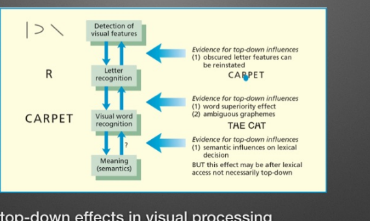
- Evidence for top-down effects in visual processing
- But evidence for top-down semantic effects is equivocal (open to more than one interpretation) - lexical-lexical associations (words that commonly go together) rather than semantic similarity? (e.g. BREAD primes BUTTER, but BREAD doesn’t prime CAKE)
What is the Neural Mechanism Model of Visual Word Recognition? (Dehaene, Cohen, Sigman, & Vinckier, 2005)
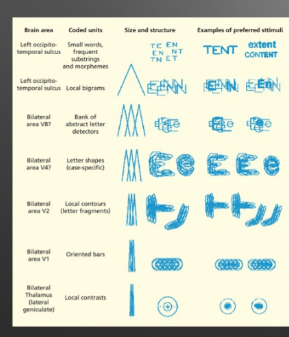
- They believe that there is a bit of your brain that has become specialised for word recognition – called the visual word form area (VWFA) in the fusiform gyrus.
- Bottom-up processing
- Seven steps involved:
- Local contrasts (simplest processing) – edges
- Oriented bars – orientation of lines
- Local contours (letter fragments)
- Letter shapes (case-specific)
- Bank of abstract letter detectors – different fonts, different handwriting
- Local bigrams – pairs of letters
- Small words, frequent substrings and morphemes
- This model shows how the VWFA might be encoding printed words.
- Dehaene et al. argue that there are some general properties of the primate visual cortex that causes our brain to be specialised in identifying words in this way:
- Hierarchical organisation – start out by encoding the simplest aspects, and things get more complex as you go farther. Our visual cortex is suited well for this model as the model states you start by encoding edges, and then things get more complex as you go on.
- Shape selectivity – columns of neurons that specialise to respond to specific shapes and orientations – suits model well.
- Plasticity and perceptual learning – repeated exposure to stimuli can cause neurons to respond to specific orientations, shapes, features.
Does the VWFA respond selectivity to whole words we know or letter strings that are consistent with the words we know? (ing, pseudowords, pre-lexical)
Cohen, Lehéricy, Chochon, Lemer, Rivaud, & Dehaene (2002) tried to address this question:
- fMRI recordings of VWFA
- Stimuli were words or consonant strings
- Stimuli presented in left or right hemifield
- Results:
- Visual word form area responds to written words more than consonant strings, irrespective of which part of space they are displayed in (left vs. right visual field)
- Some response to consonant strings
- Suggests there is some degree of visual whole world processing the VWFA.
How do pseudowords affect the word length effect?
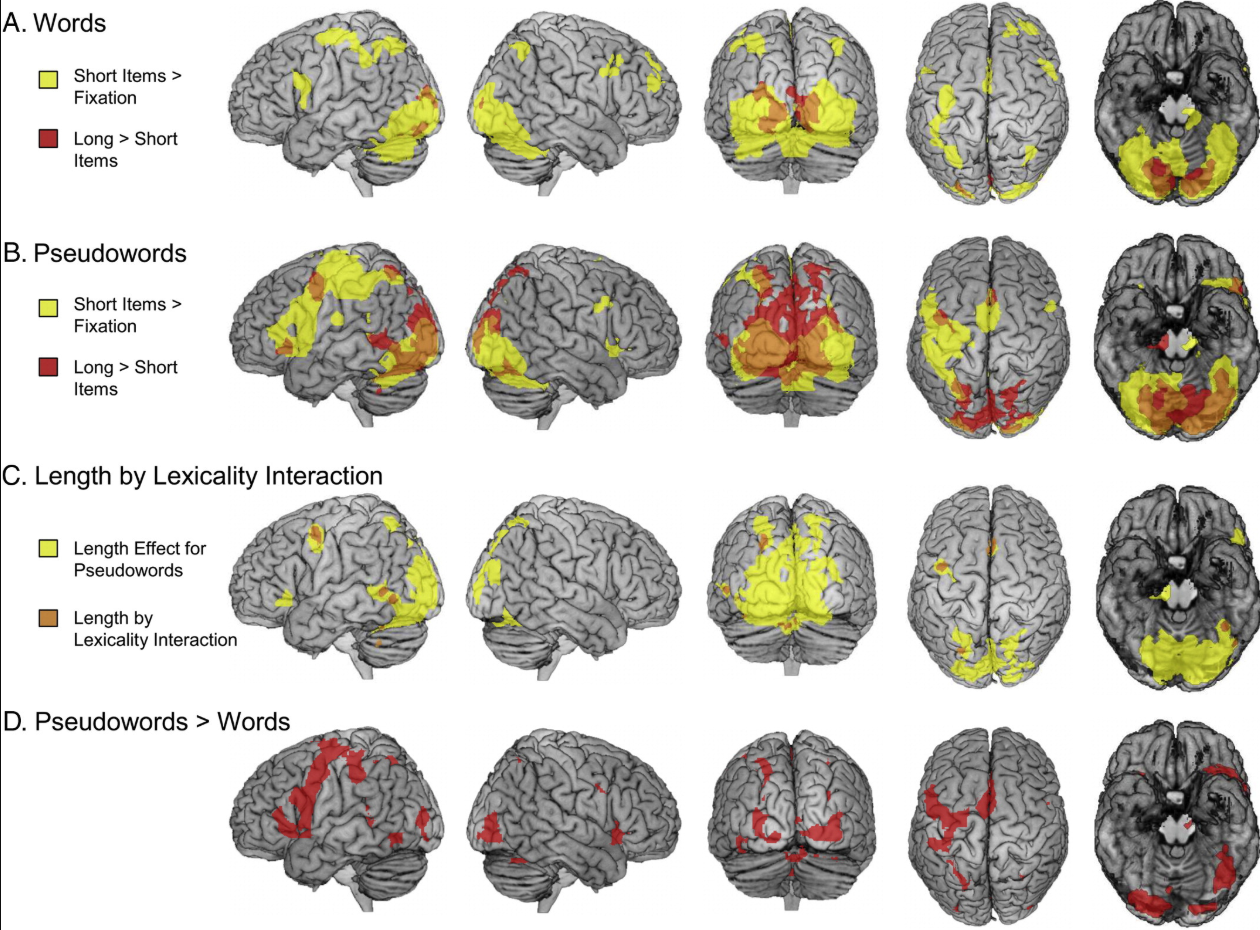
Another study by Schurz, Sturm, Richland, Kronbichler, Ladurner, & Wimmer (2010), looked at word length effect with pseudowords (follows rules of language) and real words:
- Red – difference between short and long words:
- For real words – words are processed in parallel so there is no difference between long and short words.
- For pseudowords – VWFA is showing a difference between long and short words.
- Length effect on BOLD signal for pseudowords but not for words
- Suggests the VWFA does respond to pseudowords but they are not treated as being equal to real words (sequential processing).
Other points of the VWFA:
- VWFA is not strictly visual - responds to Braille reading in congenitally blind (Reich et al., 2011)
- Depends on experience - left lateralisation depends on level of literacy (Dehaene et al., 2010). The more skilled you are at reading, the more left lateralised your brain becomes.
- Depends on interactions with spoken language - in left handers it goes in the language-dominant hemisphere (based on Broca’s region; Van der Haegen et al., 2012)
Outline the dual-route model
- Originated from Marshall & Newcombe (1973):
- six case studies of acquired dyslexia (had brain injury in later life which resulted in them getting dyslexia):
- Two patients with phonological dyslexia - word substitution errors (e.g., “dug” - “bug”), struggled to sound out words.
- Two patients with surface dyslexia - over-reliant on sounding out words, difficulties in reading irregular/exception words that didn’t follow the regular spelling to sound rules.
- Deep dyslexia - unable to name individual letters, or to read many of the words presented.
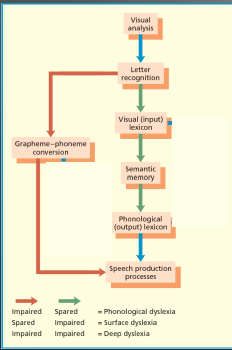
- According to the dual-route approach (Coltheart, 2007), reading words and non-words involves different processes. Core idea - two routes to word recognition:
- Lexical
- Direct route from orthography to semantics.
- Can only use this route for known words that have representations in the mental lexicon (only have semantic representations for words we know).
- Fast.
- Representations of thousands of familiar words are stored in an orthographic output lexicon. Visual presentation of a word produces activation in this lexicon. This is followed by obtaining its meaning from the semantic system, after which its sound pattern is generated by the phonological output lexicon.
- A patient using this route could pronounce familiar words (regular or irregular). However, their inability to use grapheme–phoneme conversion rules means they should find it very hard to pronounce unfamiliar words and non-words. Phonological dyslexics fit this predicted pattern fairly well. Phonological dyslexia involves special problems with reading unfamiliar words and nonwords.
- Non-lexical
- Orthography mapped onto phonology (grapheme-phoneme conversions) – linking printed letters to speech sounds.
- Can, in principle, use this route for any word/letter string – don’t need to access semantics.
- Relatively slow.
- If a brain-damaged patient used only the non-lexical route, grapheme–phoneme conversion rules should permit accurate pronunciations of words with regular spelling–sound correspondences. However, they would not permit accurate pronunciation of irregular words not conforming to the conversion rules. For example, if the irregular word pint has grapheme–phoneme conversions rules applied to it, it would be pronounced to rhyme with hint. This is known as regularisation. Finally, grapheme–phoneme conversion rules can provide pronunciations of non-words.
- Patients apparently largely reliant on this route are surface dyslexics. Surface dyslexia is a condition involving special problems in reading irregular words.
What does the dual-route model assume about dyslexics?
Cognitive evidence for dual route processing:
- Dyslexia can be both developmental and acquired
- Focus here upon acquired dyslexia
- Selective neurological damage should show specific patterns of reading difficulties/intact aspects of reading, dependent on location of damage
- Phonological dyslexia:
- Impaired non-lexical route.
- Rely on lexical route.
- Typically make lexicalization errors (e.g., reading “churse” as “nurse”).
- Struggle pronouncing non-words.
- Surface dyslexia:
- Impaired lexical route.
- Rely on non-lexical route.
- Very difficult to accurately read irregular/exception words (e.g., “island”).
- Deep dyslexia:
- Impairment in both routes.
What is semantic dementia?
- Semantic dementia - a neurodegenerative disease, characterised by loss of semantic knowledge
- “…a progressive loss of the ability to remember the meaning of words, faces and objects, which results from shrinkage of the temporal lobes of the brain.”
- Patients often have surface dyslexia alongside their broader cognitive difficulties – common occurrence of semantic dementia and surface dyslexia
- Unimpaired reading of both regular words and pseudowords, but impaired reading of irregular words
Reading disabilities:
- Developmental dyslexia is more common
- Reading difficulties are not solely associated with visual word recognition
What is comprehension?
- WIAT-II test (2005):
- “I have long floppy ears. I have pretty fur that is very soft. If I see you, I hop away.”
- “What animal is this about?”
- “What will it do if it sees you?”
- This is one item typically used to assess reading comprehension with a 7-year-old child.
- “I have long floppy ears. I have pretty fur that is very soft. If I see you, I hop away.”
- Comprehension – the ability to understand something
How is the inferior frontal lobe activated when reading?
Inferior frontal lobe (Broca’s area):
- Becomes activated when people are reading
- Increased BOLD activity for irregular, low frequency words (yacht). Three explanations for this:
- Could be reflecting phonological processing - Increased BOLD activity = greater cognitive processing difficulty with GPC conversions. Reflects difficulty of phonological processing trying and failing.
- Could be reflecting semantic processing - Increased BOLD activity = greater reliance on lexical route
- Both? - possibly subregions contributing both lexical and non-lexical (phonological) processing that are reflected in the BOLD response
- Not clear what it reflects
What do fMRI scans reveal about semantic dementia?
- Participants with semantic dementia and healthy controls
- fMRI scans while regular words, exception words (exc), and pseudowords were read aloud
- Behavioural data - significantly worse response accuracy on low frequency exception words for the SD patients:
- If you give them words they can’t identify through their non-lexical route, response accuracy decreases
- Imaging data:
- activation of inferior parietal region activated for low frequency irregular words in SD patients only – trying to identify words phonological processing (non-lexical route) but can’t because they don’t follow GPC rules.
- anterior temporal lobe activated during reading for controls, but atrophied and not activated for SD patients – they have lesions in this area of the brain.
What does the inferior parietal lobe tell us about reading?
Inferior parietal lobe:
- Associated with phonological processing - left supra-marginal gyrus associated with phonological processing
- Activated more by nonwords and shows clear nonword length effects
- Hyper-activated by patients with semantic dementia when reading irregular, low frequency words – their lexical route is damaged and reliant on phonological processing
- When presented with irregular words (yacht), this area increases in activity – trying and failing to sound it out
- GPC may occur here
What does the anterior and mid-temporal lobe?
Anterior and mid-temporal lobe:
- Activated more in semantic (lexical route) than phonological processing (non-lexical route)
- Patients with semantic dementia have lesions in this area - Wilson et al. (2009).




