Screening tests
○ generally less expensive and more widely available ○ designed to identify all individuals who have the disease of interest ○ maximization of the diagnostic sensitivity of screening tests inevitably comes at the expense of reduced diagnostic specificity.
Confirmatory tests
○ require more specialized equipment or personnel. ○ intended to correctly separate those individuals who have a disease from those who do not.
main roles of laboratory testing
-diagnosis of disease -screening for disease -risk assessment of future disease -monitoring disease and therapy
Diagnostic Specificity
the % of people who don’t have the disease testing negative (true negative)
Diagnostic Sensitivity
the % of people correctly diagnosed with disease–20 patients with strep will test negative (false negative) Implications: Misdiagnosed, ineffective treatment, more likely for sxs to come back
reference ranges
Based on people with specific disease state not present or set by expert opinion on top of data 2.5% above or below mean will still be normal but not exactly at mean
Sources of lab error
miss-labeling
Effects of packed red blood cells
1 unit of packed red blood cells should only raise your hemoglobin up by 1g/dL
What is under the orange line?
What is between blue and orange line?
What is above blue line?
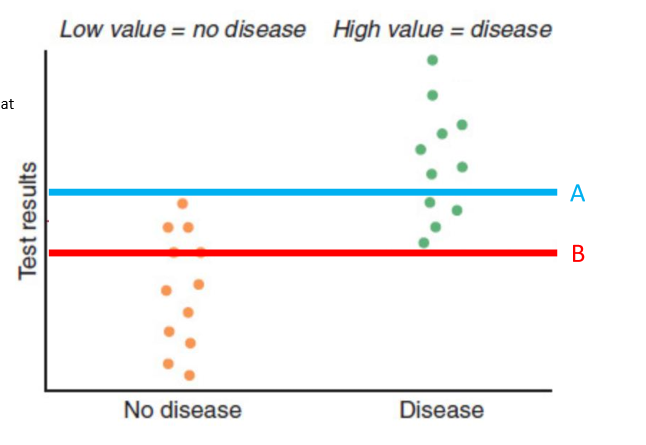
- under orange: positives
- between blue and orange: false positives and missed diagnosis
- above blue line: negatives
- screening tests will ensure that positives arent missed and confirmatory tests will make sure to rule out false positives
Four bordered of the heart
- right border (slightly convex), formed by the right atrium and extending between the SVC and the IVC.
- inferior border (nearly horizontal), formed mainly by the right ventricle and slightly by the left ventricle.
- left border (oblique, nearly vertical), formed mainly by the left ventricle and slightly by the left auricle.
- superior border, formed by the right and left atria and auricles in an anterior view; the ascending aorta and pulmonary trunk emerge from this border and the SVC enters its right side. Posterior to the aorta and pulmonary trunk and anterior to the SVC, this border forms the inferior boundary of the transverse pericardial sinus.
Four surfaces of the heart
- anterior (sternocostal) surface, formed mainly by the right ventricle.
- diaphragmatic (inferior) surface, formed mainly by the left ventricle and partly by the right ventricle; it is related mainly to the central tendon of the diaphragm.
- right pulmonary surface, formed mainly by the right atrium.
- left pulmonary surface, formed mainly by the left ventricle; it forms the cardiac impression in the left lung.
Name the arteries
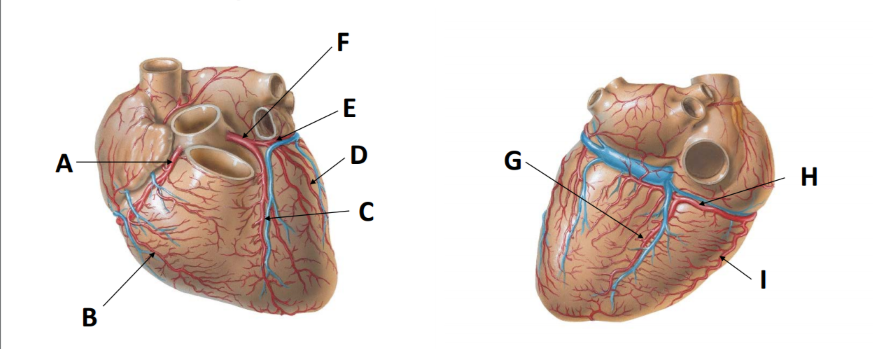
A. Right coronary artery
B. Right marginal branch
C. Anterior interventricular branch of left coronary artery
D. Left marginal artery
E. Circumflex branch of left coronary artery
F. Left coronary artery
G. Posterior interventricular branch of right coronary artery
H. Right coronary artery
I. Right marginal branch
How to determine dominance
where the posterior interventricular branch comes off of (the right coronary or left coronary artery) (or both -co dominant)
pattern of arterial supply to interventricular septum
RCA branch to the AV node is a septal branch
LCA supplies 2/3 of interventricular branch to anterior septum
Name the veins
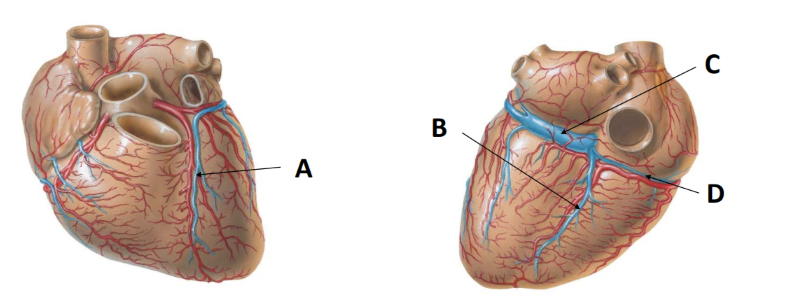
A. Great cardiac vein
B. Middle cardiac vein
C. Coronary sinus
D. Small cardiac vein
Layers of the heart
- Epicardium, a thin external layer (mesothelium) formed by the visceral layer of serous pericardium.
- Myocardium, a thick, helical middle layer composed of cardiac muscle.
- Endocardium, a thin internal layer (endothelium and subendothelial connective tissue) or lining membrane of the heart that also covers its valves.
What is happening during lub/dub
Two heart sounds are heard with a stethoscope: a lub (1st) sound as the blood is transferred from the atria into the ventricles, and a dub (2nd) sound as the ventricles expel blood from the heart. The heart sounds are produced by the snapping shut of the one-way valves that normally keep blood from flowing backward during contractions of the heart




