What is a population?
- group of individuals of same species that live in the same place.
- group of individuals that live close enough to find each other and reproduce.
What is population ecology?
- Study of how/why populations change over time and space, in terms of distribution, abundance and composition.
What’s the difference between a discrete and a continuous growth model?
- Discrete models track time in discrete steps (1 year, etc.), while conituous models track growth over a continuous, smooth curve.
- Discrete models use difference equations to model pop growth, while continuous models use differential equations.
What types of species are best-suited to discrete population growth models, and what types are best suited to continuous models?
- DIscrete models: species with pulsed reproduction (seasonal repro) or species with non-overlapping generations (short-lived).
- Continuous models: species with overlapping generations and non-seasonal reproduction.
What’s the difference between a stable population and a stationary population?
What characteristic of the population are you describing with a stable population and what are you describing with a stationary population?
- Stable populations have unchanging proportions of individuals in each demographic (i.e. adults vs. juveniles).
- Stationary populations are not growing are declining (λ=1).
- “Stable” described population distribution and “stationary” describes pop growth.
What’s the equation to predict population size at time (t) with a discrete population model?
Nt = λt * N0
What is the equation for population growth using a continuous model?
dN/nt = rN, where r = b-d
What is the equation to determine pop size at time (t) using a continuous growth model?
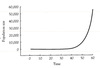
- Nt = No * ert, where r = b-d.
Derive equations to express λ in terms of r, and r in terms of λ.
Nt =λ t * No Nt = No * ert
So…
λ = er and r = ln (λ)
Derive the equation for doubling-time of a population using discrete growth.
Nt = λt * No
λt = Nt / No = 2
ln(λt) = ln(2)
t * ln(λ) = ln(2)
t = ln(2) / ln (λ)
List 5 assumptions of an exponential growth model.
- b and d are constant over time.
- no differences in b and d by demographic group.
- no e or i.
- no time lags.
- no genetic structure.
Give 4 examples of populations that might be experiencing exponential growth.
- Newly established pops with few predators.
- Invasive species.
- Pops recovering from catastrophic declines.
- Humans.
Describe how stochastic models differ from deterministic models in terms of:
- predictability,
- outcomes and
- starting conditions.
- may vary unpredictably
- outcomes uncertain
- different starting conditions can produce different outcomes.
- What kind of pattern of population growth do deterministic factors create?
- Give 4 examples of deterministic factors.
- directional, non-random growth patterns.
- habitat loss
- fragmentation
- invasive species
- overharvest
Name 3 primary sources of variation in population growth.
- Deterministic factors
- Sampling error
- Stochastic processes
What is demographic stochasticity?
Chance variation in b and d in real populations (i.e. survival rate may be 0.726, but in any given year in a population of 10 individuals, you’re not going to have 7.26 survivors!) even when λ does not change.
What is environmental stochasticity?
Uncertainty due to unpredictable changes in environmental stochasticity.
What is the “funnel effect”?
Variance in N increases with time in a pop models with stochasticity.
How do you calculate average growth rates in models with stochasticity?
Why?
- Use geometric mean (multiply the t growth rates and then take the t-th root.
- With no stochasticity, can just take average (arithmetic mean), but with stochasticity the arith mean will over estimate lambda.
Describe how you would use past year’s estimates of λ to model stochasticity.
What is an assumption of this approach?
Run many (say 1000) replicates, eac taking a value of λ at random from previous years’ data.
Assumes future variation will be same as past.
What is the effect of temporal autocorrelation on stochastic population growth estimates?
Causes underestimation of variability in growth rates (b/c you measured for a few years, and those years tend to be more similar than others).
- What is scramble competition?
- What’s another term for it?
- individuals have equal access to resources, so when shortages occur, everyone is equally affected.
- “exploitative competition”
- What is contest competition?
- What is another name for it?
- Individuals have unequal access to resources, so those with less access suffer more when there are shortages.
- “interference competition”
What is the logistic growth equation for density dependence?
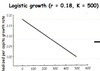
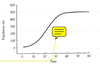
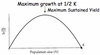
dN/dt = rN (1-N/K)
where K is the carrying capacity