two primary calssification of softwood lumber
yard lumber: structural purposes and rough framing; further classfied as boards, dimension, and timber
factory and shop lumber: used for making door frames, windows, and finish items
define board, dimension, and timber when referring to softwood yard lumber
board - less and 2” thick; 2” or more wide
dimension - 2”-5” thick; 4” to 12” or more wide
timber - 5” or more thick; 5” or more wide
Wood
- Wood is readily available as a building material
- Lower cost than concrete, masonry, and steel structures
- Stronger in compression than tension
- For improved tension and compression apply load parallel to the grain • For improved shear strength, apply load perpendicular to the grain
- Heavy Timber resists fire better than unprotected steel
Wood that will be seen in finish applications (e.g.: flooring, interior trim, furniture, hardwoods, casework) are sawn from a log in what way?
quartersawn to produce lumber that have annual rings running nearly perpendicular to the face of the piece
When a tree is cut, the water slowly begins to evaporate in the following order:
- Free Water: water held in the cavities of the cells. Reduces water content to 26% - 32% moisture
- Bound Water: water held in within the cellulose of the cell walls, wood starts to shrink at this point and the strength and stiffness of the wood begins to increase.
• Seasoning
• Water content in a piece of wood can vary between 30% - 300% of the oven-dry
weight of the wood. This unseasoned wood is called greenwood.
• Seasoned lumber is stronger and stiffer than unseasoned, more dimensionally
stable, and lighter in weight.
• Sawing:
• Most lumber intended for use in building framing is plainsawed,
which produces the maximum yield of lumber from a log.
• Some pieces have the rings running perpendicular to the faces
of the piece, some have rings on various diagonals, and some
have rings running parallel to the faces.
• Varying grain orientation cause pieces to distorted differently
during seasoning, or drying, vary differently in their appearance,
and erode at different rates when used as flooring, siding, etc.
• Grading
• Each piece of
lumber is graded for appearance or structural strength and stiffness at the mill.
• Appearance grading is done visually by trained inspectors. Structural grading is done either visually or by machine.
• •
Lumber is sold by species and grade …. Higher grade = more $$$ Grade stamps are applied to each piece of lumber.
Grade Stamp
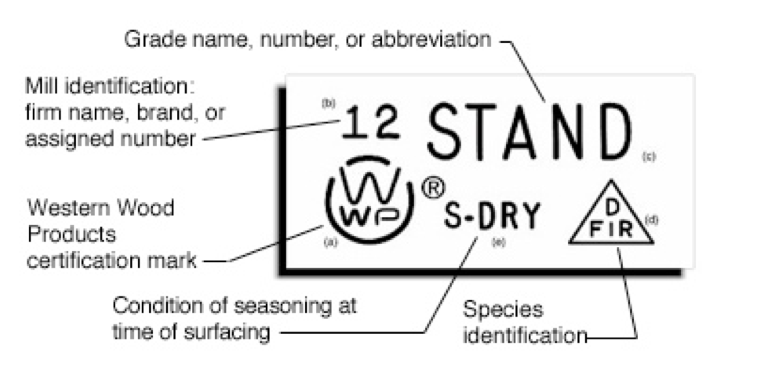
to be considered dry lumber, moisture content in wood cannot exceed ____%
19
to be grademarked kiln dry, moisture content in wood cannot exceed ___%
15
wood shrinks mostly in which direction relative to its grain?
perpendicular to its grain
When wood joists are framed into masonry walls, a fire cut is required for wood joists because…
…it prevents the masonry from being pushed up and out if the wood member should collapse during a fire.
LVL (or laminated veneer lumber)
uses the veneers in sheets and looks like thick
plywood with no crossbands
-also sometimes called thin glued laminated framing
Structural Composite Lumber
• Made up of ordinary plywood veneers or of long strands of wood fiber
• All grains of all the veneers or strands are oriented in the longitudinal direction of
the piece of lumber to achieve max bending strength.
• LVL (or laminated veneer lumber) uses the veneers in sheets and looks like thick
plywood with no crossbands
• It’s stronger, straighter, and more uniform than conventional lumber and less
likely to warp, twist, bow, or shrink
structural insulated panel (SIP)
composite unit consisting of two outer skins bonded to an inner core of rigid insulating material
- commonly composed of 7/16 OSB
- insulated with molded expanded poly styrene
advantages of SIPs
- decreased construction time (one third less)
- imporved insulation value with no thermal bridges
- reduced air infiltration
- stronger than conventional stud and sheathing construction
- very flat walls for subsequent finishes
- dimensional stability
common coordition concers for SIPs
-detailing vapor barriers
providing seismic anchors where required
-detailing termite shield in geographical areas where requried
for heavy timber construction the UBC requires that interior columns be at least
8 x 8 in nominal size
- beams and girders supporting floors be at least 6 in wide and 10 in deep
- floor decking be at least 3 in thick nominally
- roof decking to have least 2 in nominal thickness
glulams are available in 3 appearance grades
industrial - used whre appearance is not a primary concern
architactural - used where appearance is a factor but the best grade is not required
premium - finest appearance is important
pressure treated wood
preservative is forced deep into wood cells
- protects from fungi, moisture, and insects
3 basic types of wood preservative
creosote - distillate of coal tar and is effective protection against insects; insoluable in water; easy to apply; used mainly to protect railroad ties, marine timbers, and roadway guard posts; not used in building applications
oil borne preservative - include pentchlorophenol(penta); used to treat utility poles and cross arms, fresh water pilings, and bridge timbers; applied by brishing, dipping, or pressure treating; generally not used in building application but sometimes used for long span glulams
waterborne preservatives - used in building; include ammoniacal copper quaternary (ACQ); also known as alkaline copper quat, copper azole, and sodium borate (SBX); leave wood paintable; odorless
two chemical wood preservative that aren’t good to use
chromated copper arsenate (CCA), ammoniacal copper zinc arsenate (ACZA)
- harmful to health and environment because of arsenic content
- CCA was phased out by EPA in 2003; chemcials leach out form wood
- ACQ more corrisive than CCA to fasteners and flashing
- aluminium flashing should not be used with these preservative
- preservative with borates will leach out when exposed to moisture; preservative with borates are limited to areas protected from moisture and not in contact with ground
when wood that is treated with preservatives is cut exposed areas should be treated with
a copper naphenate solution containing at least 2 percent copper.






