(Fibrinous Inflammation)
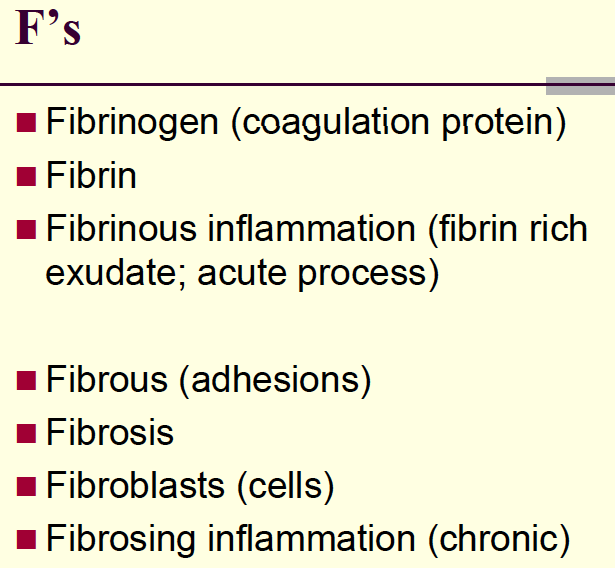
- fibrinogen –> ? –> ?
- What is the definition? not associated with what?
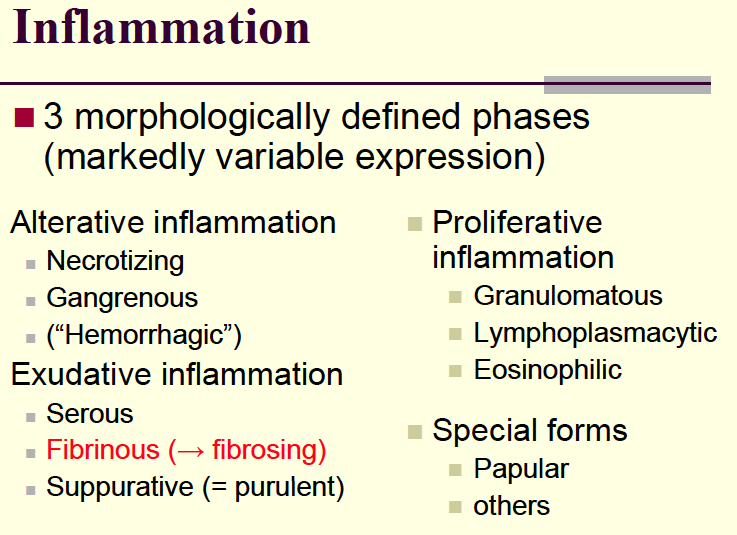
- fibrin; thrombus (intravascular/vessel-associated)
- presence of fibrin in extravascular location (occasionaly also within vasculature/heart); hemostasis
(Fibrinous Inflammation)
(Pathogensis)
- injury –> ? –> ?
- Injury induced “pro-coagulative” milieu in extravascular location… due to effect of what?
- vascular permeatbily increase; extravasatiion of fibrinogen
- cytokines (such as IL-1, TNF-a) on endothelial cells
(Fibrous Inflammation)
(Pathogenesis)
(Consequences)
- tissue necrosis due to what?
- stimulation of fibrocytes to what? can causs what three things?
- Fibrin is a good substrate for what?
- decreased perfusion
- fibroblasts; wound healing, scarring, exuberant granulation tissue formation
- for proliferation of certain bacteria
(Fibrous INflammation)
(causes)
- Infections with what? that produce what? only minor what? also what?
- What other fancy one?
- and chemical/physical injury
- gram negative bacteria; endotoxin (–>pro-coagulative); chemotaxis; secondary bacterial infection (after viral)
- immune-complex mediated reaction (type 3 hypersensitivyt)
(Fibrinous Inflammation)
- Variably dense eosinophilc (= “protein-rich’) homogenous to fibrillar exudate with relatively low cellularity
- What occurs within several days?
- beginning fibrosis (formation of granulation tissue)
(Fibrinous INflammation: Where does it occur)
- in tubular organs mainly with what? Differentiated based on what?
- Also found where?
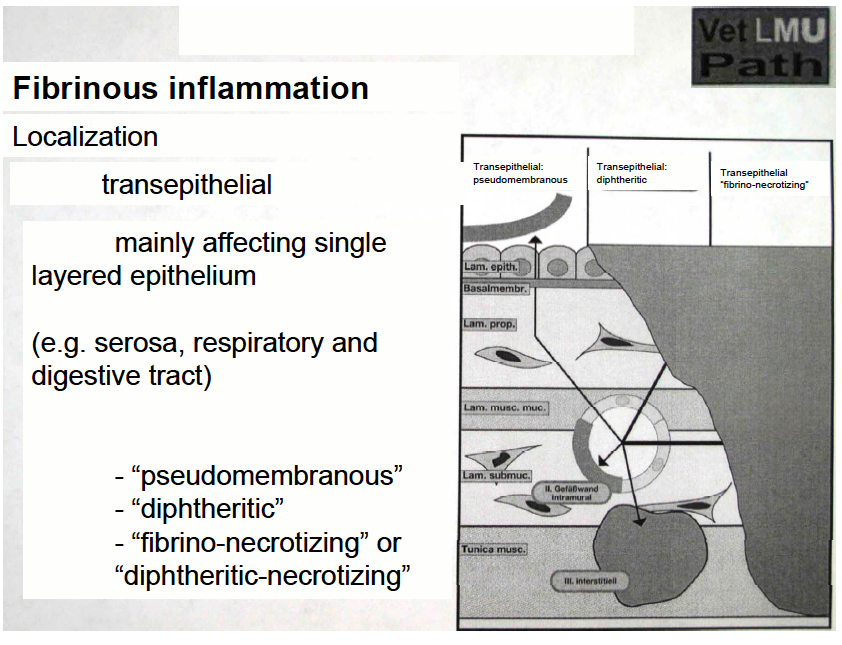
- single layered epithelium (respiratory, alimentary and on or benetah serosa); extenesion of fibrin into deeper layers (Psuedomembranosus, diptheritic (-necrotizing)
- in vascular wall (fibrinoid vascular necrosis)
(Fibrinous Inflammation: Tubular organ/body cavity)
(Pseudomembranosus)
- fibrin forms layer on what?
- fibrin removeable with or without damage to underlying mucosa/serosa?
(Diphtheritic (necrotizing))
- fibrin deposition does what?
- Is fibrin removeable without further damage to underlying mucosa/loss of substance?
- macroscopically (seemingly) intact (usually reddened) epithelium
- without (gets reddened though…)
- extends beyond basement membrane into deeper layers
- no
(then look at this and next two pages)
(Fibrinous Inflammation: Sequela)
(Small accumulations of fibrin)
1-2 what two things occur?
(Large Accumulations of fibrin)
- Stimulation of local inactive fibrocytes –> fibroblasts —> formation of what?
- resorption (dissolved by macrophages/PMNs)
- destruction (bacterial proteases)
- granulation tissue (fibrinous inflammation –> fibrous adhesions or fibrous/fibrosing inflammation)
(Fibrinous INflammation: Sequela)
(in tubular organs)
- after pseudomembranosus inflammation?
- after diptheritic inflammation?
- restitutio ad itegrum (resolution)
- loss of fibrin results in ulcer –> scarring/stricture
(Fibrinous Inflammation: Sequela)
(parenchymal organs)
1-2. what two things do you see?
(on serosa)
- Adhesions (acute - acellular) can you separate without damage to tissue?
- “fibrous tags” (chronic - fibroblastic) must do what to separate?
- diffuse contstrictive fibrosing process
- fibrosis/sclerosis (hardeining of tissue)
- seqeuster formation
- yes
- tear
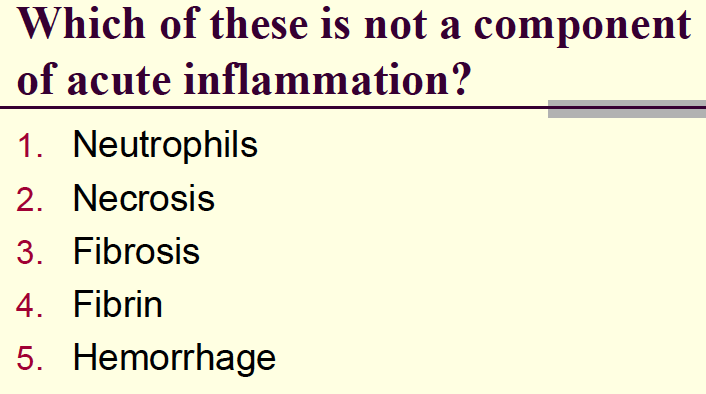
ROFK
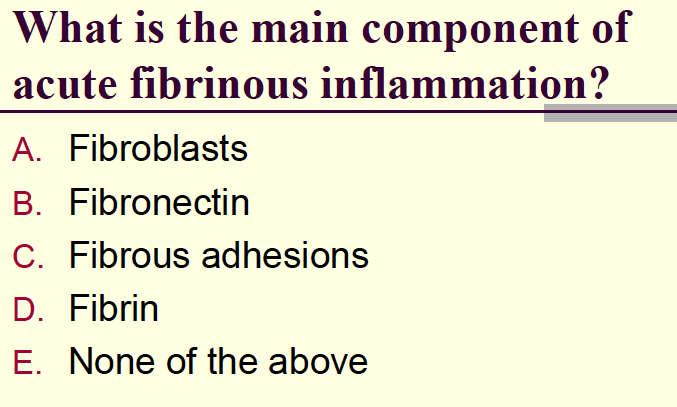
the answer id D
(Suppurative Inflammation)
(Etiology - the study of causation)
- What’s the big cause?
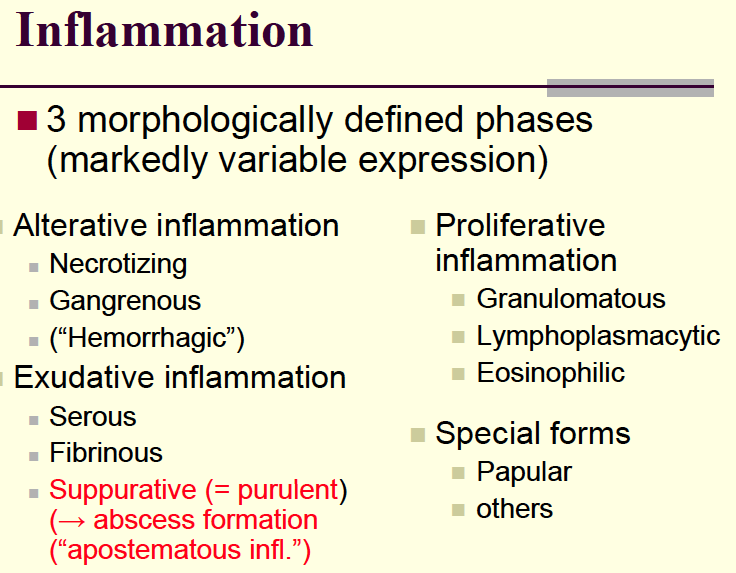
- BACTERIAL INFECTION
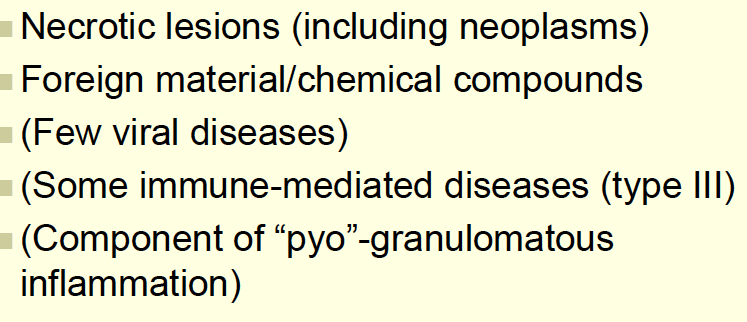
also the ones in picture
(Suppurative Inflammation)
- strong attraction of what?
2-4. by what three things?
- What is the hallmark macroscopically?
- microscopically?
- neutrophils
- mediators (chemokines)
- bacterial products
- injured tissue
- PUS
- neutrophils (viable and degenerate)
(Suppurative Inflammation)
(Pathogenesis)
(mildly aggressive insult)
- characterized by what?
- removal of occasional dead neutrophil by what?
(More aggressive insult)
- large number of what with release of large quantities of what? leads to what?
- what does pus =?
- viable neutrophils
- macrophages
- degenerate (+/- viable) neutrophils with release of large quantities of lytic enzymes; tissue lysis
- degenerate neutrophils and bacteria
(Suppurative Inflammation)
(Cause)
- what is the major one?
2-3. what are the two little ones?
- pus-producing (pyogenic) bacteria (eg arcanobacterium PYOGENES, strep, staph, etc)
- sterile chemical injury
- autoimmune disease (type II and III)
(Suppurative Inflammation)
(Where does it occur?)
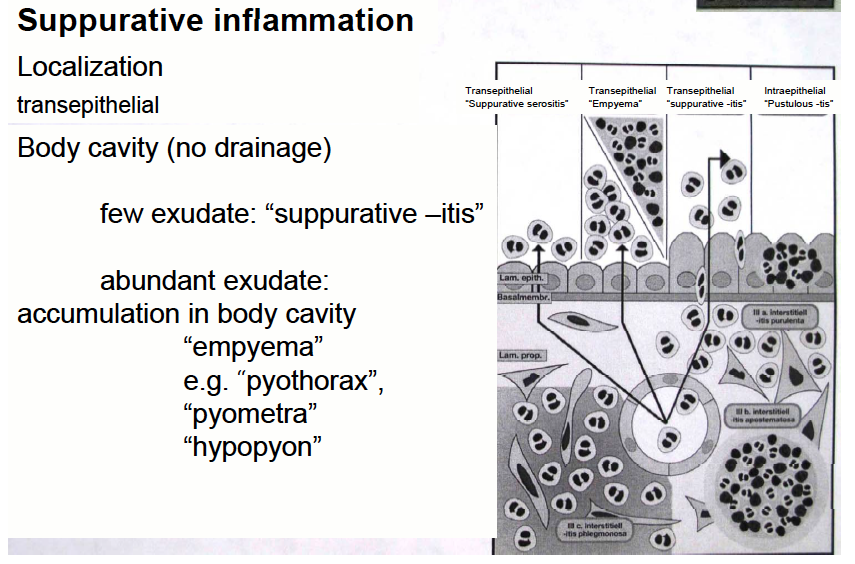
(in a body cavity/tubular organ without drainage)
1-2. can get either what or what?
(tubular organ with drainage)
- why is it difficult to recognize?
(intraepithelial accumulation in multi-layered epithelium)
- forms a what?
- small quantity of exudate (purluent pleuritis)
or
- Large quantity of exudate (empyema, pyothorax, pyometra, hypopion)
- exudate doesn’t accumulate
- pustule
(Suppurative Inflammation: where does it occur cont.)
(Parenchymal organ - “interstitial”)
(Good immune function and weak injury)
- will you get tissue lysis?
(Good immune function and aggressive injury)
- will you get tissue lysis?
3-4. what two things will you see?
- no (frequently not detecable macroscopically)
- yes
- microabcesses (only detectable histologically) and macroabcesses
- individual/multiple large abcesses
(plus learn these two slides)
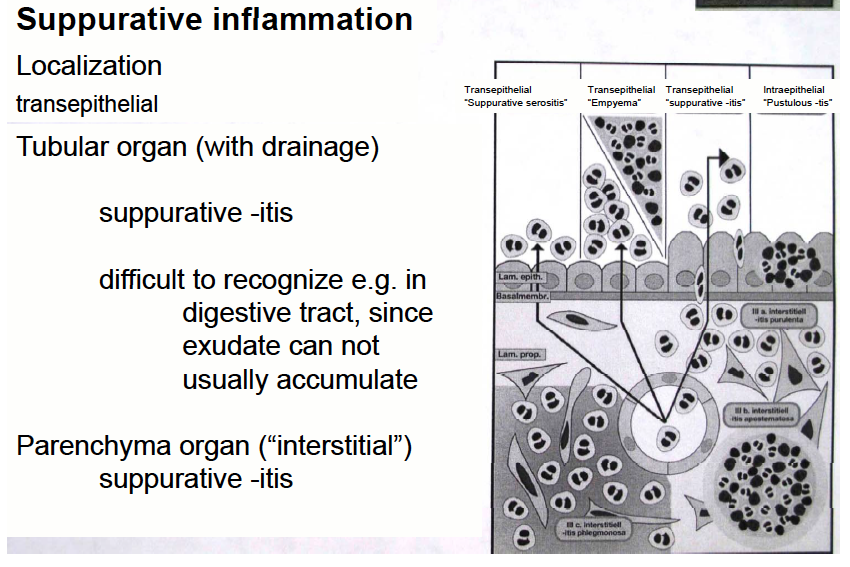
(Suppurative Inflammation: Abscess - “aposteme”)
(Abscess development)
- what happens first?
- then progression until what?
- then what?
- is it a cyst?
- tissue lysis (with accumulation of neutrophils)
- immune response overcomes injurious stimulus
- granulation tissue forms connective tissue capsule (“maturation of abcess)
- NO
(Suppurative Inflammation: Abscess - aposteme)
(Histology)
- What do you see in the center?
- in the periphery?
- at the interface?
- degenerate neutrophils (possibly with bacterial or fungal agents)
- capsule of connective tissue
- “pyogenic membrane” with inner layer (viable neutrophils) and outer layer of granulation tissue with interspersed inflammatory cells
(Suppurative Inflammation: Fistule)
- what type of suppurative inflammation?
- with draining tract to what?
- What happens first? with accumulation of what?
- progression until what occurs?
- then what?
- chronic
- body surface, body cavity, lumen of tubular organ
- tissue lysis; neutrophils
- immune response overcomes injurious stimulus
- granulation tissue formation (bordering draining tract)
(Suppurative Inflammation: “Phlegmone”/phlegmonous inflammation)
(Subcutis and Skeletal muscle)
- Under what conditions does this occur?
- rapid spread along fascia without what?
- when poor immune function and aggressive injurious stimulus
- tendency of demarcation
(Chronic Suppurative Inflammation)
- Histologic lesion of chronic suppurative inflammation (in tubular organs) or body cavities may be dominated by what with only a few what?
- dominated by lymphocytes and plasma cells with only a few neutrophils (Eg pyometra)
+ figure this out