The W3C Web Ontology Language (OWL) is a ___ ___ language designed to represent ____ and ____ knowledge about ____, groups of ____, and ____ between ____.
The W3C Web Ontology Language (OWL) is a semantic** **web** language designed to represent **rich** and **complex knowledge about things, groups of things, and relations between things.
OWL is a ____ ____-based language such that knowledge expressed in OWL can be ____ by computer programs, e.g. verify the ____ consistency of that knowledge or to make important knowledge explicit.
OWL is a computational** **logic**-based language such that knowledge expressed in OWL can be **exploited** by computer programs, e.g. **verify the consistency of that knowledge or to make important knowledge explicit.
OWL documents, known as ____, can be published in the World Wide Web and may refer to or be referred from other ____ ____.
OWL documents, known as ontologies, can be published in the World Wide Web and may refer to or be referred from other OWL** **ontologies.
OWL is part of the W3C’s Semantic Web ____ ____, which includes RDF, RDFS, SPARQL, etc.
OWL is part of the W3C’s Semantic Web technology stack, which includes RDF, RDFS, SPARQL, etc.
OWL 2 is an ____ and ____ of the 2004 version of OWL developed by the W3C Web Ontology Working Group.
OWL 2 is an extension** and **revision of the 2004 version of OWL developed by the W3C Web Ontology Working Group.
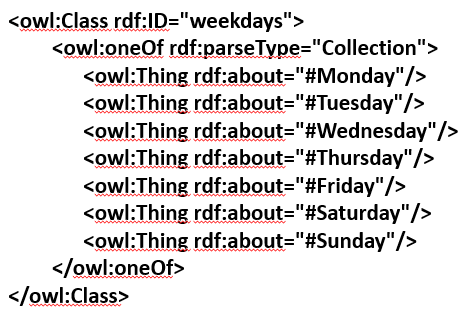
Write an enumeration of the days of the week with owl:oneOf
Declare an instance of an #academicStaffMember in RDF
True or false: OWL adopts the unique-names assumption of database systems
False
If two instances have a different name or ID does not imply that they are different individuals
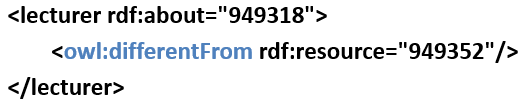
What RDF tag do you use to ensure different individuals are recognized as such?
owl:differentFrom
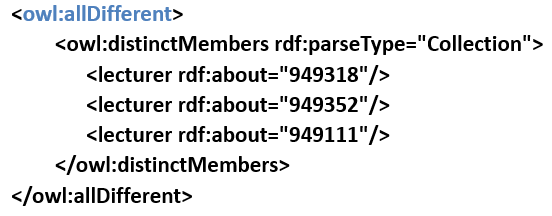
What is the shorthand notation to assert pairwise inequality of all individuals in a list?
owl:allDifferent
Property Separation
(Restriction of Features in OWL)
- The set of object properties and datatype properties are disjoint
- Therefore, the following can never be specified for data type properties:
- owl:inverseOf
- owl:FunctionalProperty
- owl:InverseFunctiolnalProperty
- owl:SymmetricProperty
Which two assumptions does OWL inherit from Description Logic?
- The open-world assumption
- The non-unique-name assumption
Open-World Assumption
- cannot conclude some statement x to be false simply because we cannot show x to be true
- Question:“Did it rain in Tokyo yesterday?”
- Answer:“I don’t know that it rained, but that’s not enough reason to conclude that it didn’t rain.”
Closed-World Assumption
- allow deriving falsity from the inability to derive truth
- Question:“Was there a big earthquake disaster in Tokyo yesterday?”
- Answer:“I don’t know that there was, but if there had been such a disaster, I’d have heard about it. Therefore, I conclude that there wasn’t such a disaster.”
By the use of two examples, one in databases and the other in web, describe how a database uses closed world and web uses open world assumptions.
Web present data about uncounted concepts, Consider the following statement: “Tim Smith with the ID of 785654549 is a citizen of France.” Now, what if you ask “Is Tim Smith with the ID of 785654549 a citizen of Malaysia?” Under a closed world assumption, the answer is “no” whereas under the open world assumption the answer is “not known”. Web is full of such kinds of data. Hence, open world assumption is used in a system with incomplete information, to which Web belongs.
On the other hand databases usually presents data about limited concepts, say a university. For instance, if the database of UOW shows that Tim Smith with the ID of 785654549 is not UOW’s student, definitely he is not UOW’s student.
Moreover in web non-unique names are used, and two different ID may show the same resource, whereas in database this not the case
Future Extensions of OWL
- modules and imports
- defaults
- closed world assumption
- unique names assumption
- procedural attachments
- rules for property chaining
Modules and Imports
- OWL only allows importing an entire ontology, not parts of it
- Modules in programming languages based on information hiding: state functionality, hide implementation details
OWL builds upon ___ and ___ ___.
OWL builds upon RDF and RDF Schema.

-
01: Semantic Web Vision & Structured Web Documents in XML24
-
02: Describing Web Sources in RDF22
-
02b: XPATH Practice15
-
03: SPARQL27
-
04: Processing RDF With SPARQL in ASP.NET28
-
05: RDF Continued25
-
06: Search Engines52
-
07: Web Ontology Language: OWL43
-
08: OWL continued18
-
09: SPARQL Advanced22
-
10: Logic and Inference Rules34
-
11: Logic and Inference Rules (Part 2)11
-
12: Ontology Engineering28
-
00: All Diamond-Marked Questions39



