What is the pKa for the amino and carboxyl groups of amino acids?
Amino group: 8.0
Carboxyl group: 4.0
Peptide bonds are . . .
a) planar and cis
b) planar and trans
c) unconstrainedly rotational and cis
d) unconstrainedly rotational and trans
Peptide bonds are b) planar and trans.
Peptide bonds formed by the 19 amino acids OTHER than proline are found in the trans conformation >99% of the time. The steric clash between bulky C-alpha groups when the peptide bond is cis, is reduced by the small proton that swaps positions with the C-alpha group when the peptide bond is trans. Pro, however, has a clash between bulky carbon groups either way; consequently, about 1⁄4 of X-Pro peptide bonds are cis.
How is rotation around the CO-NH peptide bond characterized?
Partial double bond character prevents rotation about the CO-NH bond, resulting in only two rotatable bonds per amino acid residue. The atoms linked with red dashed lines define a virtual “plate”: they define the backbone conformation of the protein and most rotate together. Because of their significance they have been given names: phi and psi.
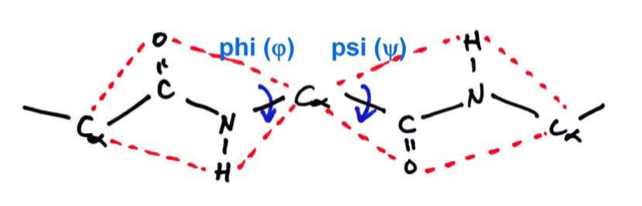
What do phi (Φ) and psi (Ψ) angles tell us?
The backbone rotations for each residue, which are limited by steric factors. Knowing all the phi and psi dihedral angles would tell us the complete conformation of the polypeptide backbone.
Phi and psi values close to 180° mean that the chain is in an extended conformation, like with β sheets; values close to 0º indicate compaction, like with α helices.
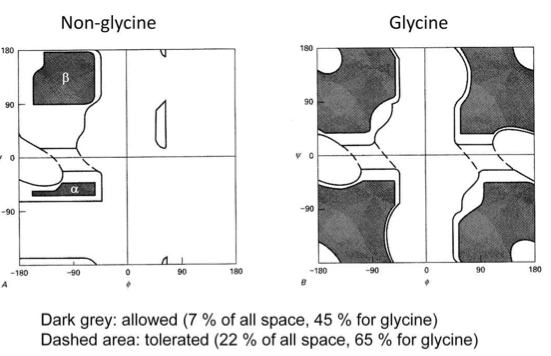
What is a Ramachandran map?
A way of visualizing allowed and non-allowed (Φ, Ψ) combinations. Only a small fraction of (Φ, Ψ) values are allowed, which allows only certain structures to form. These strucures are predictable, must satisfy the Ramachandran plot (lie in the gray regions), and arise from the way atoms are connected.
What are the pKas of Asp, Glu, His, Cys, Lys, and Arg?
Think “necker,” in order of increasing pH: NEHCKR.
- Asp/N: 4.0
- Glu/E: 4.0
- His/H: 6.5
- Cys/C: 8.5
- Lys/K: 10.0
- Arg/R: 12.0
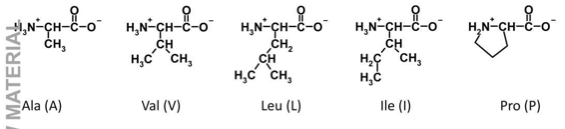
Which amino acids’ side chains are the most hydrophobic (aliphatic)?
Think ALIVP, like aliphatic.
- Ala/A
- Leu/L
- Ile/I
- Val/V
- Pro/P
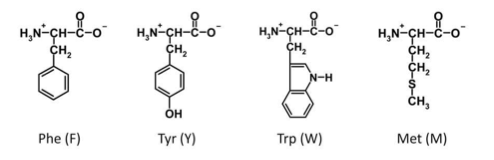
Which amino acids’ side chains are hydrophobic, but not aliphatic?
The AAs with aromatic or sulfur-containing side chains.
- Phe/F
- Tyr/Y
- Trp/W
- Met/M
How can pKa values be changed, and when is this phenomenon particularly significant?
The local environment can raise or lower pKa by >4 units. Deprotonated amino acids will decrease the pKa of nearby amino acids (nearby AA will give up the H+ more easily, because the usually positively charged AA wants it), while protonated amino acids will increase the pKa (nearby AA will retain its H+ more easily, because the usually negatively charged AA wants to give theirs up).
This phenomenon is particularly significant for enzymes, which can “tune” the pKa of active site residues to the appropriate value to carry out their chemical reaction. Some pH-sensing proteins will use ionizable side chains to trigger conformational changes, complex assembly/disassembly, or protein denaturation.
Which amino acids have polar uncharged side chains?
The hydroxyls: Ser/S, Thr/T
(only reactive at searingly high/low pH; same long [i] in searing as in serine and threonine)
The amides: Asn/N, Gln/Q
(generally unreactive, except at high/low pH; unreactive has an n, like the 3-letter codes: Asn and Gln)
Which amino acids have so-called “unique” side chains?
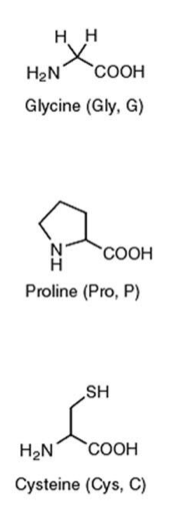
- Gly’s lack of side chain makes it flexible
- Pro’s cis-peptide bond favors kinks, turns
- Cys’s thiol group can oxidize to S-S, introducing cross-links
What are the four noncovalent forces that operate on proteins and biomolecules?
- Electrostatics: proteins fold to maximize favorable charge-charge and charge-water interactions; proportional to Coulomb’s Law
* *E = -(q1q2)/(r2D)** - Hydrogen bonding: special case of electrostatic attraction where electronegative atoms compete to bond with a hydrogen. The first bond pulls excess (-) from the hydrogen, making the hydrogen more (+) and more attractive to another electronegative atom.
- van der Waal’s forces: mutually induced dipoles; two atoms that are close to each other polarize their e- clouds. Manifested in proteins by tight packing of interior atoms.
- Hydrophobic interactions: tendency of nonpolar molecules to interact with other rather than water. Major driving force for folding.
What is believed to be the origin of the hydrophobic effect?
Since water molecules cannot H-bond to nonpolar molecules, it is thought that they satisfy their H-bonding potential by forming clathrates, or H-bonded “icebergs” around the nonpolar surface. This effect, however, is very energetically costly, so nonpolar molecules tend to bond to each other instead of to water.
What are the three major secondary structures in proteins?
- α-helix: Most common. Characterized by bonds between the peptide NH of residue i and the peptide CO of residue i+4. Periodicity = 3.6.
- β-sheet: 2nd most common. 2 or more β-strands form H-bonds between the peptide groups of each strand, typically in an antiparallel formation. Parallel formations are less common, possibly because they are more bent.
- Reverse β-turn: 1/4 of protein structures. Several types, with much sequence variability. Requires Gly, but prefers Pro.
What is the periodicity of the α-helix, and why?
3.6, which means that the side chains of every 4th residue lie on approx. the same face. This conformation is stable because of . . .
- Backbone-backbone interactions: extensive network of H-bonds with nearly optimal geometries, tight backbone packing → favorable vdW energy
- Backbone-sidechain interactions: since all of the peptide groups point in the same direction as the helix, all of the dipoles add to the helix macrodipole
- Sidechain-sidechain interactions: the sidechains of residues i and i+4 are often in contact and often work to stabilize the helix
What are some intrinsic amino acid preferences for α-helix formation?
Ala is a helix former. Apart from the helix indifferent (long, straight chains: Arg, Lys, Glu), most everything else is a helix breaker:
- Strong helix breaker: Pro, Gly
- Medium helix breaker: the β-branched/bulky: Val, Thr, Trp, Phe
What are some characteristics of β-sheets?
- Frequently amphipathic; periodicity of 2 (1st AA points up, next one down) allows for hydrophobic and hydrophilic faces
- Favorable backbone diherdral angles
- Φ, Ψ ~140° (chain is nearly fully extended)

-
1-10 Bacterial Genetics10
-
1-11 Commensalism vs. Pathogenicity4
-
1-12 Control of Microorganisms: Infection Control, Sterilization, and Disinfection6
-
1-13 Anaerobic Bacteria6
-
1-15 Eukaryotic Transcription I15
-
1-14 Membranes and Microscopy23
-
1-4 DNA Replication16
-
1-16 Eukaryotic Transcription II14
-
1-17 Protein Synthesis1
-
1-20 Mechanisms of Action of Antibiotics14
-
1-21 Cells and Tissues of the Immune Response (Intro to Immunology)19
-
1-24 Mechanisms of Resistance to Antibiotics13
-
1-22 Intracellular Bacteria14
-
1-5 Dynamic Genomes and the Creation of Genetic Diversity11
-
1-6 Mendelian Patterns of Inheritance4
-
1-7 Bacterial Growth and Function7
-
1-8 DNA Repair2
-
1-27 ER and Vesicular Transport14
-
1-28 The Immune Response6
-
1-31 Linkage and Recombination (Clinical Applications)12
-
1-32 Introduction to Cytogenetics18
-
1-33 Numerical and Structural Abnormalities18
-
1-43 Genetic Diagnostic Technologies13
-
1-44 Epigenetics and Imprinting12
-
1-42 Population Genetics7
-
1-34 Antibody-Antigen Interactions (Immunoassays)12
-
CP 1: Tetanus10
-
1-38 Protein Sequence/Structure/Function Relationships17
-
1-19 Spirochetes and Vibrios10
-
1-29 Enteric Bacteria11
-
1-30 Mycobacteria7
-
1-40 Mutations and Proteins10
-
1-45 Protein Misfolding and Disease12
-
1-46 Correcting Protein Defects13
-
1-37 Cytoskeleton I (Microfilaments)13



