What are the implications of DNA’s double-stranded nature for its replication?
It is a safety mechanism. Replication is semiconservative, meaning that each new strand of DNA contains one old strand and one newly synthesized one.
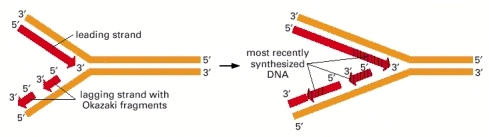
It also means that there is a leading and lagging strand (which is replicated in chunks) during the process, as well as leading and lagging polymerases.
What is topoisomerase?
An enzyme that cuts supercoiled strands (a result of natural torsional stress). There are two types:
- *Type 1** cuts one strand
- *Type 2** cuts two strands
Topoisomerase inhibitors are commonly used anticancer therapies.
How does DNA polymerase self-correct?
While DNA polymerase polymerizes the new strand 5’-3’, its exonuclease domain proofreads in the 3’-5’ direction, excising incorrect bases.
There is also a pause when DNA misaligns so that there is time to correct.
What is telomerase?
A reverse transcriptase enzyme that adds the necessary repetitive sequences to elongate telomeres. Encoded by Telomere Reverse Transcriptase (TERT) and Telomerase RNA (TERC).
What determines the suitability of an origin of replication?
- Rich [A] and [T]
- Matrix attachment sites
- CpG islands
- Transcriptional control elements
- Topological state and presence of unusual DNA
Not all potential origins are selected/activated; “many are called, but few are chosen” . . . and many are repressed.
Why is origin function important for gene expression?
It can result in deletions or other mutations that can cause disease.
ex) Thalassemia is associated with a gene silencing in a beta-globin cluster.
When does the pre-replicative complex assemble?
In a very short window, between late mitosis and G1.
How many times per cell cycle does DNA replicate, and why? How is it controlled?
DNA replicates only once per cell cycle, during the S phase, in order to avoid the damaging effects of gene amplification. The process is controlled by immediate disassembly of the pre-replicative complex (pre-RC):
- At the beginning of the S phase, the phosphorylation of Cyclin A/Cdk2 suppresses or degrades the origin recognition complex (ORC).
- Cdt1 is also degraded; what remains of it is inactivated by Geminin.
- Cyclin A/Cdk2 then phosphorylates Cdc6, which is excluded from chromatin and the nucleus.
DNA synthesis should take only 1 hour but actually requires 8. Why does it take so long?
Not all chromosomal DNA replicates at the same time; different regions on the same chromosome replicate at distinct, yet coordinated times during S phase. Highly condensed chromatin replicates late, while less condensed chromatin replicates early. There are several biological reasons for this control:
- Gene expression: active genes replicated early, inactive genes replicated late
- Developmental regulation
- Genomic imprinting: methylation of one of two copies of identical genes in embryonic DNA to mark parental origins; can result in silencing
- Allelic exclusion: one gene expressed, one gene not
- X chromosome inactivation
What consequences of replication timing control involve asynchronous replication timing between 2 copies of the same gene?
- Genomic imprinting
- Allelic exclusion
- X chromosome inactivation
What are the three major mechanisms of genomic instability induced by replication stress?
- Deregulation of origin licensing/firing
- Impediments to replication fork movement (stabilization, restart)
- Interference between replication and transcription
What can be the consequence of defective growth control?
DNA replication stress, which can result in cancers: genomic instability and escape from senescence/apoptosis.
What is the ATM/p53/MDM2-mediated DNA damage response pathway?
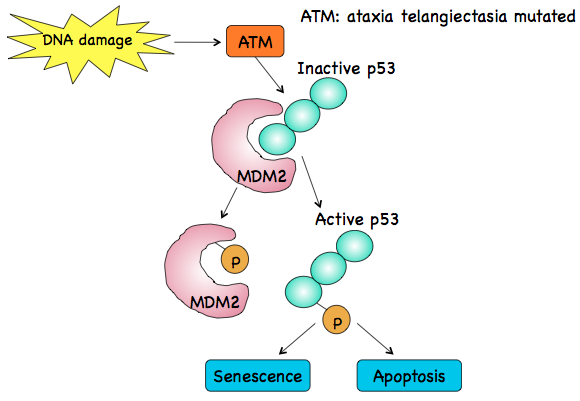
In response to DNA damage, the ATM gene is activated. It phosphorylates both p53 and p53’s sequestering ligase, MDM2. p53, now active, can induce senescence and apoptosis in damaged cells.
Why does the replication fork have stabilization and restart mechanisms?
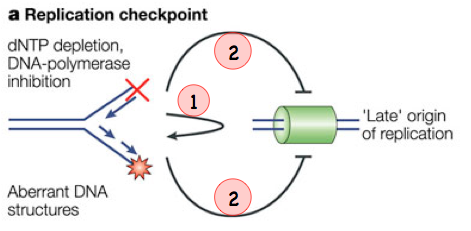
- To protect replication fork integrity, allowing the recovery of replication after DNA repair and/or the restoration of the dNTP pool
- To inhibit the initiation of DNA replication from unfired/late origins
What is ATR?
ATR, or ATM-related protein, is a homolog of ATM involved in the DNA replication checkpoint pathway.
What is the mechanism of interference between replication and transcription?
Since replication and transcription do not occur at the same time, there can be problems with very long genes that require more than one cell cycle to be transcribed. One such problem is chromosome fragility.
Mutations can result in more frequent and more severe negative outcomes.

-
1-10 Bacterial Genetics10
-
1-11 Commensalism vs. Pathogenicity4
-
1-12 Control of Microorganisms: Infection Control, Sterilization, and Disinfection6
-
1-13 Anaerobic Bacteria6
-
1-15 Eukaryotic Transcription I15
-
1-14 Membranes and Microscopy23
-
1-4 DNA Replication16
-
1-16 Eukaryotic Transcription II14
-
1-17 Protein Synthesis1
-
1-20 Mechanisms of Action of Antibiotics14
-
1-21 Cells and Tissues of the Immune Response (Intro to Immunology)19
-
1-24 Mechanisms of Resistance to Antibiotics13
-
1-22 Intracellular Bacteria14
-
1-5 Dynamic Genomes and the Creation of Genetic Diversity11
-
1-6 Mendelian Patterns of Inheritance4
-
1-7 Bacterial Growth and Function7
-
1-8 DNA Repair2
-
1-27 ER and Vesicular Transport14
-
1-28 The Immune Response6
-
1-31 Linkage and Recombination (Clinical Applications)12
-
1-32 Introduction to Cytogenetics18
-
1-33 Numerical and Structural Abnormalities18
-
1-43 Genetic Diagnostic Technologies13
-
1-44 Epigenetics and Imprinting12
-
1-42 Population Genetics7
-
1-34 Antibody-Antigen Interactions (Immunoassays)12
-
CP 1: Tetanus10
-
1-38 Protein Sequence/Structure/Function Relationships17
-
1-19 Spirochetes and Vibrios10
-
1-29 Enteric Bacteria11
-
1-30 Mycobacteria7
-
1-40 Mutations and Proteins10
-
1-45 Protein Misfolding and Disease12
-
1-46 Correcting Protein Defects13
-
1-37 Cytoskeleton I (Microfilaments)13



