Define a stroke
- A neurological deficit attributed to an acute focal injury of the central nervous system by a vascular cause, including cerebral infarction, intracerebral haemorrhage and subarachnoid haemorrhage
- “Serious life-threatening condition in which blood supply to part of brain is cut off. Signs & symptoms persist for more than 24 hours”
Define TIA (transient ischaemic attack)
- A transient episode of neurological dysfunction caused by focal brain, spinal cord or retinal ischaemia without acute infarction
- “Mini stroke- similar features of a stroke but completely resolve within 24 hours”
State the 3 broad categories of stroke and for each include:
- Any subdivisions
- % of strokes that are this category
- Ischaemic (85%)
- Thromboembolic
- Haemorrhagic (10%)
- Intracerebral (rupture of vessel in brain parenchyma)
- Subarachnoid
- Other (5%)
- Dissection (separation of walls of atery which can lead to blood accumulating in the separation and occluding the branches of the artery)
- Venous sinus thrombosis (occludes veins and causes backpressure & reduced blood flow resulting in ischaemia)
- Hypoxic brain injury
The emergency management of strokes is based on two main principles; state these two main principles
*NOTE: more stroke teaching later on in unit
- Are they in the window for thrombolysis? (<4hrs)
- Do a CT head to determine if it is a haemorrhagic or ischaemic stroke (as cannot give thrombolysis if it is a haemorrhagic stroke)
What imaging is preferred in suspected stroke, MRI or CT?
CT
Describe the appearance of an ischaemic stroke on CT
- Ischaemic area of brain not visible early on
- But as the infarct becomes more established ischaemic area will become more hypodense (darker)
Describe the appearance of a haemorrhagic stroke on a CT scan
- Bright white area, maybe with mass effect
Describe the appearance of ischaemia on an MRI
High signal area (bright)
What 2 things does the clinical features of a stroke depend on?
- Anterior or posterioc circulation (specifically if was ACA, MCA or PCA)
- Whether pathology is in the proximal or distal territory
Describe the classical presentation of someone who has had an anterior cerebral artery infarct
*7 points to disucss
- Contralateral weakness in lower limb
- Homunculus and primary motor cortex
- Lower limb affected much worse than face
- Homunculus
- Contralateral sensory changes in same pattern as motor deficits
- Homunculus and primay somatosensory cortex
- Urinary incontinence
- Paracentral lobules are essentially the most medial part of the motor/sensory cortices and supply the perineal area
- Apraxia
- An inability to complete motor planning often caused by damage to left frontal lobe
- Dysarthria/aphasia
- Unusual in ACA (in comparison to MCA infarcts where it is common) may be present if damage to frontal lobe
- Split brain syndrome/alien hand syndrome
- ACA normally supplies corpus callosum hence may get damage to corpus callosum so hemispheres can’t communicate
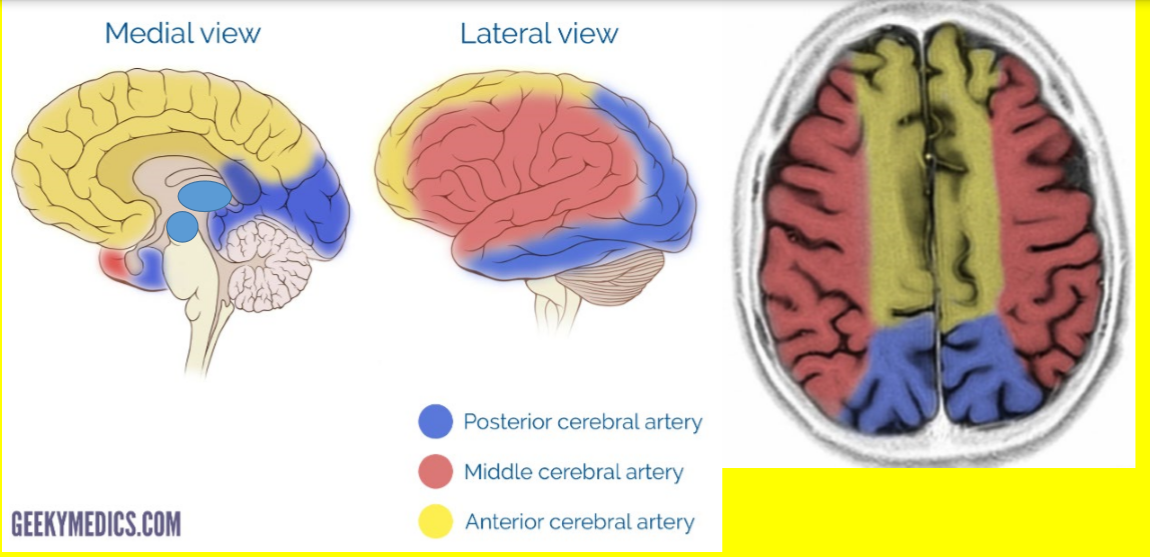
MCA infarcts in the main trunk of the MCA have an 80% mortality associated with them; suggest why the mortality is so high for MCA infarcts
- MCA supplies large area of brain (lateral frontal & parietal lobes, superficial temporal lobes, lentiform nucleus, caudate nucleus, internal capsule)
- If the main trunk of MCA is affected large area of brain will be affected and hence there will be lots of cerebral oedema
Can haemorrhagic transformation occur in a stroke?
Yes, idea that is was initially an ischaemic stroke however the vessels in the infarcted area break down and it becomes a heamorrhagic stroke
The MCA can become occluded, and result in a stroke, in 3 places; state and describe the position of these 3 places
- Proximal (after where it branches/continues off the ICA and before the lenticulostriate arteries)
- Lenticulostriate artery/arteries
- Superior or inferior division
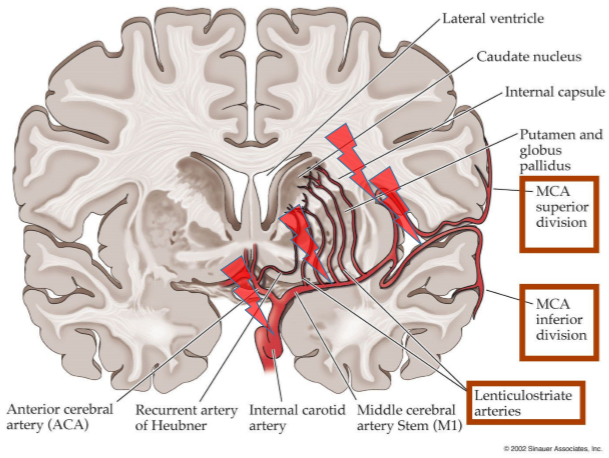
Describe the classical presentation of someone who has had a proximal MCA occlusion/stroke
All branches of MCA willbe affected:
- Contralateral full hemiparesis (in which face, arm and leg are affected)
- Homunculus would make us think only face and arms affected however because MCA supplies internal capsule and the IC carries fibres to face, arm AND leg the leg is affected
- Contralateral sensory loss in face and arm
- Most likely face and arm due to homunculus however if sensory fibres in IC capsule affected may be larger area
- Visual field defects
- Destruction of both superior & inferior optic radiations which would lead to contralateral homonymous hemianopia without macular sparing. NOTE: more distal occlusions may only affect one radiation causing quandrantanopia
- Aphasia
- Global if the dominant hemisphere affected (remember dominant hemisphere is usually left)- can’t understand or express words (Wernicke’s & Broca’s aphasia)
- Contralateral neglect
- Usually occurs if lesion in right parietal lobe. Don’t acknowledge left side of space, or even own body, exists
Describe neglect, include:
- What is is
- Where lesion usually is
- Other features
- Don’t acknowledge left side of space or even own body exists despite visual fields being normal
- Lesion usually in right parietal lobe
- Other features:
- Tactile extinction: if touch either side simultaneously doesn’t feel the affected side
- Visual extinction: if ask to draw clock face will only put numbers on the right side
- Anosognosia: does not acknowledge that they have had a stroke so will confabulate (fabricate imaginary experinces) to explain disability
What is anosognosia?
Lack of understanding, awareness, or acceptance that you have a medical condition
*In relation to stroke, it happens as a feature of neglect; person does not belive they have had a stroke and will confabulate (make up imaginary experiences) to explain their disability
If a lenticulostriate artery/arteries are occluded, what kind of stroke do we call this?
Lacunar stroke
Describe the differnt types of lacunar stroke and describe the typical presentation for each
Lacunar stroke means lenticulostriate artery/arteries are affected. LS arteries supply internal capsule, lentiform nuclues and caudate nucleus. Since there are numerous lenticulostriate arteries you can have different types of lacunar strokes:
- Pure motor
- Face, arm, leg affected equaly due to damage to motor fibres travelling in IC
- Pure sensory
- Face, arm, leg affected equally due to damage to snesory fibres travelling in IC and proabably due occlusion of thalmaoperforator arteries and maybe also lenticulostriate
- Sensorimotor
- Mixed motor & sensory due to infarct somewhere at boundary between motor & sensory fibres
- Other (don’t need to worry about)
Why could an occlusion of thalamoperforator arteries lead to pure sensory stroke?
Thalamus is the ‘hub’ to relay sensory information to the cortex
What feature, of the presentation, allows you to distinguish a lacunar stroke from say a proximal MCA infarct?
Lacunar stroke= NO CORTICAL FEATURES
Proximal MCA= CORTICAL FEATURES
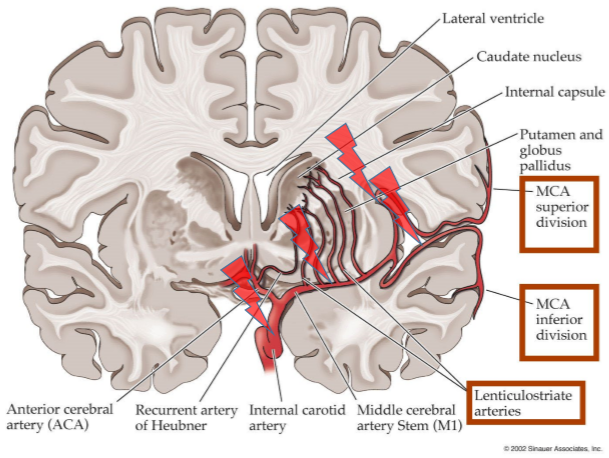
Distally, the MCA splits into superior and inferior division. Describe the classical presentation of someone who has an occlusion in the superior division
Superior division essentially supplies lateral frontal lobe including primary motor cortex & Broca’s area hence occlusion will cause:
- Contralteral face and arm weakness
- Expressive aphasia (if left hemisphere affected)
Distally the MCA splits into superior and inferior divisions. Describe the classical presentation of an occlusion in the inferior divison
Inferior divisoin essentially supplies the lateral parietal lobe and superior temporal lobe hence it supplies primary sensory cortex, Wernicke’s area and both optic radiations. Hence will present with:
- Contralateral sensory changes in face and arm
- Receptive aphasia (if left hemisphere)
Contralateral visual field defect without macular sparing (often contralateral homonymous hemianopia as both radiations damaged)
MCA splits into superior and inferior divisions; state which area each division supplies
- Superior divison: lateral frontal lobe
- Inferior division: lateral parietal and superior temporal
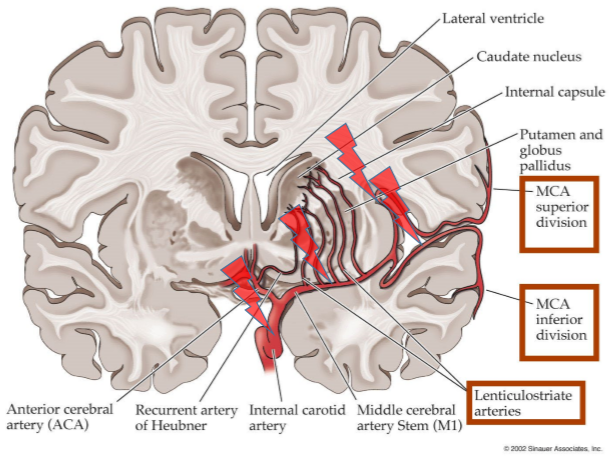
If you occluded branches distal to the superior and inferior divisions of MCA what kind of presentation would you get?
More specific effects e.g. you might just damage Broca’s area hence have expressive dysphasia but with no motor deficit



-
1b.) Development of Nervous System43
-
1a.) Basic Topography89
-
2a.) Neurones & Glia72
-
3a & 3b.) Somatosensory System45
-
4a.) The Retina & Central Vision Pathways29
-
4b.) Arterial Supply to the Brain29
-
5a & 5b.) Motor System35
-
6a.) Movement Disorders & Basal Ganglia52
-
8c.) Neuropathology67
-
8a.) Higher Cortical Function50
-
8b.) Consciousness49
-
9a.) Confusion in the Elderly57
-
8b.) Headaches44
-
10a.) Stroke37
-
10b.) Intracranial Pressure45
-
10c.) Subarachnoid Haemorrhage & Meningitis45
-
11a & 11b.) Anxiety37
-
12a.) Mood Disorders37
-
12b.) Psychosis39
-
Stroke Week: Clinical Management23
-
Stroke Week: MDT25



