What is meant by neuroplasicity?
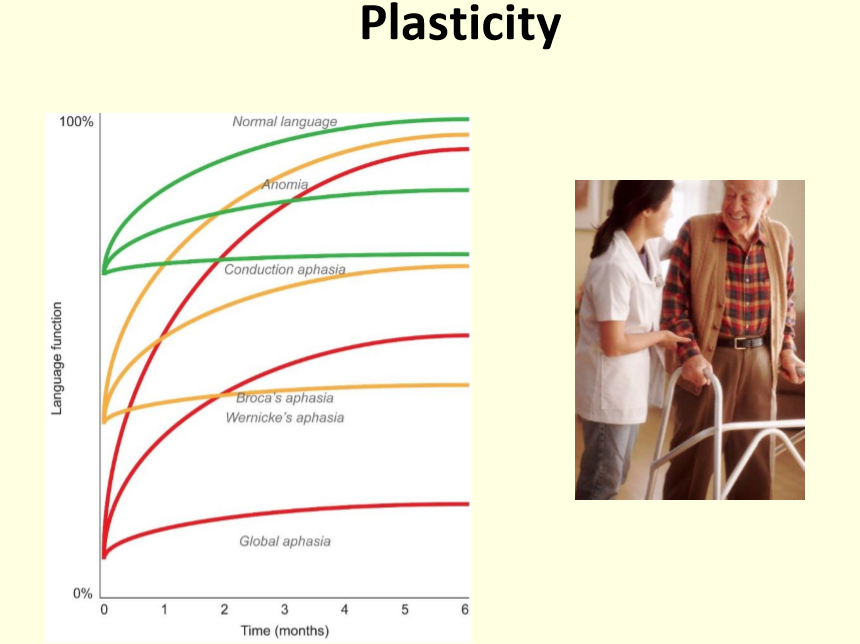
Ability of brain to undergo biological changes; this could be small cellular changes or coritcal re-mapping. Neuoroplasticity allows us to:
- Learn a new skill
- Very important in recovery from stroke
- Changes resulting from socioeconomic condition
- Changes due to psychological stressors
etc….
What is the commonest cause of long term disability?
Stroke
Give an approximation of what % of strokes occur in under 65’s
- 25% occur in under 65’s
- 3% in under 40’s
*1 in 4 of us will have a stroke
Complete the sentence:
Stroke is the ____ leading cause of death in the developed world
3rd
What is the stroke pathway?
Document that details the core components of optimal service for someone who has suffered a stroke
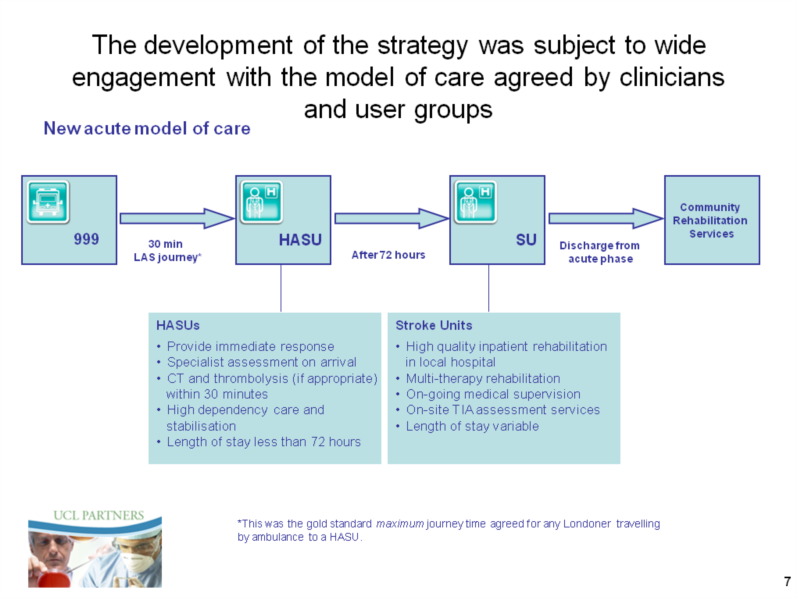
Sumarise the stroke pathway
- Pre-hospital
- Hopefully patient will recognise signs of stroke (FAST) and ring 999
- Priority 1 call for paramedics
- Paramedics quickly assess patient
- Paramedics use’ bat phone’ to alert hospital that they have a pt who may be having acute stroke
- Stroke team is pre-alerted to be ready
- Acute response and treatment on HASU
- Stroke team meet pt in A&E and do the following:
- Brief focused history
- IV acess to get bloods
- ECG
- Baseline observations
- NOTE: some of this may happen on route to CT
- CT scan is interpreted there and then
- Determine immediate treatment (thrombolysis [start giving whilst in CT scanner], bp lowering, thrombolectomy)
- Pt transferred onto stroke unit for up to 72 hours
- Stroke team meet pt in A&E and do the following:
- Life after HASU
- Options: home, discharge at home with intensive therapy at home, rehabilitation, transfer to acute stroke ward
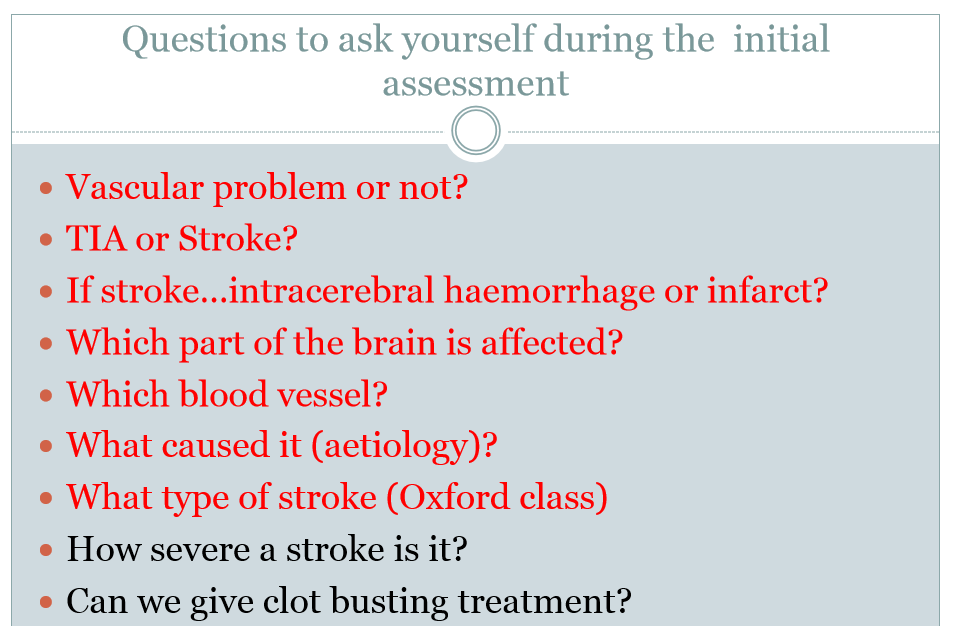
State some questions you need to ask yourself during the initial assessment of a stroke patient
What is the NIHSS?
National Institute of Health Stroke Scale: an assessment tool which gives a quantitative measure of stroke-related neurological deficit. It can be used as a measure of stroke severity.
It assess 11 key components:
- Level of consciousness & communication
- Eye movements
- Visual fields
- Facial palsy
- Upper limb motor
- Lower limb motor
- Limb ataxia
- Sensation
- Langauage/aphasia
- Dysarthria
- Extinction/inattention
Score ranges from 0 to 42
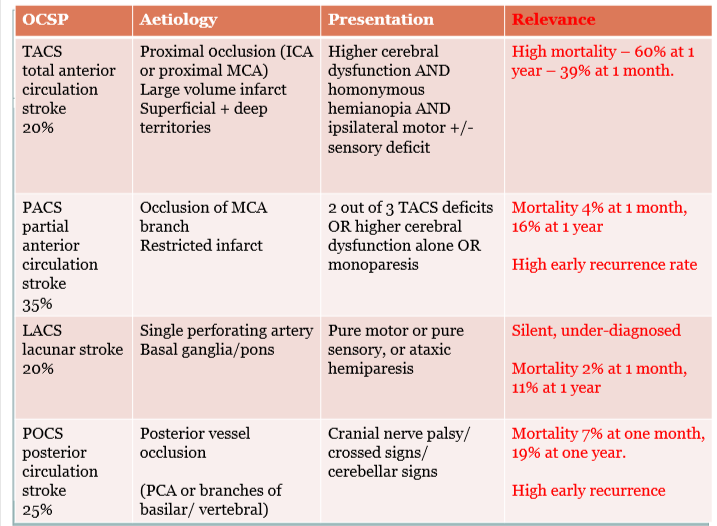
Remind yourself of the Oxford clinical classification of strokes
State the NIHSS scores for:
- No stroke
- Minor stroke
- Moderate stroke
- Moderate to severe stroke
- Severe stroke
- 0= no stroke symptoms
- 1-4= minor stroke
- 5-15= moderate stroke
- 16-20= moderate to severe stroke
- 21-42= severe stroke
Is NIHSS a diagnostic tool?
NIHSS is NOT a diagnostic tool and it is NOT a substitution for a neuro exam
What Oxford classification of strokes does NIHSS underestimate (in terms of severity)?
POCs
How does fresh blood appear on CT scan?
FRESH blood on CT scan appears as bright white (high attenuation)
*If you did a CT scan 12 hours later, on a pt who had been given no treatment, there would be a dark area of infarcted brain (low attenuation)
CT scans of patients suffering an ischaemic stroke are often normal in the acute phase following a stroke; true or false?
True
Following immediate treatment of stroke, what happens on HASU
- Thrombolysis completed (if started in CT scanner)
- Observations every 15 mins
- Junior doctor completes thorough assessment, checks bloods and head scan report
In the next 24hr:
- Nurses complete nutrition & pressure area screening
- Consultant review
- Patient reviewed by physio, occupational therapy, speech & language therapy
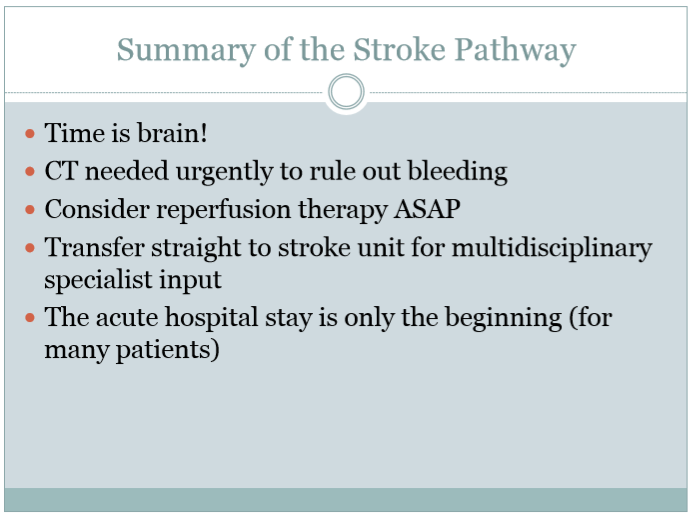
Image is a summary of stroke pathway
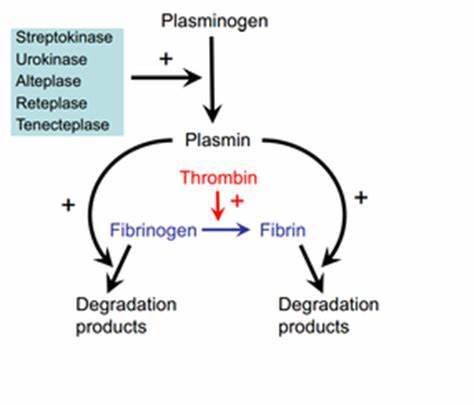
What drug is commonly used for thrombolysis in strokes?
Alteplase
Discuss the criteria which you must consider when considering whether to give intravenous thrombolysis for a stroke
- Clinical diagnosis of acute ISCHAEMIC stroke causing one or more of NIH score =/>4, binocular visual field deficit, swallowing deficit
- Imaging consistent with ischaemic stroke
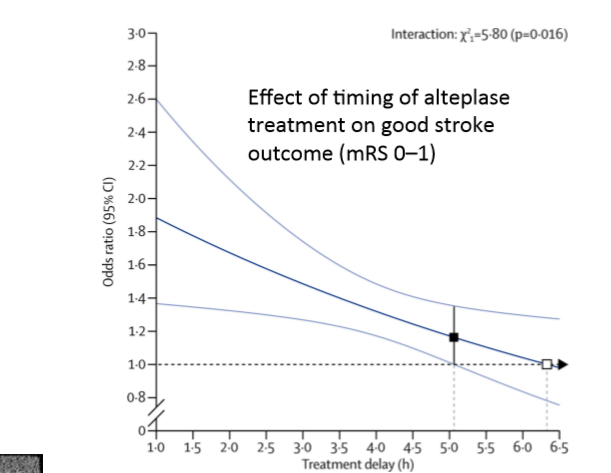
- Symptom onset within 4.5 hours prior to initiation of thrombo
What is the main complication of thrombolysis?
Bleeding (often in area where ischaemia occured)
Only about 20% of patients are eligible for thrombolysis; state some other factors which make a bigger difference to the outcome for a patient
- Prompt admission to stroke unit
- Prompt secondary prevention
- Early MDT
- Maintaining homeostasis (hydration, nutrition, oxygenation, normoglycaemia)
- Preventing complications
If a patient is not eligible for thrombolysis (as we know only about 20% are eligible) we can ofer them early secondary prevention; state some of these treatments
- Aspirin
- Statin
- Control bp (target <130/85)
- Anticoagulate if in atrial fibrillation (DOACs used as first line)
- Carotid surgery (e.g. carotid endarterectomy)
State some ways in which we treat intracerebral haemorrhages
- Reversal of coagulopathy
- BP lowering if hypertensive
- Surgery only if:
- Haemorrhage with hydrocephalus
- Lobar haemorrhage with GCS between 9 and 12
- Cerebellar haemorrhage
In terms of what doesn’t work for ICH:
- Surgery (most of the time)
- Steroids
- Platelets
- Aspirin
- VTE prophylaxis with compression stockings or LMWH
State some potential complications following a stroke
- Pneumonia (Sit up? Safe swallow?)
- Seizures
- Pressure sores
- Dehydration/malnutrition
- Constipation
- Incontinece/retention
- Depression
- Spasticity
- Venous thromboembolism

-
1b.) Development of Nervous System43
-
1a.) Basic Topography89
-
2a.) Neurones & Glia72
-
3a & 3b.) Somatosensory System45
-
4a.) The Retina & Central Vision Pathways29
-
4b.) Arterial Supply to the Brain29
-
5a & 5b.) Motor System35
-
6a.) Movement Disorders & Basal Ganglia52
-
8c.) Neuropathology67
-
8a.) Higher Cortical Function50
-
8b.) Consciousness49
-
9a.) Confusion in the Elderly57
-
8b.) Headaches44
-
10a.) Stroke37
-
10b.) Intracranial Pressure45
-
10c.) Subarachnoid Haemorrhage & Meningitis45
-
11a & 11b.) Anxiety37
-
12a.) Mood Disorders37
-
12b.) Psychosis39
-
Stroke Week: Clinical Management23
-
Stroke Week: MDT25



