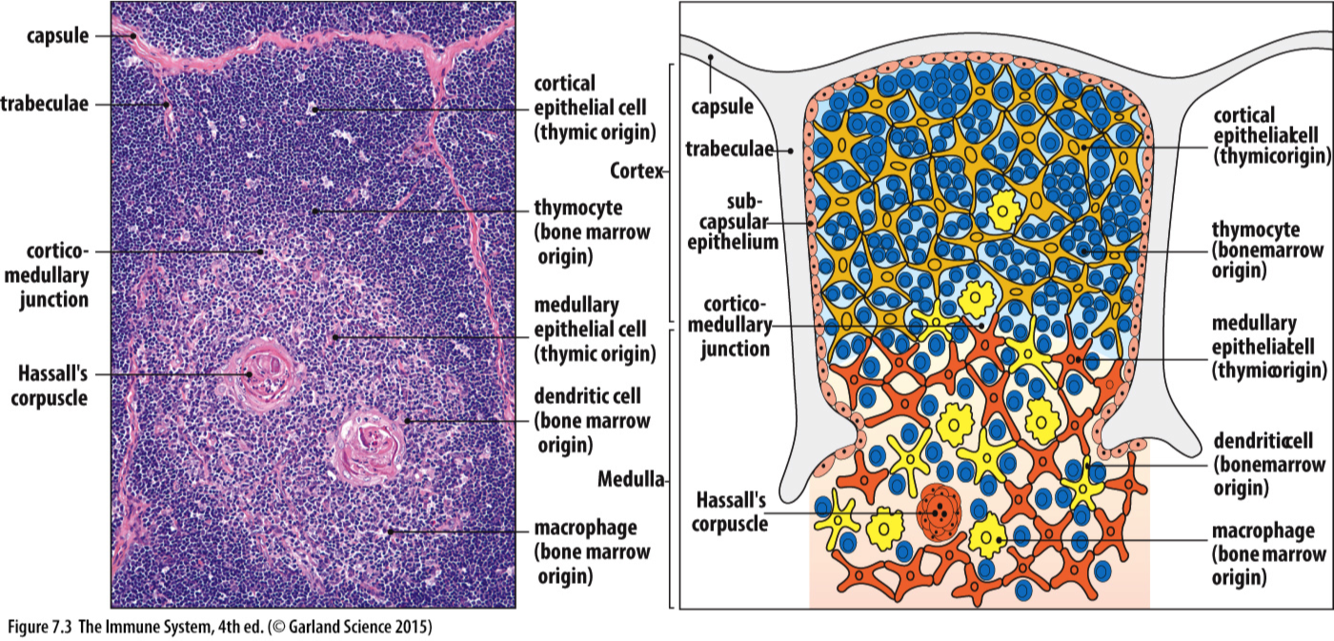
What is the cellular composition of the thymus?
- Organized into cortex and medulla, with a cortico-medullary junction between them
- Cortex: immature thymocytes, branched cortical epithelial cells, macrophages
- Medulla: mature thymocytes, medullary epithelial cells, dendritic cells, macrophages; characteristic Hassall’s corpuscles
- Macrophages in both cortex and medulla remove the many thymocytes that fail to mature properly
How does the thymus change over a person’s lifetime?
Beginning with birth, the T cell-producing tissue of the thymus is gradually replaced by fatty tissue (involution of the thymus), and thymus function declines. Thymectomy does not appear to impair T-cell immunity significantly; once established, the repertoire of mature peripheral T cells seems to be long lived, self-replenishing, or both.
Where are T cells originally from, and where do they end up?
T cell precursors are the products of bone marrow stem cells; they travel to and develop in the thymus.
After maturation, T cells leave the thymus for the secondary lymphoid organs: lymph nodes, spleen, gut-associated lymph tissue (GALT).
What are the major T-cell subsets within the thymus?
T-cell precursor → α:β T cells (majority) + γ:δ T cells (minority)
α:β T cells → CD4 (recognizes peptide antigens presented by MHC class II) + CD8 (recognizes peptide antigens presented by MHC class I)
What are the stages of T-cell development?
- Cell surface markers can be used to identify stages of T-cell development
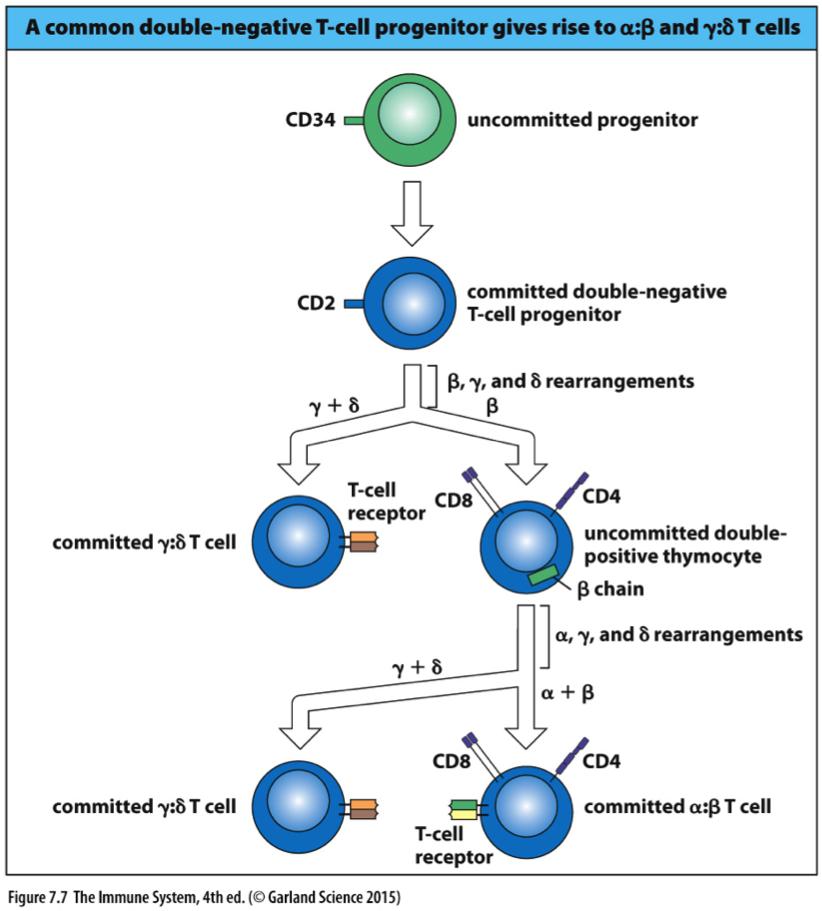
- Uncommitted progenitor cells, which express stem-cell surface marker (CD34) and adhesion (CD44) glycoproteins → double-negative thymocytes committed to the T-cell lineage
- Developing T cells are in close contact with the thymic epithelium, which introduces them to antigens
What is the overall scheme of lineage commitment in T cells?
Essentially, the γ and δ loci compete with the β locus in double-negative committed T-cell precursors in a race to make functional T-cell receptor chains. Even after that particular “race,” rearrangements continue. Cells that fail to make productive T-cell receptor rearrangements apoptose and are phagocytosed by cortical macrophages.
How can T-cell gene rearrangements generate different receptors?
- γ:δ T receptor assembles and γ:δ T cell leaves thymus
- OR β receptor assembles first (favored, because only 1 rearrangement required and 2 attempts allowed per chromosome), followed by . . .
- 1st checkpoint: functional β chain can bind α chain → pre-T cell receptor
- The α-chain locus can sustain several attempts at productive rearrangement, but the linked δ chain gets spliced out irreversibly
- 2nd checkpoint: α chain can bind a β chain and assemble a T-cell receptor → positive selection
The same RAG enzymes are used as in B cells.
What are positive and negative T cell selection?
Positive selection
- In cortical epithelial cells of thymus (both MHC class I and class II molecules)
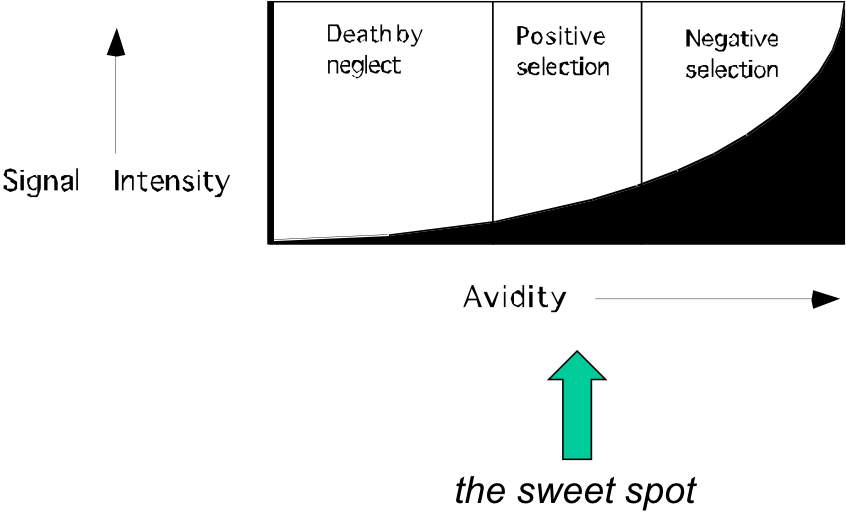
- Double-positive (CD4+CD8) α:β T cells with moderate/strong binding to self-MHC molecules → single-positive CD4 or CD8 α:β T cells
Negative selection
- In dendritic cells, macrophages, and other cells in thymus
- Double-positive α:β T cells with tight binding to self-MHC/-peptides (potentially autoreactive) → apoptosis
- Process by which T cells become self-tolerant
What is the avidity model of T-cell selection?
- Depends on the affinity of the TCR-peptide/MHC interaction + the density of the peptide/MHC on the thymic epithelial cell (i.e., the avidity)
- More avidity → more intense signal

-
2-1 Virus Structure and Classification7
-
2-2 Virus Life Cycle14
-
2-3 Signaling I11
-
2-4 Development of B Cells and Generation of Diversity8
-
2-5 T Cell Development9
-
2-6 Signaling II15
-
2-7 Enzymes as Biological Catalysts12
-
2-8 Enzyme Mechanism and Therapeutic Inhibition of Enzymes8
-
2-9 Cell Division Cycle18
-
2-10 RNA Viruses I5
-
2-11 RNA Viruses II10
-
Geriatrics II and Falls Assessment14
-
Research Ethics3
-
2-12 Enzyme Regulation and Clinical Applications12
-
Clinical Quality and Safety8
-
2-19 Viral Genetics10
-
2-20 Viral Oncogenesis15
-
2-21 and 2-22 Cancer Genetics26
-
2-23 Embryogenesis24
-
2-24 Introduction to the Hepatitis Viruses18
-
2-25 Antiviral Drugs19
-
2-26 Mechanisms of Development11
-
2-27 B-Cell Immunity10
-
2-28 Viral Pathogenesis10
-
Abdominal History and Exam2
-
2-17 T-Cell Receptor and MHC11
-
2-18 T Cell-Mediated Immunity0
-
2-29 Immune Regulation17
-
Clinical Prevention II: Vaccines, Chemoprophylaxis, and Behavioral Counseling6
-
2-30 Gut Immunity10
-
2-31 Fungi I13
-
2-32 Fungi II20
-
2-33 Prenatal Genetics16
-
2-34 Introduction to Parasitic Diseases12
-
2-35 Prions19
-
2-36 Speciality Genetics and Personalized Medicine15



