Definition: Priming
Prime Object
Priming:
“[…] the processing of an initially encountered stimulus influences a response to a subsequently encountered stimulus.
- Priming occurs because the processing of the prime stimulus makes content, and the cognitive operations used to comprehend and
- manipulate this content, more accessible.” Priming ≈ „blazing the trail“, „facilitation”
Types of Priming
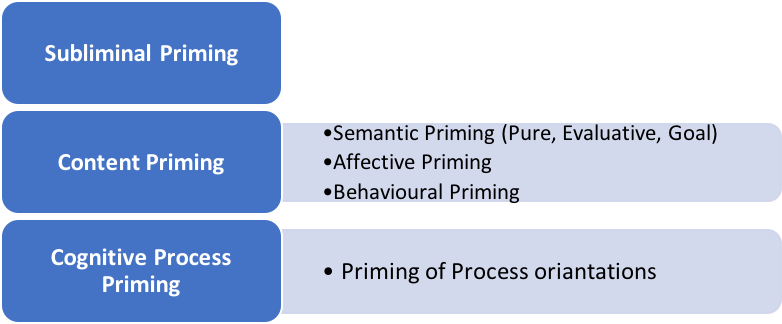
a) Subliminal Priming
Threshold:
- No clear definition of the boundary between subliminal and supraliminal perception.
Method of limits:
- Intensity of a stimulus which is barely perceived and a stimulus that is just no longer perceived are averaged over several passes to determine the threshold
Thresholds: 10-50ms (at central position); under 100ms (at distributed position
b) Content Priming
Semantic Priming:
Definition:
- “…prior exposure to related semantic concepts increases the ease of processing of the target;
for example, prior exposure to a related product, such as mayonnaise, facilitates associations to the target product ketchup.”
(1) Evaluative Priming:
- Priming of positive/negative semantic content activates evaluative concepts
- Influences evaluation of independent contents
Example: sunshine ↔ Love; smiling faces ↔ good
(2) Goal Priming:
b) Content Priming
Affective Priming
An affect is:
“a neurophysiological state that is consciously accessible as a simple, non-reflective feeling that is an integral blend of hedonic (pleasure–displeasure) and arousal (sleepy–activated) values”
- emotion (=object-oriented)
- mood (=not object-oriented, longer duration)
Example: Experimental Design?
- Factor: Music à Pleasant, Unpleasant
- Factor: Awareness à Yes or No
–> 2x2 design

b) Content Priming
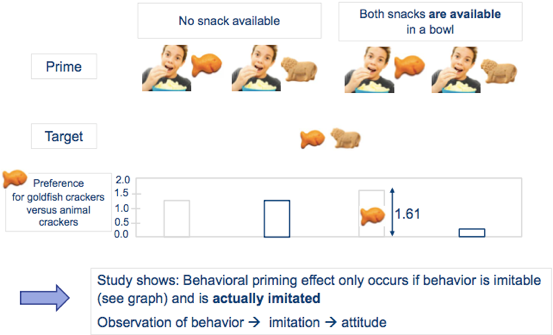
Behavioral Priming
Direct:
Assumption:
- Physical behavior has a meaning, i.e., it transmits semantic, affective and goal-orientated information
Typically occurs in the case of observation and imitation
Only occurs: if the behavior is Indirect
- Easy to do
- Linked to objectives (e.g. need for attachment)
- Situationally appropriate
Indirect:
Semantic, affective or goal primes make a certain behavior more likely
c) Cognitive Process Priming
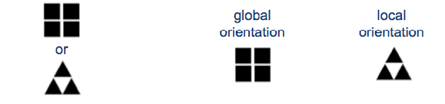
Priming the orientation of cognitive processes:
- the activation of a process makes it more likely that it will be used in subsequent processing tasks
Orientation of cognitive processes:
- information processing: Global vs. local (piecemeal- vs. category-based processing) (see chapter 2.1. and 2.2)
- information recognition: Gestalt vs. component orientation

-
1. Introduction & Basics13
-
1.2 Categories of goods and purchasing process3
-
1.3 Theories of Attitudes Formation5
-
2. Information Processing Models: 2.1 Categorization and Schema Theories7
-
2.2 Dual Process Models4
-
2.3 Fluency6
-
2.4 Cognitive Consistency6
-
2.5 Reactance and Persuasion Knowledge6
-
3. Priming7
-
4. Self-Referencing8
-
5. Narrative & Emotional Advertising6
-
6. Decoys, Phantoms and Compromises6



