Self-Referencing
- Creation of a relationship between product and target group (managerial perspective)
Mental processes: Consumers refer information contained in stimuli to themselves and link them with memory contents. This leads to another meaning of the stimulus (perceptual perspective).
Imagery
Imagery:
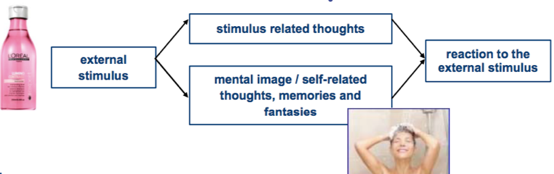
- Mental process in which an external stimulus (e.g. an advertising, a call to action or an exercise) activates autobiographical memory contents or leads the recipient to develop fantasies (imaginations) which influence the reaction to the stimulus
Imagery Processing: Creation of mental Images
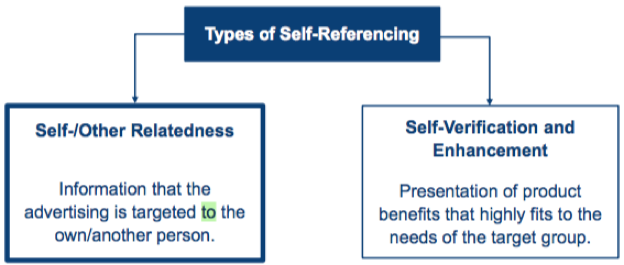
Types of Self-Referencing
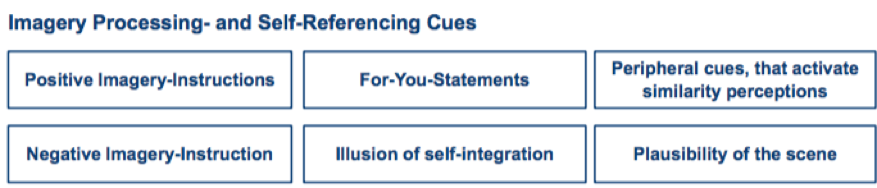
Self-Referencing Cues
Consequences of Self-Referencing
- Spontaneous perception that oneself is targeted (self-targetedness)
- High amount of cognitive resource is allocated to process the stimulus (you are more attentive and interested)
- Information is processed more intensely (e.g. brand name, arguments, quality signals)
- Recipients can develop self-related thoughts
Theoretical Explanations (Self-Referencing):
Three Perspectives
Imagery-based approach:
Particularly relevant when self-referencing is triggered by the following cues:
„Illusion of self-integration “: „Imagery-Instructions”: „Plausibility of the scene “
(1) Theory of Grounded Cognitions (Barsalou 2008)
- The kind of stimulus presentation eases the mental simulation.
- Illusion of self-integration can trigger the imagination of how the possession/usage (of a product) „looks like“.
(2) Imagery Processing (Unnava/Burnkrant 1991)
- More sensory information is retrieved from memory (haptic impressions, e.g. how a steering wheel feels…). This increases the probability that someone can imagine the possession/usage of the product.
(3) Availability-Valence-Hypothesis
- Mental image and its valence (positive vs. negative) is important for the impact of persuasion; the valence with the highest cognitive availability is the most important one when a decision is made.
(4) Emotional Contagion
- “The tendency to automatically mimic and synchronize movements, expressions, postures, and vocalizations with those of another person and, consequently, to converge emotionally”
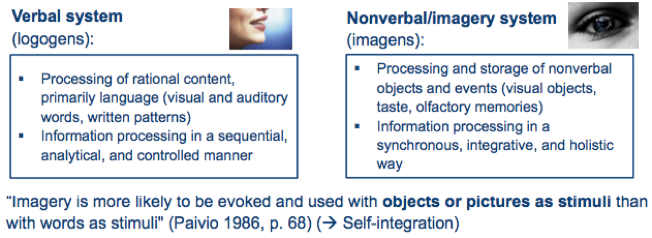
(5) Dual-Coding-Theory (Paivio, 1986, 1991, 2007)
- Verbal and nonverbal information cues are processed, encoded, stored and retrieved for
- subsequent use in two distinct but referentially interconnected memory systems
Theoretical Explanations (Self-Referencing):
Three Perspectives
Self-worth-based approach:
Particularly relevant when self-referencing is triggered by the following cue:
“Peripheral stimuli, that activate similarity perceptions”
(1) Balance-Theory (Heider 1958) and Festinger (1957)
- Individuals like consistent evaluations of simultaneously presented or related stimuli
- Consistent structures → pleasant → are maintained
- Inconsistent stimuli → cognitive dissonances → are reduced through adaption of particular evaluations
Example:
The picture combined with the slogan makes it likely that a recipient feels that the mobile is for him/her. As a person judges her-/himself positively, consequently, the relation between the recipient and the mobile will become more positive, and e.g., switch from neutral to positive.

Theoretical Explanations (Self-Referencing):
Three Perspectives
Perception of ownership:
Particularly relevant when self-referencing is triggered by the following cue:
„Illusion of self-integration“
(1) Loss-aversion: Prospect-Theory (Kahneman/Tversky 1979)
- Losses (view of owner: not being able to use the product) are regretted stronger than gains (view of non-owner: being able to use the product) are evaluated positively.
(2) Endowment-Effect (Thaler 1980)
- Imagine oneself as an owner leads to a strong feeling of not wanting to give the object away whereas a non-owner must decide whether he wants the product at all
Example:
The ad makes you feel like you own the Porsche. Most people never owned or drove a Porsche and might find that unlikely to ever happen. But if you once felt as the owner of a Porsche, it is likely that you don’t want to lose it. You feel that the Porsche is yours and connect with it emotionally.


-
1. Introduction & Basics13
-
1.2 Categories of goods and purchasing process3
-
1.3 Theories of Attitudes Formation5
-
2. Information Processing Models: 2.1 Categorization and Schema Theories7
-
2.2 Dual Process Models4
-
2.3 Fluency6
-
2.4 Cognitive Consistency6
-
2.5 Reactance and Persuasion Knowledge6
-
3. Priming7
-
4. Self-Referencing8
-
5. Narrative & Emotional Advertising6
-
6. Decoys, Phantoms and Compromises6



