What are the four drivers of idiosyncratic risk?
- Brand reputation risk
- value derives from negative information signals regarding the brand
- Brand dilution risk
- Loss of unique brand meanings (because of competition)
- Brand cannibalization risk
- Loss of sales because of other products offered by the firm
- Brand stretch risk
- Lack of flexibility to take advantage of new market opportunities (changing consumer tastes)
Disadvantages of brand extension
- Retailers may be reluctant to accept another product that carries your brand. >> Want to avoid shelve dominance, e.g. kicking out competitors.
- Can succeed but cannibalize sales of parent brand
- Can succeed but diminish identification with any one category
- Can succeed but hurt the image of parent brand
- Example: There is a possibility that Sunkist Fruit Rolls (a candy) hurt the Sunkist health image
Tauber studied 276 brand extensions and concluded that most fit into seven approaches
Which 7? (examples)
- Same product in a different form
- Cranberry Juice Cocktail, Dole frozen fruit bars or Dettol regular soap.
- Distinctive taste, ingredient, or component
- Philadelphia cream cheese salad dressing or Amul Cheese and Chocolates (milk related)
- Companion product
- Miele vacuum cleaners and dust bags, Colgate toothbrushes
- Customer franchise
- Visa traveler’s checks, Gerber baby clothes
- Expertise
- Honda lawn mowers (experience in small motors)
- Benefit, attribute, feature
- Rexona deodorants (based on freshness of Rexona soaps).
- Designer or ethnic image
- Pierre Cardin wallets, Benihana frozen entrees.
What is systematic risk?
Systematic risk stems from economy - wide factors (e.g., macro economic risk, industry risk) that affect the overall stock market and all firms in it.
Why will these kind of extensions not work?
Apple with Hotels
Campbell’s tomato sauce
Bic perfume
Levi’s tailored classics suits
Domino’s fruit-flavored bubble gum
- Apple with Hotels
- Wouldn’t probably work. Because apple is a high tech, design brand and hotels are services.
- Campbell’s tomato sauce
- Campbel in a wellknown soup brand in America. To extend to tomato sauce. Soup is really watery, not an element you want to have in spaghetti sauce (should be thick and creamy). So different associations
- Bic perfume
- Bic is cheap, perfume is not
- Levi’s tailored classics suits
- Levi is known as a working class brand. So combining that with suits. Who would want a working class suite?
- Domino’s fruit-flavored bubble gum
- Pizza flavored bubble gum could have worked better
What are the 5 hypotheses of
BRAND ARCHITECTURE STRATEGY AND FIRM VALUE: HOW LEVERAGING, SEPARATING, AND DISTANCING THE CORPORATE BRAND AFFECTS RISK AND RETURNS (HSU ET AL., 2016)
- Sub-branding is associated with higher abnormal returns than branded-house strategy
- Suggests that investors appreciate demand-side benefits of subbrandings ability to target niche markets, while maintaining supply side scale and scope.
- Sub-branding is associated with higher idiosyncratic risk than branded-house strategy
- Challenges the implicit assumption that there is a linear ordering of risks from highest to lowest along the BH →→ HOB
- Endorsed branding is associated with lower idiosyncratic risk than sub-branding strategy
- Endorsed branding provides risk control benefits that are similar to the independent HOB.
- Hybrid branding is associated with higher abnormal returns than house-of-brands strategy (not supported)
- Hybrid branding is associated with lower idiosyncratic risk than branded-house strategy
- It states that the BH - HOB hybrid does significantly improve the firm’s idiosyncratic risk profile versus the pure BH.
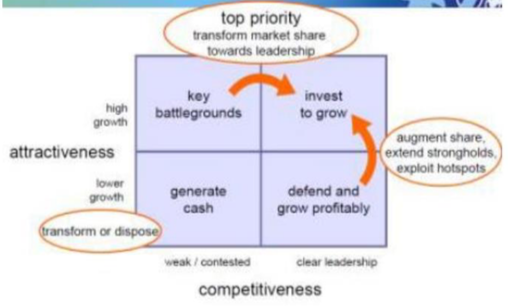
What model can you use to determinde on which brands you should invest and on which you should divest?
Y: Market attractiveness (stage of product life cycle)
X: Level of competitveness (are you taking position 1, 2, 3?)
- Suppose you’re a clear leader in a not so attractive segment, then only try to defend and hold the position or make it even better (right low corner).
- If the market is extremely attractive, but you are not the leader, then try to get the leader profile (= left upper corner).
- In the left low corner don’t invest and just squeeze the product to money.
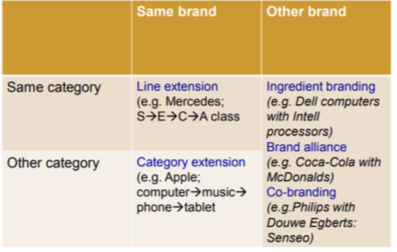
Make a grid of extension types (examples)
X: Same brand, Other brand
Y:
- Same category,
- Other category
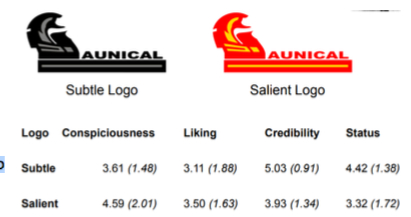
Subtle Logo versus Salient logo
- The subtile logo is perceived as more credible, higher status, but a lower liking.
- Liking is higher for the salient logo, but respondents perceive it as less credible.
Six design principles of brand hierarchy
- Principle of simplicity : Employ as few levels as possible >> The more levels, the more specific.
- One level (economic benefits): Philips
- More levels (better understanding of product): Nike (running, basketball, football, golf)
- Principle of clarity : Logic relationship of brand elements must be obvious.
- Types of ‘Knorr Wereldgerechten’ / Becel light, gold, pro-active
- Clear because of package, colors, logo etc.
- (!) Principle of relevance : Associations are relevant to as many brands as listed >> more abstract associations are better (strong product oriented associations may limit extensions)
- For Cup-a-Soup (standalone brand) is hard to stretch te brand
- Nike & Philips more easy to stretch their brands
- Principle of differentiation : Differentiate items within a brand as much as possible, but keep relatedness in mind
- Unilever’s Blueband(care taking), Bona(taste), Becel(health), Bertolli(authentic), Lätta(contemporary), Zeeuws meisje (value for money)
- Principle of prominence : Which brands elements become primary one(s) and which secondary one(s)?
- ‘Xperia Sony smartphone’ versus ‘Sony Experia’
- Principle of commonality : The more common elements are shared, the stronger the linkages between the products.
- McDonalds: Mc Nuggets, McChicken, McKroket
- HP: OfficeJet, InktJet, DeskJet
4 levels of a brand hierarchy
- Corporate brand : Unilever
- Family brand: Becel
- Individual brand: Pro-active
- Individual item or model : Oil (versus Margarine)
explain:
A brand that is seen as prototypical of a product category can be difficult to extend outside a category.
Campbel in a prototypical soup brand in America.
To extend to tomato sauce. Soup is really watery, not an element you want to have in spaghetti sauce (should be thick and creamy). So different associations
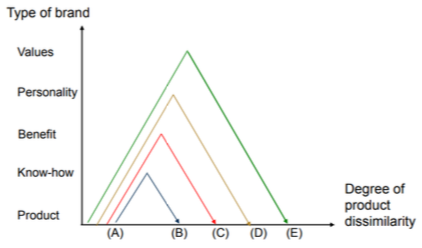
What types of brands are better able to extend?
Give an example of when cannibalization might occur.
Line extensions can drive consumers to migrate from the firm’s premium products to its cheaper products if the firm performs a downward line extension.
If this form of cannibalization occurs, the overall profitability of the firm decreases despite the increase in demand and market share.
A product extension strategy that may prevent consumers from migrating to cheaper products is the addition of a premium version of a product – an upward line extension.
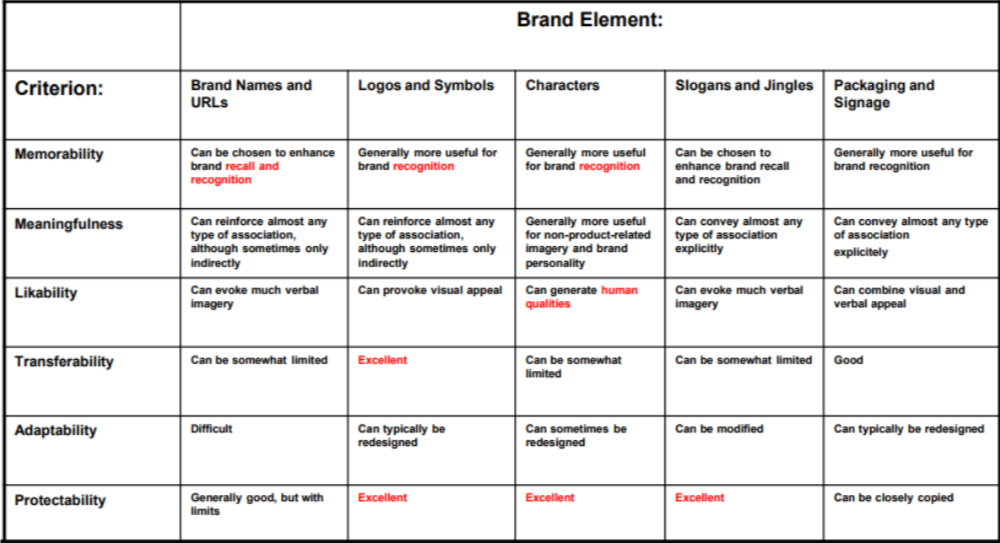
How do..
- Brand names and URLs
- Logo’s and Symbols
- Characters
- Slogans and Jingles
- Packaging and Signage
…perform on the 6 brand element selection criteria?
HARMFUL UPWARD LINE EXTENSIONS:: CAN THE LAUNCH OF PREMIUM PRODUCTS RES U LT IN COMPETITIVE DI SADVANTAGES?? (CCA LDIERARO ET AL..,, 20 15))
Mangerial implications (2):
Managers of leading brands who face competitive threats must consider carefully whether they should tackle competitors by launching premium sub - brands featuring product attributes that are similar to those of the competitor aimed at neutralizing potential gains of the competing product.
If extending firm believes that launching the premium sub - brand with attributes overlapping with those of a competing product is likely to cause negative spillovers on the parent brand or positive spillovers on the competing brands, then the firm is better off by foregoing the launch of a premium product, as changes in consumer perceptions due to spillovers can be very damaging to the firm’s overall competitive position in terms of market share and profits.
6 criteria for selecting brand elements
- Memorable: Necessary for brand awareness (recall / recognition)
- Meaningful: Enhances the formation of brand associations
- Descriptive
- Persuasive
- Appealing: Imagery, fun interesting, Peripheral cues
- Adaptable: Consumer’s values change, brand must be updatable
- Protectable: Trademarks prevent imitation
- Transferrable:
- Is brand usefull for extensions? (less specific = better transferrable)
- Are brand elements valueble across cultures?
3 types of brand alliances
- Ingrediënt co-branding.
- Involves creating brand equity for materials, components or parts that are contained within other products.
- Same-company co-branding.
- When a company with more than one product promotes their own brands together simultaneously.
- Joint venture co-branding.
- Two or more companies going for a strategic alliance to present a product to the target audience
Give an example of a successful brand extension if favorable associations/fit with parent brand.
Fisher Price, extended the brand to maxicosi. It does not harm, there is a perfect fit since it is for the same target group
Definition of a Brand Extension
Brand extension is using the leverage of a well-known brand name in one category to launch a new product (in a different category)
Kapferer, 2012 : Brand extension has become a common practice. What was reserved for luxury goods is becoming a general managerial procedure … such development is the direct consequence of the recognition that brands are the real capital of a company and a source of competitive advantage.
What do we mean with ‘abnormal returns’?
Describes the returns generated by a given security or portfolio over a period of time that is different from the expected rate of return.
The expected rate of return is the estimated return based on an asset pricing model, using a long-run historical average.
5 Reasons to narrowing the product portfolio
- Customer have an ever-increasing number of options for purchasing products. >> need to put more focus into managing each brand in the portfolio.
- Consumers are exposed to more and more brands (globally)
- Force to invset in new technologies to improve product quality
- (Global >>) There is a strong need to innovate but you can only give a certain amount of money.
- Invest in brands with scale/synergies (avoid orphan brands)
- Orphan brands: Brands no one took care of. And people forget brands really easily.
- Flat performance
- Stock holders on P&G are not happy.
- … New CEO
- The new CEO wanted to give P&G a boost.
HARMFUL UPWARD LINE EXTENSIONS:: CAN THE LAUNCH OF PREMIUM PRODUCTS RESULT IN COMPETITIVE DISADVANTAGES?(CALDIERARO ET AL., 20 15))
Launching a premium sub-brand with attriubutes similar as competing brand.
What are the outcomes of the research’s post-launch scenario?
- The smaller the magnitude of the parent-brand spillover effect
- The higher the magnitude of the cross-brand spillover effect
=
- The less attractive it is to launch a premium sub-brand.
5 types of extensions with example
- Line extension: Parent brand is used to brand new product in new market segment within the same product category
- Coke extends itself to Diet Coke in the same product category of soft drinks
- Category extension: Parent brand is used to enter a different product category
- Hugo Boss clothing extends to Hugo Boss cosmetics
- Ingredient branding: Same category but leveraging on the good image.
- ‘Intel Inside’ for processors in computers
- Brand Alliance: In between ingredient branding and co-branding
- All McDonalds have CocaCola / Bar that serves Heineken
- Co-Branding: Two brands join and create new brand.
- Philips & DE; Senseo






