What is Statical Stability?
Statical Stability (as opposed to Dynamical Stability) is the ability of a vessel to return to her initial position after being forcibly inclined.
It is the measure of the righting moment at a given angle of heel.
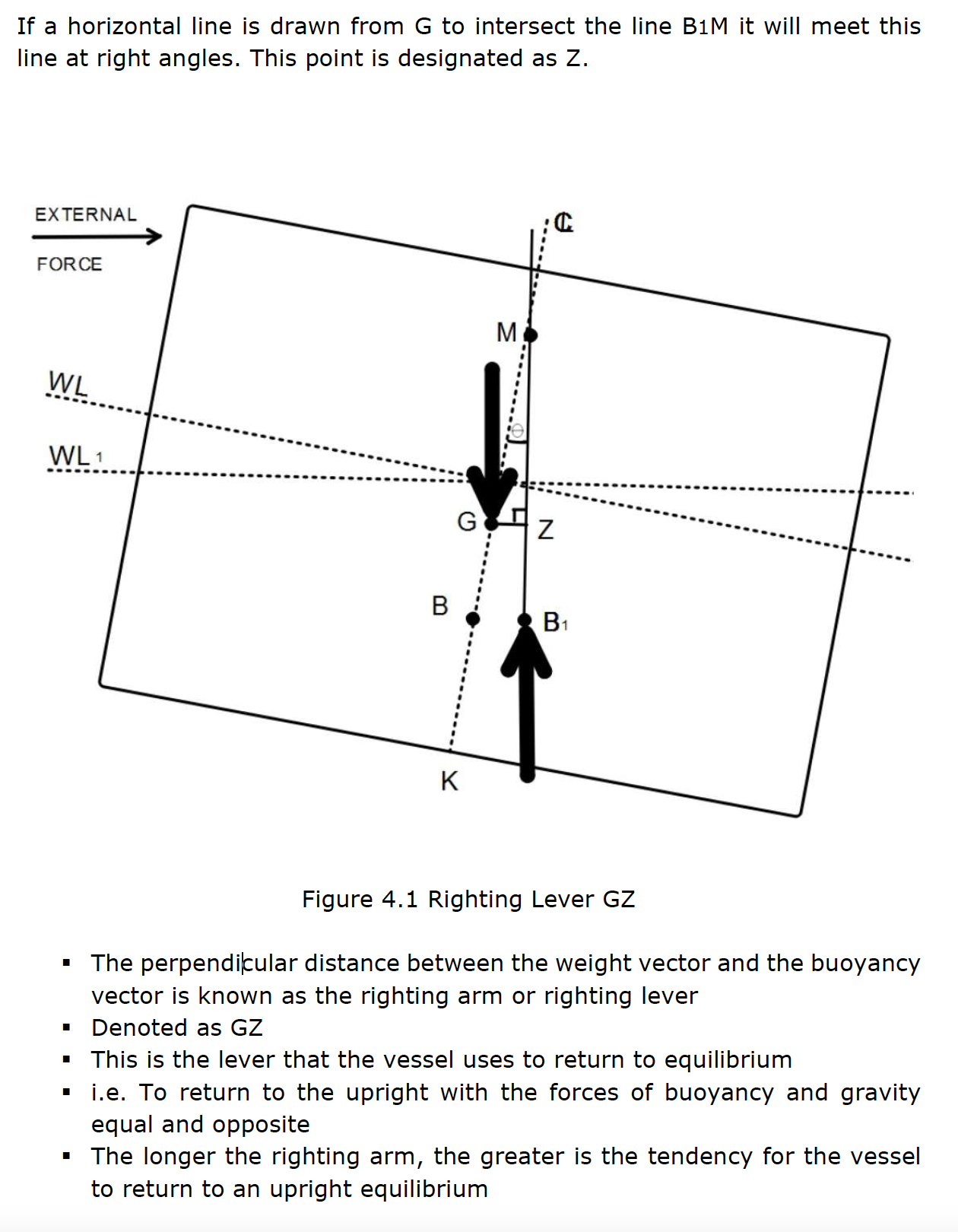
Draw a vessel with a small angle of inclination showing all forces acting upon the vessel.
See image.
Changing from Stiff to Tender Vessel, Give Reasons for G to Rise.
- Loading a weight high in the ship, above initial CoG
- Discharging a weight from low in the ship, below initial CoG
- Moving a weight already on board upwards
- Lifting a weight with yacht crane (suspended weight)
- Ice accretion on superstructure
- Water from heavy seas landing on deck
- Vessel keel taking to the blocks in dry dock
- Grounding
- Helicopter landing on deck, above initial CoG
- All guests and many crew gathering on upper decks (arrival, departure, sighting of interesting sea life)
- Retrofitting (equipment, furniture, pools etc.) above initial CoG
- Blocked scuppers and freeing ports on upper decks
- Hatches left open leading to flooding and FSE (virtual rise of G)
- Free Surface Moments due to flooding or slack tanks (virtual rise of G)
- Saturation of timber deck cargo
Tender Vs Stiff
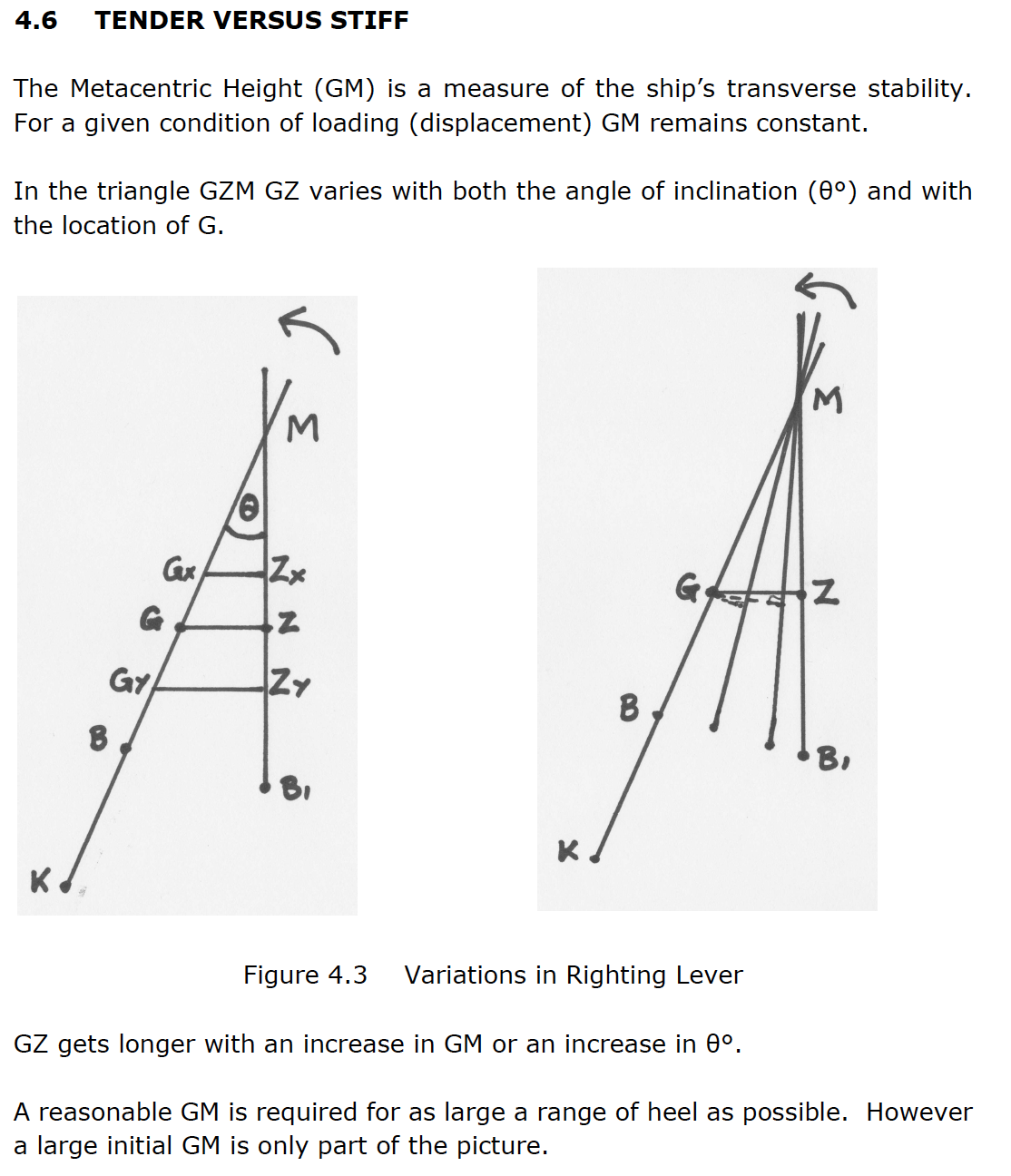
Tender, Standard and Stiff Vessel comparisons.
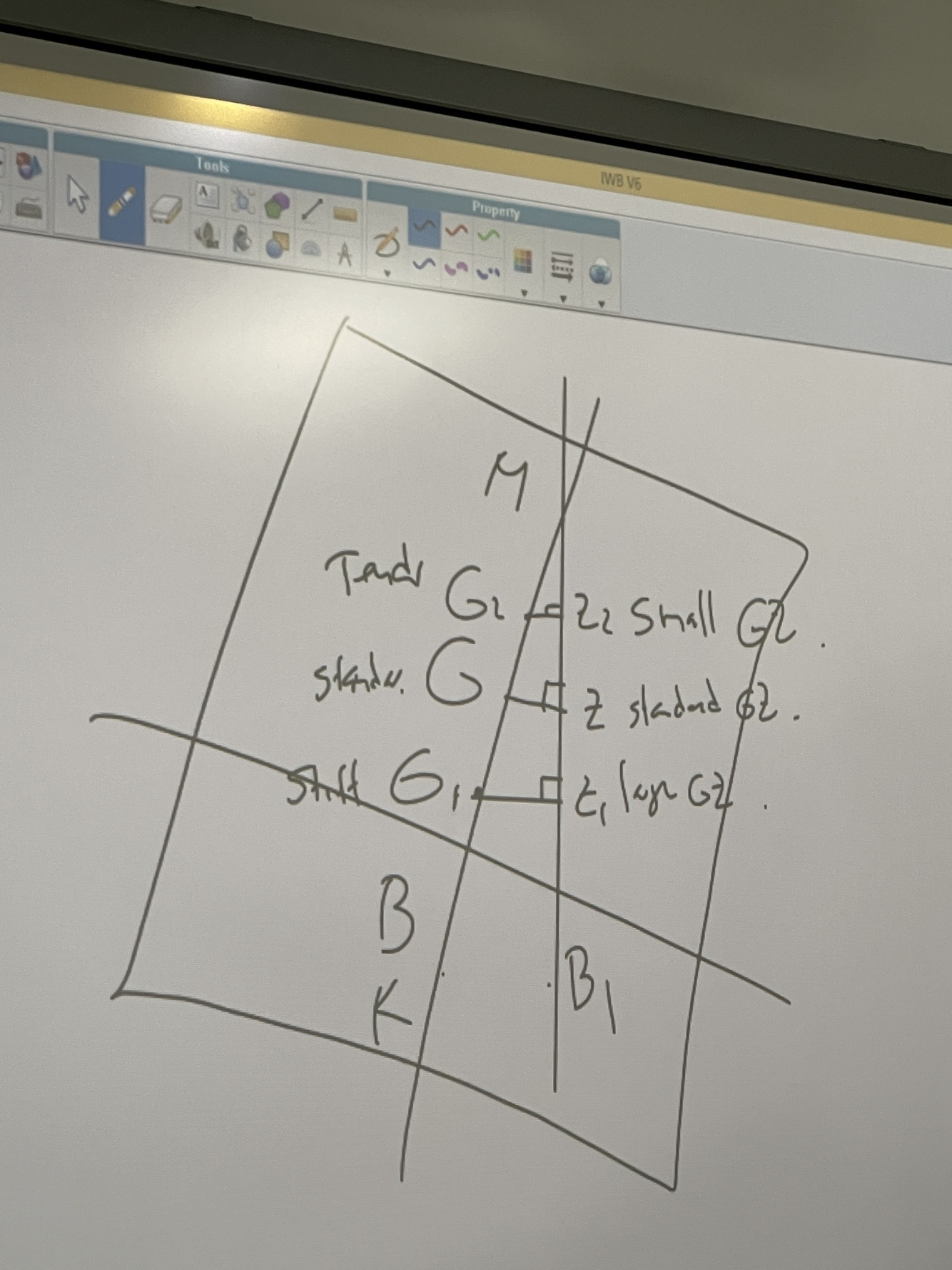
Stiff Vessel Advantages and Disadvantages
Adv:
- Returns to upright quicker
- More safety in case of flooding, damage or cargo shift
- Less tendency for breaking seas on deck
- less tendency to synchroniouw rolling.
Diadv
- Fast, large, violent rolling
- Racking stresses
- Discomfort for crew and passengers
- Cargo shift possible and cause damage
Tender Advantages and disad’s
Adv:
- Slow and more comfortable roll
- Less racking
- Less chance of cargo shift
Disadv:
- Less safety in case of flooding
- more tendency for seas to break on deck
- More dangerous if synchronius rolling occurs.
Explain Stable, Neutral and Unstable Equilibrium.
The GM of a vessel is a measure of its transverse stability and the position of G in relation to M, whether below, on or above it, dictates whether the vessel has positive, neutral or negative stability.
“Equilibrium” means that a body is at rest because any forces acting upon it are equal and opposite.
A vessel has heeled over due to an external force.
What happens once that external force has been removed is dependent on the GM and resulting GZ.
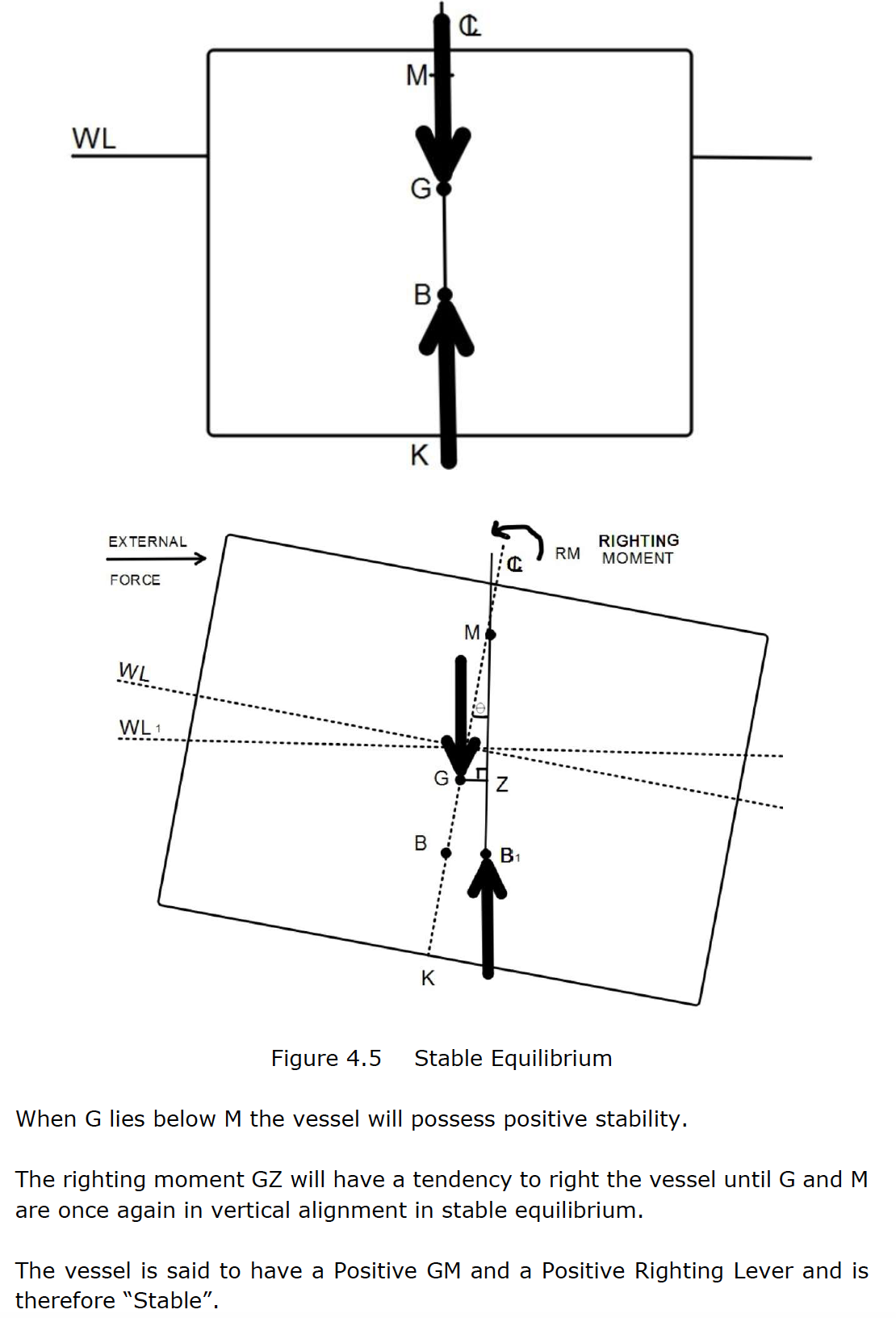
In mechanics we say that if, when the vessel is disturbed from her initial position by external forces, she tends to return to that position then she is in STABLE EQUILIBRIUM.
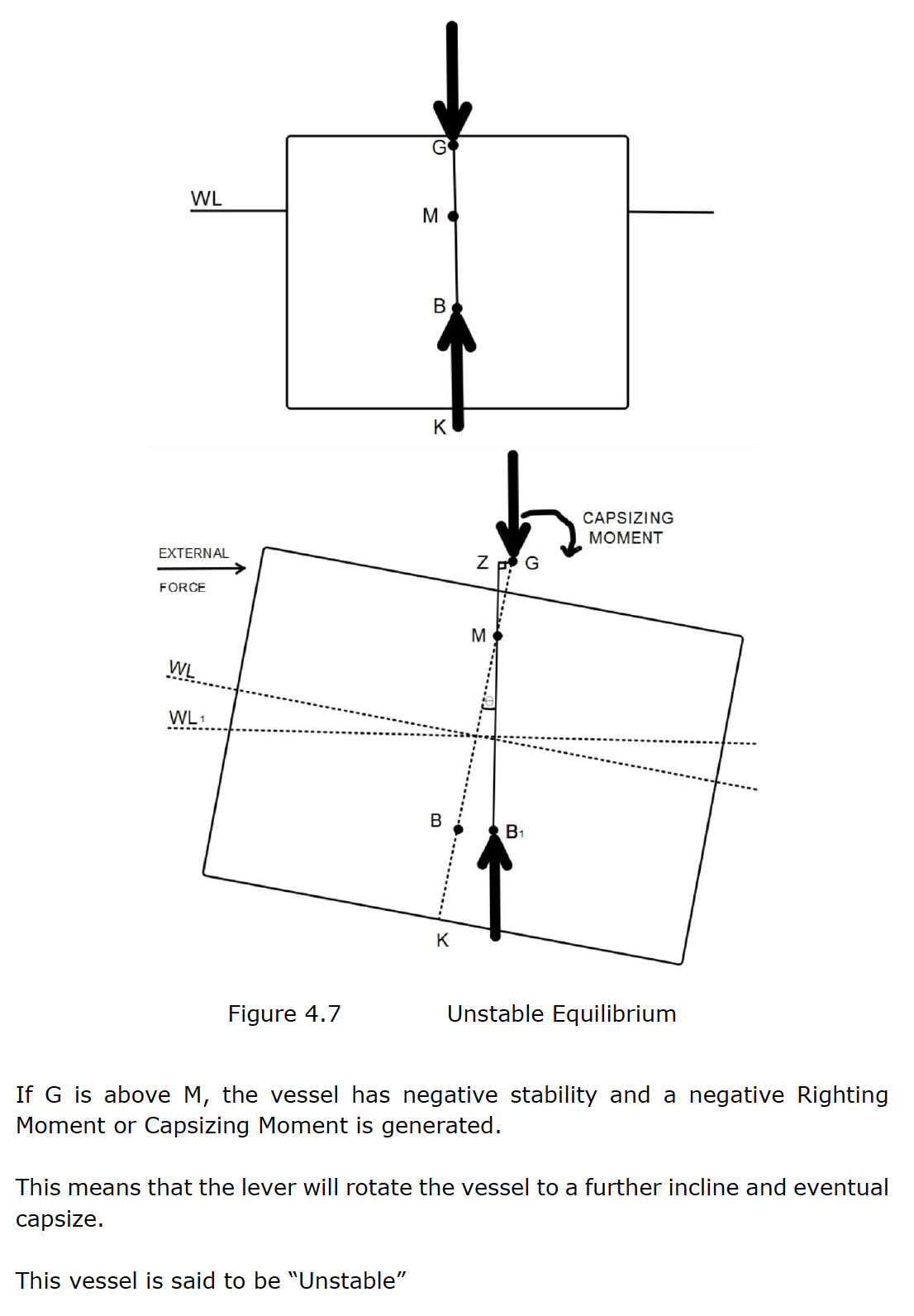
If this disturbance produces a tendency to move further away from the initial position on removal of the disturbing forces then the vessel is said to be UNSTABLE EQUILIBRIUM
Illustrate Stable Equilibrium
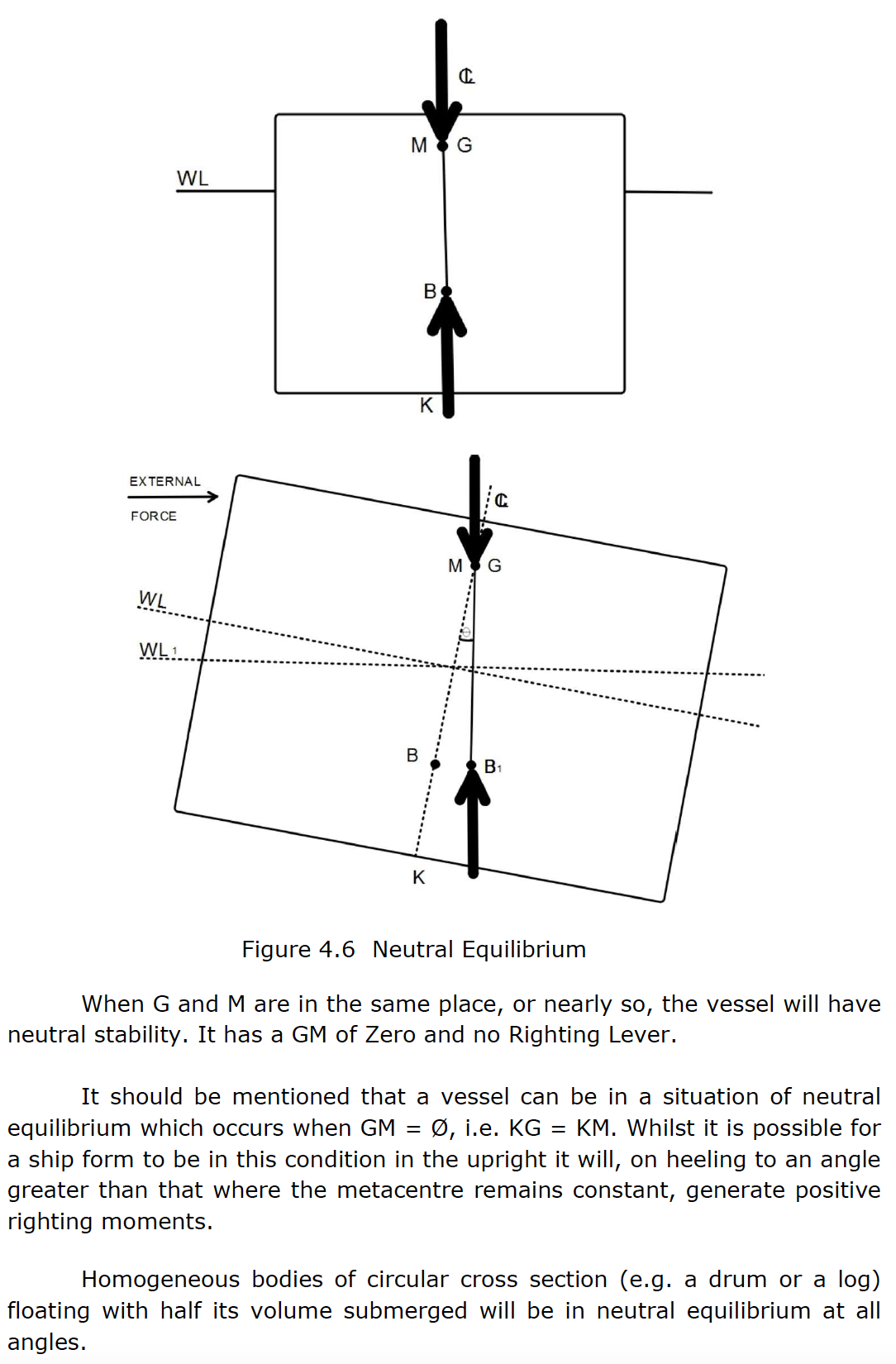
Illustrate Neutral Equilibrium
G and M are equal.
Illustrate Unstable Equilibrium
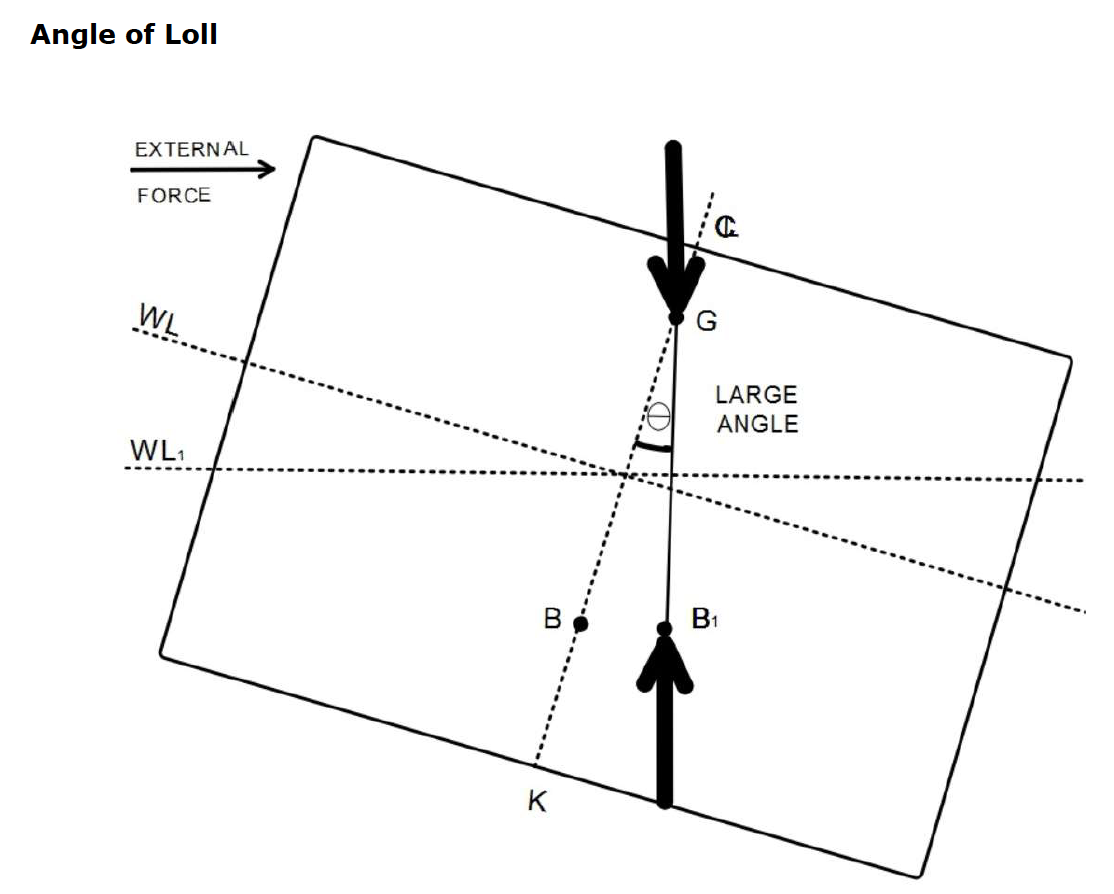
Explain and Illustrate Angle of Loll
How does it come about?
Only boxed shaped vessels.
- It starts initially in an upright vessel with G very slightly above M, producing a small negative righting lever and creating unstable Equilibrium
- If an external force is applied, the vessel will heel over and this small capsizing lever will start to incline the vessel still further to one side.
- At some degree of heel, the vessel will leave the realms of initial statical stability and B will no longer be acting through the initial metacentre and M disappears.
- The vessel will incline until B moves under G creating equilibrium and this angle of inclination is known as the Angle of Loll.
- With any further heeling beyond this point, B will move out further away from the centre line and more importantly, further away from G creating a small righting lever that will only return the vessel to the Angle of Loll
- The ship will roll about at this angle of loll.\
- If the initial negative GM is too great there is a risk that B will never reach the point where it is under the G and the vessel will capsize, hence this is dangerous and must be corrected immediately.
Loll versus List
List:
- G moves off the centreline, but remains under M
- Is a Safe condition and still considered stable.
- B is under G acting upwards through M
- Will not flop to the other side, but roll about its inclination.
- Larger GM means a larger righting leaver.
Loll
- G moves slightly above M, creating a small negative righting lever.
- M eventually disappears
- Positive satbility is must be developed almost immediately
- Can flop to the otherside at the same inclination and create possible capsizing moment if the wrong corrective measure is taken.
- is very Dangerous
- Reactive to sudden movements and shifts in weight.
- happens in Box shaped vessels only.
- Reducing KG will help the situation, to restore positive GM.
How Can you correct Angle of Loll?
- Immediately lower G and create stable vessel (do not try to correct inclination, very dangerous as ship could flop to opposite side)
- Add weight below G on low side of vessel(ballast double bottom tanks)
- Remove weight above G from the high side.
- or move weight from above G on the high side to below G on the Low side.
- Once Stable Equlibrium achieved, then correct list.
To achieve a reduction in KG under a controlled manner the following can be considered:
- Check the state of the tanks and reduce free surface to the narrower width tanks.
- Lower weights in the vessel; remove weights from above G taking care to remove those from the high side first;
- Add weights below G and add to the low side first.
- Ballasting
The reaction to the foregoing will create a greater angle and might
appear to be contradictory but this will not induce any sudden motion and the situation will be kept under control.
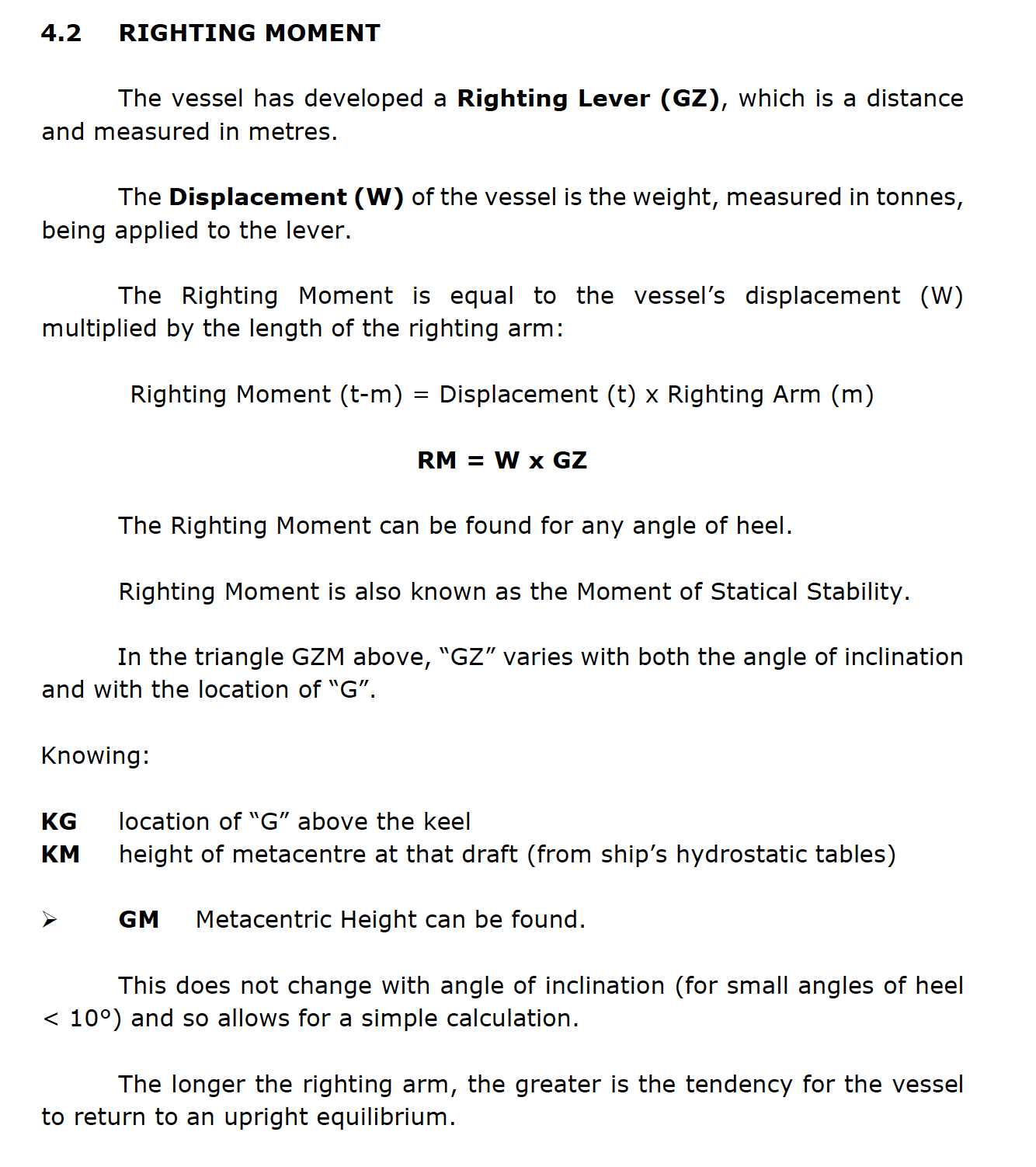
Explain “Righting Moment”
The Righting Moment is the best measure of a ship’s overall stability. It describes the ship’s true tendency to resist inclination and return to equilibrium.
Explain Righting Lever
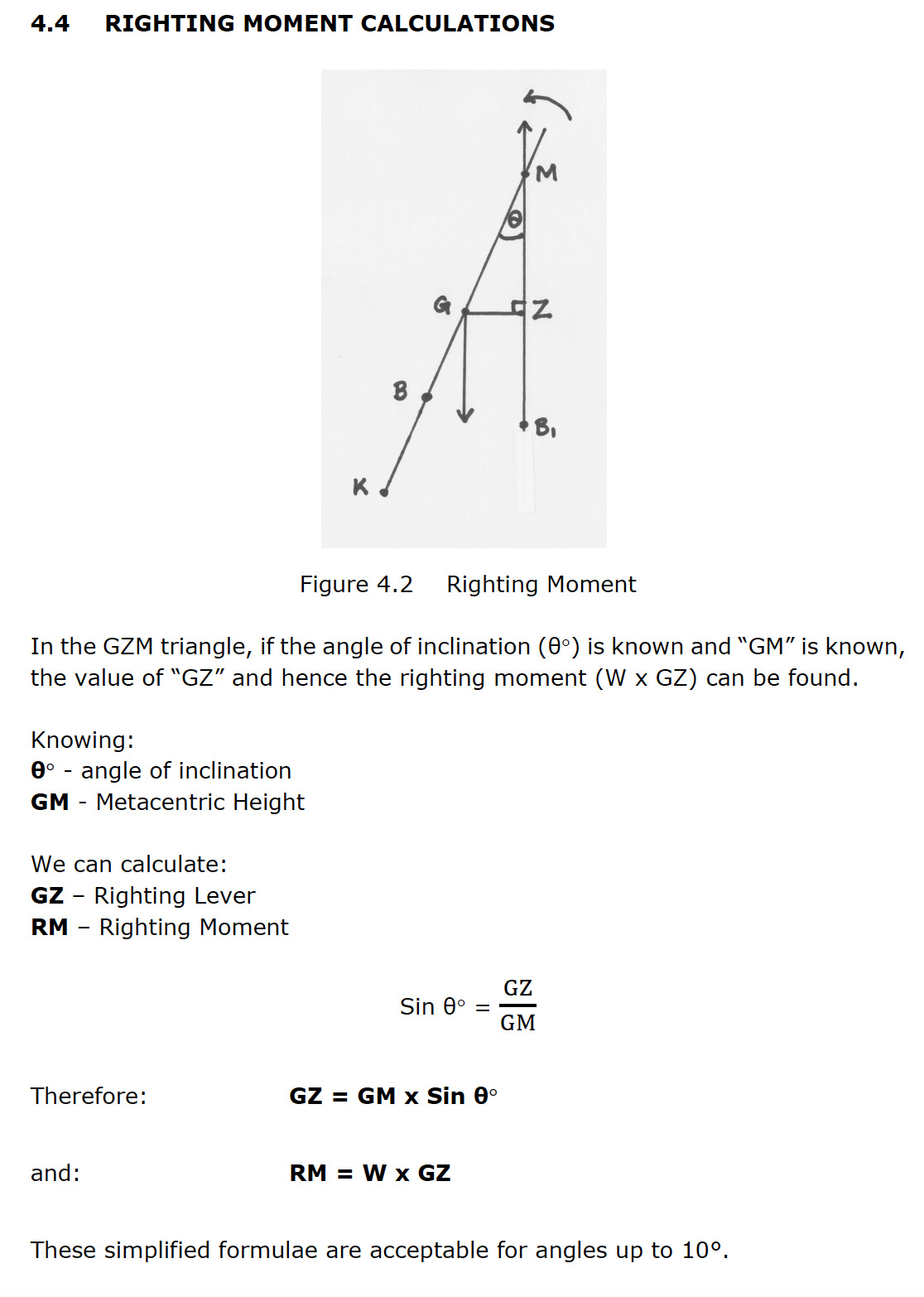
Righting lever (GZ) is defined as the horizontal distance, measured in metres, between the centre of gravity (G) and the vertical line acting upwards of the centre of buoyancy (B1) when the ship is heeled.
§ The perpendicular distance between the weight vector and the buoyancy
vector is known as the righting arm or righting lever
§ Denoted as GZ
§ This is the lever that the vessel uses to return to equilibrium
§ i.e. To return to the upright with the forces of buoyancy and gravity
equal and opposite.
§ The longer the righting arm, the greater is the tendency for the vessel
to return to an upright equilibrium.
DIFFERENCE BETWEEN NEUTRAL STABILITY & ANGLE OF LOLL
Neutral Stability
A Vessel in Neutral stability has G and M in the same position i.e. there is no righting lever.
Vessel will sit at any angle, within the realms of initial statical stability.
However, when this vessel reaches the threshold of initial statical stability (10 degree’s) and beyond, the centre of buoyancy will move outboard sufficiently that a positive righting lever will be created.
Angle of Loll
Light Displacement
A ship’s lightweight or light displacement is the actual weight of the ship with no passengers, cargo, bunkers, lube oil, ballast, fresh water, stores, etc., on board.
Load Displacement
The loaded displacement is the weight of the ship loaded down to its load line marks, that is, loaded to its maximum capacity with passengers, cargo, bunkers, lube oil, ballast, fresh water, stores, etc., on board.
Ship’s Dead Weight
A ship’s deadweight is the difference in metric tons between the loaded displacement tonnage of the ship and the lightweight of the ship.
However, the difference between the loaded displacement tonnage and the lightweight does not reflect the cargo carrying capacity only, as deadweight also includes bunkers, stores, freshwater, etc.
Whats the Trigonometry Anachronim?
Trig Reminder
“SOH CAH TOA”
Sin Ø = Opposite / Hypoteneuse
Cos Ø = Adjacent / Hypotenuse
Tan Ø = Opposite /Adjacent
Right Angle Triangles only and any Triangle all angles must sum to 180°
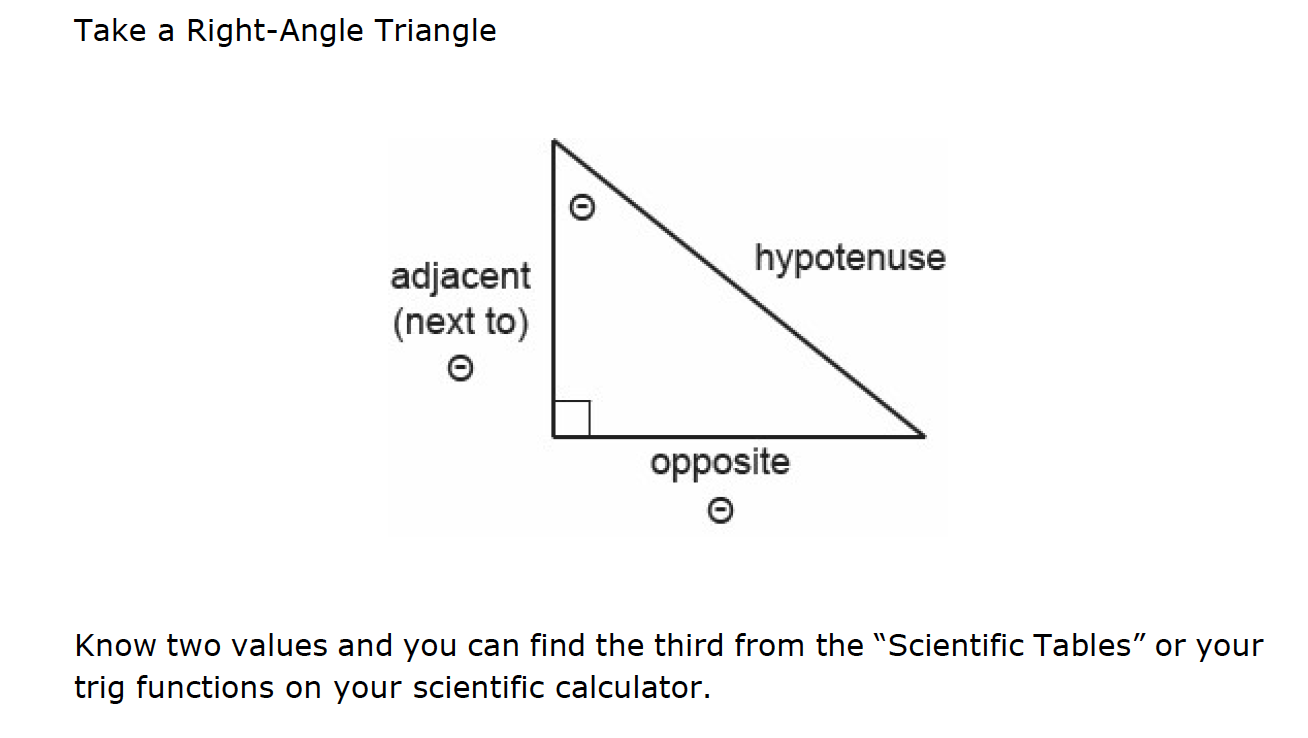
Illustration of Righting Moment calculations.
Why use GM as a measure of Stability rather than GZ?
If Displacement may be assumed to be constant, the GZ must be the variable.
Righting Moment (RM) = W x GZ
GZ changes with the angle of heel.
It is a dynamic and constantly changing value, which makes it difficult to use as a datum or measure of stability.
In an upright vessel, GZ = 0.
GM is a static value which exists at all angles of inclination and in a static vessel.
It has a value in an upright vessel.
This is why GM is calculated and used as the measure of stability.
EFFECT OF HULL SHAPE ON VESSEL STABILITY?
KB and BM are affected by hull shape.
KM is affected by the beam of the vessel and hull shape will determine that beam and therefore KM at particular drafts.
The REG LYC Stability Criteria (Module 8) ensure that all hull designs are checked as safe before being put into service.


-
1. Units and Measures used in Stability26
-
2. Flotation9
-
3. Transverse Stability1
-
4. Initial Stability10
-
5. Statical Stability25
-
6. Calculating GM when loading and discharging weights2
-
7. Freesurface Effect6
-
8. List12
-
9. Curves of Statical Stability14
-
10. Longitudinal Stability6
-
11. Stability Data supplied to Yachts4
-
12. Fineness of Hull form and Resistance to forward motion.2
-
13. Dry Docking10
-
14. Formula's and Equations13



