How does the CoG react with loading, discharging or shifting of weight.
G will move:
• directly towards a weight loaded
• directly away from a weight discharged
• parallel to a weight moved
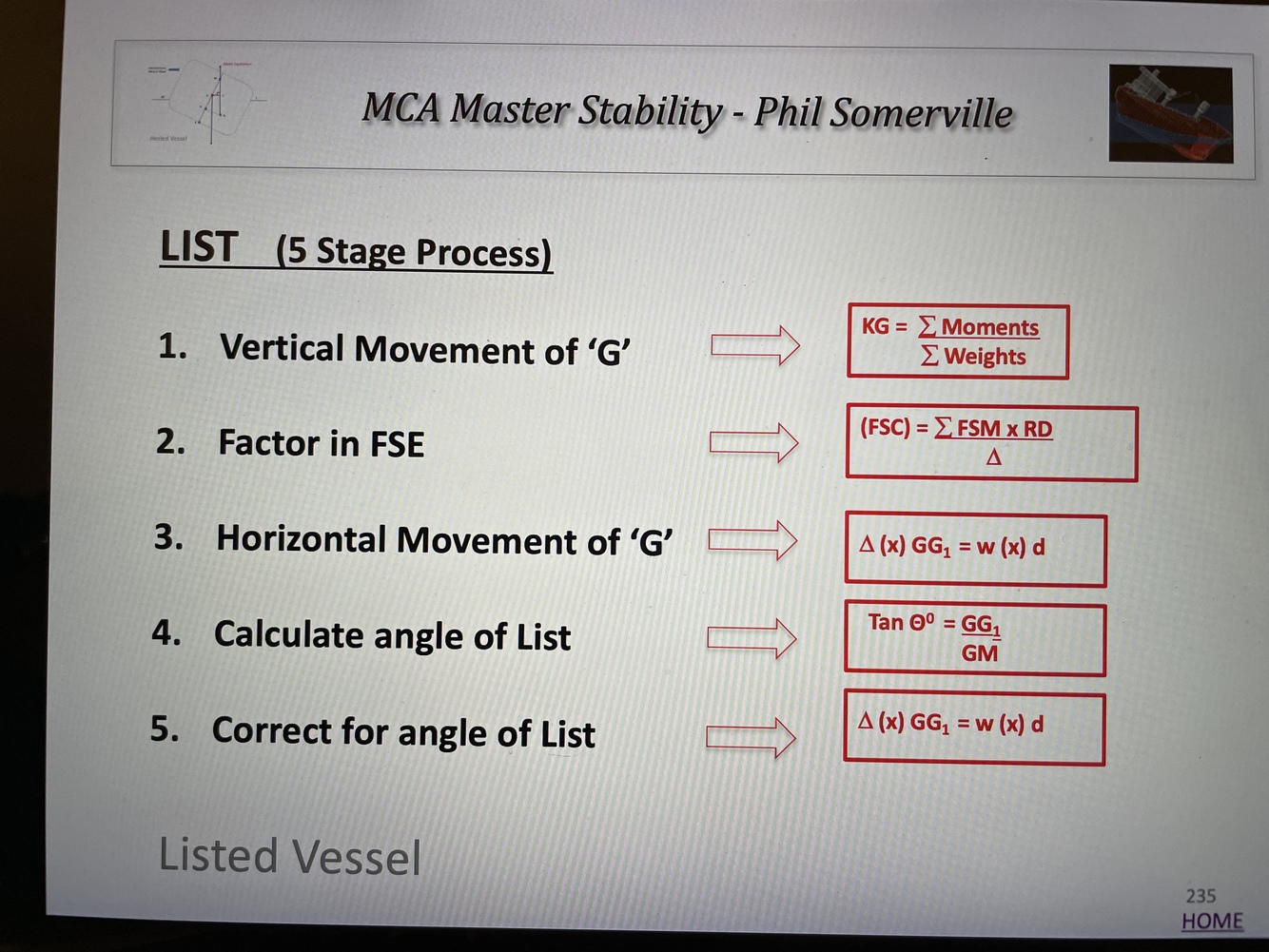
What 5 steps must be considered when considering the vertical and horizontal movement of the CoG?
There are five steps and we must consider the vertical plane first.
- Step 1. Vertical movement of weights and new G and new GM
- Step 2. Include FSM in Step 1 if applicable
- Step 3. Horizontal movement of weights and G to G1
- Step 4. Calculate Angle of List
- Step 5. Correct for Angle of List
Explain the procedure to conduct an inclination test?
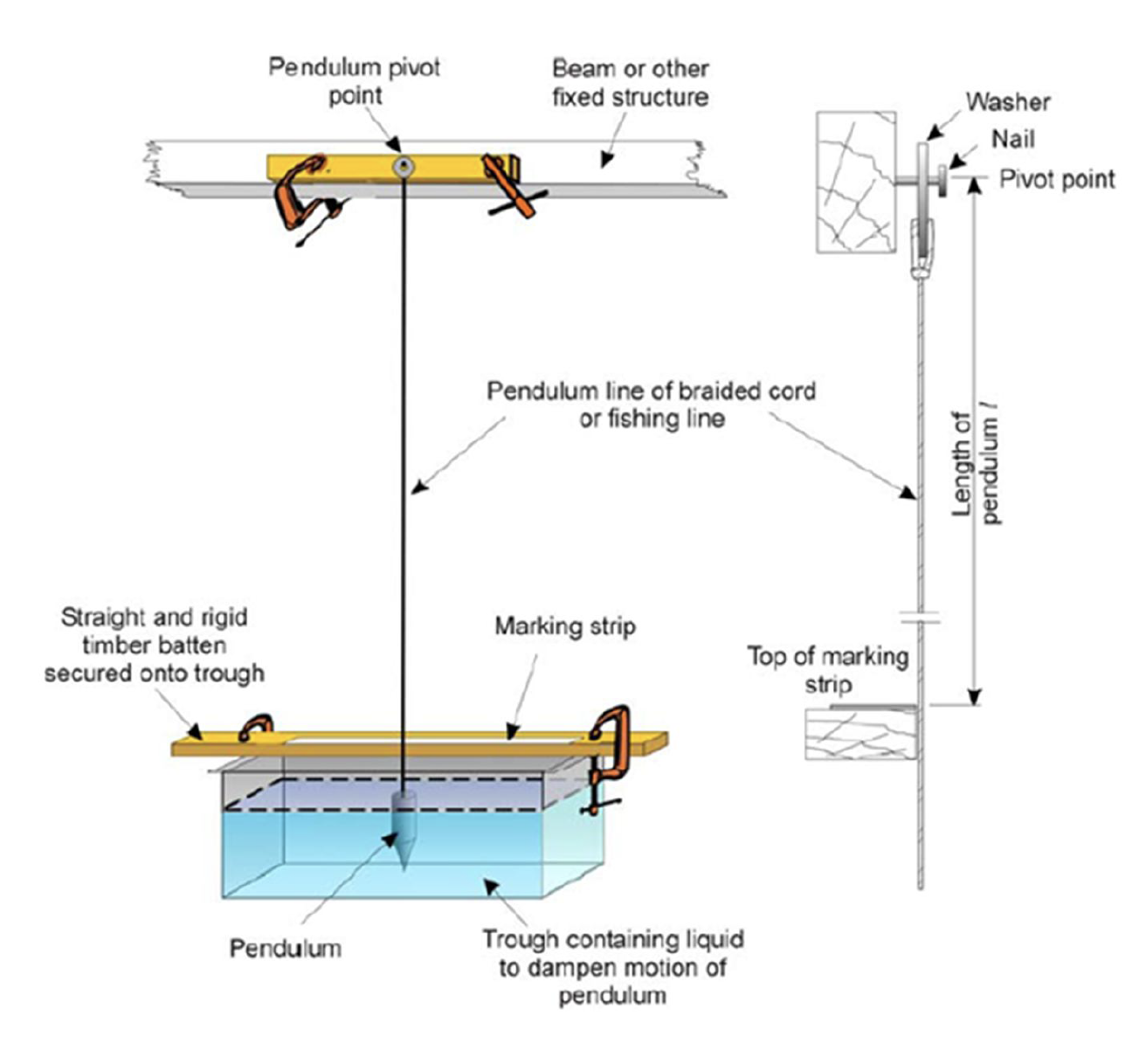
A long pendulum is set up with the weight immersed in an oil trough.
This is to dampen any oscillations. In larger ships, two pendulums are set up,
one forward and one aft.
A known weight is moved transversely and horizontally across the ship
to produce a small list. The angle of list is kept to less than one degree to
ensure that M does not move.
The deflection of the pendulum is measured and, knowing the deflection
and length of the pendulum, the angle of list can be calculated very accurately.
The process is repeated many times to ensure an accurate result.
What are the reasons for conducting an inclination test and when would you carry it out?
Inclining Test has two purposes:
- to establish the position of “G” in the lightship condition
- to confirm the underwater volume and, hence, the lightship displacement.
An inclining test is required at
1) newbuild and maybe required:
2) on change of registry,
3) after major modifications,
4) if there is any doubt as to the accuracy of the stability data or
5) if a surveyor requires it.
What conditions/preferences are required to carry out an inclination test?
The test is carried out under strictly controlled conditions, with the ship
in the light condition or as close to that condition as possible.
• Certain weather conditions are necessary. Ideally, a flat calm day is
required, but a light breeze may be acceptable if it is from ahead or astern.
- The water in the dock or basin must be still and calm.
- All tanks should be empty, for preference, otherwise they must be pressed up full.
- The gangway is removed and all moorings are slack.
- The density of the dock water, sea water if possible, is obtained.
- The drafts, forward, amidships and aft are read.
- There is no fluid onboard the ship which is free to move.
- The position and weight of all movable weights, including people is known. (Normally, only those whose presence is strictly necessary for the test are allowed onboard)
Suspended Weight: what is referred to as the Point of suspension?
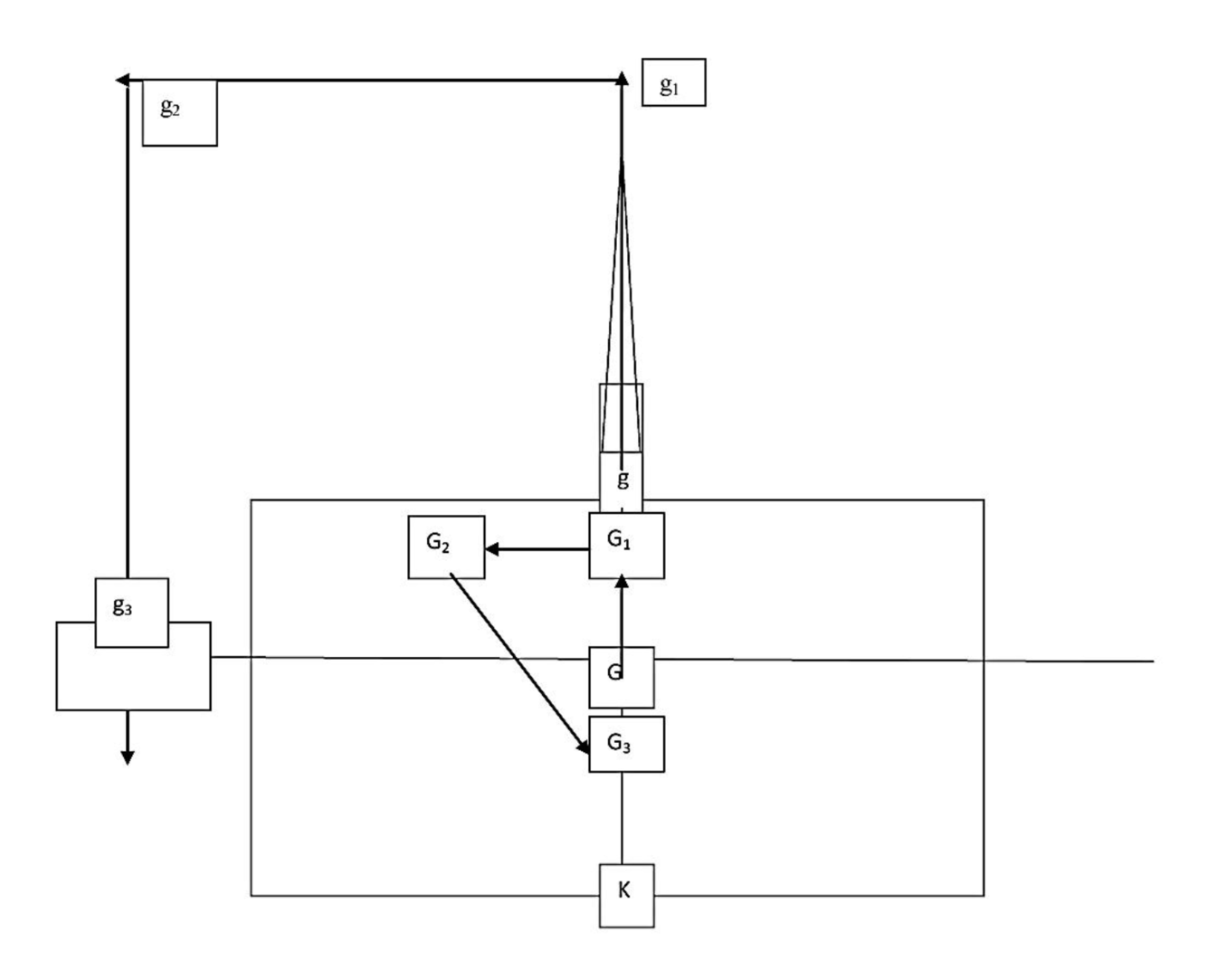
The instant the weight is hoisted by the crane, the effective centre of
gravity (g) of the weight moves to the head of the crane or derrick (g1).
What checks should be done before lifting heavy weights on deck with your crane/davits?
Make sure that:
- The ship has adequate stability.
- Free Surface is reduced to a minimum.
- The maximum angle of list during the operation has been calculated in advance.
- It is known whether it is possible to counter ballast the ship to reduce this angle.
- The task is properly planned and appropriate equipment and personnel are available.
- Moorings are tended and adequate fendering is available.
What is an Incline test and why are they carried out?
- To determine Lightship KG(where your CoG above your Keel)
- To confirm Lightship displacement
- Required for new builds or major structural changes made to the vessel
- Change of Registry
- When stability data is thought to be inaccurate
- When requested by a surveyor
What are the conditions required to carry out an inclination test?
- Need an approved surveyor such as class or flag state.
- Vessel in Lightship condition, (which includes FFE and LSA)
- Calm weather conditions, if windy, it should be from ahead or astern
- Gangway removed and mooring lines slacken.
- All non essential personnel removed
- Calm Dock or basin
- Tanks empty, if not possible then pressed.
- Density of water confirmed
- Draft marks logged fwd, aft and amidships
Explain point of suspension?
Suspended weights have a large effect on List.
Whenever weights are moved using cranes or derricks, the centre of gravity of the ship is affected.
The instant the weight is hoisted by the crane, the effective centre of gravity (g) of the weight moves to the head of the crane or derrick (g1).
This is called the Point of Suspension (POS).
Illustrate how CoG reacts with Suspended Weight when removing a weight and placing it on the dock.
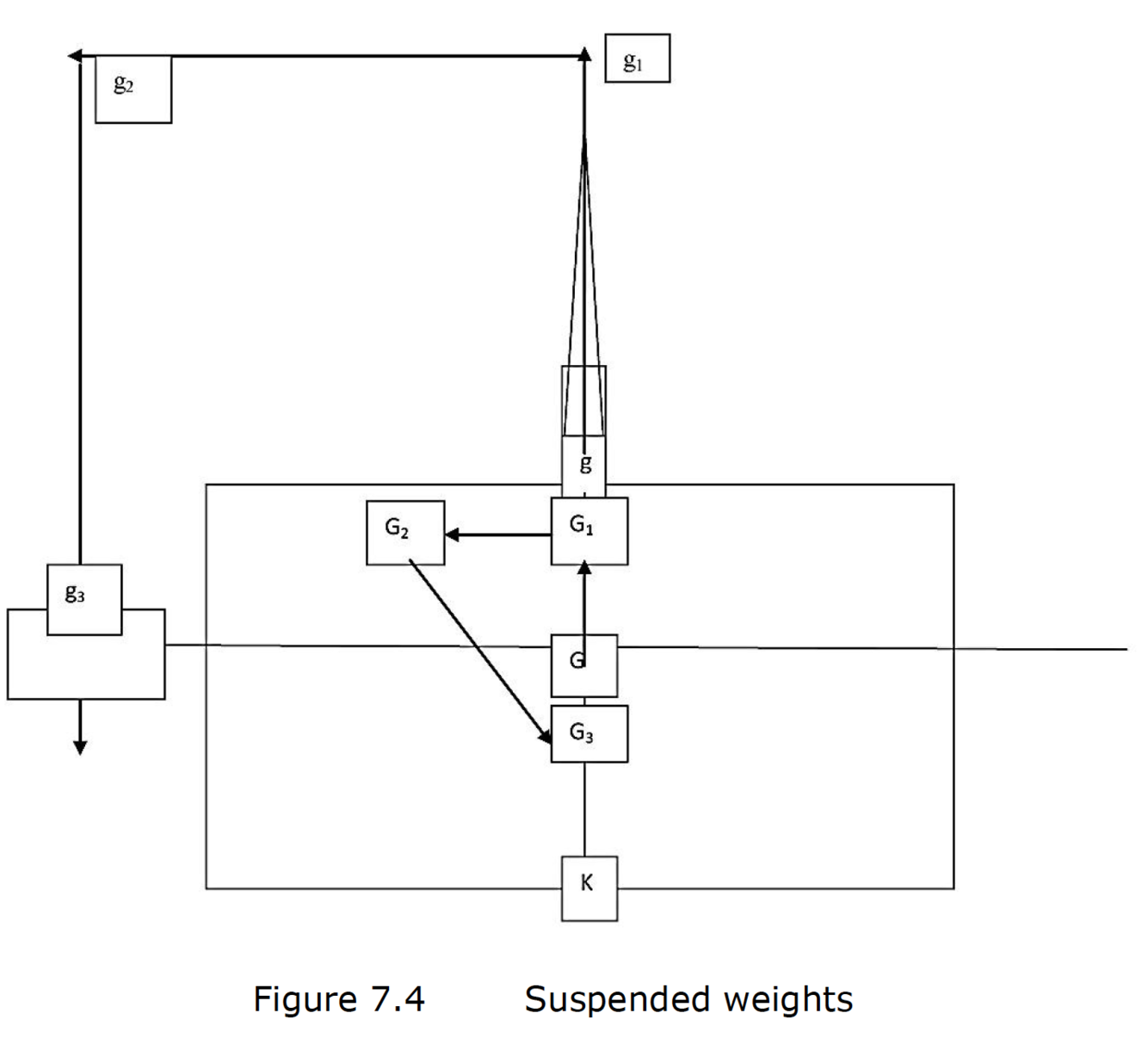
In the example below, a weight (g) is being lifted from the deck amidships and landed to the quay.
As the weight is hoisted, g rises to the point of suspension.
The ship’s own centre of gravity also rises, from G to G1.
As the weight is slewed out, g moves outboard and, again, G follows point g2 going to G2.
When the weight is released from the crane, G returns to the centreline, but somewhat lower in the ship at G3, since when originally on deck g was above G.
Before, during and after lifting heavy weights with a crane, it is essential to ensure that:
- The ship has adequate stability, therefore adequate GM.
- Free Surface Moments reduced to a minimum.
- The maximum angle of list during the operation has been calculated in advance.
- It is known whether it is possible to counter ballast the ship to reduce this angle.
- The task is properly planned and appropriate equipment and personnel are available.
- Moorings are tended and adequate fendering is available.
- Double Bottom Tanks Pressed.
- Top weight reduced.

-
1. Units and Measures used in Stability26
-
2. Flotation9
-
3. Transverse Stability1
-
4. Initial Stability10
-
5. Statical Stability25
-
6. Calculating GM when loading and discharging weights2
-
7. Freesurface Effect6
-
8. List12
-
9. Curves of Statical Stability14
-
10. Longitudinal Stability6
-
11. Stability Data supplied to Yachts4
-
12. Fineness of Hull form and Resistance to forward motion.2
-
13. Dry Docking10
-
14. Formula's and Equations13



