1
Q
Shoulder arthroscopy
A
- Beech chair position / head ring / anaesthetist happy –
- remove posterior portion of table Prep and Drape arm so it is able to hang free and is manoeuvrable during procedure
- Posterior portal – landmark – soft spot 2cm medial and 2cm inferior to the posterolateral aspect of acromion
- Skin incision – blunt trochar aiming for your finger placed on the coracoid process – feel the indentation between the glenoid and the humeral head
- Lateral portal – 4 cm down from lateral aspect acromion – use green needle first to get orientation (not >5cm = axillary nerve damage)
- Anterior portals – via green needle lateral to coronoid (to avoid nv structures)
- Arthroscopic order 4mm 30 deg scope
- Find long head of biceps tendon insertion (suproglenoid tubercle) 12 o clock
- SHGL 1 o clock
- Sublabral space 2 o clock
- MGHL – 2 o clock (present in 30%)
- Labrum - 3 o clock to 9 o clock should be firmly attached Ant
- IHGL – 4 o clock = hammock (O’Brien AJSM 1990)
- Axillary pouch – loose bodies
- Pos IGHL – 8 o clock
- Posterior capsule Up to LHB
- Glenoid surface
- Humeral head surface – hill sachs lesion (posteriorly)
- Bursoscopy SS tear
Funk 10 point guide - http://www.shoulderdoc.co.uk/article.asp?section=61
- Superior Labrum and LHB
- Glenoid, Humeral Head and Posterior Labrum
- Inferior Recess (loose bodies)
- Humeral head (Bare area) and posterior cuff (IS) – Hill Sachs lesion
- Superior cuff (SS)
- Rotator Interval (a triangular space situated between the supraspinatus and subscapularis tendons) - LHB entering groove, biceps pulley and SGHL
- Subscapularis, Antero-superior labrum & MGHL
- Antero-inferior labrum, IGHL and anterior capsule
- Acromial surface of bursa and CA ligament
- Bursal surface of rotator cuff
2
Q
Ankle arthrosocpy
Indications
- osteochondral lesions of the talus
- microfracture of OCD
- debridement of post-traumatic synovitis
- ATFL anterolateral impingement
- AITFL anterolateral impingement resection of
- anterior tibiotalar spurs such as anterior bony impingement os trigonum
- excision removal of loose bodies cartilage
- debridement in conjunction with ankle fusions
A
- Positioning and Scope insertion
- Position patient placed supine leg over well padded bolster
- Tourniquet place tourniquet and exsanguinate limb
- Joint distention external traction device applied to distract tibiotalar joint
- can load joint with saline to distend joint
- Scope insertion
- nick and spread method commonly utilized to access joint and minimize neurovascular injury
- Portals
- Anteromedial primary viewing portal access to anteromedial joint location and technique medial to tibialis anterior and lateral to medial malleolus make portal between tibialis anterior and saphenous vein
- Anterolateral primary viewing portal access to anterolateral joint location and technique located just lateral to peroneus tertius and superficial peroneal nerve and medial to lateral malleolus
- can trace out superficial peroneal nerve prior to incision
- Anterocentral anterior viewing portal location and technique not commonly utilized due to danger to dorsal pedis artery medial to EDC and lateral to EHL
- Posterolateral posterior viewing portal for access to os trigonum location and technique located 2cm proximal to tip of lateral malleolus medial to peroneal tendons and lateral to achilles tendon
- Posteromedial function posterior viewing portal for access to os trigonum location and technique just medial to achilles tendon
3
Q
- Deltopectoral approach
A
- Incision over deltopectoral groove just above the tip of the coracoid process (faces anterolaterally) passing lateral to the apex of the axilla (control bleeding)
- IP: deltoid m (axillary) – pec major (med+lat pect nn)
- Divide the fascia between them where the cephalic vein is and retract it laterally
- Cauterize the deltoid branches of the thoracoacromial artery which lie in the groove
- Laterally reflect the anterior part of deltoid to expose structures about the coracoid
- Identify conjoined tendon and retract it medially staying laterally to it (safe side)
- SHB (musculocutaneous n: lies 5-8cm distal to the coracoid)
- Coracobrachialis (musculocutaneous n)
- Then → identify subscap and pass an artery forceps beneath it, apply STAY SUTURES, apply ER to avoid the axillay nerve which runs distal to it and divide it 2cm from its insertion stopping at the distal border where is a triad: 1 artery + 2 veins (ant humeral circumflex vessels): either ligate them or avoid them
- Apply stay sutures in the capsule and a vertical tenotomy is made in the capsule 1/2cm medial to the sectioned stump of subscapularis
- Rotator interval is identified: Its superior border is indistinct as it blends with supraspin
- Palpate axillary nerve at the inferior capsule
- EXTENT: proximally reach middle 1/3 of clavicle + detach subclavius, trapezius, pec major + minor and distally at the lateral border of biceps → move medially → BRACH
4
Q
- Elevate head to ↓Pvenous → ↓bleeding
- Indications: rc repair – proximal # ORIF – shoulder replacement - MIPO
- 5cm incision from anterior border of acromion down the lateral aspect
- Split deltoid m in line with its fibers
- Identify the rhaphe between the anterior and middle 1/3s of deltoid
A
- Proximal extension: to reveal exposure of the whole supraspin → across the acromion and parallel to upper margin of spina scapulae → incise trapezius parallel to spina, 1cm above it
- Subacromial = Subdeltoid bursa!! Because it lies between CAL + supraspinatus and between deltoid + supraspinatus
- Split subacromial bursa and incise longitudinally to provide access to the upper lateral portion of the head
- Rotating and abducting the arm brings different parts of the rc into view into the floor of the wound
- Rupture of supraspin allows direct communication between subacromial bursa + joint
- ACJ: subperiosteal elevation of the confluent insertions of deltoid + trapezius
5
Q
- Position: lateral
- Landmarks: acromion + spina scapulae
- Straight incision over entire length of spina scapulae
- Alternatively, vertical skin incision centered on posterior arthroscopy portal
- INP: teres minor(axillary n) – infraspinatus (suprascapular n)
- Locate plane bt deltoid + underlying supraspinatus LATERALLY
- Subperiosteal dissection of deltoid from spine or split between middle and posterior 1/3 fibers
- Infraspinatus is multipennate – teres minor is unipennate
- SOS: Inferior retraction of teres minor: axillary n + post circ hum a (quadrangular space)
- SOS: Medial retraction of infraspinatus: suprascapular n
- SOS: Circumflex scapular artery, runs in triangular space, be careful with dissection between teres major & teres minor
- Closure: the posterior 1/3 of the deltoid is reattached to the spine of the scapula with absorbable sutures passed through drill holes in the spina scapulae
A
6
Q
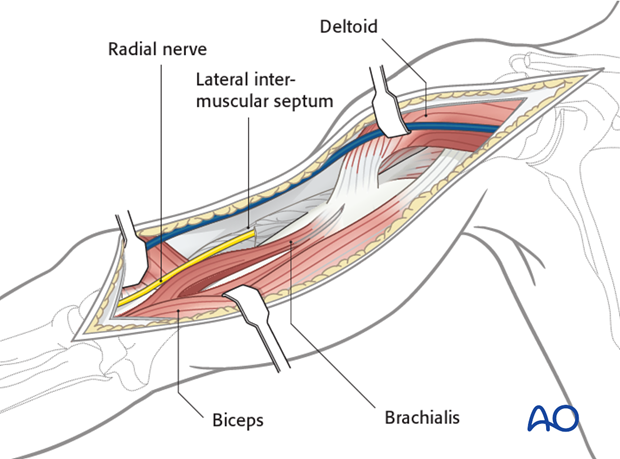
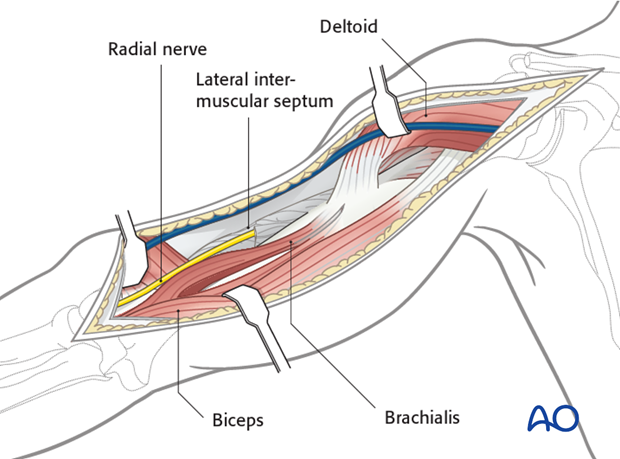
- Incision from coracoid → deltopectoral groove → up to the insertion of deltoid on deltoid tuberosity → lateral aspect of biceps → stop 5cm before flexion crease
- IP:
- ¡Proximal: same
- ¡Distal:
- ¢Medially: medial fibers of brachialis (musculocutaneous n)
- ¢Laterally: lateral fibers of brachialis (radial n)
- Deep dissection:
- ¡Proximal: detach the insertion of Pec major from the lateral bicipital groove
- ¡Ligate anterior humeral circumflex artery
- ¡Distal: flex the elbow to take tension off brachialis
- ¡Identify LACN and the muscular interval between biceps and brachialis and retract biceps medially and then split brachialis fibers
- ¡OR
- ¡Identify LACN interval between brachialis + brachioradialis and divide between them identifying radial n and retracting brachioradialis laterally + brachialis medially and incising lateral border of brachialis down to the bone (advantage: can be extended distally between BR and PT: anterolateral approach)
- SOS - Radial n: Proximal: in spiral groove at back of middle 1/3 of humerus: dissect subperiosteally
A
7
Q
- Lower ¾ of humerus
- Longitudinal incision 8cm distal to acromion to fossa olecrani
- IP: no true (medial head dual inn: radial + ulnar nn)
- Triceps anatomy:
- Outer layer:
- lateral head (from lateral lip of spiral groove)
- ¢long head (from infraglenoid tubercle)
- ¡Inner layer:
- ¢medial (deep) head (from whole width of the posterior aspect below the spiral groove)
- Spiral groove contains radial n: therefore, radial n actually separates the origins of lateral + medial heads
- Begin proximal dissection to see the gap between lateral-long heads before fusing to the common tendon
- Retract lateral head laterally + long head medially
- Good haemostasis!!
A
8
Q
- Flex elbow to 90ο & pronate the forearm to move the PIN away from operative field
- Gently curved incision 5cm proximal to the posterior aspect of lateral epicondyle to 5cm distal to the olecranon
- IP:
- ¡Proximal Triceps (radial n)
- ¢ECRB/BR (radial n)
- ¡Distal:
- ¢Anconeus (radial n)
- ¢ECU (PIN) (identify ECU by moving wrist, look distally, anconeus doesn’t move!), they share a common aponeurosis
- Or, dissect straight down onto the lateral epicondyle
- DO NOT incise the capsule too anteriorly (radial n)
- DO NOT dissect below annular lig (PIN)
-
- Common extensor origin: EDC – EDM – ECU - Anconeus
- Posterior interosseous a: superficial and deep extensor mm
- Anterior interosseous a: flexor mm
A
9
Q
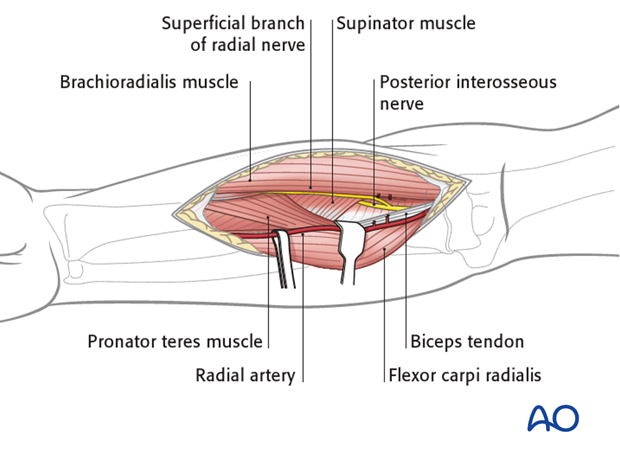
- Straight incision from anterior flexion elbow crease just lateral to the biceps tendon down to the radial styloid
- IP:
- ¡Proximally:
- ¢Brachioradialis (radial n)
- ¢PT (median n)
- ¡Distally:
- ¢Brachioradialis
- ¢FCR (median n)
- Begin dissection distally → proximally
- Ligate the vessels that go to undersurface of brachioradialis
- Identify radial a beneath the brachioradialis and retract it medially
- Deep dissection:
- Proximal 1/3: Follow biceps to its insertion into tuberosity, staying lateral to it, fully supinate exposing the insertion of supinator and incise along its fibers to protect PIN
- Middle 1/3: Identify the 2 mm that cover the radius: PT + FDS → pronate to see the insertion of PT + detach it and retract medially
- Distal 1/3: Identify the 2mm that cover the radius: FCR + PQ → supinate to detach the lateral aspect of the radius lateral to the PQ
-
A
10
Q
- Tensile side of radius: dorsal side → plates should be placed
- Incision: straight from just anterior to the lateral epicondyle of the humerus along the dorsal aspect of the forearm to just distal to the ulnar side of Lister’s tubercle at the wrist
- IP:
- ¡Proximal: ECRB (radial n) + EDC (PIN)
- ¡Distal: ECRB + EPL (PIN)
- Identify the gap bt ECRB + EDC: more obvious distally where the APL+EPB emerge together bt them traversing obliquely (also Kaplan approach)
- Deep dissection:
- ¢Proximal 1/3:
- Identify supinator and PIN as it runs bt spf + deep heads where it emerges 1cm proximal to the distal edge of the m → distal to proximal dissection → supinate to see + detach the insertion of supinator onto anterior radius
- ¢Distal 1/3:
- APL and EPB cover the dorsal aspect of radius – retract them off bone
-
A
11
Q
- EPL is trapped bt styloid of base of 3rd MC + Lister’s tubercle at wrist extension → rupture after radius malunion
- volar approach to ulnar nerve
- Curved incision following the radial border of the hypothenar eminence and crossing the wrist obliquely 60ο
- Identify FCU proximally → incise the fascia (volar carpal lig) on the radial border and retract it ulnarly to reveal ulnar n+a (Artery is the most lateral structure)
VOLAR APPROACH TO SCAPHOID
- Hyperextend wrist
- Vertical incision from the tuberosity → FCR
- Bed of FCR then angle to scaphoid through AbPB
- Identify radial a → retract it laterally (annoying branch of spf palmar branch radial a)
- Identify FCR → retract it medially → incise capsule
DORSOLATERAL APPROACH TO SCAPHOID
- Good for proximal pole
- Hyperflex wrist
- S-shaped incision centered over snuffbox
- Identify EPL dorsally + EPB volarly
- Open the fascia bt them - SOS: SpfRN
- Identify the radial a inferiorly
-
-
-
A
12
Q
- Landmarks:
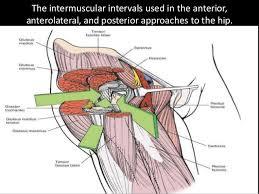
- ¡ASIS and iliac crest – Bikini incision starting form the anterior ½ of iliac crest to ASIS and continue vertically 10cm heading towards lateral side of patella
- Supine
- IP:
- ¡Superficial plane: sartorius (femoral n) – TFL (superior gluteal n)
- ¡Deep plane: rectus femoris (femoral n) – gluteus medius (superior gluteal n)
- Dissection:
- ¡Develop the plane bt sartorius and TFL after ER the leg to stretch sartorius
- ¡Incise the fascia on its medial side to protect the LFCN
- ¡Retract sartorius upward + medially and TFL downward + laterally
- ¡Ligate the ascending branch of the LFCA
- ¡Palpate the femoral artery (it is directly anterior to the hip joint with the psoas m interposed) (femoral n is lateral to it): it is well medial
- ¡Detach both origins of rectus femoris (AIIS + sup acetabulum) (excessive reflection may damage the descending branch of LFCA)
- ¡Identify iliopsoas inferomedially and detach it from its attachment to the hip capsule
A
13
Q
- Incision:
- ¡based on GT slightly curved posteriorly
- IP:
- ¡No true since gluteus maximus (inserts on GT and ITB) is split in line of its fibers
- Superficial dissection:
- ¡Subcut fat (buzz bleeders)
- ¡Incise fascia lata to uncover vastus lateralis
- ¡Split the fibres of gluteus maximus (inferior gluteal nerve) proximally with blunt dissection
- ¡Use a Charnley retractor to retract the edges of fascia lata and gluteus maximus
- ¡Short ERs (piriformis, superior gemellus, obturator internus, inferior gemellus, quadratus femoris) lie under a layer of fat and bursa (peel off with a large swab)
- Deep dissection:
- ¡IR the leg to put the ERs on stretch and pull the operative field away from sciatic nerve which lies on short ERs encased in fat
- ¡Incise between piriformis and gluteus medius, fag anteriorly over neck of femur to expose gluteus minimus.
- ¡Use Bristow to develop plane between minimus and capsule, then fag over neck of femur, exposing capsule
-
- ¡
*
A
- ¡Ethibond stay sutures in piriformis and short ERs, then diathermy (bend tip) muscles close to GT (with left hand on large swab over muscles to control bleeding) AND capsule all in one go, then ethibond stay suture into corner of capsule and inferiorly, cut the capsule stay sutures shorter than the muscle stay sutures
- ¡Neck cut - 1 finger breadth above LT to tip of GT
- ¡Anterior retractor: over anterior lip of acetabulum, held with weight and chain.
- ¡(Inferior release: index finger outside acetabulum, middle finger inside, inferior edge of capsule between fingers, use shears to snip it and expose the transverse ligament)
- ¡Inferior retractor below TAL into tear drop.
- ¡Norfolk and Norwich superiorly to expose superior edge of acetabulum (x2)
- ¡Debride capsule/labrum, curette/diathermy out soft tissue
- ¡Hip is dislocated by IR and adduction
- Structures at risk:
- ¡Branches of inferior gluteal artery are invariably injured when gluteus max is separated / inferior gluteal a leaves the pelvis beneath the piriformis → if it retracts into the pelvis → supine position, open the abdomen and tie off the artery’s feeding vessel, the internal iliac a
14
Q
- It may worth mentioning that I would seek help from a general surgeon as dissection involves isolating and mobilizing femoral vessels/nerves and spermatic cord
- Exposure of inner surface of pelvis from the SIJ to the symphysis pubis
- Visualization of the anterior and medial surfaces of acetabulum and anterior column
- Incision: line starting 5cm above ASIS to around 1cm above pubic tubercle
- IP: no true
- Expose aponeurosis of external oblique
- Identify LFCN at the lateral edge of the dissection
- Divide the aponeurosis in line of its fibers from superficial inguinal ring to ASIS
- Expose spermatic cord or round lig and isolate it
- Continue medially and divide the anterior part of rectus sheath to expose the underlying rectus abdominis
- Strip iliacus from the inside of the iliac wing
- Divide rectus abdominis 1cm proximal to its insertion into symphysis pubis
- Develop a plane bt the back of symphysis pubis and the bladder: space of Retzius
- Cut through internal oblique and transversus abdominis that form the posterior wall of the inguinal canal
- Ligate the inferior epigastric artery where it crosses the posterior wall of the canal at the medial edge of the deep inguinal ring
A
- Identify the extraperitoneal fat and push the peritoneum upward to reveal the femoral vessels, the femoral nerve and the iliopsoas
- Isolate the femoral vessels together (1st sling) and pass a 2nd sling around the iliopsoas with the femoral nerve lying on top of it
- Retract them either medially or laterally to see medial surface of the acetabulum and superior pubic ramus
- Medial window
- ¡midline to external iliac artery & vein (medial to femoral vessels)
- ¡access to pubic rami and symphysis pubis; indirect access to internal iliac fossa and anterior SIJ
- Middle window (Contains the obturator n + LFCN)
- ¡between external iliac vessels and the iliopsoas (lateral to femoral vessels)
- ¡access to pelvic brim, quadrilateral plate and a portion of the superior pubic ramus
- Lateral window
- ¡lateral to iliopsoas (iliopectineal fascia)
- ¡access to quadrilateral plate, SIJ and iliac wing (inner surface of the ilium)
- Superficial inguinal ring: gap above the pubic tubercle at the aponeurosis to allow the passage of spermatic cord or round ligament
- CPN palsies: DD of the site of the injury with EMG of SHB (the only muscle of the thigh supplied by the common peroneal division of the sciatic n: lesions at the level of the fibular head leave it unaffected)
15
Q
- Position:
- Lateral: for posterior column/lip #
- Prone: if transverse # to keep femoral head from migrating medially which can occur if patient is in lateral position
- Incision: start just below iliac crest and distally around 10cm below GT along its line
- IP: no true
- Superficial dissection:
- Fascia lata is split in line with the wound
- Split gluteus maximus proximally along its anterior margin exposing the piriformis and short ERs
- Deep dissection:
- Detach short ERs and piriformis from their insertion
- Place retractors carefully in the greater and lesser sciatic notch
- It can be increased by GT osteotomy
- Structures at risk:
- Sciatic nerve
- Inferior gluteal artery: it leaves pelvis just below piriformis
A
16
Q
- ¡Provides access to:
- ¢Pubic body – ilium above and below the pectineal line – medial displacement of the quadrilatelar plate – anterior sacroiliac joint – upper ilium & iliac crest
- ¡Stoppa:
- ¢Avoids the middle window of the ilioinguinal approach, resulting in minimal dissection of the inguinal canal, femoral n and external iliac vessels
- ¢Care must be taken when placing a retractor on the anterior aspect of the sacrum, as the L4 and L5 nerve roots are both at risk
- ¡Incision:
- ¢Transverse 2cm above the symphysis
- ¡Dissection:
- ¢Incise rectus fascia
- ¢Release pyramidalis
- ¢Split rectus abdominis along the linea alba
- ¢Open the transversalis fascia (opens the potential space of Retzius: space behind the symphysis and anterior to the bladder)
- ¢For the “lateral window”, release the insertion of external oblique
- ¢Release the insertion of rectus abdominis off the posterior pubic rami
- ¢Release the iliopectineal fascia to enter the true pelvis
- ¢Identify and ligate the corona mortis along & behind the superior pubic ramus
- ¢Elevate subperiosteally the iliopsoas
- ¢Expose and protect the nv bundle as the quadrilateral surface and posterior column are dissected
*
A
17
Q
- Incision:
- ¡Start laterally over the biceps, curve and come over the medial gastrocnemius
- Dissection:
- ¡Lateral to the small saphenous v is the medial sural cutaneous n (τα νευρα είναι ΔΕ)
- ¡Incise the fascia medial to the small saphenous v
- ¡Trace the medial sural cutaneous n back to its source, the tibial n
- ¡Dissect the common peroneal n in a proximal to distal direction as it runs along the posterior border of the biceps femoris
- ¡Identify the popliteal a and v which lie medially to the tibial n
- ¡Popliteal a has 5 branches around the knee: 2 superior, 2 inferior and 1 middle genicular a
- ¡Popliteal v lies medially to the a as it enters the fossa from below → then it curves, lying directly posterior to the a while in the fossa
- ¡Above the knee joint, it moves to the posterolateral side of the a
- ¡Gain further access either through the posteromedial or the posterolateral joint capsule
- ¡Superior medial genicular vessels are ligated and divided
- ¡Identify and retract laterally the tendon of gastrocnemius
- ¡Elevate subperiosteally popliteus and soleus from posterior tibia
A
- ¡Boundaries of popliteal fossa:
- ¢Superiorly: medially (SM + ST) – laterally (biceps)
- ¢Inferiorly: 2 heads of gastrocnemius
- ¢Roof: popliteal fascia
- ¢Floor: posterior aspect of femur – posterior capsule of the joint - popliteus
- Popliteal fossa: 2 nerves (tibial and CPN), 1 vein (popliteal vein) and 1 artery (popliteal artery); the tibial nerve is most superficial and the popliteal artery deepest with the popliteal vein in between
- Tibial n:
- ¡Continuation of sciatic n
- ¡Enters the popliteal fossa lateral to the popliteal a
- ¡At the midpoint, it crosses the a and lies medially to it leaving the fossa together passing between the heads of gastrocnemius and enters the calf by passing beneath the fibrous arch in the origin of soleus
- ¡Innervates: plantaris – gastrocnemius – soleus – popliteus – plantar flexors
- ¡Only cutaneous branch: sural n
- CPN:
- ¡Runs laterally at the medial side of the biceps
- ¡It disappears into the PL, under a fibrous arch dividing into deep and spf n
18
Q
- Structures anterior to the ankle: Tom Has A Nasty Dirty P…
- ¡Tibialis anterior
- ¡Extensor Hallucis longus
- ¡Artery
- ¡Nerve
- ¡Extensor Digitorum Longus
- ¡PT
- ¡Anterior nv bundle lies bt ATT and EHL at the ankle joint and bt the EHL and EDL distal to it
- ¡EHL crosses the nv bundle in a lateral to medial direction at the level of the ankle joint
- Midline incision bt medial and lateral malleoli
- Dissection:
- ¡Identify and protect the SPN
- ¡Cut the extensor retinaculum
- ¡Plane bt the EHL and EDL
- ¡Identify the neurovascular bundle: anterior tibial a and DPN MEDIAL to the EHL and retract both medially
- ¡Retract EDL laterally and EHL with the nv bundle medially
- ¡In pilon #, incise the deep fascia to the medial side of the ATT → anteromedial capsule
- ¡
A
19
Q
- Lateral or prone position
- Incision bt the posterior border of lateral malleolus and lateral border of Achilles tendon
- IP: bt PB (superficial peroneal n, it lies anterior) - FHL (tibial n)
- Identify and protect short saphenous v and sural n (it lies posterolateral) just behind lateral malleolus (keep them anterior to the incision)
- At the level of the ankle joint, PB lies ANTERIOR to the PL (the PB is muscular almost down to the ankle whereas the PL is tendinous)
- Incise the peroneal retinaculum and retract the peronei laterally to expose FHL
- Make a longitudinal incision through the lateral fibers of the FHL
- Continue subperiosteal dissection from the posterior border of the fibula across the IOM
- Excellent exposure for posterior malleolus #
A
20
Q
- For triple arthrodesis
- 2 cm anterior to the anterior border of the fibula
- IP
- ¡Bt the peroneal mm (superficial peroneal n) - extensor mm (deep peroneal n)
- Dissection:
- ¡Cut through superior and inferior extensor retinacula
- ¡DO NOT develop skin flaps
- ¡Preserve any dorsal cutaneous branches of superficial peroneal n
- ¡Identify peroneus tertius and EDL and incise just laterally to them
- ¡Retract the extensors medially and expose the capsule
- ¡Identify the origin of EDB from calcaneus and detach it
- ¡Identify the capsules of cc and tn joints
- ¡Identify and clear the fat in the sinus tarsi
- ¡
A
21
Q
- 3ple arthrodesis
- Oblique incision from below lateral malleolus, over sinus tarsi, medially over talocalcaneonavicular joint finishing over the base of 2nd or 3rd MTT
- Superficial dissection:
- ¡Do not mobilize skin flaps widely
- ¡Divide inferior extensor retinaculum in line with the skin incision
- ¡Retract PT and EDL medially
- ¡Identify in the inferior part of the incision the peroneals and retract them inferiorly
- Deep dissection:
- ¡Partially detach the fat pad that lies in the sinus tarsi by sharp dissection
- ¡Under it lies the origin of EDB
- ¡Detach its origin by sharp dissection to expose the talocalcaneonavicular joint and more laterally the calcaneocuboid joint
A
22
Q
- ¡Prone on a Montréal mattress so the abdomen hangs free - Kneeling position with hips and knees flexed (90-90 position) to open interspinous spaces
- ¡IP:
- ¢Bt the 2 paraspinal mm (erector spinae) each of which receives a segmental nerve supply from the posterior primary rami of the lumbar nn
- ¡Dissection:
- ¢Reach the spinal process
- ¢Incise lumbodorsal fascia and detach the paraspinal mm using a Cobb elevator
- ¢Dissect down the spinal process and along the lamina to the facet joint
- ¢Continue dissecting laterally, stripping the joint capsule from the descending and ascending facets
- ¢Remove the ligamentum flavum by cutting its attachment to the superior or leading edge of the inferior lamina (inserts into the anterior surface of the lamina above)
- ¢Once it is entered, a thin spatula should be placed beneath it to protect the underlying dura from being torn
- ¢Cauterize the branches of the lumbar vessels located at the area bt the transverse process
- ¢Immediately beneath are epidural fat and the blue-white dura
- ¢Staying lateral to the dura, continue down to the floor of the spinal canal, retracting the dura and its nerve root medially
- ¢Each nerve root must be identified individually and protected
- ¢
A
- ¡Define the inferior border of the upper lamina and use a upper-cutting punch to nibble around and take off the attachment of the ligamentum flavum to enter the spinal canal – careful use of the punch, checking regularly with a Watson Chain that the dura is not adherent to the ligamentum flavum
- ¡The iliac vessels lie on the anterior aspect of the vertebral bodies
- ¡If the transverse process must be reached, continue dissection down the lateral side of the ascending facet and onto the transverse process itself
- ¡Highest point of iliac crest: L4-L5 interspace (intersects L4 spinous process)
- ¡Anatomy of paraspinal muscles:
- ¢Superficial layer: latissimus dorsi (origin from spinous processes and insertion into the intertubecular groove of the humerus)
- ¢Deep layer: paraspinal muscles
- Superficial portion: sacrospinalis (erector spinae)
- Deep portion: multifidus and rotators
- ¡The illiocostalis, longissimus, and spinalis muscles share a common origin sacrum, iliac crest, and lumbar spinous process. A mnemonic to help remember the anatomy is from lateral-to-medial: “I(liocostalis) L(ongissimus)ike S(pinalis)tanding”.
- ¡Structures at risk:
- ¢Venous plexus surrounding the nerves and the floor of the vertebra may bleed during the blunt dissection needed to reach the disc
23
Q
- Thyroid cartilage: C5
- Carotid tubercle: adjacent to the carotid pulse on anterior part of the transverse process of C6
- Transverse collar incision from midline to posterior border of SNM
- IP:
- ¢Superficial: no
- ¢Deep: bt the SNM (spinal accessory n) and the strap mm of the neck (C1,C2,C3)
- ¢Deeper: bt the left and right longus colli mm (C2-C7)
- Dissection:
- ¡Incise the fascia over the platysma: facial expression Facial N (VII)
- ¡Split the platysma longitudinally: cervical fascia
- ¡Identify and if necessary ligate external jugular vein
- ¡Identify anterior border of SNM, incise the fascia and retract the SNM laterally
- ¡Identify and retract sternohyoid and sternothyroid mm medially with trachea and esophagus
- ¡Identify carotid pulse and retract carotid sheath (common carotid a, vein, vagus n) laterally
- ¡Cut through pretracheal fascia
- ¡Identify +/- ligate the 2 arteries (superior and inferior thyroid arteries) that connect the carotid sheath with the midline structures
- ¡Identify the vertebrae, covered by longus colli m and prevertebral fascia, ALL in the midline and the sympathetic chain which lies on the longus colli, just lateral to the vertebral bodies
- ¡Split the longus colli m longitudinally and retract longus colli and ALL laterally
- ¡Identify level with needle in disc space and lateral X-ray
-
A
- ¡Protect the recurrent laryngeal n (branch of vagus n) by placing the retractors well under the medial edge of the longus colli (on the left, it turns beneath the aortic arch and ascends in the tracheoesophageal groove – on the right it crosses under the subclavian artery and is usually in the surgical field often crossing to the tracheoesophageal groove at C5-C6)
- ¡Protect the sympathetic nn and the stellate ganglion by avoid dissecting onto the transverse process
- ¡Acute postoperative obstruction of upper airway: laryngospasm – hematoma – paralysis of the vocal cords – allergy - edema
- ¡The safest approach to the anterior vertebral body is at the level of the superior end plate/uncinate process, because the anterior transverse process protects the vertebral artery. There is no uncinate process at C7-T1
- ¡The thoracic duct lies anterior to the intercostal branches of the aorta. It arches across the dome of the left pleura to enter the left brachiocephalic vein
- ¡Complication: Horner’s syndrome:
- ¢Presentation
- Ipsilateral ptosis (injury to nerve to Muller’s muscle)
- Ipsilateral miosis (injury to long ciliary nerve to pupil dilator)
- Ipsilateral anhidrosis
- ¢Cause:
- Injury to the cervical sympathetic ganglia/trunk, which are located anterolaterally to the longus colli and longus capitis muscles
- These muscles lie anterolaterally to the cervical vertebral bodies
- ¢Avoid by performing subperiosteal dissection of the longus colli muscles

FRCS
flashcards
Decks in class (17)
# Cards



