1
Q
- Primary afferents carrying auditory information to the brain come from which cranial nerve? Which part?
- Where do they enter the brainstem?
- Where do these primary afferents synapse
A
- VIII (Vestibulocochlear)-Specifically the cochlear part
- Enter brainstem @ pontomedullary junction
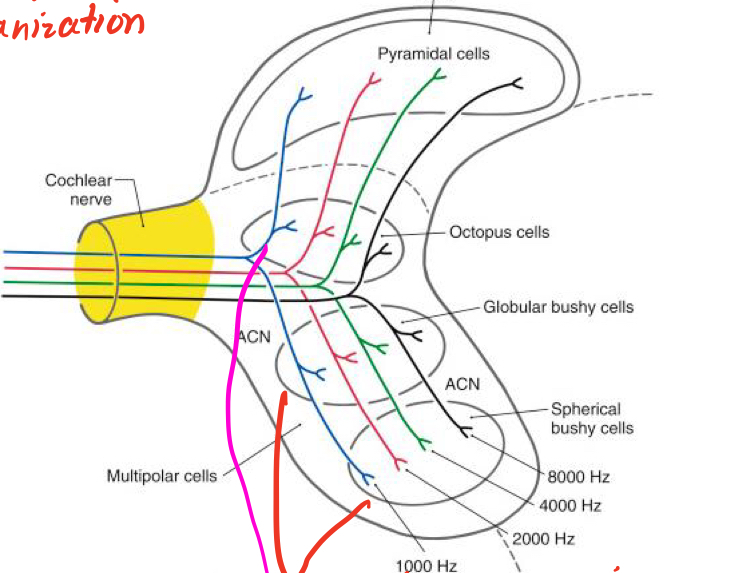
- Primary afferents descend or ascend to synapse on ventral or dorsal cochlear nuclei in the brainstem
2
Q
- What is the function of the dorsal cochlear nucleus?
- It is part of what auditory tract?
A
- Receives primary afferent fibers containing information on:
- Identifying sound source elevation
- Identifying complex spectral characteristics of sounds
- Monaural (Dorsal and Monaural both have an O)
3
Q
- What is the function of the ventral cochlear nucleus?
- It is part of what auditory tract?
A
- Receives primary afferent fibers from the cochlear portion of CN VII
- Horizontal localization of sound
- Anterior and posterior subdivisions (see physio)
- Binaural
4
Q
- Describe the monaural tract
A
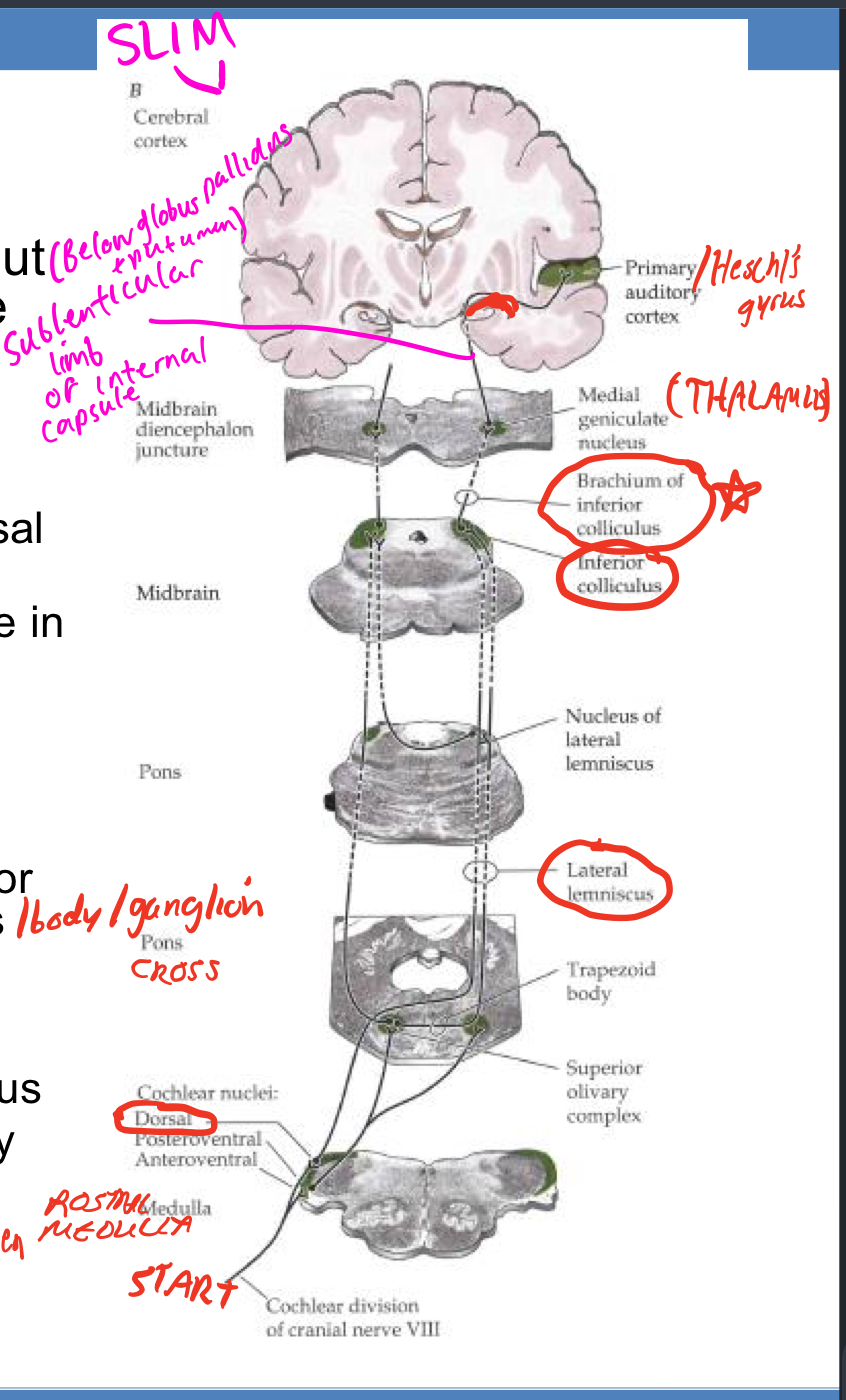
- Primary afferents from cochlear portion of CN VIII travel to the dorsal cochlear nucleus where they will synapse
- FIbers then CROSS and ascend in the lateral lemniscus
- These fibers will synapse on the inferior colliculi
- Axons from the inferior colliculi will travel through the brachium of the inferior colliculi to the medial geniculate nucleus (remember SLIM mnemonic for superior and inferior colliculi)
- Fibers from MGN will ascend thru the sublenticular limb of the internal capsule and travel to the primary auditory cortex
5
Q
- Describe the binaural tract
A
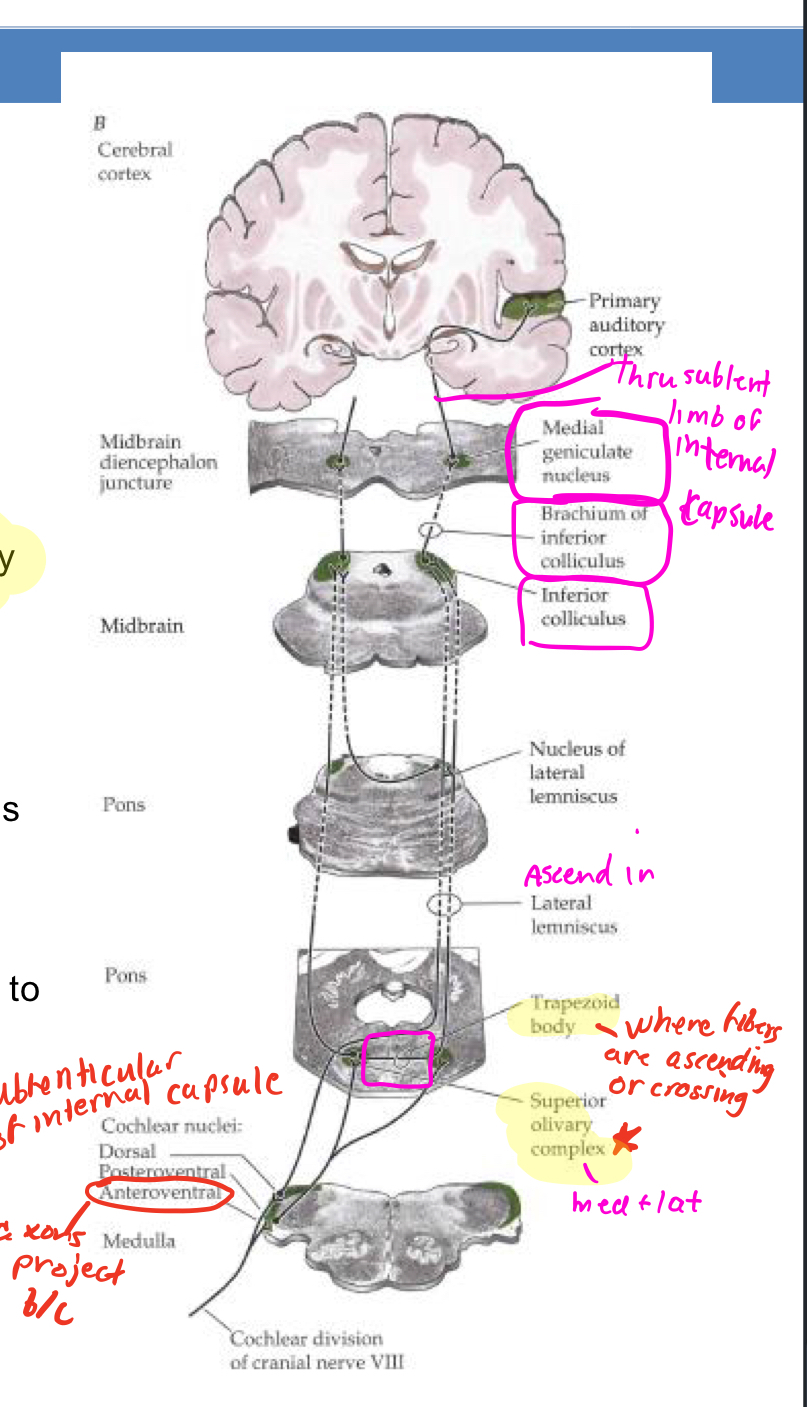
- Primary afferent fibers of cochlear portion of CN VIII synapse in ventral cochlear nucleus
- Axons project BILATERALLY by passing thru the trapezoid body to the superior olivary complex (pons)
- Cell bodies from medial and lateral olivary nucleus ascend in lateral lemniscus to the inferior colliculus
- Axons from inferior colliculus will travel through the brachium of the inferior colliculus to the MGN (medial geniculate nucleus) of the thalamus
- Axons from MGN will travel through SUBLENTICULAR LIMB of the internal capsule and synapse on cells of primary auditory cortex
6
Q
- What layer of the primary auditory cortex do cells from the MGN synapse in?
- What is another name for the primary auditory cortex?
A
- Layer IV
- Heschl’s gyrus
7
Q
- What are two rules to consider when discussing monaural and binaural auditory tracts?
A
- All nerve fibers from cochlea will synapse in one of the cochlear nuclei (ventral or dorsal or both)
- Fibers in brainstem cross multiple times
- ALL fibers will synapse in the following areas
- Inferior colliculus
- MGN
- Primary Auditory Cortex
8
Q
- Lesions that occur in the brainstem and damage the vestibulocochlear n will or will not cause deafness?
A
- Will not.
- Fibers cross too many times at that point
- Will have issues localizing sounds but will still be able to hear
9
Q
- Where are three places that auditory nerve fibers cross?
A
- Trapezoid body (between medial and lateral superior olivary nuclei)
- Lateral lemniscus
- Brachium of inferior colliculus
10
Q
- Conduction deafness versus
- Sensorineural deafness versus
- Central deafness
A
- Conduction deafness
- Problems with external or middle ear
- Can’t conduct sound from the outside world into the inner ear
- Transformation of sound to the tympanic membrane or thu ossicle chain
- Sensorineural (Nerve) deafness
- Damage to cochlea
- Damage to cochlear part of CN VII or cochlear nuclei
- Ipsilateral nerve deafness (fibers have not crossed yet)
- Central
- Damage to the central pathways (aka areas in the brainstem)
11
Q
- What does the basilar a. supply?
A
- Cochlear
- Auditory nuclei of pons and medulla
12
Q
- What does the labyrinthe (internal auditory) a. supply?
- What is it a branch of?
A
- Branch of AICA
- Supplies inner ear and cochlear nuclei (esp in medulla)
13
Q
- What happens if there is an occlusion of the AICA
A
- Monaural hearing loss (supplying cochlear nuclei in medulla before they have had the opportunity to cross?)
- Can also damage facial nerve (Bell’s Palsy-ipsilateral facial paralysis) and pontine gaze center (inability to look towards side of lesion)
14
Q
- What do short circumferential branches of the basilar a supply?
A
- Superior olivary complex
- Lateral lemniscus
15
Q
- What do the superior cerebellar and quadrigeminal a’s supply?
A
- Inferior colliculus
16
Q
- What do the thalamogeniculate arteries supply?
A
- Medial geniculate bodies of thalamus
17
Q
- What does M2 supply?
A
- M2=branch of middle cerebral a.
- Supplies primary auditory and association cortices
18
Q
- What makes up Wernicke’s area and what is its function?
- On what side is it most common (AKA dominant side)?
A
- Wernicke’s area:
- Supramarginal gyrus (part of parietal)
- Angular gyrus (part of parietal)
- Parts of superior temporal gyrus
- Function
- Comprehension of spoken language
- Most people-LEFT hemisphere
19
Q
- What makes up Broca’s area? What is the function of this area?
- What lobe is it dominant in?
A
- Broca’s area
- Opercular gyrus
- Triangular gyrus
- Both of these gyri are parts of the inferior frontal gyrus
- Function
- Instruction for language output
- Planning movements to produce speech
- Grammatical function of words (no ifs, ands or buts)
- LEFT hemisphere
20
Q
- What is the function of non-dominant lobe Wernicke area?
A
- Interpreting nonverbal signals
- EX: Shrugging shoulders means IDK
21
Q
- What is the function of the non-dominant Broca’s area
A
- Instructions for producing non-verbal communication
- Emotional gestures (flipping someone off)
- Intonation of speech (George is here. vs George is here?)
22
Q
- What is the pathway of auditory information from the primary auditory cortex to the action of producing actual speech?
A
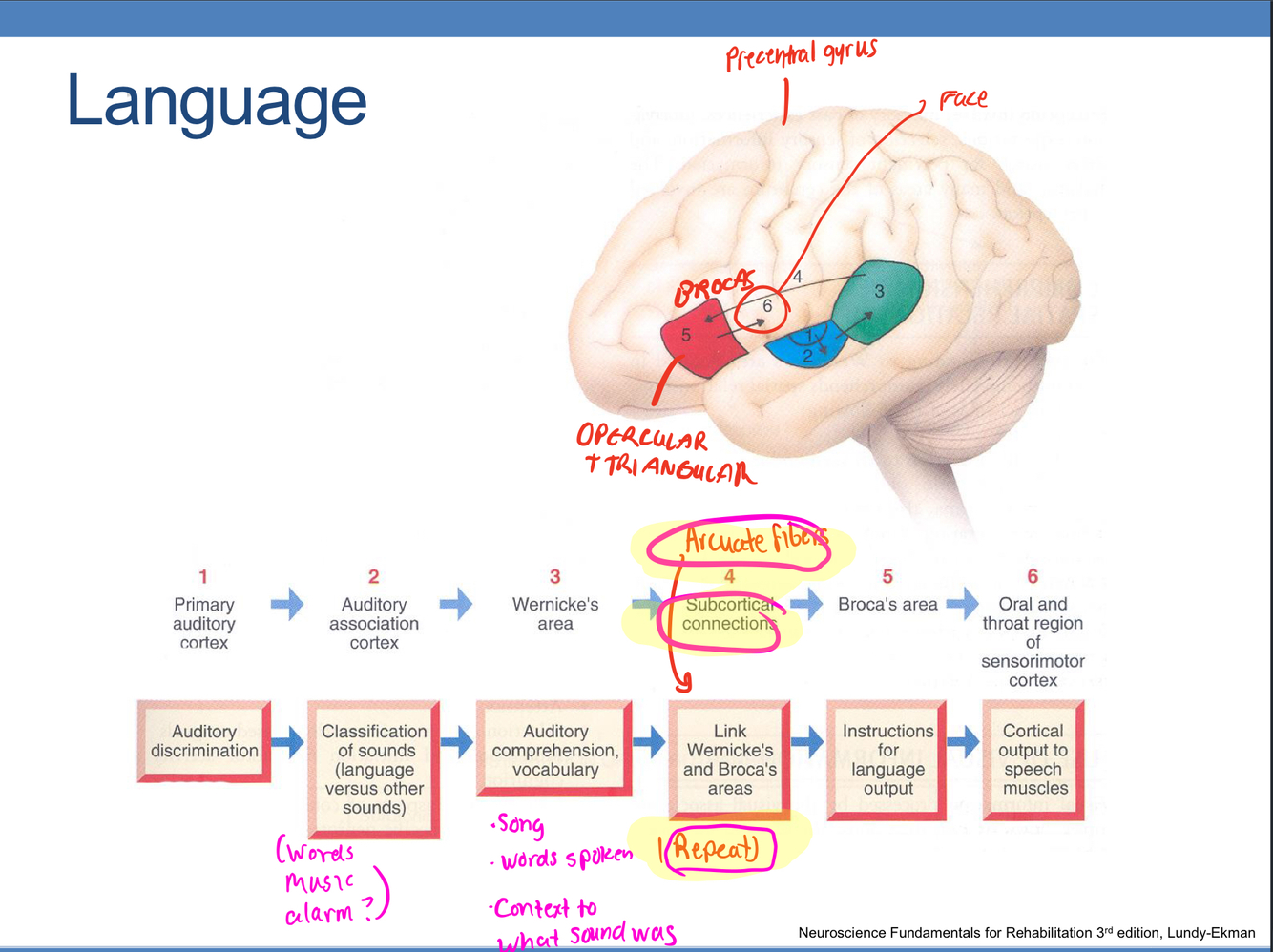
- Auditory discrimination (Primary auditory Cortex)
- Classifying sounds (Auditory association cortex)
- Auditory comprehension (Wernicke’s)
- Linking understanding area (Wernicke’s) to speech area (Broca’s) via Arcuate fibers
- Instruction for language output (Broca’s)
- Cortical output to speech muscles (Oral and throat region of sensorimotor cortex)
23
Q
- Visual word form area is important for what activity?
- Lateral temporal cortex is important for _
A
- Reading
- Semantic knowledge (reading/seeing the word cat and knowing what that means)
24
Q
- Auditory agnosia
A
- Inability to describe a sound that has been heard
- LESION IS UNIMODAL SENSORY ASSOCIATION CORTEX B/L (B/L TEMPORAL LESIONS REQUIRED TO DEVELOP AUDITORY AGNOSIA)
- Damaging transverse temporal gyrus of Heschl
25
* ***Broca's Aphasia (Expressive aphasia/Non-Fluent Aphasia)***
* *******Where is the lesion?* *Are the following functions intact?***
* *Fluent?*
* *Grammar?*
* *Comprehension?*
* *Naming?*
* *Repitition?*
* Lesion in **left inferior frontal gyrus (Broca's area)**
* Non-fluent (impaired word formation)
* Impaired grammar
* Comprehension impaired for complex sentences
* Naming is preserved
* Repitition impaired for complex sentences
These people can understand what you are saying, but have a difficult time responding to what you are saying d/t inability to produce affluent speech
26
* ***Wernicke's aphasia (Receptive or Fluent Aphasia)***
* ***Where is the lesion?***
* ***Are the following functions present?***
* ***Fluency***
* ***Grammar***
* ***Comprehension***
* ***Naming***
* ***Repitition***
* **Lesion in left superior temporal gyrus, inferior parital lobule, posterior middle temporal gyrus**
* Are fluent
* Grammar may be normal
* Comprehension _impaired even for single words_
* Naming is impaired
* Repetition impaired for single words
27
* ***Conduction Aphasia***
* ***Where is the lesion?***
* ***Are the following functions present/absent?***
* ***Fluency***
* ***Grammar***
* ***Comprehension***
* ***Naming***
* ***Repitition***
* **Lesion of arcuate fasciculus**
* Non-fluent
* Grammar is preserved
* Comprehension is normal
* Naming is preserved
* **Repitition is preserved**
28
* ***Transcortical motor lesions***
* ***Where is the lesion located?***
* ***Are the following functions absent/present:***
* ***Fluency***
* ***Grammar***
* ***Comprehension***
* ***Naming***
* ***Repitition***
* **Lesion in ACA-MCA watershed area**
* Nonfluent
* Grammar is preserved
* Comprehension is normal
* Naming is preserved
* Repitition is preserved
29
* ***Transcortical sensory lesions***
* ***Where is the lesion located?***
* ***Are the following functions present/absent:***
* ***Fluency***
* ***Grammar***
* ***Comprehension***
* ***Naming***
* ***Repitition***
* **Lesion in MCA-PCA watershed regions**
* Fluency is normal
* Grammar preserved
* Comprehension is impaired
* Naming is impaired
* **Repitition is preserved**
30
***Global lesions***
* **Type of non-fluent aphasia**
* **LESION OF LATERAL SULCUS (hitting both Broca's and Wernicke's)**
* **Usually MCA issue**
*
31
* Transcortical lesions
* Sensory or motor
* Can repeat
32
* **Conduction aphasia**
* Type of fluent aphasia
* Lesion of supramarginal gyrus and arcuate fasciculus
* Can't repeat

Neuro Exam 3
flashcards
Decks in class (14)
# Cards
-
Cerebellum44
-
Vestibular System43
-
Visual Tracts50
-
Physiology of Visual System35
-
Basal Ganglia23
-
Voluntary Motion37
-
Auditory Tracts32
-
Control of Eye Movements23
-
Physiology of the Auditory and Vestibular Systems35
-
Case Studies0
-
Histo0
-
Neuroanatomy of Taste and Olfaction0
-
Physiology of Olfaction and Gustation0
-
Hypothalamus0



