1
Q
- Components of the vestibular system
A
- Peripheral receptor apparatus
- Central vestibular nuclei
- Vestibuloocular network
- Vestibulospinal netwoark
- Vestibulothalamocortical network
2
Q
Function of the peripheral receptor apparatus
A
- Inner ear
- Transducing head motion/position
3
Q
- Location/Function of central vestibular nuclei
A
- Integrating and distributing info that controls motor activity and spatial orientation
- Located in brainstem
4
Q
- Location/Function of vestibuloocular network
A
- Location-vestibular nuclei
- Control of eye movements
5
Q
- Function of vestibulospinal network
A
- Coordinates head movements, axial muscles, postural reflexes
6
Q
Function of vestibulothalamocortical network
A
- Conscious perception of movement-spatial orientation
7
Q
- The vestibular labyrinth has _ separate receptor structures
- What are the two components of the labyrinth?
A
- 5
- 3 semicircular canals
- 2 otolith organs
- Bony labyrinth
- Shell that houses fluid-filled membranous labyrinth
- Membranous labyrinth
- Connecting tubes and prominences houses vestibular receptors
8
Q
- Space between membranous and bony labyrinth contains _ fluid (similar to CSF)
- Space withinthe membranous labyrinth is filled with _
- Different ionic concentrations between the two fluids is maintained by _ in the membranous labyrinth and endolymphatic sac
A
- Perilymph
- Endolymph
- Secretory cells
9
Q
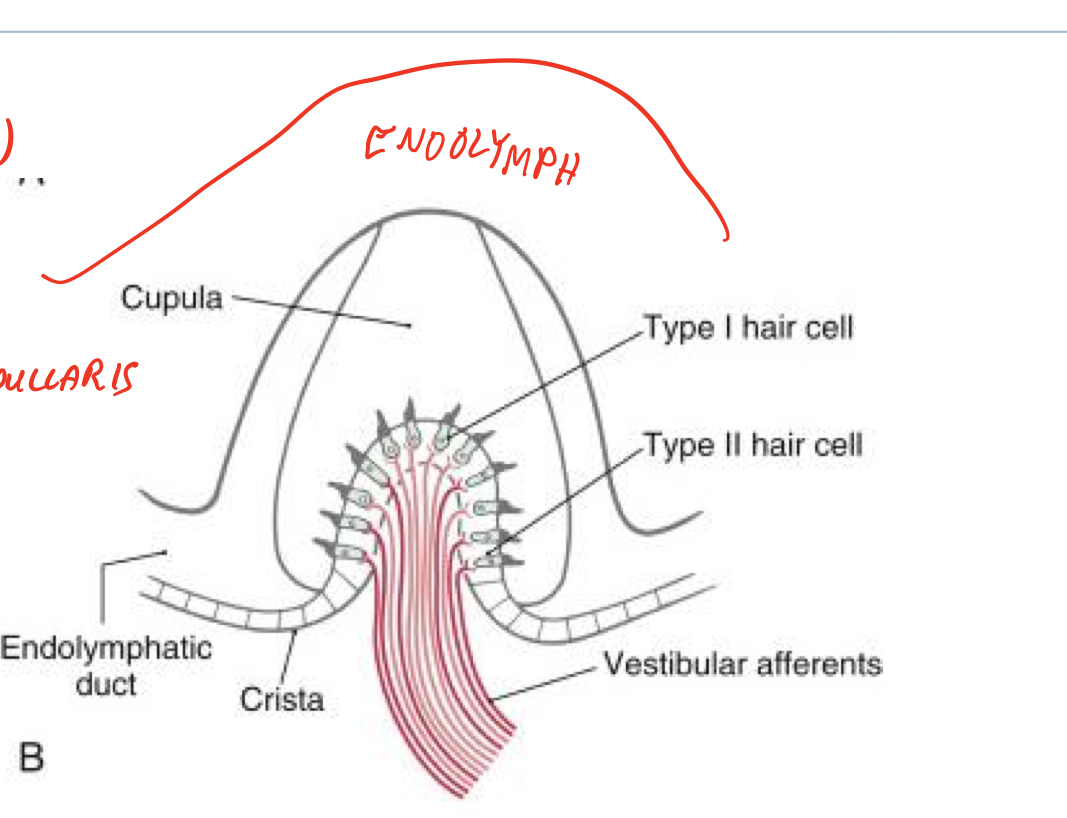
- What are semicircular canals responsible for sensing?
- What innervates them?
A
- Rotational head movements/angular accelerations
- Vestibular ganglion/Scarpa (primary afferent fibers)
10
Q
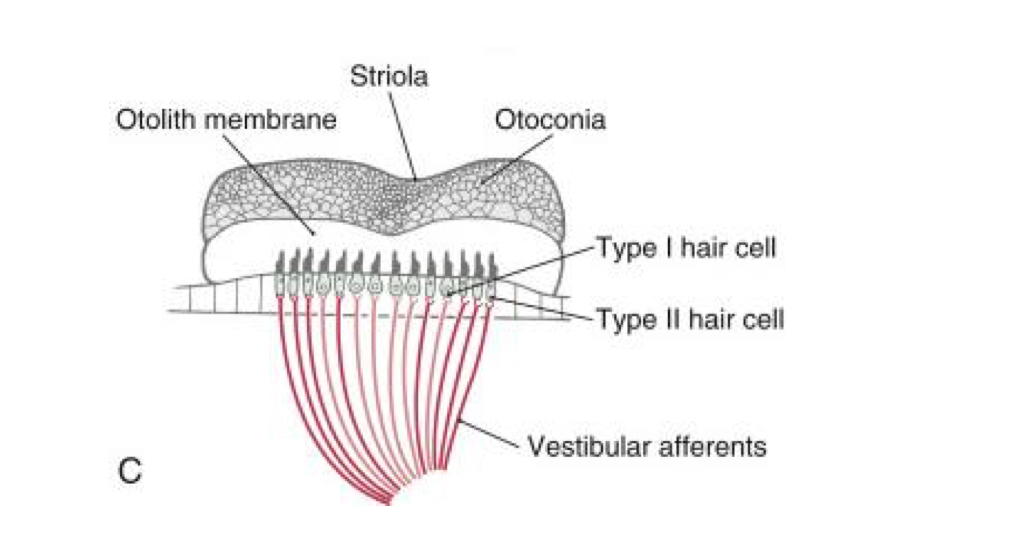
- What are otolith organs sensitive to?
- What innervates them?
A
- Translational head movements/linear acceleration
- Vestibular ganglion/Scarpa’s ganglion (primary afferent fibers)
11
Q
What is the blood supply to the labyrinth?
A
- Labyrinthe a (branch off AICA)
- Enters temporal bone thru internal auditory meatus
- Stylomastoid a. (semicircular canals)
- Not primary supply
12
Q
- Membranous labyrinth
- Enlargements of ends of ducts= _
- Receptors in the _ are oriented horizontally/longitudinally
- Receptors in the _ are oriented vertically
A
- Ampulla (contains sensory receptors for the semicircular canals))
- Utricle
- Saccule (ball sacs are vertical #madisonfacts)
13
Q
- _ (the fluid of the membranous labyrinth) is drained into the _ via small ducts
- Sinus communicates through the endolymphatic duct with the _ (located adjacent to the dura mater)
A
- Endolymph, Endolymphatic Sinus
- Endolymphatic sac
14
Q
- Saccule of the membranous labyrinth is connected to the cochlea via _
A
- Ductus reuniens
- (Family reunion between the saccule and the cochlea)
15
Q
- Meniere’s Disease
A
- Increase in endolymph volume-abnormal distension of membranous labyrinth
- Symptoms
- Fluctuating hearing loss
- Vertigo
- Positional nystagmus
- Nausea
- Unpredictable attacks of auditory and vestibular symptoms (vomiting, tinnitus, inability to make head movements or stand passively)
- Treatment
- Diuretic and salt restricted diet-reduces hydrops
- Implantation of shunt to drain swollen endolymphatic sac
16
Q
- What is the long sensory hair cell called?
A
- Kinocilium
17
Q
- What are the two types of vestibular sensory receptors?
- From where do they receive their input?
A
- Type I
- Chalice shaped
- Surrounded by afferent termina (nerve calyx)
- Type 2
- Cylindrical
- Innervated by synaptic buttons
- Both receive synapses from vestibular efferents that control receptive sensitivity
18
Q
- Ampulla
- Hair cells embedded in _ that extends across base
- Type I cells occupy _ region
- Type II cells occupy _ region
- Enveloped in _
A
- Crista
- Central
- Peripheral
- Cupula (gelatinous structure)
19
Q
- How does transduction of signals from the ampulla (semicircular canals) work?
A
- Rotational head movements produce angular accelerations
- Endolymph is displaced
- Pushes cupula to one side or the other
- Displace steriocilia in same direction
(Remember that you are stimulating one side but inhibiting the other)
20
Q
- Macula
- Hair cell stereocilia extend into _ membrane covered by _ (more dense than surrounding endolymph and not displaced by normal endolymph movements)
A
- Otolith membrane covered by otoconia (carbonate crystals)
21
Q
- How does transduction of signals in the macula work?
A
- Changes in head position relative to gravity and linear accelerations(forward/backward/upward/downward) displace the otoconia
- Displacement of otoconia bends underlying hair cell stereocilia (activating or inhibiting signal based on the direction of movement)
22
Q
- Functions of the vestibular nuclei
- Targets of the vestibular nuclei
A
- Functions
- Positional movement information processing
- Control of visual and postural reflexes
- Target
- Oculomotor nuclei
- Vestibulocerebellum
- Contralateral vestibular nuclei
- SC
- Reticular formation
- Thalamus
23
Q
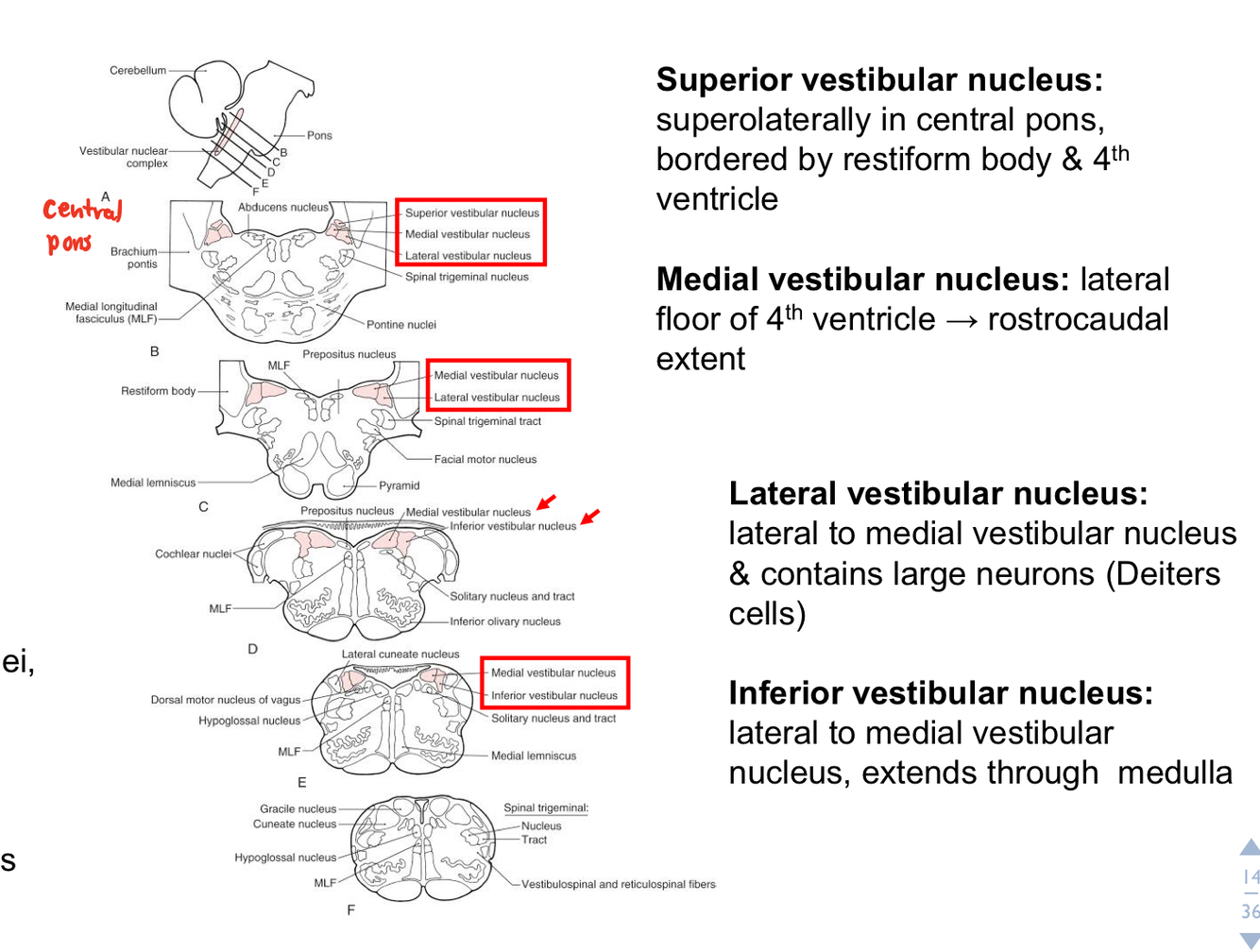
- Location of:
- Superior vestibular nucleus
- Medial vestibular nucleus
- Lateral vestibular nucleus
- Inferior vestibular nucleus
A
- Superior vestibular nucleus
- Superolat central pons
- Medial vestibular nucleus
- Lateral floor of 4th ventricle
- Lateral vestibular nucleus
- Lateral to medial (shocker)
- Contains Deiters cells
- Inferior vestibular nucleus
- Lateral to medial
- Extends thru medulla
24
Q
- Afferents from semicircular canals (ampulla) project to what vestibular nuclei (primarily)?
- Afferents from otolith organs (maculae) project to what vestibular nuclei?
- Afferents from the saccule project to _ nucleus and influence vertical eye movements
A
- Superior, medial
- Lateral, medial, inferior
- CONTRALATERAL OCULOMOTOR
25
* _ fibers go through juxtarestiform body (part of inferior cerebellar peduncle) and send projections to _ and _ nuclei of the cerebellum (and terminate as mossy fibers)
* Vestibular nuclei send _ projections to fastigal and dentate nuclei
* Primary vestibulocerebellar fibers (from fastigal)
* Dentate and fastigal
* Secondary vestibulocerebellar
26
* What afferent fibers arise from all vestibular nuclei?
* What nuclei are they more prominent in?
* What is their function?
* Vestibulovestibular nuclei
* Superior and medial
* Reciprocal connections w/ contralateral nucleus
27
* What afferent vestibular fibers arise from all levels of the spinal cord?
* Which vestibular nuclei do they provide input to?
* Spinovestibular
* Proprioceptive input to medial and lateral vestibular nuclei
28
* Besides the spinal cord, cerebellum and other vestibular nuclei, where else can vestibular nuclei neurons receive input from?
* Reticular formation
* Raphe nuclei
* Thalamus
* Cortical regions
29
* Vestibuloocular reflex
* Compensatory (equal in magnitude and opposite direction)
* Any direction or speed of head movement (we talked about horizontal)
30
* Can the vestibuloocular reflex be suppressed?
* Yes-for example when you are focusing on a moving target (catching a football while running a route)
31
* ***MOA of the Vestibuloocular reflex***
1. Primary afferents from horizontal semicircular canals project to specific neurons in medial and lateral vestibular nuclei
2. Send axons thru MLF to contralateral abducens nucleus
3. Abducens motor neurons send excitatory stimulus via CN VI to ipsilateral lateral rectus m.
4. Abducens interneurons send excitatory impulses to the contralateral oculomotor nucleus to innervate medial rectus m.
A second set of vestibular neurons send excitatory signals to ipsilateral oculomotor nucleus (medial rectus m.)
A third set of vestibular neurons carry inhibitory signals to ipsilateral abducens nucleus

32
* ***Nystagmus (how does it work?)***
* **Slow phase**
* Vestibuloocular reflex sending signals to your eyes to look opposite the direction that your head is turning (EX: Looking to the right when turning head left)
* Eventually eyes reach a limit of how far they can turn
* **Fast phase**
* Eyes rapidly spring back to central position
* Then will move in the same direction as head (EX: Turning head to left, eyes will look left)
* Another slow phase begins
* Continuation of slow and fast phases=nystagmus
33
* ***What test can you use to test for nystagmus?***
* Caloric test
* Introducing warm or cold water to the external auditory canal
* Warm water-nystagmus beats to same side
* Cold water-nystagmus beats to opposite side
* COWS nystagmus mnemonic
34
* ***Unilateral lesions of the vestibular pathway result in a reduced of absent nystagmus \_***
* IPSILATERALLY
35
**LVST (lateral vestibulospinal tract)**
**Neuron location**
**Where are projections going (are they ipsilateral or contralateral)**
**Where do they travel through**
**Where do they terminate**
**Overall Function**
* Neurons in lateral and vestibular nuclei
* Projects to all levels of ipsilateral SC
* Anterorostral-cervical cord
* Posterocaudal-lumbosacral cord
* Fibers go through lateral medulla and anterior funiculus of SC
* Terminate on alpha and gamma motor neurons and interneurons in laminae VII to IX
* Coordination of postural control
36
* MVLT
* Nuclei location
* Receives input from?
* Where do fibers descend?
* Where do fibers terminate?
* Functions?
* Nuclei-primarily medial vestibular (some lateral and inferior)
* Vestibular receptors, cerebellum, PCMLS in SC
* Fibers descend thru MLF
* Terminat in lamina VII to IX of cervical spinal cord
* Neck flexion and extension (stabilize neck in vestibulocolic reflex)
37
What part of the thalamus do vestibular nuclei send projections to?
* VPL
* VPI
* Sensory and vestibular stimulation (some)
* Some specific to vestibular stimulation
* Anterior pulvinar (dorsal to VPL)-also receives inputs
38
* What cortical regions does the vestibular system send projections to?
* Area 2v and 3a (Primary somatosensory cortex)
* 2v-whole body motion
* 3a-head and body
* Area 7 (Parietal cortex)
* Spatial coding
* Body motion in space
* **Lesions-agnosia-confusion of spatial awareness**
* Insular areas of lateral sulcus and PIVC (parietoinsular vestibular cortex)
* **PIVC lesions-episodes of vertigo, unsteadiness, and loss of perception for visual vertical**
* Prefrontal cortex and superior central gyrus
* Related to frontal eye field
* Saccades and smooth pursuit eye movements
39
* ***Dizziness***
* Nonspecific-may or may not involve feelings of movement
* Not necessarily vestibular in origin
40
* ***Vertigo***
* Illusion of body motion (spinning/turning) when no motion is happening
* **Subjective-**patient experiences sensation of moving while things aren't
* **Objective-**sensation of objects moving while patient is still
41
* ***Benign Paroxysmal Positional Vertigo***
* Episodes of vertigo w/ changes in body position (turning in bed, getting up in morning, bending over, rising from bent position)
* **Otoconial crystals from utricle separate from otolith membrane and lodge in cupula of semicircular canal (cupulolithiasis)**
* **Produces abnormal cupula deflections when head changes position relative to gravity**
42
***Vestibular Schwannoma***
Benign tumor originating from Schwann cells of vestibular root
Usually @ cerebellopontine angle where it impinges on structures in internal acoustic meatus (CN VII, CN VIII, Labyrinthe a.)
Hearing loss, gait difficulties, tinnitus
43
* ***Vestibular Neuritis***
* Edema of vestibular n or ganglion (from viral infection (EX: HSV, URI, cold, flu)
* Symptoms
* Vertigo
* Nausea
* Vomiting
* _No hearing loss_

Neuro Exam 3
flashcards
Decks in class (14)
# Cards
-
Cerebellum44
-
Vestibular System43
-
Visual Tracts50
-
Physiology of Visual System35
-
Basal Ganglia23
-
Voluntary Motion37
-
Auditory Tracts32
-
Control of Eye Movements23
-
Physiology of the Auditory and Vestibular Systems35
-
Case Studies0
-
Histo0
-
Neuroanatomy of Taste and Olfaction0
-
Physiology of Olfaction and Gustation0
-
Hypothalamus0



