How do marine organisms not only survive but become successful in some of the most challenging ecosystems?
- Physiology is the study of the function of animals and their constituent parts. A basic understanding of these functional processes allows us to study responses to environmental variability. What is it about these organisms that allow them to survive in their habitat.
- Reproductive success is part of the calculation for fitness and a key element in the theories of natural selection and evolution
- Behaviour, from mating to foraging and avoiding predation an understanding of behavioural patterns provides insights into the adaptive ecology of a species or taxa. To avoid predation, improve mating success with migrations ect.
What are the potential challenges posed by of some of our familiar marine environments?
Examples; Deep-sea
- Pressure, overcome with biochemical and morphological adaptations
- Temperature – cold and hot!
- Finding food – finding mates - low densities
- Aphotic
- Anoxia
What are the potential challenges posed by of some of our familiar marine environments? Examples; Open ocean
UV irradiation, plants with UV filtering chemicals
Finding food and avoiding being eaten
What are the potential challenges posed by of some of our familiar marine environments? Examples; Estuaries
- influence of freshwater input
- Salinity
- Osmoregulatory adaptations
- Anoxia
What will marine environments may exhibit variability in?
- Salinity
- pH
- Temperature
- Oxygen
- Irradiation
- Population size
- Food availability (prey abundance)
- Predator abundance
However, organisms in these environments may not find them to be challenging
As they exhibit varying degrees of adaptation over different time-scales.
External – abiotic characteristics
Ecology of animals also allow organisms to survive in different habitats
What are the different types of extremophiles?
- Thermophiles - High temp over 45 degrees. (hydrothermal vents)
- Psychrophile (Cryophile) Low temperatures - sub 15 degrees. (Low temperatures)
- Halophile - salt loving 5x seawater (supersaline brine)
- We are most interested in highly fluctuating salinity - most literature on high altitude lakes.
- Barophile (Piezophile) High pressures (1100atm, 117 Mpa)
Describe thermophiles
- Majority are Archaea
- Thrive at temperatures above 45oC
- Often found in geothermally heated regions
- deep-sea hydrothermal vents
- Contain enzymes that can function at high temperatures, and does not disrupt the folding mechanisms of the protein.
- Can be classified as OBLIGATE (require high temp) or FACULTATIVE (tolerant of high temperatures)
- Some require high temperatures for growth others can thrive over a range of temperatures
Give an example of a eukaryotic thermophile?
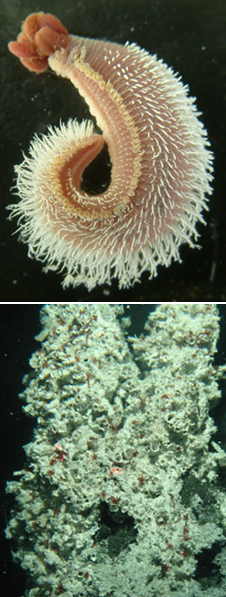
Alvinella pompejana
- Deep-sea polychaete (up to 15cm)
- Only found at Pacific vents attached to smoker chimneys
- Thrive at temperatures up to 80oC
- One of the most heat tolerant complex organisms
- Live in thin-walled tubes
- Posterior end exposed to high temperatures
- Head and gills in 22oC
- Covered in white bacteria, provide food and protection from heat
- Huge temp variability over the length of the worm from inside the black smoker to the waters outside
Describe psychropiles
- Majority are Bacteria or Archaea
- Capable of growth and reproduction at temperatures below 15oC
- Often found in high latitude waters and the deep oceans
- Utilise a range of metabolic pathways
- Maintenance of functional lipid membranes
- lipid cell membranes chemically resistant to the stiffening caused by extreme cold
- Create protein ‘antifreezes’ to keep their internal space liquid and protect their DNA
- Average temperature of the Antarctic sea is -1.8 degrees
- Overcome problems of lipids becoming stiff and inflexible
Describe eukaryotic Psychrophiles.
- Antarctic water is very cold (1°C to -1.8°C) - slows larval development
- Antarctic krill, associated with ice edge
- Problems associated with ice – being frozen
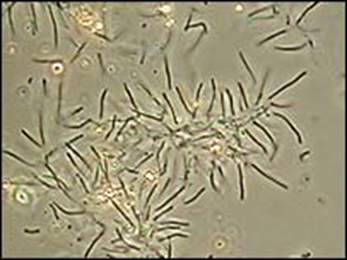
Describe halophiles
- Majority are Bacteria or Archaea
- Very high saline conditions
- Categorised as slight, moderate or extreme, by the extent of their halotolerance
- Expend energy to exclude salt from their cytoplasm to avoid protein aggregation
- prevent desiccation, through osmotic movement of water out of their cytoplasm,
- Specialised pigments for converting light to energy as they cannot fix CO2
- Conduct photosynthetic reactions with a red retinal pigment rather than chlorophyll
- Red pigment such as rhodopsin to create energy
What is the term for existing in a broad range of salinities, and explain.
- Euryhaline
- Exist and can be found in a broad range of salinities,
- Carcinus meanus, Salmon – migrations, Eel
- Dessication, freezing, over-heating, Osmoregulation
Under pressure: reproduction in deep-sea echinoids
- Echinus affinis – Young & Tyler 1993
- Seasonally reproducing, lives at bathyal depths (~2000m) in NE Atlantic
- Embryos developed more rapidly at 200atm than at 100atm
- At 0atm and 50atm fertilisation membranes formed and nuclei cleaved but cytoplasmic division was inhibited
- Low pressures may be as lethal for deep-sea embryos as high pressures are for shallow-water species
- Surface pressure embryos don’t develop / cleave
- Require high pressure for reproduction to work
Talk about the generation of ATP in terms of what we need to know.
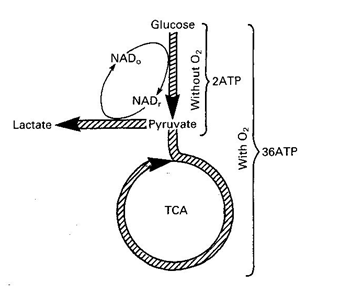
- Glucose is a fuel
- Glycolysis occurs in cytoplasm – no O2
- TCA cycle occurs in mitochondria – O2
- NADr (co-enzyme)donates electrons – oxidised
- More ATP molecules with O2
- The level of understanding that is required - oxygen is required as allows extra ATP to be produced.
Uptake of oxygen - describe diffusion.
- Aerobic metabolism depends on the availability of oxygen to the tissues
- DIFFUSION – O2 molecules moving from high to low partial pressure (PO2)
- Oxygen diffuses down a pressure gradient
- Rate of diffusion depends on PO2 gradients and tissue properties
- Diffusion coefficients and O2 demands dictate that the distance between metabolising tissues and respiratory surface can be no more than 1mm
- Easy for a flatworm
- Oxygen rapidly bound after passing through the barrier in larger organisms.
- This transports the oxygen, but also maintains the gradient allowing oxygen to continue to diffuse.
Describe circulatory systems.
- Increase capacity for O2 transport
- Rapidly remove O2 from respiratory surfaces – steep PO2 gradient
2 main systems:
- Both require muscular pumps
- Open System - Large haemocoel
- Contractile tubes and valved ostia
- Arthropods and molluscs
- Closed system – Arteries and veins
- Muscular pulsing blood vessels (‘lateral’ hearts)
- Annelids
What are respiritory pigments?
Blood is primitively colourless and close in composition to seawater – gastropods and bivalves
- Respiratory pigments - specialised proteins capable of binding with O2
- Consist of proteins linked to a prosthetic group containing a metal
- Prosthetic groups can be porphyrins (haem) or polypeptides.
Describe three respiritory pigments.
Haemcyanin
- Contains copper, carried in solution. Blue when oxygenated, colourless when deoxygenated
- Molluscs: chitons, cephalopods, gastropods, crabs and lobsters
Haemerythrin
- Contains Iron, always cellular. Non-porphyrin structure. Violet in colour
- Sipunculans, Polychaetes, Priapulans, Brachiopods
Haemoglobin
- Iron-porphyrin protein in solution or cellular. Red in colour
- Vertebrates, Echinoderms, Crustaceans: Daphnia and Artemia, Annelids; Arenicola, Spirorbids Nematodes: Ascaris
What does the amount of O2 carried depend on?
Amount of O2 carried depends on quantity of pigment and OXYGEN AFFINITY
Importance of O2 uptake relative to availability (ambient PO2)
What is a P50?
OXYGEN DISSOCIATION CURVES – P50 (half saturation value of pigment)
P50 values can vary with temperature, pH and PO2
Describe how the enviroment affects the P50 values.
Pigment variability
Animals living in high ambient PO2 have high P50. Sabella, Loligo and Nephtys*
P50s can be low even at high PO2 when respiratory surfaces present a diffusion barrier. Decapods
P50s very low (<1) in low ambient PO2. Polluted or anoxic environments. Arenicola.
Why does the bohr effect occur?
The Bohr Effect describes the relationship between the partial pressure of carbon dioxide and the oxygen affinity of the respiratory pigment haemoglobin (). An enzyme, carbonic anhydrase within the haemoglobin molecule converts most of the carbon dioxide into carbonic acid, which further dissociates into protons and hydrogen-carbonate ions, which decrease the pH of the blood outside the cell. Protons will bind to the surface amino acids on the protein and cause a shift in the structure towards a T-shape form. This creates an equilibrium between the concentration of protons and the structure of the protein. A shift towards the T-form will inhibit the proteins oxygen carrying capacity, decreasing the oxygen affinity of haemoglobin ().
What P50 would be expected from the lug worm?
Arenicola – low P50; burrows in deoxygenated muds, irrigates burrow but not continuously so high-affinity pigments are advantageous as O2 store
What do alrger organisms require for oxygen uptake?
- Size of respiratory surface is another limitation on oxygen uptake
- Increase in size, activity and evolution of protective and impermeable coverings requires VASCULARISED RESPIRATORY SURFACES
- Increase surface area by EVAGINATION
- ‘Gills’ in polycheates and arthropods, CTENIDIA in molluscs

-
Basic Physiology54
-
Osmoregulation29
-
Invertebrate locomotion18
-
Temperature, desiccation and exposue13
-
Polar seas: Adaptation to the cold27
-
Adaptations to the warm11
-
Transparency and camoflauge16
-
Reproductive patterns22
-
Reproduction in the deep sea11
-
Chemosynthetic pigments25
-
Vision and Light15
-
Life in the dark22
-
Buoyancy26
-
Adaptations to low food20
-
Adaptation to low food - pelagic14
-
Biological rhythms19
-
Per43
-
Plastic and POPs6
-
WR Osmoregulation14
-
WR Reproduction (9, 10)13
-
WR Chemosynthetic (12)9
-
WR Vision (13, 14, 15)12
-
WR Adaptations to low food (18, 19)8
-
WR Buoyancy, Colour and Micro plastics17
-
WR Marine Mammal34
-
WR Sharks and fishes3
-
WR locomotion and temperature (5,6)18



