What is buoyancy?
Buoyancy
An upward force exerted by a fluid (liquid or gas) that opposes the weight of an immersed object.
What are the different types of buoyancy?
- Positive buoyancy is when the upward force exceeds the downward force (weight or mass + gravity)
- Negative buoyancy is when the upward force does not exceed the weight
- Neutral buoyancy is when the upward force equal the downward force (weightlessness)
What does neutral buoyancy allow species to
- Neutral buoyancy allows species to minimise the energy cost of staying or moving laterally at a particular depth
- Fish can exert a propulsive force >25-50% of its body weight for only brief periods of time.
- Continuous effort to support its body by muscular power alone would be energetically costly.
- Reducing the weight of the body in water makes propulsion easier, and energetically less costly
What does this equation show us?

The resulting force (FR) acting upon an animal in water can be calculated using:
Where:
FR =Resulting force (N)
FB =Buoyancy force (N)
FW =Wet weight (N)
FD =Drag force (N)
Fnb =Net buoyancy (N)
Animals are constantly balancing forces to maintain buoyancy.

The are 4 main strategies used in buoyancy:
- Incorporation of a swimbladder as a low-density gas-filled space.
- Incorporation of large quantities of low-density compounds in the body
- Generation of lift using shaped and angled fins and body surfaces during propulsion
- Reduction of heavy tissues such as bone and muscle.
Most species will adapt with a swim bladder of low-density compounds with either being combined with weight reduction measures and/or lift generation.
Where is the swimbladder located?
- The swimbladder is approximately oval shape but can vary among species.
- Located in the abdominal cavity just below the spinal cord.
- Due to specific gravity differences of seawater and freshwater, marine swimbladders occupy 5% of fish, but 7% of freshwater fish.
How do fish maintain swimbladder buoyancy when changing depth?
Fish only remain neutrally buoyant at one depth, therefore if there is vertical movement they have to be able to adjust the gas content of their swimbladder.
When a fish moves deeper, the swimbladder is compressed and it loses buoyancy. The fish will have to swim in order to maintain its position in the water column or adjust the gas in the swimbladder.
When a fish moves shallower, the swimbladder expands and becomes more buoyant. The fish either has to swim down or lose gas from its swimbladder.
If it cannot do either it will float to the surface.
What are the two types of swimbladder?
Swimbladder
There are two basic types of swimbladder, which vary in structure and function.
Physostomus (Greek Physa = bladder, stoma = mouth) swimbladders are connected to the oesophagus, which is maintained from the embryological stage.
Physoclistous (Greek kleistos = closed) swimbladders have no connection to the outside and are therefore closed.
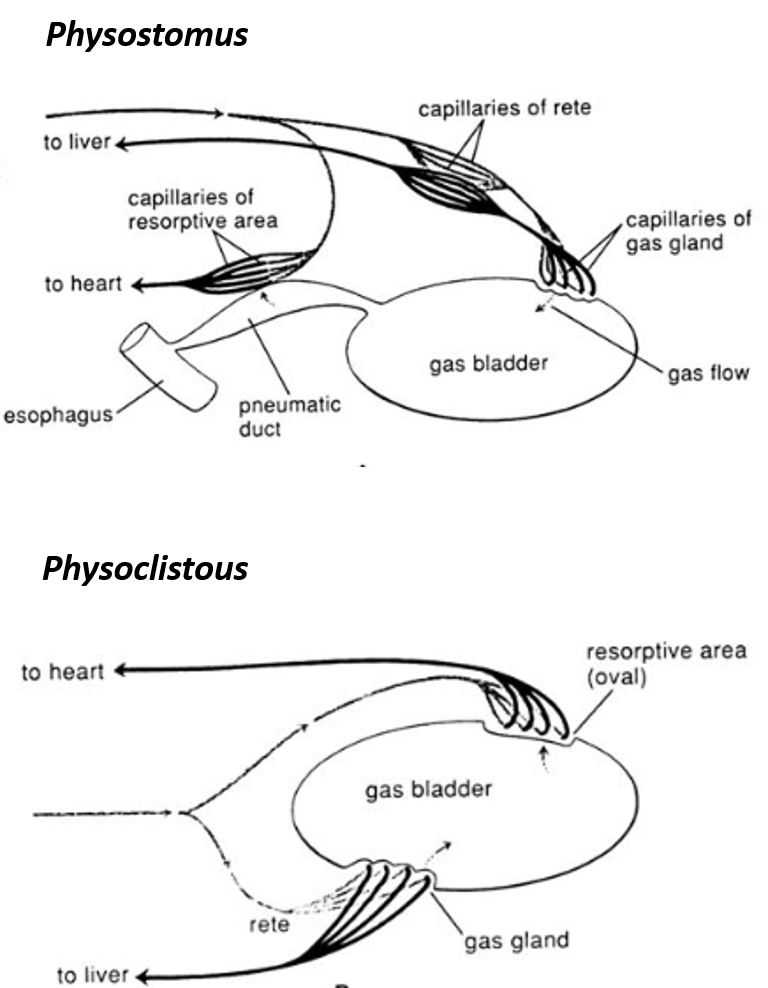
Swimbladder: Physostomus
Physostomus swimbladders are connected to the gut via the pneumatic duct.
- Fish inflate the swimbladder by gulping air at the surface and forcing through the pneumatic duct by a buccal* force mechanism.
- This is therefore limited to shallower water species.
- As gas (air) is compressed under pressure.
- These fish cannot descend to any great depth and still maintain neutral buoyancy as the volume collected on the surface to neutralise at depth, would be huge and impossible to sink.
Swimbladder: Physoclistous
- Physoclistous swimbladders do NOT have a connection (Pneumatic duct) between the swimbladder and the gut.
- Over two-thirds of teleosts have physoclistous swimbladders.
- Referred to as ‘closed’ swimbladders and ‘free’ the fish from the connection to the surface.
- Other advantages are great efficiency at higher pressures.
- Disadvantages are they are slow to adjust.
- Retrieval of fish from depth often result in the rapid pressure equilibrium of the gas causing it to expand.
Swimbladder: Physoclistous
How is gas transferred into the swim bladder?
- Rather than a pneumatic duct, these swimbladders have a gas gland and rete mirabile (“wonderful net”) which is important for transferring gas to the swimbladder.
- Gas has to flow from the arterial system via the rete mirabile to the gas gland which fills up the swimbladder.
- Rete mirabile is a branching capillary structure with thin walls, which allow diffuse into the gas gland but not out.
- Gas is moved by changing the partial pressure of the system by lowering the pH (i.e. more acidic) through a combination of the Root and Bohr effects.
- The change in pH is achieved through glycolysis which creates CO2 and lactic acid, which results in O2 passing from the rete mirabile to the gas gland and then into the swimbladder.
- The rete mirabile works on a countercurrent principle.
How is gas maintained within the swimbladder?
- Gas is also retained in the swim bladder because the wall is often made of gas-impermeable material such as fat or layers of guanine crystals.
- Crystals give swim bladder characteristic silver colour.
- Greater depth = greater potential rate of diffusive loss
- Deeper living fishes have thicker guanine layers in the swim bladder walls.
- Guanine crystals – impermeability of swim bladder so gas does not escape – greater depths – greater pressure – more guanine
How are swimbladders deflated?
Deflation of the swimbladder is done by allowing gas to escape.
- In physostomus swimbladders, the pneumatic duct is opened and the gas escapes into the gut.
- In physoclistous swimbladders, diffusion of gas back into the bloodstream occurs via a rich vascularised area, which transfers the gas to the gills.
- This is achieved by closing off an area of swimbladder either by having a sphincter that closes off an area or by having an adjustable diaphragm.
Are swim bladders an effective buoyancy strategy for the deep sea?
This shows that the difference (light blue area) between the density of oxygen as a function of pressure calculated from Amagat’s results (yellow) and the density of seawater at the same pressure (blue) remains negative down to the maximum ocean depth of 11 km.
Therefore an oxygen-filled swim bladder always provides positive buoyancy to fishes.
How does the gas composition of swim bladders change in the deep sea?
Fish swim bladders generally contain a mixture of gases including oxygen, nitrogen and carbon dioxide but in the deep sea they are predominantly filled with oxygen.
How is gas bladder volume affected by depth?
- For fishes living near the surface, changes in the volume of the swim bladder with depth are a major difficulty.
- A freshwater perch (Perca fluviatilis) ascending from 2 m depth to the surface results in a 16% increase in swim bladder volume.
- This requires maximum available vertical thrust from the fins in order to compensate for increased buoyancy.
- Because of the relative incompressibility of gases at high pressure, ascent from 6000 m to 5000 m for an abyssal fish causes only a 14% increase in buoyancy.
- It is probable that deep-sea fishes do not make major adjustments to their swim bladder buoyancy since the minimal change in vertical thrust from the fins is sufficient to maintain equilibrium.
- Great vertical excursions are trivial for these abyssal fishes.
- An anomaly remains that it is not fully understood is
- how fish living at great depths can pump gas into their swimbladders. The secretion of gas in fishes living at depths beyond ~3000 m depth has never been satisfactorily explained.
Since the buoyancy available from a swimbladder at 6000 m depth is approximately half of that for a shallow-water fish this suggests that deep-sea fishes should have much larger swim bladders.
However, in, for example, neobythitine cusk-eels the deeper-living species have smaller swim bladders.
Why is this?
The food-sparse conditions in the abyss mean that their body protein content is low, tissues are watery and skeletons are light which results in low body density possibly avoiding the need for large swim bladders.
- Reduced Swimbladder
- Reduction of heavy tissues
- Low-density compound top up
- Generation of lift
Gas swimbladders can help support heavier body component than other buoyancy mechanisms.
Reduction of heavy tissues
- Where swimbladders are absent the reduction of heavy tissue components is used e.g. increased water content, decreased protein content and reduced skeletal mass.
- Mesopelagic and bathypelagic fish without swimbladders have high water content, relative small hearts and reduced red muscle.
- Smaller or absence of swim bladder can be counterbalanced with little ossification and watery tissues.
Skeletal reduction and density is also observed in the suborder Notothenioidei, which does not contain a swimbladder.
- They are a largely inactive group using labriform locomotion (anterior-posterior oscillation of pectoral fins) and do not generate much lift like continuous swimmers.
- Replacing bone (density 2.0 g cm-3) with cartilage (1.1 g cm-3), means a fish reduces its weight in water.
- Depending on the species, there is considerable differences in the ossification of bone with some of the most extreme examples in the family Channichthyidae.
Explain the increasing importance of gelatinous substances at depth.
- Acellular* gelatinous matrix
- In addition to structural support and transparency, one possible role proposed for gelatinous larval fishes and some deep-sea invertebrates is to allow growth to large size at low metabolic cost
- Fishes in the superorder Elopomorpha (Anguilliformes, Albuliformes, Elopiformes and Saccopharyngiformes) have larvae called leptocephali in which most of the body consists of an acellular gelatinous matrix that provides structural support in the absence of a vertebral column and transparency for camouflage.
- * not consisting of, divided into, or containing cells
Low-density compounds - examples
- Increased ratios of low-density fatty-acid compounds in comparison to other teleost fish help to provide species of Notothenioidei with hydrostatic lift (Figure 1, C) (Wöhrmann et al, 1997).
- The pelagic silverfish Pleuragramma Antarctica contain internal oil sacs, comprising around 50% of their dry mass (Vacchi et al, 2017).
- T. lepidorhinus occurs around and above continental shelf, making it an intermediate between benthic and pelagic life, rather than being neutrally buoyant with large oil sacs it instead has fat stores throughout its organs such as the intestines.
- This compromise allows it to effectively feed on the benthos and in the pelagic zone (Hubold and Ekau, 1990).
- D.longedorsalis has the lowest lipid stores and is a benthic feeder, therefore requiring the least hydrostatic lift (Friedrich and Wilhel, 1994).
What are lipids a good alternative to swim bladders?
Lipids are good alternative to swim bladders because they are low-density compounds and there change in volume is negligible compared to water.
The result is little adjustment is needed in concentrations for moving vertically in the water column.
Myctophids can be classified into different functional groups depending on their buoyancy:
lipids
- Low lipid content (< 5%), gas-filled swimbladder and large pectoral fins
- Medium lipid content (~8%) and gas-filled swimbladder
- High lipid levels (14% to 22%), small pectoral fins and no gas swim bladder
- Species with low lipid levels or without swimbladder.
The functional groupings are relate to the distance for which they undergo their daily vertical migration.
The large pectoral fins are probably used to generate lift at the deeper end of the depth range.
Predominant skeletal traits of the suborder Notothenioidei, relevant to increasing buoyancy.
Reduced bone ossification when compared to other teleosts, reducing the skeletal mass. (A, B, C and D in Figure 1)
Ctenoid scales are poorly mineralized in neutrally buoyant species.
Porous bone which contains higher percentages of cartilage, an example being Dissostichus mawsoni. (B, C and D in Figure 1)
Bone reduction in the vertebral column, accompanied by a large notochordal canal.

-
Basic Physiology54
-
Osmoregulation29
-
Invertebrate locomotion18
-
Temperature, desiccation and exposue13
-
Polar seas: Adaptation to the cold27
-
Adaptations to the warm11
-
Transparency and camoflauge16
-
Reproductive patterns22
-
Reproduction in the deep sea11
-
Chemosynthetic pigments25
-
Vision and Light15
-
Life in the dark22
-
Buoyancy26
-
Adaptations to low food20
-
Adaptation to low food - pelagic14
-
Biological rhythms19
-
Per43
-
Plastic and POPs6
-
WR Osmoregulation14
-
WR Reproduction (9, 10)13
-
WR Chemosynthetic (12)9
-
WR Vision (13, 14, 15)12
-
WR Adaptations to low food (18, 19)8
-
WR Buoyancy, Colour and Micro plastics17
-
WR Marine Mammal34
-
WR Sharks and fishes3
-
WR locomotion and temperature (5,6)18



