what is respiration
- conversion of cehmcial energy in molecular bonds into usable energy needed to drive processes of living cells
- respiration refers to use of oxygen, intake from environment and transport in blood
*external respiration = enterance of air into lungs and the gas exchange between alveoli and blood
*internal respiration = exchange of gas between blood and cells and intracellular processes of respiration
what are the favoured feuld sources
carbohydrates and fats
- C-H bond is energy rich (Co2 has very little usable energy, its a stbale energy exhausted end product of respiration)
what id dehydrogenation
- occurs during respiration, high energy hydrogen atoms are removed from organic molecules
(oxidation rxn)
- H is accepted by an H acceptr (oxygen in final step fo ETC), this is reduction comp of redox rxn
*this oringial oxidation reuqires energy input but has net energy production forming ATP
what are the two main stages of glucose catabolism
- glycolysis and cellular respiration
what is glycolysis
- first stage of glucose catabolism
- involves 9 steps, in step 4 6 carbon mol is split into a 3 carbon molecule which is isomerized into PGAL (glyceraldehyde 3 phosphate)
- one mol of glucose turns into 2 mol fo pyruvate, 2 mol of ATP and 2 mol of NADH
* production of ATP refered to as substrate level phosphorylation bc no participation of intermediate molecule like NAD+, tis directly coupled to glucose degredation
- all occurs in cytoplasm
net reaction: Glucose + 2 ADP + 2 Pi + 2 NAD+ –> 2 Pyruvate + 2 ATP + 2 NADP + 2H+ + 2 H2O
what happens to the pyruvate product of glycolysis
- pyruvate still has most of the energy from initial glucose mol
- if under anerobic conditions pyruvate is reduced by fermentation
- uner aerobic conditions its further oxidized during cellular respiration in mitochondria
explain the process of fermentation
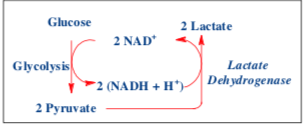
- NAD+ must be regenerated for glycolysis to continue in absence of O2
- pyruvate is reduced into ethanol or lactic acid, produces only two ATP per glucose moleculse
* not making any more ATP just using pyruvate to regenerate your NAD+ so glycolysis can cont
Alcohol Fermentation: occurs only in yeast and some bacteria, pyruvate produced in glycolysis is converted to ethanol to regenerate NAD+
Lactic acid fermentation: occurs in certain fungi, bacteria and human muscle during strenuous activity. When oxygen supply to muscles is not sufficient, still regen NAD+ to be used in step 5 of glycolysis
what is cellular respiration: the net result and the different stages
- most efficient catabolic pathway to get energy from glucose
- yeilds 36-38 ATP
- aerobic process in which oxygen acts as the final acceptor of electrols passed along ETC
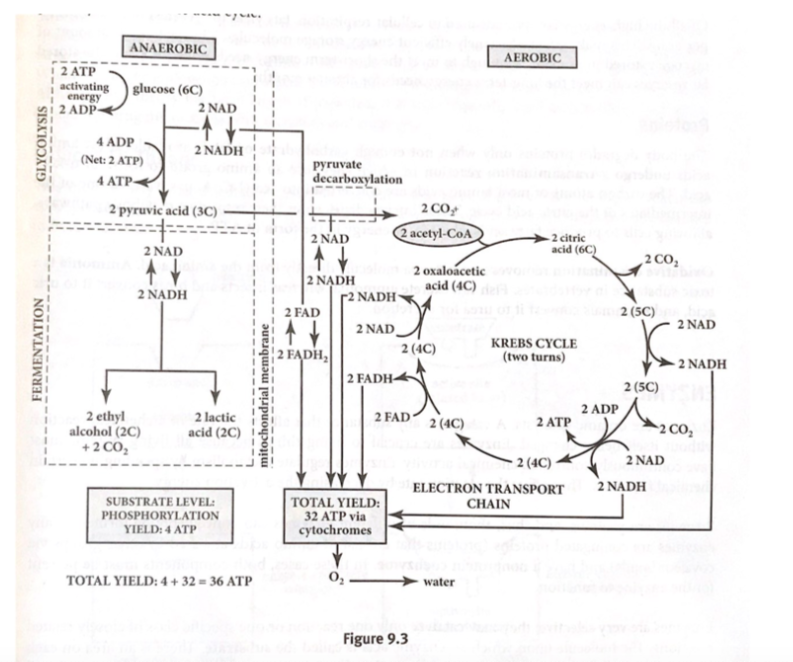
- 3 stages: pyruvate decarboxylation, the citric acid cycle and the electron transport chain
explain pyruvate decarboxylation
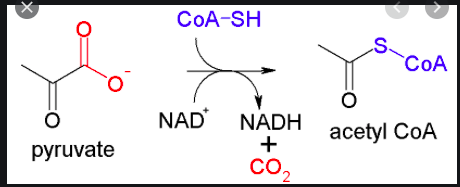
- pyruvate formed during glycolysis is transported from the cytoplasm into mitochondria matrix where is it decarboxylated
- acetyl group is transfered to coenzyme A forming acetyl-CoA which then can enter the kerbs cycle
- 2NAD+ is reduced to 2NADH and also 2 CO2 is released
explain the citric acid cycle
- aka krebs cycle
- begins w/ two carbon acetyl CoA mol which combine with oxalate ( a 4 carbon mol) to form a 6 carbon mol cirtrate
- through the cycle two CO2 are released and oxaloacetate is regenerated
net rxn: 2 acetyl CoA + 6 NAD+ + 2FAD + 2 GDP + 2 Pi + 4 H2O —-> 4 CO2 + 6NADH + 2FADH2 + 2 GTP + 4H+ + 2CoA
-
explain the electron transport chain
- carrier mechanism located on inside of inner mitochondrial membrane
- during oxidative phosphorylation ATP is produced when high energy potential electrons are transferred from NADH and FADH2 to oxygen be series of carreir mol on IMM
- as e- transfered from barrier to carrier free energy si released and used to form ATP
*most mol on ETC are cytochromes that resemble hemoglobin in the structure of their active site
*contain central iron capable of redox
- each carreir is reducaed as it accepts an electron and then is oxidized when it passes it to the next carrier
- last carrier is O2 which picks up a pair of hydrogen ions from surrounding medium to form
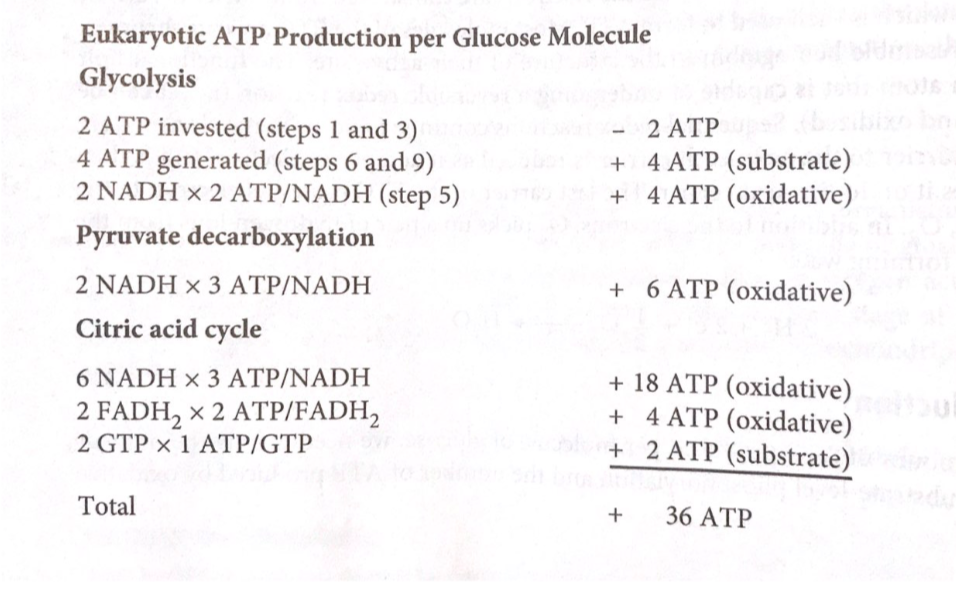
**NADH produced 3 ATP and FADH2 produces 2 ATP in ETC
what is substrate level phosphorylation
- degradation of one glucose molecule yield a net of two ATP from gylcolysis and one ATP for each turn of the citric acid cycle
*total 4 atp produced by substrate level phosphorylation
(not using NAD or FAD)
what is the production fo ATP from oxidative phosphorylation
- produces more than 90% of ATP used by cells in our body
- at the end of the ETC, respiratory enzyme pump H ions from matrix of mitochondria to intermembrane space creating a alrge conc gradient
- H ions pass through chnnels in respiratroy enzymes along concentration gradient, energy created used to convert ADP into ATP
* two pyruvate decarboxylations = 2 NADH
*each turn of kerbs produces 3 NADH and 1 FADH2, since happens twice per glucose mol 6 NADH and 2 FADH2
- each FADH2 generates 2 atp and each NADH generates 3 ATP
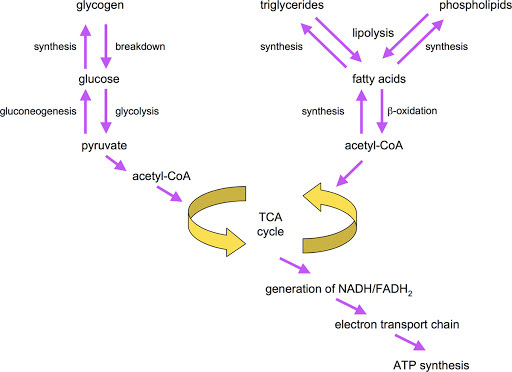
what are the alternative energy sources
- carbohydrates, fats then proteins
how are carbohydrates used for energy
- disaccharides are hydrolyzed into monosaccharides which can then be converted into glucose or glycolytic intermediates
- glycogen stored in liver can be converted when needed into a glycolytic intermediate
how are fats used as energy
- stored in adipose tissue in the form of triglycerides
- when needed hydrolyzed by lipases to fatty acids and glycerol and carried by blood to other tissues for oxidation
- glycerol can be concerted to PGAL (glycolytic intermediate)
- fatty acids must first be activated in the cytoplasm, process reuqires two ATP then transported to mitochondrion and undergoes beta oxidation into 2 carbon fragments
- fragments then converted to acetyl CoA which enters the citric acid cycle
* for each round B oxidation of a saturated fatty acid one NADH and 1 FADH2 produced
how are proteins used as energy
- amino acids undergo transamination reaction: lose an amino group to form a alpha-keto acid
- carbon atoms of most amino acids are converted into acetyl CoA, pyruvate or an intermediate of the citric acid cycle
what is oxidative deamination
- removes an ammonia molecule direcctly from the aminoa cid
- amminoa is toxic in certebrates
what are enzymes
- organic catalysis: affect rate of reaction w/o itsel fbeing changed
- decrease activation energy
- proteins, somtimes conjugated and have a nonprotein coenzyme (both must be present for enzyme to function)
- highly seletive
- do NOT alter equilibrium constant
- are NOT consumed in reaction
- are pH and temp senstive
what is the lock and key theory
- spatial structure of an enzymes active site is exactly complementary to spatial strucutre of its substrate
what is enduced fit theory
- active site has flexibilty of shapre
- when approprate substrate comes in contact w/ active site the conformation of active site changes to fit the substrate
enzyme specificity
- enzyme action is dependent on temp, pH and conc of enzyme and substrate
- as temp inc rte of enzyme inc intil optimal temp is reached: beyond that the shape of active site is altered and deactivates enzyme
- opperate at an optimal pH, typically 7.2, unless something like pepsin which works in stomach at pH2
- inc of conc of substrate inc rate until all active sites of enzyme is occupied, then reach a Vmax where inc substrate conc will not help
explain competitive inhibition
- active site is specfici for particular substrate or class of substrates, similar mol can bind
- is conc are similar will be competition of occupation fo active site
- can outcompete if inc the concentration of substrate
explain noncompetitive inhibition
- inhibitor forms a strong covalent bond w/ enzyme making ti unable to bind with tis substrate
- noncompetitor cant be displaced (irriversible inhibition)
- excess substrate will not help, rxn will never reach Vmax
- can have allosteric inhibition in which inhibitor binds to another site than active but it changes the shape of the active site

-
Cellular Biology44
-
Biological processes27
-
Genetics30
-
Evolution27
-
Microorganisms18
-
Medical Microbiology11
-
integument and immune systems34
-
Nervous System49
-
Nervous system part 2. special senses16
-
Skeletal and Muscular Systems33
-
Circulatory and Respiratory systems34
-
Digestive System22
-
Excretory System22
-
Endocrine system53
-
Reproductive System46
-
DNA and RNA27
-
proteins35
-
lipids28



