why do we need the excretory system, what diff processes produce wastes
- removal of emtabolic wastes
- most bodily activities produce metabolic wastes including mineral salts that have to be removed
- aerobic respiration produces carbon dioxide and water
deamination of amino acids in liver produces nitrogenous wastes (urea and ammonia)
- excretion is removal of indigestible material like dietary fiber
what different organs are involved in excretion
- lungs, liver, skin and kidneys
- lungs: carbon dioxide and water vapor fuse from blood and are continuously exhaled
Skin: contains sweat glands to excrete water and dissolved salts and small quantity of urea, also helps to reg body temp
Liver: processes nitrogenous wastes, hemoglobin, and other chem for excretion
*urea produces in liver diffuses into blood for excretion by kidneys
*bile salts excreted in bile pass out with feces
kidneys: function to filter, maintina osmolarity of blood, excrete mucerous products and toxic chemicals and conserve glucose water and salt
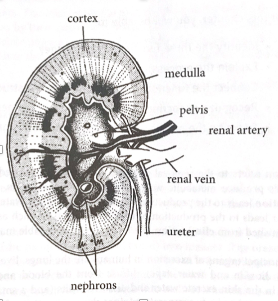
- bean shaped and located behind stomach and liver
- each contains appro 1 million nephrons
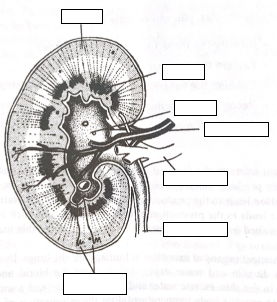
what is the structure of the kidney
- 3 regions: outer cortex, innder medulla and renal pelvis
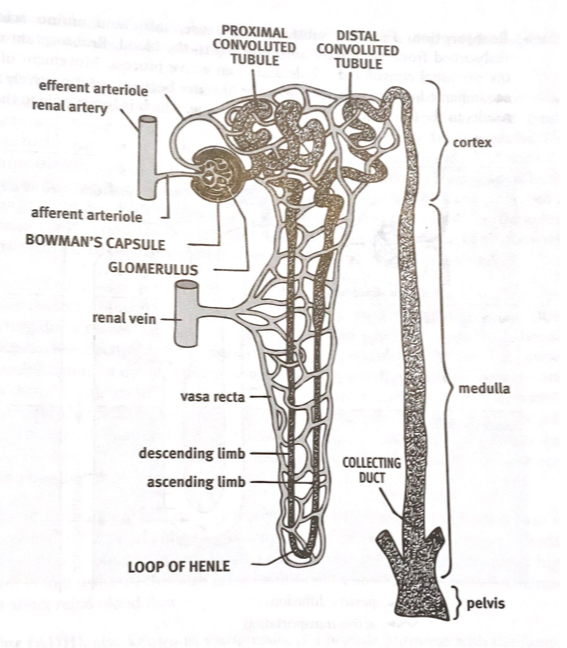
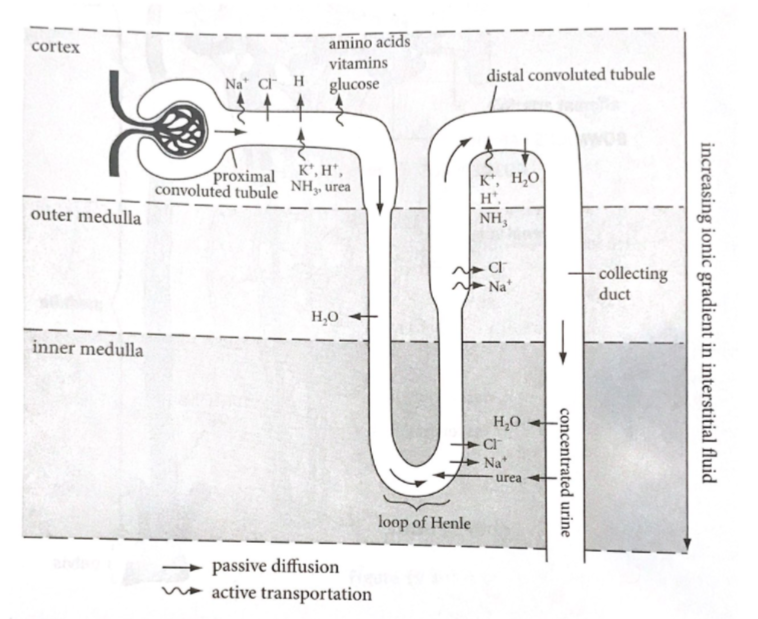
- nephron consists of bulb called bowmans capsule which enbraces a capillary bed called glomerulus
- bowmans capsule leads to long coiled tubule broken into: proximal convoluted tubule, loop of henle, distal convoluted tubule and collecting duct
- loop of henle and collecting duct run through the medulla while convoluted tubule and bowmans cupsule are in cortex
how does urine flow
- concentrated urine in collecting tubules flows into the pelvis of the kidney, a funnel like region that opens directly into ureter
- ureter from the kidneys empty into urinary bladder where urine colelcts until expelled via the urethra
- most of the nephron is surrounded by a complex peritubular capillary network that facilitates reasborption of amino acids, glucose, salts and water
what are the 3 processes of urine formation
filtration, secretion and reabsorption
explain filtration what drives it?
- blood pressure forces 20% of the blood plasma entering the glomerulus through capillary walls and into the surrounding bowmans capsule via diffusion
- the fluid and small solutes entering the nephron are called filtrate which is isotonic with blood plasma
- particles too large to filter through glomerulus like blood cells and albumin remain in the circulatroy system
- filtration is riven by hydrostatic pressure, as a result having inc blood pressure can lead to kidney damage over time since that combines with hydrosttic pressure
explain secretion
- nephron secretes wastes such as acids, ions and other metabolites form interstitial fluid into filtrate be passive and active transport
explain reabsorption
- essential substances (glucose, salts and amino acids) and water are reabsorbed from the filtrate and returned to the blood
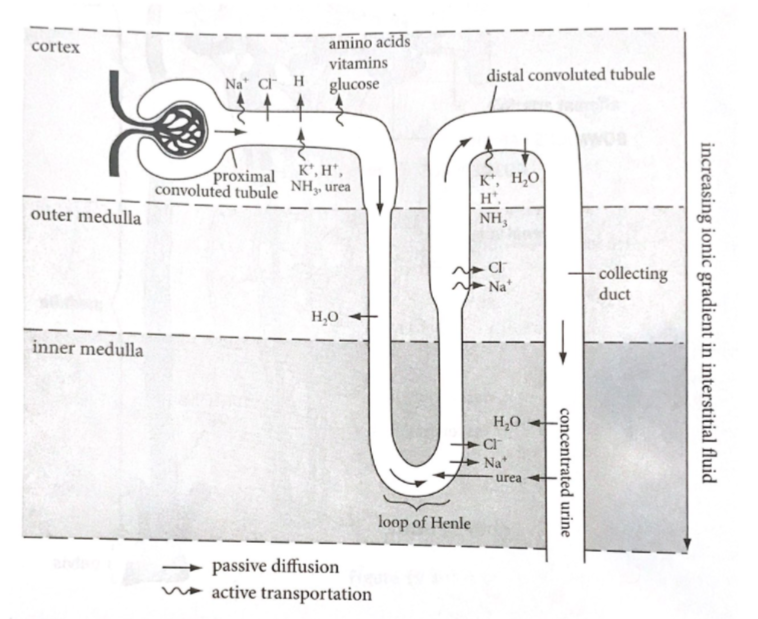
- reabsorption occurs primarily in proximal convoluted tubule and is an active process
- movement of mol is accompanied by passive movement of water bc water passively follows the solute
- results in formation of concentrated urine which is hypertonic to blood
what is the primary function of the nephron: what part of nephron is mainly responsible for this
- prim function is to clean the blood plasma of unwanted substances as filtrate passes through the kidney
- blood plasma contains wanted and unwanted substances so reabsorption is selective to transport wanted substances back into plasma and rest to be excreted in urine
- primary site of reabsorption is the proximal convoluted tubule
what is the primary site for water, sodium and lotassion loss regualtion
- ascending loop of henle, collecting duct and descending loop of henle
what is the primary role of the distal convoluted tubule
- secretion of substances into filtrate
explain the different permeabilities of parts of loop of henle for water absorption and electrolyte concentration
- descending loop very permeable to water but not ot ions or urea
thin ascending limb of loop of henle: impermeable to water but permeable to ions allowing for passive diffusion
- thick ascending limb of loop of henle: sodium potassium and chloride are actively reabsorbed from urine
what is the prupose of the selective permeability of tubules
- establishes an osmolarity gradient in surrounding interstitial fluid
- tissue osmolarity increases from cortex to inner medulla
* sodium and chloride ions are responsible for maintaining the gradient
- osmolarity of urine (conc of dissolved particles) is established in the renal tubule by counter current multiplier system in which energy is used to create conc gradient
explain the counter current multiplier system
- causes the interstitial space in medulla of kidney to be hyperosmolar with respect to dilute filtrate flowing through renal tubule
- as filtrate in collecting ducts passes through medulla water flows out via osmosis, water is removed by capillaries in medulla permitting the concentration of urine
- permeability of distal convoluted tubule is regulated by ADH (vasopressin) which inc permeability of the collecting duct to water so more water can be absorbed
*if have too much ADH can retain too much fluid
what is aldosterone
- steroid hormone that causes increased transport of sodium and potassion ions along distal convoluted tubule and collecting duct
- results in decreased excretion of sdium ions and inc excretion of potassion in urine
- also causes additional water reabsorption: does not affect renal blood flow
what is ADH
- anti diuretic hormone (vasopressin)
- peptide hormone with same net effect of inc water reabosrption as aldosterone
- directly affects water absorption by distal convoluted tubule and collecting ducts opening additional aquaporins
- causes a decrease in urine output and corresponding inc in blood pressure (like alsosterone)
- allows humans to compensate for periods of dehydration or other causes of low blood pressure
what are diuretics
- drugs that increase urine production: can target different parts of the kidney to cause the same net effect
- loop diuretics inhibit sodium reabsorption in ascending loop of nephron
- thiazide diuretics inhibit the sodium chloride transporter in distal convoluted tubult
*both have net effect of increasing amount of water present in urine (inc in urine excretion)
how is pH maintained and what tests can be done to test body pH
- body pH maintained at 7.4 by removal of carbon dioxide in lungs and hydrogen ions by kidney
- can be tested be arterial pH, arterial pressure of carbon dioxide and plasma bicarbonate
what are the 2 types of acid base disorders
- respiratory disorders: affect blood acidity by causing changes in PCO2
- metabolic disorders: affect blood acidity by causing changes in HCO3-
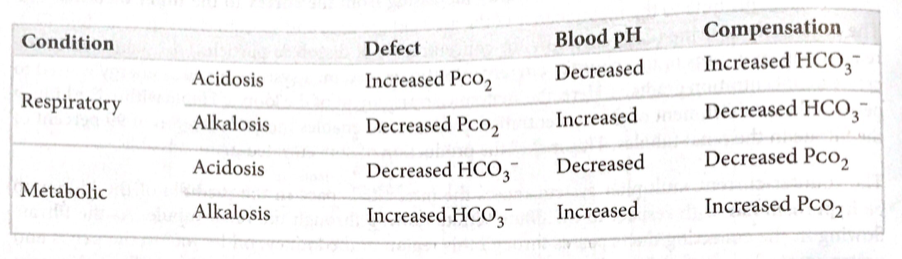
how are changes in PCO2 and HCO3- compensated for
- PCO2 compensation are performed by the respiratory system and can be changed quickly
- compensation for HCO3- are performed by kidneys and can take longer to manifest
- the cause of acidosis or alkalosis (respiratory or metabolic) will dictate how a patient is treated medically

-
Cellular Biology44
-
Biological processes27
-
Genetics30
-
Evolution27
-
Microorganisms18
-
Medical Microbiology11
-
integument and immune systems34
-
Nervous System49
-
Nervous system part 2. special senses16
-
Skeletal and Muscular Systems33
-
Circulatory and Respiratory systems34
-
Digestive System22
-
Excretory System22
-
Endocrine system53
-
Reproductive System46
-
DNA and RNA27
-
proteins35
-
lipids28



