Wolff’s Law
- not really a strict law, but..
- laid the foundation for our understanding of bone as a mechanically optimising tissue
- In general: bone is added where strain is high and removed where strain is low (i.e. modelling), resulting in structures matching strain fields of the organ
- The idea is that bone attempts to ensure that it is neither under- nor overstrained
- Bonea adapts to load
Typical Long Bone
(Bone Organs)
- Diaphysis (made of compact bone)
- Epiphyses
- Metaphyses (ends at physis of growth plate)
- Cortex
-Compact, cortical bone
•Medullary cavity
- Marrow
- Trabeculae, cancellous bone
•Periosteum covered (dense connective tissue that wraps around the outside of the bone) -> has blood vessels and nerves (painful when breaks)
- covers everywhere, but the joint surface
- Except articular regions: HAC
•Very vascular
-Nutrient foramen: long bones have one or more through diaphysis (artery or arteriole)
- The middle of diaphysis (medullary cavity) has yellow marrow (fat, adipose tissue)
- In younger animals, and in parts of adult animals (the sternum) has hematopoietic red bone marrow- where blood cells are made
- bone marrow transplant–> want to get out red bone marrow for chemo patients
Cortical Bone
- dense bone
Trabecular Bone
- spongy bone or cancellous
Bones Functions
(Multiple, regional, Functions of Bones)
- Resist tension, compression, bending, torsion, shear
- bones are the fulcrum in a lever arm
- Articulations (provide sites for attachment)
- Joint surfaces
- Muscle action
- Tendon, ligament and joint capsule attachment
- long Fatigue life (deal with load over and over) and high monotonic strength (stength under a single impact)
- Space for other organs (skull, ribs)
- Air filter & transfer surface (nasal turbinates)
- Transmit vibration (malleus, incus, stapes)
Bone Function
(Metabolism)
- Haematopoiesis (make new blood cells)–> occurs in marrow of long bones
- Calcium store (most of calcium in body is in your bones)
Modelling
•Bone deposition and/or resorption with a net change in organ shape
- shape of the bone tissue change
- mechanical stress env’t, more bone where there is stress, less bone where there is less stress
- bone matches the stresses
•Evens out stresses
- Modeling is when bone resorption and bone formation occur on separate surfaces (i.e. formation and resorption are not coupled).
- Response according to stress on the bone
- This improves monotonic strength
- happening all the time–> ex: tennis arm, responds to activity by modelling. Diaphysis will get thicker
- stress field is not even so bone is trying to make it even
Remodeling
*Cells are the same (osteoclasts and osteoblasts)
•Bone resorption (osteoclasts) followed by deposition filling the resorption pit
-osteoclasts dig a hole, osteoblasts ill it back up
•Repairs fatigue damage
Bone remodeling (or bone metabolism) is a lifelong process where mature bone tissue is removed from the skeleton (a process called bone resorption) and new bone tissue is formed (a process called ossification or new bone formation).
-this improves fatigue life
“Rubber” Bone
- place in vinegar
- left with all the bone except the mineral composition
In contrast:
baking a bone rids of the collagen matrix and leaves just the minerals where it can crumble on impact
Bone Matrix
*Composite of
- Type I collagen (35%, tensile E)–> great with tensile strength, why you find it in tendons/ligaments
- Hydroxyapatite mineral (60%, compressive E)–> good at resisting compression
-two together gives composite behavior: need to resist compression and tension
- Water (4%)
- Proteoglycan (1%)
*Osteoid (organic portion of bone matrix, no mineral in it) is as above but water not mineral, what osteoblasts actually make.
-jelly like substance where the water portion is replaced by mineral over time
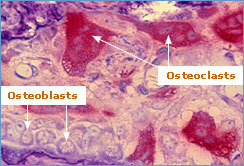
Osteoblasts
•Secrete unmineralised bone matrix, osteoid
-On bone surface (fills in the hole)
•Derived from mesenchymal stem cell: like a fibroblast (MSC’s are generally found in bone marrow)
-lineage: more like fibroblasts, cartilage, lipid adipocytes
•Bury themselves in osteoid and become osteocytes
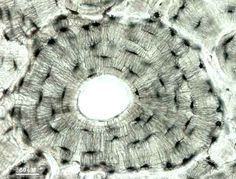
Osteocytes
•Adult cell of mature bone
-resorbing and forming bone around them
- Maintain local bone matrix mineralisation
- Sense mechanical load (controversial)
- lie within an osteon
- processes communicate with neighboring osteocytes
- osteon is very vascular (lumen) and cellular
Osteoclasts
•Resorb bone
-“dig holes”
•Derived from _haematopoietic tissue (_red bone marrow): like a macrophage (WBC’s)
–> not a WBC but in that family
**High degree of communication among bone cells
Osteocyte structure
- Cell body in lacuna
- Very many long cell processes in canaliculi
- Narrow (80nm) interstitial space around OC
- Assumed to be bone’s mechanosensor
- Maybe through fluid flow, or tugging of matrix on processes
- Detect microdamage
- Apoptosis
- Resorb mineral
- Osteocytic osteolysis->They destroy bone through a rapid, transient (relative to osteoclasts) mechanism called osteocytic osteolysis
- Ca / P homeostasis -response to drop in calcium or rise in blood calcium. Too little calcium, start resorbing bone to release it
- Signal to OB and OCl
Osteoblast Structure
- sit on surface
- Cuboidal cell
- Secrete osteoid
- Unmineralised gel deposited on bone surface
- Gel accumulates hydroxyapatite – kickstarted by matrix vesicles (outbuddings of osteoblast cell surface, kick start matrix mineralization process)
- Buries itself in osteoid, becoming osteocyte
- Signal to osteoclasts & their precursors
- M-CSF, Rank signalins systems
–> osteoblasts can tell osteoclasts to form
–>Stimulate osteoclast differentiation and resorption
–>Coordinating resorption/formation
–>OB osteoprotegrin blocks Rank ligand binding, inhibits Osteoclast activation
- Form membrane and network with OC processes
- Separates bone extracellular fluid from marrow
- Control of Ca2+ and HPO42- flow
Osteoclast Structure
- Large, multinucleated cells (form from precursor cells fused together)
- Ruffled border
- Haematopoietic lineage
- Resorb bone matrix
- releases Hydrochloric acid/cathepsin and removes mineral and collagen and bone–> leaves depression called Howship’s lacuna
- Bind to mineralised matrix (not unmineralised)
- Sealing zone binding with transmembrane receptors
- H+ from carbonic anhydrase (substrate CO2 , H2O)
- Enzymes
–>cathepsin K, matrix metalloproteinases, tartrate-resistant acid phosphatase (TRAP), cysteine
**STUDY CELL SIGNALLING- rank ligand and rank receptor binding controlled by osteoblasts and stromal cells to signal osteoclasis by osteoclasts or not
*Osteoclasts release growth factors to signal osteoblasts for bone formation (coupling)
Osteoperosis
Osteoporosis means your bones have become less dense due to the loss of bone material.
Primary Osteons
- usually find them in the bone cortex and form in periosteum
- Increase outside diameter of diaphysis by subperiosteal bone deposition which leaves periosteal blood vessels buried inside osteonal tunnels
- ridges of osteoblast continue to get larger around blood vessel and form a “roof” over the vessel and therefore a tunnel
- osteoblasts inside the tunnel continue to fill the tunnel up with layers of concentric osteocytes
- ones on outside form the next layer–> see concentric rings in animals
- Osteoclasts are not involved in this process, no resorption –> modelling process
Secondary Osteons
- look nearly the same under the microscope (only difference is cement line bc secondary osteons have osteoclasts)
- get bored through existing bone
- start with “boring machines”(osteoclasts) cutting away existing bone and osteoblasts would be behind it laying osteoid (filling it up)
- Remodling as the bone has not changed shape
- Osteoclasts tunnelling through bone
- Followed by osteoblastic infilling of tunnel
- New Haversian system containing blood vessel
- In any bone structure large enough to contain it
- > 0.5mm diameter: large trabeculae; cortex (not mouse)
- usually see secondary osteons in any bone that is BIG enough
Collagen formation
- Part of osteon formation process leads to collagen formation
- Lamellar bone is laid down in packets, collagen they produce is arranged lines
- Osteoblasts align collagen to mechanical forces they are experiencing
- Collagen secreted aligned to strain field
- Regional variation in collagen orientation
- Transverse in compression, longitudinal in tension
- Organisation more defined in secondary than primary ‘woven’ bone
2 Arrangements of Bone Tissue
- Trabecular (cancellous, spongy): 40-50% bone tissue, rest is marrow
- Cortical (compact)
•Differentiating factors are location and volume fraction
- Mature forms of both are ‘lamellar’ (cf. ‘woven’)
- Both may contain osteons – if big enough!
Endochondral Ossification
- How long bones grow
- Endochondral ossification is one of the two essential processes during fetal development of the mammalian skeletal system by which bone tissue is created.
- Unlike intramembranous ossification, which is the other process by which bone tissue is created, cartilage is present during endochondral ossification
- growth cartilage gets invaded by a blood vessel and then the bone invades the epiphysis
- blood vessel goes through nutrient frame for long bone growth
- cartilage is dividing in proliferating zone, cell expands in hypertrophic zone and the blood vessel is invading the hypertrophic zone as the chondrocytes are mineralizing the matrix around them and bone grows into that cartilaginous region ( this process move in epiphyseal direction)
Endochondral Ossification
- Increases bone length and shapes epiphysis
- Chondrocytes proliferate, hypertrophy
- Mineralise their matrix via matrix vesicles (like osteoblasts)
- Blood vessels invade
- Septoclasts remove uncalcified transverse septa
- Osteoblasts secrete osteoid on calcified cartilage spicules
- Primary trabeculae, later (re)modelled into mature trabeculae
- Growth plate
- thick when growth rapid, thins and “closes” in adult
- Similar process occurs in epiphyseal growth cartilage
- Secondary ossification centre




