Differentiate JVP from arterial pulse?
- not palpable 2. complex wave form, seen to flicker twice in one cardiac cycle (if in sinus) 3. fills with occlusion 4. becomes more distended with hepatojugular reflex 5. moves with respiration (decreases with inspiration) * Kussmaul’s sign is a paradoxical rise in the JVP / lack of a decrease of JVP in inspiration —> indicative of increased right heart pressures eg constrictive pericarditis or restrictive cardiomyopathy.
Signs of severity of AS?
Narrow pulse pressure (and not usually hypertensive)
Slow rising, low volume pulse (pulsus parvus et tardus)
Palpable systolic / aortic thrill
Heaving / pressure loaded character to apex beat which is not displaced (or displaced just a little)
Soft S2, or reverse splitting of S2
A long, late-peaking ESM (not the volume of the murmur) — The later the peak, the more severe (see below)
Fourth heart sound (won’t get if in AF)
Signs of cardiac failure
Differentials for ESM
AS
- loudest in aortic area and on expiration
- radiate to carotids
- signs of severity
- softer on valsalva
Aortic sclerosis
- loudest in aortic area and on expiration
- DOES NOT radiate to carotids
- signs of severity
HOCM
- jerky pulse
- double, triple impulse apex beat
- louder at the LSE
- louder on valsalva
- a/w murmur of MR Pulmonary stenosis
- rarer
- louder on inspiration in the pulmonic area
- prominent A waves
ASD
- loudest in pulmonary area
- midsystolic
- split S2
Differentials for PSM
MR - heard at apex - radiates to axilla
TR - heard at LLSE - louder on inspiration - peripheral signs
VSD - heard at LLSE, may be a/w thrill - softer with valsalva - no peripheral signs of TR
MVP a/w MR - Mid sistolic click which is earlier and associayed with a longer murmur in valvaslva (later and shorter murmur on handgrip)
Presentation of a murmur
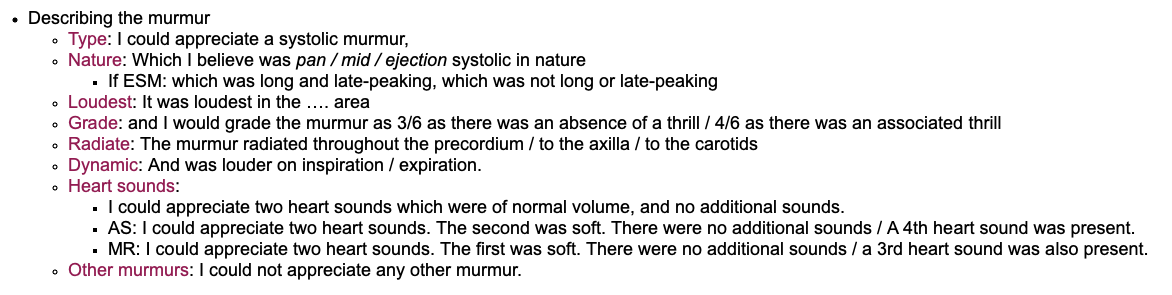
Type: I could appreciate a systolic murmur,
Nature: Which I believe was pan / mid / ejection systolic in nature
If ESM: which was long and late-peaking, which was not long or late-peaking
Loudest: It was loudest in the …. area
Grade: and I would grade the murmur as 3/6 as there was an absence of a thrill / 4/6 as there was an associated thrill
Radiate: The murmur radiated throughout the precordium / to the axilla / to the carotids
Dynamic: And was louder on inspiration / expiration.
Heart sounds:
I could appreciate two heart sounds which were of normal volume, and no additional sounds.
AS: I could appreciate two heart sounds. The second was soft. There were no additional sounds / A 4th heart sound was present.
MR: I could appreciate two heart sounds. The first was soft. There were no additional sounds / a 3rd heart sound was also present.
Other murmurs: I could not appreciate any other murmur.
Signs of severity of MR
- Small pulse volume in very severe MR
- Displaced apex beat
- Thrill over the apex
- Soft 1st heart sound
- Split second heart sound
- S3
- Early diastolic murmur (in association with the PSM)
- LVF & Signs of pulmonary HT
What rhythm is AS and MR usually associated with?
AS usually sinus
MR usually AF due to dilation of LA
CXR features of LA enlargement
Splaying of carina > 90 degrees
Double right heart border
Convesxity of the left atrial appendage
ECG features of mitral regurgitation
AF
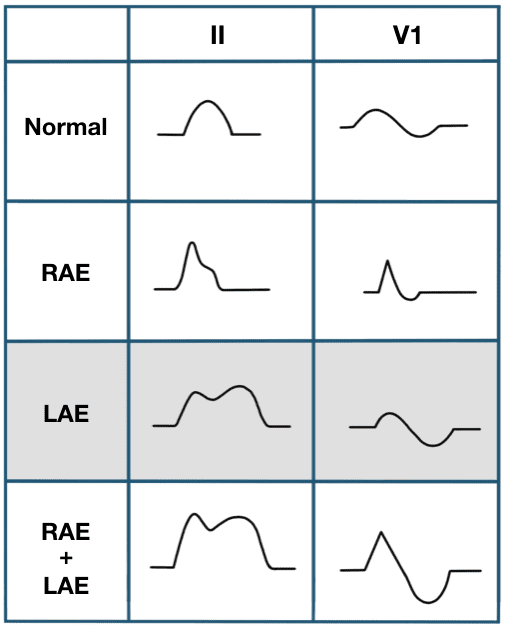
If in sinus - bifid p waves in lead II and biphasic p waves in V1
What is the treatment of MR?
Treat the heart failure
Treat the AF (if associated)
Treat the MR
Prefer repair, then replacement then mitra-clip
If symptotamtic + severe
Asymptomatic + severe + EF 30-60%
What is secondary or functional?
Treat if requiring a CABG and if EF > 30%
What are the TTE features of severe MR?
LA enlargement
LV elargmenet (LVESD)
Pulmonary hypertension at rest ir with exercuse
LVEF
TTE features of pulmonary HT
RVSP of > 35mmHg
(35 - 45 is mild
45 - 60 is moderate
> 60 is very severe)
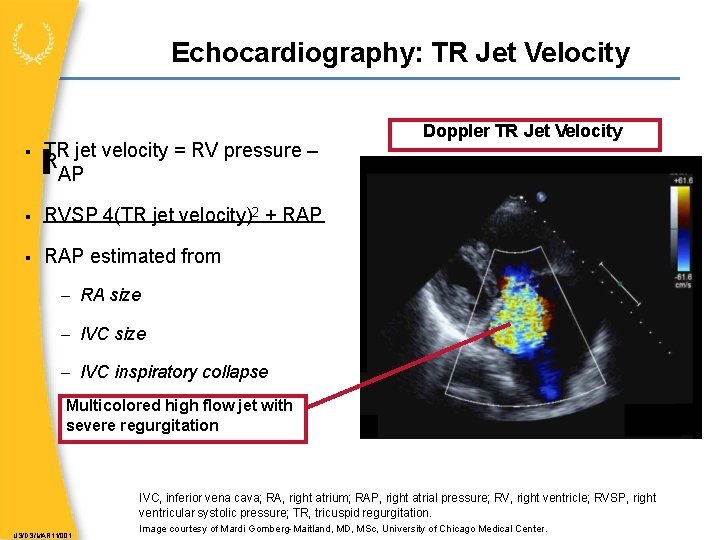
RVSP is calculcated from TR jet and RAP
RAP is calculated from RA size and IVC size
What are the causes of MR?
Ischaemia
Dilated cardiomyopthay —> functional MR
Ruputured cordae tendinae and infarcted papillary muscle
Myxomatous degeneration
Infective Endocarditis
Rheumatic heart disease
Mitral valve prolapse secondary to myxomatous degenartion or connective tissue diseases (Marfans, Ehlers Danlos)
Voltage criteria for LVH
R wave in V5 or V6 plus S wave in V1 > 35 mm
ECG features of LVH
Voltage criteria: R wave in V5 or V6 plus S wave in V1 > 35 mm
Left axis deviation
Can get LBBB shape / widening
Left ventricular strain pattern: ST depression and T-wave inversions in left sided leads
(I, aVL and V5-6)
Comment on a normal J point in LBBB / paced rhythm.
Why is this useful to know / in what set of rules does this have importance?
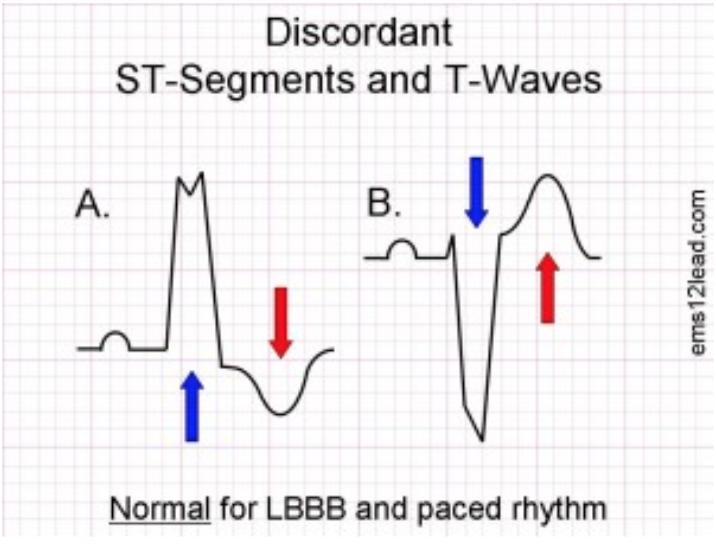
There is normally a small amount of discordance.
It is normal for the J point or the ST segment to move in the opposite direction of the QRS complex.
- in leads where the QRS complex is normally a positive deflection, the J-point and ST-segment should be slightly below the isoelectric line
- in those leads where the QRS is negative (primarily V1-V3), the J-point and ST-segment should rise slightly above the isoelectric line.
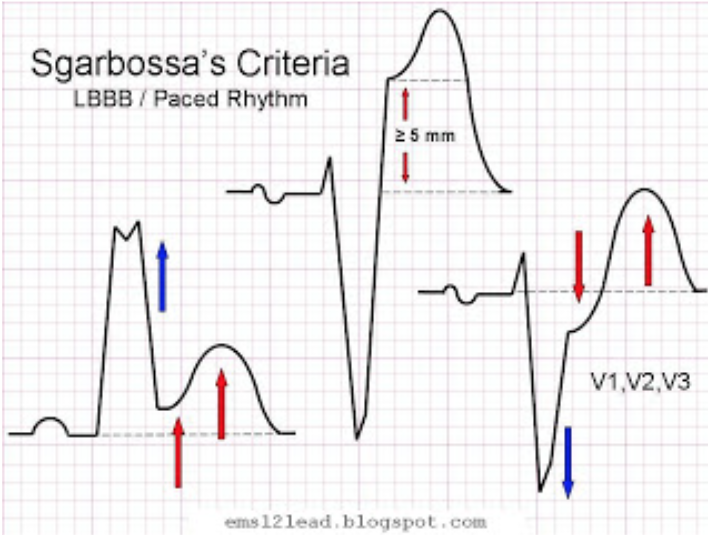
This is important to know in Sgarbossa’s Criteria.
Sgarboassa’s criteria is based on the presence of excessive discordance or inappropriate concordance
It is used in the diagnosis of STEMI in the presence of LBBB or RV pacing.
As per the most recent guidelines “presumed new LBBB is no longer considered an indicator or equivalent of STEMI” –> need to use Sgarbossa’s criteria instead.
What is Sgarbossa’s criteria?
What is it used for?
Used in the diagnosis of STEMI in the presence of LBBB / paced rhythm.
Original (& Modified) Sgarbossa Criteria
The original three criteria used to diagnose infarction in patients with LBBB are:
- Concordant ST elevation > 1mm in > 1 lead with a positive QRS complex (score 5)
- Concordant ST depression > 1 mm in > 1 lead in in V1-V3 (score 3)
- Excessively discordant ST elevation > 5 mm in > 1 lead with a -ve QRS complex (score 2).
- In the modified criteria this has been changed to excessive discordance > 25% of the preceeding S wave in > 1 lead with a negative QRS complex
These criteria are specific, but not sensitive for myocardial infarction. A total score of ≥ 3 is reported to have a specificity of 90% for diagnosing myocardial infarction.
The first illustration below demonstrates innappropriate concordance in a positive direction.
The middle illustration demonstrates excessive discordance (the weakes of the three criteria)
The third illustration demonstrates innappropriae concordance in a negative direction.
What do normal Q waves represent?
What is considered a normal Q wave?
- The normal Q wave represents the normal left-to-right depolarisation of the interventricular septum
- Small ‘septal’ Q waves are typically seen in the left-sided leads (I, aVL, V5 and V6)
- Small Q (<2mm) waves are normal in most leads
- Deeper Q waves (>2 mm) may be seen in leads III and aVR as a normal variant
- Under normal circumstances, Q waves are not seen in the right-sided leads (V1-3)

What qualifies a pathological Q wave?
Q waves are considered pathological if:
- > 40 ms (1 mm) wide
- > 2 mm deep
- > 25% of depth of the ensuing R wave
- Seen in leads V1-3
They are usually associated with a substantial loss in amplitude of the ensuing R wave
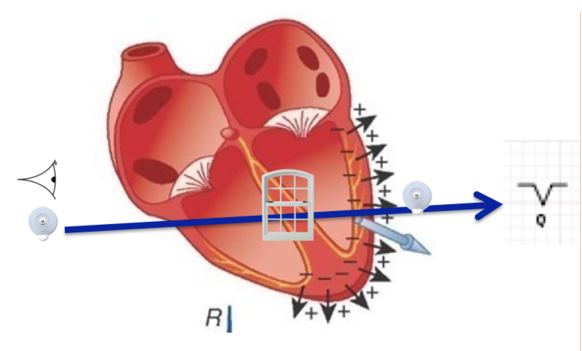
Pathological Q waves usually indicate current or prior myocardial infarction, they are usually non-reversible.
This is because the dead septal tissue means creates is a “window” and you are seeing the myocardium depolarise away from you (it depolarisies from inside –> outside)
How do you tell a LBBB from a RBBB in lead V1?
(you usually do this when looking at a WCT)
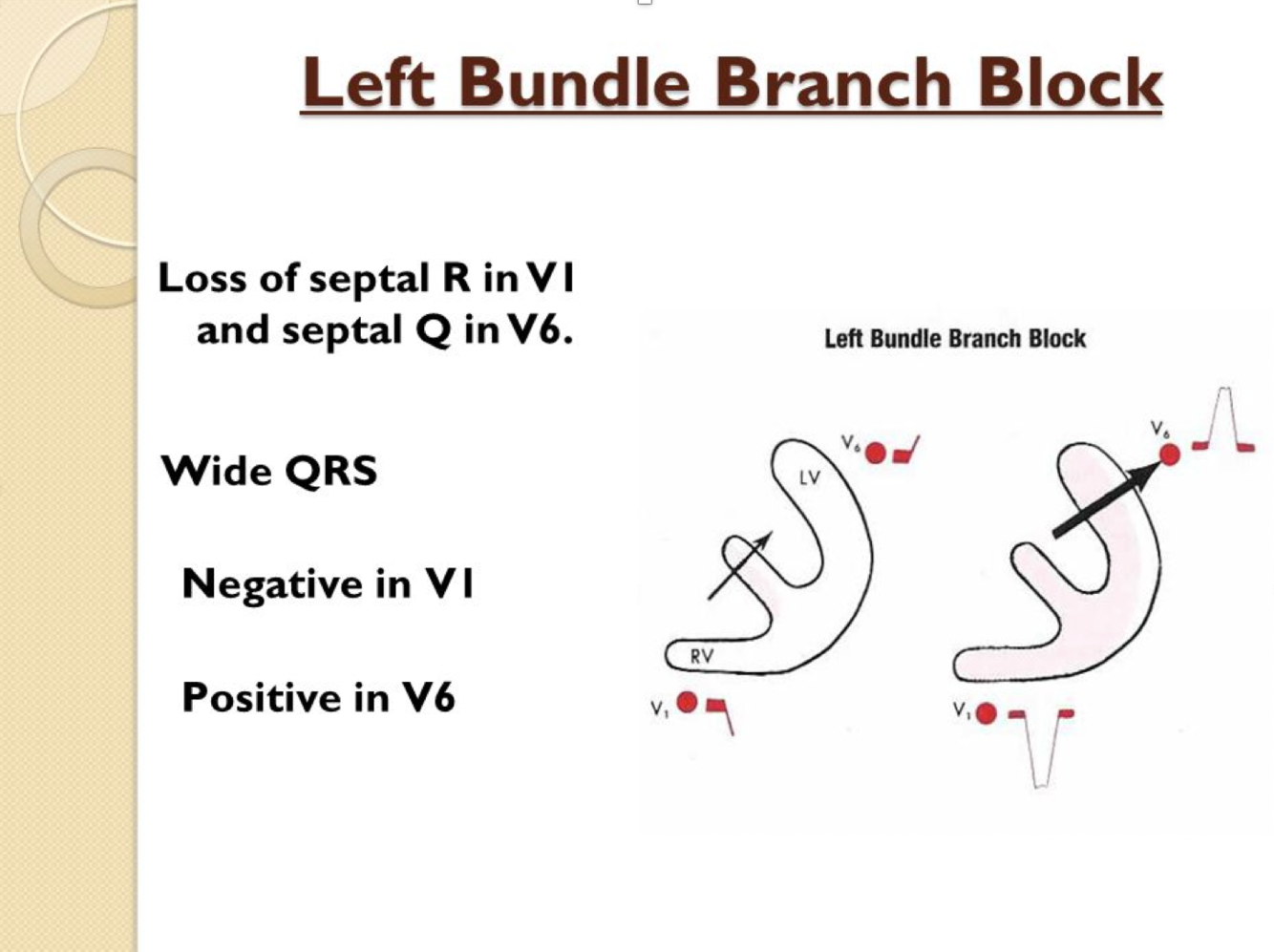
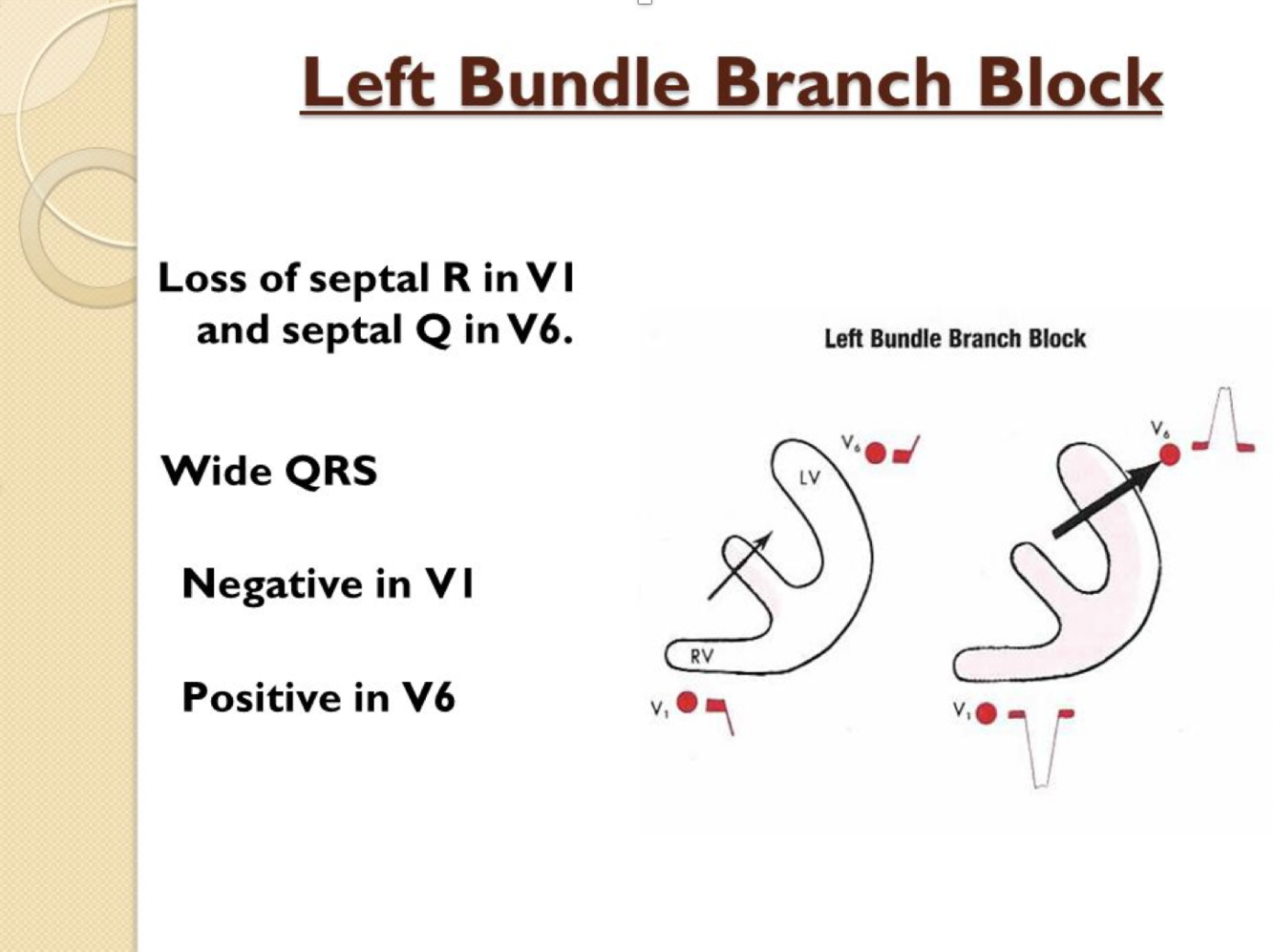
- Widened QRS complex (> 120 ms)
- Then look at lead V1.
- If the QRS complex is downwardly deflected in lead V1, a left bundle branch block is present.
- If the QRS complex is widened and upwardly deflected in lead V1, a right bundle branch block is present.
Think: this is because if the left bundle branch is dysfunctional the impulse will spread outside of the conduction system, it will be slow and cause the QRS to broaden with the direction of the impulse being away from V1 most of the time.
When you are looking at V1 in VT you say there is a “left/right BBB pattern” (they are not true BBBs)
- a left BBB pattern arises from the right ventricle (because it goes to the left last)
- a right BBB pattern arises from the left ventricle (because it goes to the right last)
How do you tell a LBBB from a RBBB in lead V1?
(you usually do this when looking at a WCT)
- Widened QRS complex (> 120 ms)
- Then look at lead V1.
- If the QRS complex is downwardly deflected in lead V1, a left bundle branch block is present.
- If the QRS complex is widened and upwardly deflected in lead V1, a right bundle branch block is present.
Think: this is because if the left bundle branch is dysfunctional the impulse will spread outside of the conduction system, it will be slow and cause the QRS to broaden with the direction of the impulse being away from V1 most of the time.
When you are looking at V1 in VT you say there is a “left/right BBB pattern” (they are not true BBBs)
- a left BBB pattern arises from the right ventricle (because it goes to the left last)
- a right BBB pattern arises from the left ventricle (because it goes to the right last)
What qualifies a pathological Q wave?
Q waves are considered pathological if:
- > 40 ms (1 mm) wide
- > 2 mm deep
- > 25% of depth of the ensuing R wave
- Seen in leads V1-3
They are usually associated with a substantial loss in amplitude of the ensuing R wave
Pathological Q waves usually indicate current or prior myocardial infarction, they are usually non-reversible.
This is because the dead septal tissue means creates is a “window” and you are seeing the myocardium depolarise away from you (it depolarisies from inside –> outside)
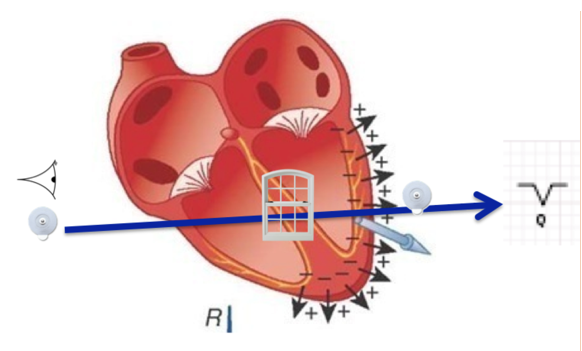
What do normal Q waves represent?
What is considered a normal Q wave?
- The normal Q wave represents the normal left-to-right depolarisation of the interventricular septum
- Small ‘septal’ Q waves are typically seen in the left-sided leads (I, aVL, V5 and V6)
- Small Q (<2mm) waves are normal in most leads
- Deeper Q waves (>2 mm) may be seen in leads III and aVR as a normal variant
- Under normal circumstances, Q waves are not seen in the right-sided leads (V1-3)

ECG features of AS
sinus
LVH




