how many pumps are there in the heart and how do they work?
what circulation results in high/low pressure?
- 2 acting in series
- high = systemic
- low = pulmonary
what type of muscle is the heart?
whats special about the cellular arrangement?
whats the duration of a cardiac AP?
- striated cardiac muscle, made up of myocytes that are interconnected electrically with each other
- 280ms
what are the valves of the heart?
why do they open?
what are they attatched to?
- tricuspid , mitral (bicuspid) , pulmonary , aortic
- due to pressure differences from artia/ ventricles or ventricles/PA/Aorta
- attached to papillary muscle via chordae tendinae which prevents the prolapse of the valve upon high pressure
what are the main cells in the conduction system and describe how they cause conduction steps that results in contraction?
- pacemaker cells in the SAN generate the AP across the atria - resulting in atrial systole
- , which reaches the AVN,
- from AVN spreads down the septum between the ventricles then through the ventricular myocardium from inner (endocardial) to outer (epicardial) surface causing ventricle contraction from the apex upwards forcing the blood through th valves
7 phases of the cardiac cycle?
1) atrial contraction
2) isovolumetric contraction
3) rapid ejection
4) rejected ejection
5) isovolumetric relaxation
6) rapid filling
7) reduced filling
plot a ‘x’ diagram
what does x mean?
for what side of the heart is it usually plotted?
image
wiggers diagram
left side , it can be plotted for the right but at lower pressures
phase 1
atrial contraction
A wave. d ^ in atrial pressur d atrial systole (atrial pressure graph)
at the end we reach EDV
- small increase in pressure due to atria contracting to push that final little bit of blood out ,
- M and T valves open and filling is passive except for the last 10%
- P wave in ECG (volume) signifies the onset of atrial depolarisation
phase 2
isovolumetric contraction
- M valve closes as intraventricular pressure increases atrial pressure
- rapid rise in pressure as the ventricles contract
- closing of mitral valve = C wave on pressure curve
- on ECG (volume) QRS complex forms and signifies the onset of ventrcular depolarisation
- closure of M + Tvalve = ‘lub’ sound 1
- no change in the ventricular volume because the valves are closed
phase 3
rapid ejection
ventricular contraction increases pressure so higher pressure in the V than A = aortic valve opens and blood ejected through it
- in artial pressure graph the pressure decreases = ‘X DESCENT’ because the ventricular contraction pulls the atria downwards
- aortic valve open
phase 4
reduced ejection
pressure in the A rises higher than ventricule
- same time atria filling up d continous venous return from lungs so gradual increasein pressure of atria = V wave
- T wave in the ECG depicts ventricular repolarisation
- aortic valves open
phase 6
- isovolumetric relaxation
close A valve when intraventricuar pressure falls below aortic pressure, theres a backflow of blood wc causes the aortic valve to close = dicrotic notch causing slight increase in pressure
- rapid decreae in ventricular pressure , but volume constant as all values closed =isovolumetric relaxation
- ESV = minimum blood the ventricles can hold since not 100% blodd ejected from v to a
- closure of the A and p valve cause the second heart sound
phase 6
rapid filling-
decrease in A pressure after opening of M valve =’ Y descent”
- when intraventricular pressure is lower than atrial pressure the mitral valve opens and b starts filling the ventricles rapidly
- sound 3 can be heard a little in kids is normal due to the b going from atria to ventricle, but in adults sound heard = pathological issue
mitral valve open
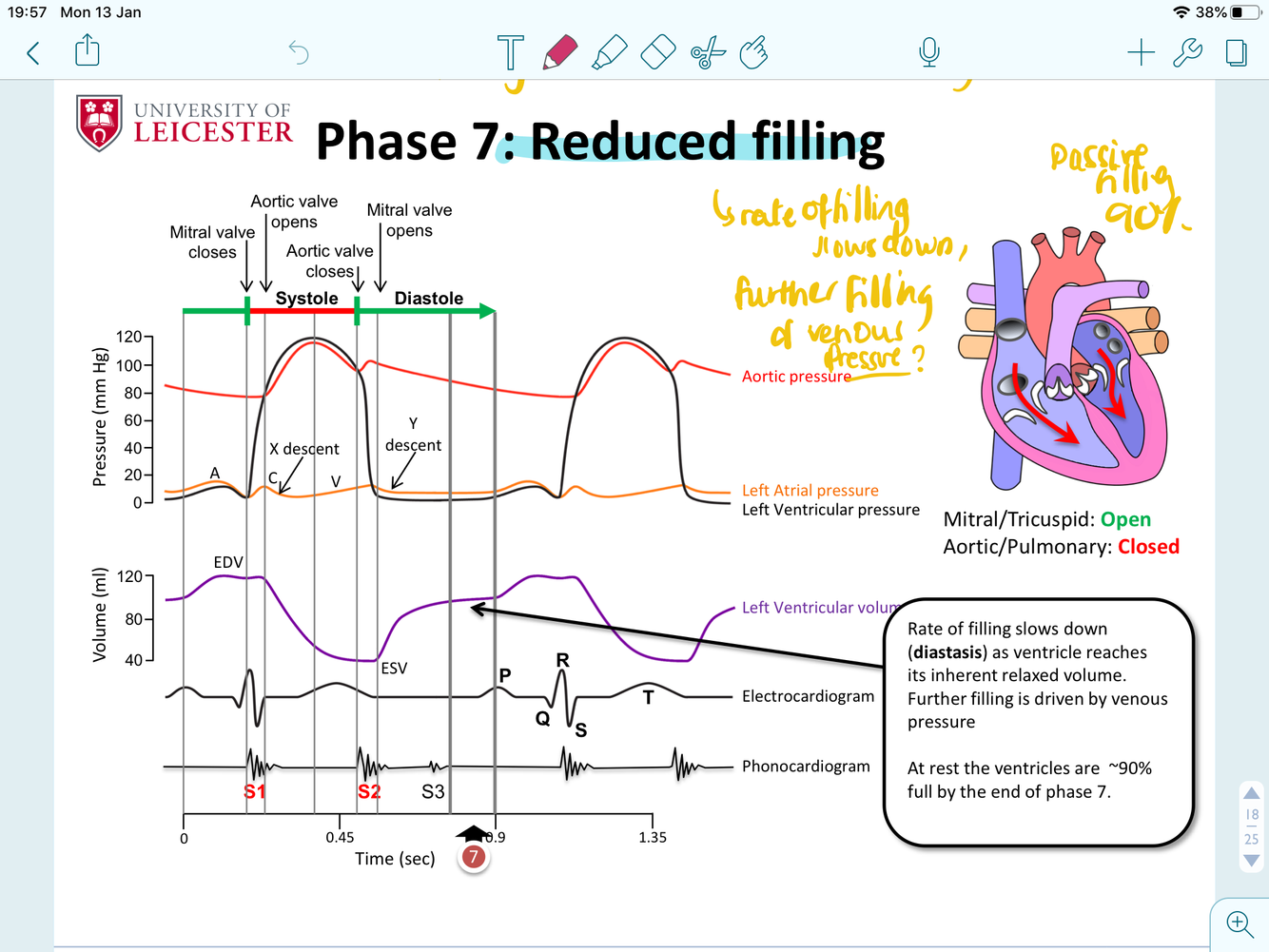
phase 7
- reduced filling
rateof filling slows down diastasis as ventricle reaches its inherent relaxed volume, further filling is driven by venous pressure
- at rest 90% filled ventrice
- mtiral valve isopen
2 abnormal valve functions and causes
- STENOSIS = valve doesnt open enough , obstruction to blood flow when valve normally open
- REGURGITATION (imcompetence/insufficiency) valve doesnt close all the way, back leakage when valve should be closed
size of normal valve and the size requirements for stenosis?
causes of aortic valve stenosis
what does this result in?
sound
- N= 3-4 cm2. S = <1cm2
- degenerative (senile/calcificaition fibrosis/ vegetation)
- congenital ( bicuspid form valve instead of tricupsid)
- chronic rheumatic fever - from Strep.A group c inflammation can get autoimmune response where own antibodies attack the structure of the valve
- less blood can get through valve so;
increased LV pressure = LV hypertrophy / left sided heart failure = syncope / angina
or sheer stress of the RBC being pumped at high pressure can cause haemolysis resulting in MICROANGIOPATHIC HAEMOLYTIC ANAEMIA
- crescendo-decrescendo murmur after S2
causes of aortic valve regurgitation
what does this result in?
sound?
- aortic root dilation (leaflets pulled apart)-
- valvular damage due to endocarditis rheumatic fever
- blood flows back into LV during diastole
- increase in stroke volume
- systolic pressure increases
- diastlic pressure decreases
- bounding pulse is found in these patients / QUINKE’S SIGN = pulsation in the nail bed/ changing colour with the pulsationsof the nail bed
- LV hypertrophy
- early decrescendo diastolic murmur
mitral valve regurgitation
- chordae tendinae + papillary muscles weakened due to MYXOMATOUS DEGENERATION causing prolapse so blood leakage into LA
- or other weakenesed of = papillarymuscle weakening post MI, left sided heart failure leads to LV diation which can stretch valve / rheumatic fever can lead to leaflet fibrosis which distrupts seal formation
- blood leaks back into LA causing increase in preload resulting in more blood entering in subsequent cycle = LV hypertrophy
- holosystolic murmur
mitral valve stenosis cause?
describe the mechanism by which this may cause damage?
sounds heard when?
- rheumatic fever (99.9%) cases
- comissural fusion of valve leaflets so harder for blood to flow LA to LV which causes increased LA pressure;
- causes pulmonary oedema because due to increased LA pressure blood is pushed into veins resulting in an increase in VP which pushes fluid out into the air spaces (alveoli) of the lungs
- dyspnea shorteness of breath
- pulmonary hypertension (^BP in the pulomary blood vessels
this all above cause RV hypertrophy
- LA dilation can cause atrial fibrillation = thrombus formuation / osephagus compression = dysphagia
- snapping sound sound heard after the first S1
narrow pulse pressure?
aortic stenosis
Quinke’ sign?
aortic regurgitation
beds of the nail changing colour
bounding pulse
aortic regurgitation
Murmur loud upon inspiration
right sided valve lesion
murmur louder with patient in lateral position
mitral regurgitation
rigth side 2nd intercostal space
aortic valve

-
Intro23
-
CVS imaging22
-
Haemodynamics26
-
Cardiac Cycle27
-
Control of Cardiac Output20
-
Electrical and Molecular Mechanisms of the Heart and Vasculature12
-
Heart Abnormalities1
-
Embryology of the Heart18
-
Autonomic control of CVS13
-
Hypertension32
-
Interpreting ECG44
-
ECG46
-
Questios16
-
Arrhythmias29
-
Drugs of CVS16
-
Special Circulations50
-
Peripheral Arterial and Venous Diseases55
-
Chest pain30
-
Acute Coronary Syndrome13
-
Heart Failure29
-
ECG18
-
ECG conditions30
-
Haemodynamics22



