Closed Circulatory System
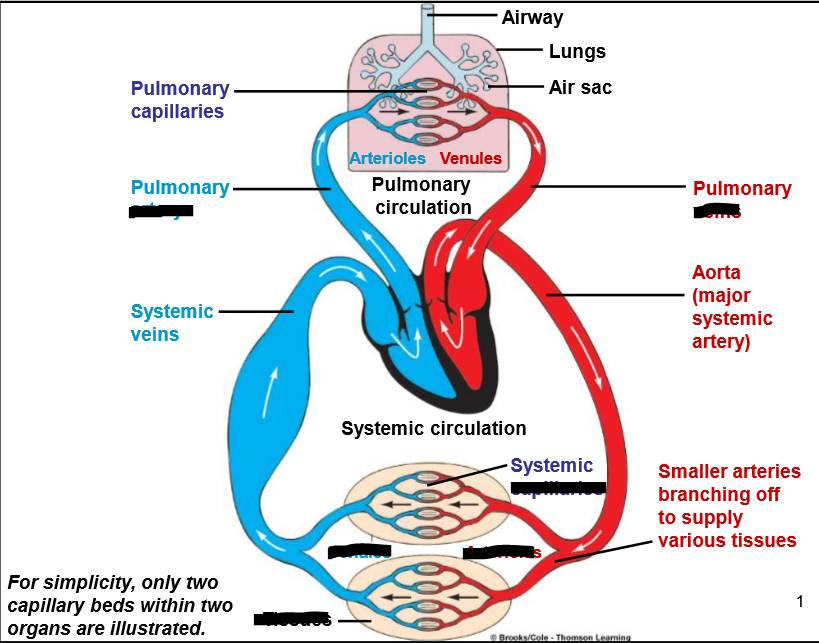
Humans (all vertebrates), blood never ____ vessels, movement of gases, O2, CO2, glucose, fatty acids move through ____ and exchage at ____ level
______: tiny arteries that provide blood flow to capillary beds throughout the body
_____ _____: site of exchange between blood and tissue
______: tiny veins that drain blood back to right side of heart
Are THICK bc are lax, ___ resistance/non ______ vessels
leaves, diffusion, tissue
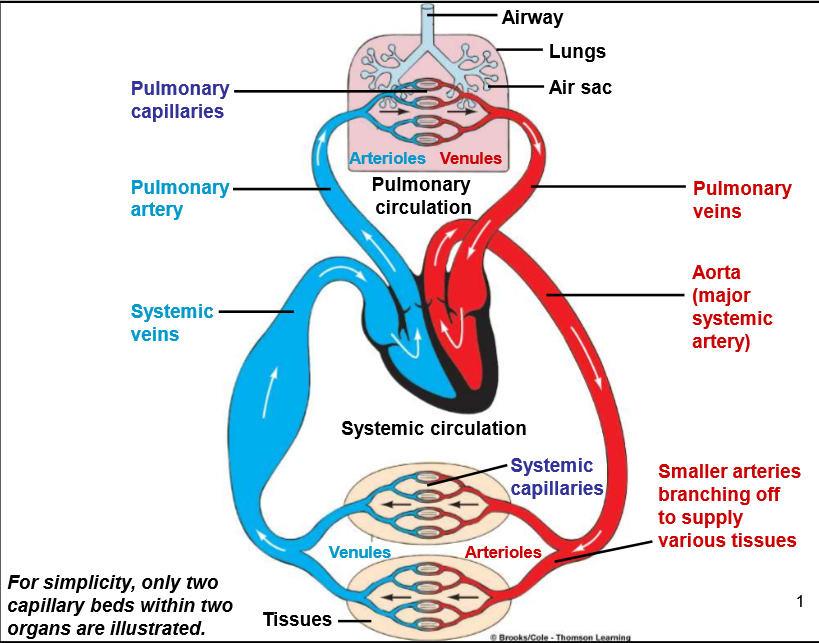
Arterioles
Capillary Beds
Venules
low resistance, non-muscular
Flow Dynamics
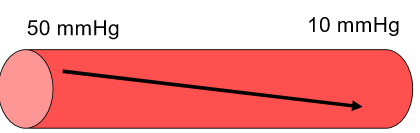
F = ►P/R
- F =
- ►P =
- R =
- Flow rate through vessel
- Pressure gradient
- Resistance of blood vessel
Flow Dynamics Notes
- Flow rate = v_____ per t____
- Pressure gradient = P_____ pressure
- Pressure gradient/Resistance = _______ related
Resistance to flow comes from 2 things
- _______: (thickness) of blood determined by ______: ratio of cells to plasma
- High viscosity =
- ______ of Vessel*: relationship between r_____ and r______ is ______ (small change in radius produces big changes in resistance
- volume per time
- perfusion
- inversely
- Viscosity, Hematocrit
- Lot of cells, Low plasma
- Diameter, radius and resistance
- Exponential
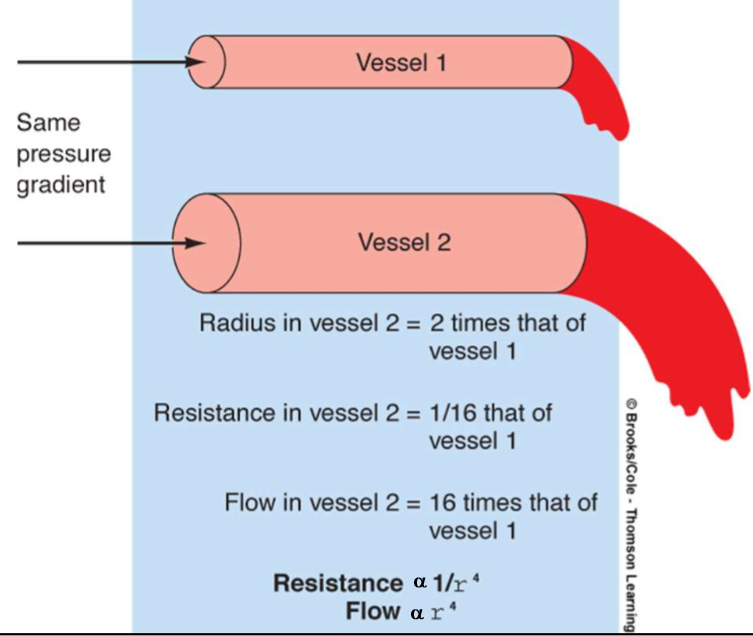
Radius vs. Resistance
- Smaller Radius -> ______ Resistance -> ______ in flow
- Bigger Radius (______) -> _____ Resistance -> ____ in flow
In the picture, the diameter increases by __x but the flow increases by ___x
- higher -> decrease
- Dilation -> lower -> increase
2x diameter -> 16x flow
Arteries
The arteries are designed to perform two major duties:
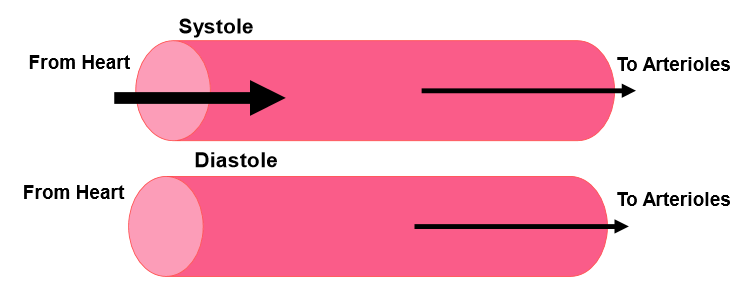
- Fast _____ from heart to tissues (____ diameter vessels)
- _____ pressure and provide _____ force for flow when heart is resting (elastic walls)
Connective tissue layer ______ and _____ fibers
Underlying _____ _____
External _____ _____ covering
- transport (large)
- Store, driving force
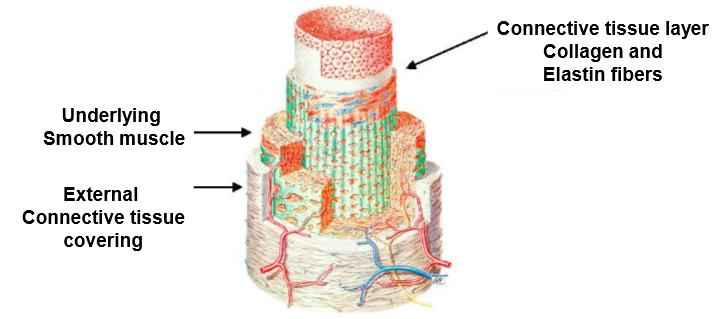
collagen and elastin
smooth muscle
connective tissue
Arteries as a Pressure Reservoir
Pressure transfers from ventricular _____ -> ____ on aortic wall -> perfusion pressure during diastole when aortic wall ______
contraction -> stretch -> rebound
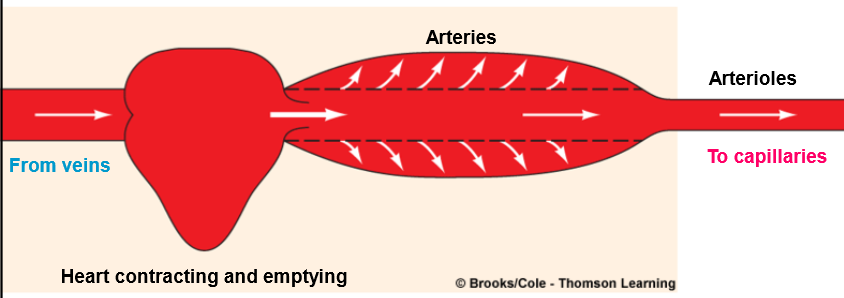
What is happening in this picture?
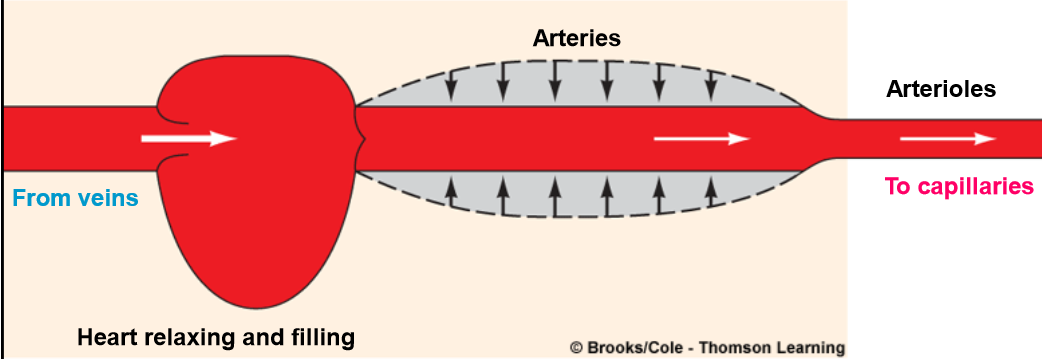
The energy is transferred into?
Driving Force
Arterial Blood Pressure
Blood Pressure - ____ of blood against vessel wall
Compliance and Distensibility
- Arteries compliance?
- Veins compliance?
Notes
- BP = indirectly measuring _____ pressure by measuring ____ artery pressure
- Systolic = ____ arterial pressure (generated by systolic contraction of ventricles)
- Diastolic = ____ pressure of arteries (generated by how healthy artery walls are and blood volume)
force
- not very compliant
- very compliant
- aortic, brachial
- peak
- resting
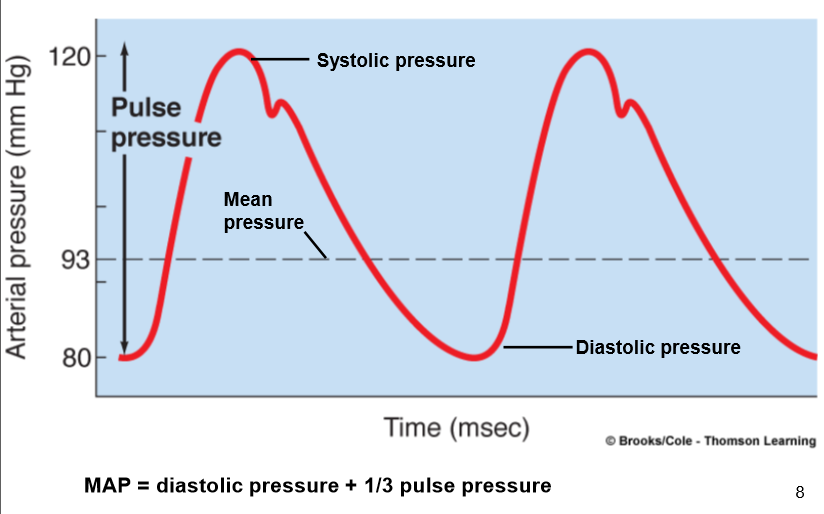
Arterial Blood Pressure
- Systolic: ____ average
- Diastolic: ___ average
(1): Difference between systolic and diastolic pressure
- represents the potential for _____
- Lower pulse pressure = less ____ ventricles can push into aorta
(1): constant perfusion pressure that is present in the arteries no matter what phase your heart is in
- ADEQUATE MAP = _____ OF ______
- weights _____ pressure > _____ pressure bc your BP spends more time closer to diastolic than it does to systolic
- MAP = ____ + _____
- 120
- 80
Pulse Pressure
- Perfusion
- blood
MAP
- PERFUSION OF ORGANS
- diastolic > systolic
- Diastolic pressure + 1/3 pulse pressure
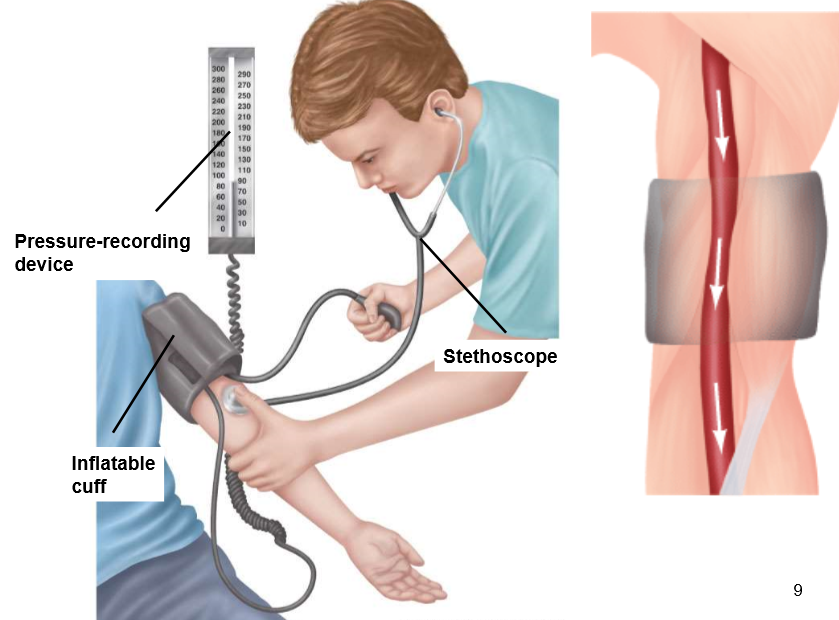
Manual BP
Pump up bladder until you lose ____ pulse: this represents when cuff pressure is just ____ systolic pressure (just harder than the peak pushing pressure of that artery)
lose radial pulse -> above SBP
Korotkoff Sounds
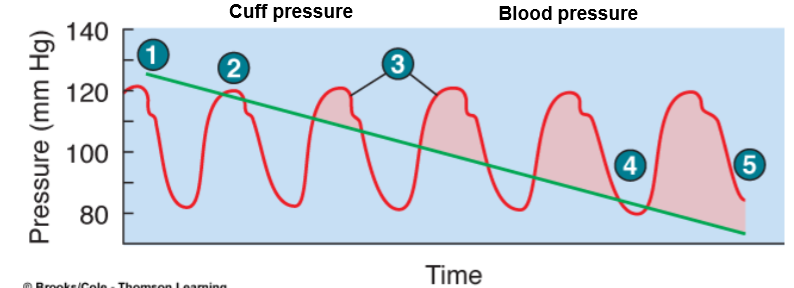
- Green line = Cuff Pressure
- Tapping sounds = _____ blood flow
- ___ radial pulse left
- First tap =
- Last tap =
- Both numbers when taking manual BP are ________ (slightly less than systolic and diastolic)
- turbulent
- No
- Comes from force of blood that comes through the squeezed brachial artery that represents cuff pressure just below systolic pressure
- When cuff pressure falls just below diastolic pressure
- underestimations
Oscillation of Pressures through the Vascular Tree
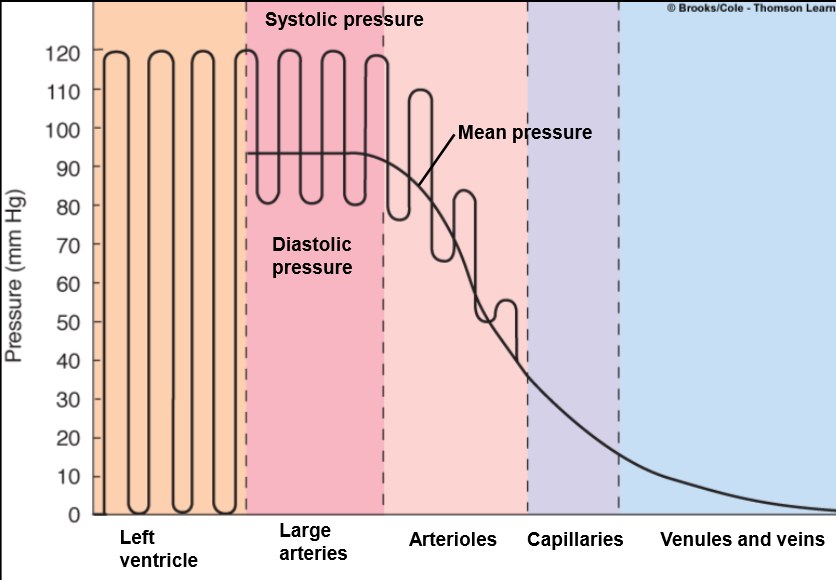
Gradual ____ of MAP through arteries, arterials, veins promote movement of blood in that _____ way
- Left ventricle:
- Systemic arteries:
- Arterioles:
- Capillaries and Veins:
Decline
- 0-120
- 80-120
- starts to lose pulse pressure
- completely looses pulsatile nature
Arterioles
- Supplies Organs
- Arteriole walls very simplified compared to arteries -> very ____ connective tissue**, still has ____ _____ covering
- Diameter changeable
- ______ distributes CO based on current _____: “_______” to blood entering an organ
- Regulates arterial _____ _____: bc has signficant ability to ____ and ____ -> effects overall _____ in the system
- Supplies Organs
- little connective tissue**, smooth muscle
- Diameter changeable
- Variably distributes CO, demands, “gatekeepers”
- BP: constrict and dilate -> resistance
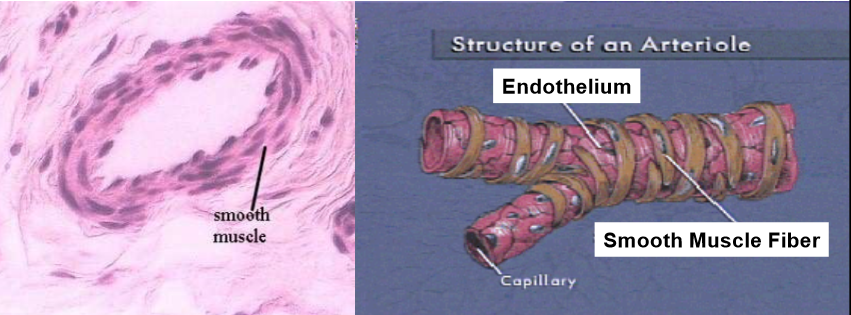
Arteriole Tone
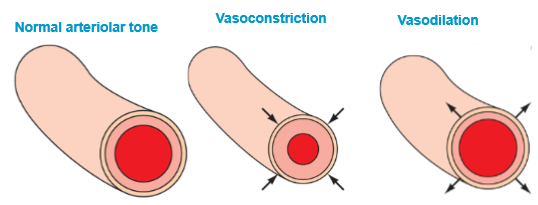
What Factors Cause Vasoconstriction or Vasodilation
Normal Arteriolar Tone =
Produced by:
1)
2)
Resting diameter of arterial produced by basic properties of muscles that surround arterioles and baseline SNS output
1) Myogenic activity - elastic property of the muscle tissue
2) Baseline sympathetic input
What Factors Cause Vasoconstriction or Vasodilation?
Factors fall into two general categories:
Intrinsic Factors (1)
Extrinsic Factors (2)
Local Factors
Neuronal or Hormonal Factors
Intrinsic Local Control
= Changes with ______
- Chemical (2)
- Physical (2)
Tissue
- Chemical
- Local metabolic changes
- Histamine release
- Physical
- Local application of heat or cold
- Myogenic response to stretch
Local Control - Chemical Factors
- Local Metabolic Changes (4)
- Vasoconstriction
- O2 =
- CO2 =
- Acidity =
- Adenosine =
- Vasodilation
- O2 =
- CO2 =
- Acidity =
- Adenosine =
O2, CO2, Acidity, Adenosine
- Vasoconstriction
- Increased
- Decreased
- Decreased
- Decreased
- Vasodilation
- Decreased
- Increased
- Increased
- Increased
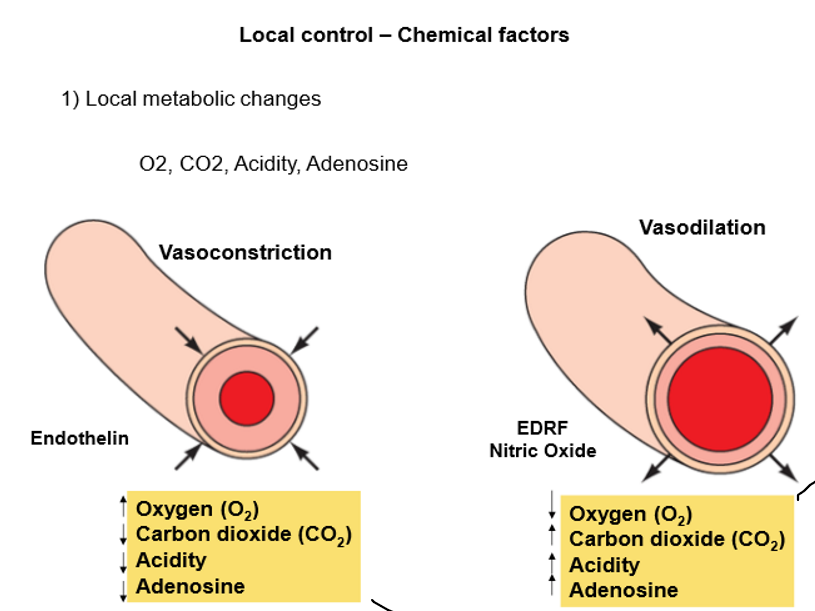
Local Metabolic Changes Notes
Free ____ increases whenever you are consuming ATP
______ Cells: Critical player in local control, cells that directly face the blood and sense changes in O2, CO2, Acidity, Adenosine
Endothelial Cells will Release what during
- High Metabolic Activity (1)
- Low Metabolic Activity (1)
Adenosine
Endothelial Cells
- Nitric Oxide: gas that acts on smooth muscle to dilate vessel when tissue is very metabolically active (low O2), so dilation will dilate to increase perfusion and O2 delivery to tissue
- EDRF = Endothelial Relaxing Factor (first name for NO)
- Endothelin: substance that goes next door to smooth muscle to cause vasoconstriction -> shunts blood to somewhere else where is most needed
Extrinsic Control
Includes both _____ and ______ influences
Most important is the effect of?
Sympathetic nerve fibers supply arteriole smooth muscle everywhere but the brain
- Increased activity = generalized ______
- Decreased activity = generalized ______
Releases what hormone? - onto what receptors?
Helps regulate _____ _____
neural and hormonal
Sympathetic nervous system
- vasoconstriction
- vasodilation
Norepi -> alpha-adrenergic receptors
Blood pressure
Extrinsic Control Notes
Increased sympathetic activity
- Total peripheral resistance?
- CO = HR x SV -> HR? SV?
- Vaso_____ on vein -> increases venous ______ -> increase end ____ volume -> more ___ volume
Generalized vasoconstriction is the NET effect - Think Fight or Flight (Sympathetic Response)
- Specific effect that sympathetic stimulation has to a particular arterial bed depends on ____ that arterial bed resides
- Arterioles that perfuse smooth muscle and bronchioles have ____ receptors
- Norepi binds to beta receptors causes = ______
- Arterioles that perfuse nearly all other organs have ____ receptors
- Norepi binds to alpha receptors causes = ______
- TPR increases
- HR and SV increases
- constriction -> return -> diastolic volume -> stroke
- where
- Beta
- Vasodilation (allows you to RUN/FLEE)
- Alpha
- Vasoconstriction (blood flow shunts away from GI/liver/kidneys)
How does Arteriole Diameter relate to Blood Pressure?
F = ►P/R
Cardiac Output (CO) =
Mean Arterial Pressure (MAP) =
Total Peripheral Resistance (TPR) =
CO = MAP/TPR or MAP = CO x TPR therefore..
TPR most influenced by _____ resistance
CO = Flow
MAP = ►P
TPR = R
Arteriolar Resistance
TPR is a function of blood viscosity (hematocrit) AND overall arterial constriction vs. dilation
Relationship between CO and MAP - positive association
So depending on what arterioles are doing TPR goes up and down which causes our MAP to go up or down
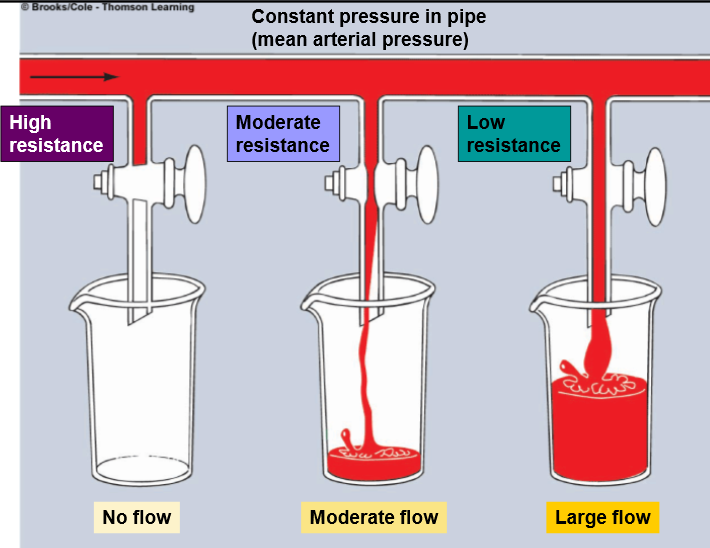
Constant Pressure in pipe (MAP)
High resistance = ___ flow
Moderate resistance = ___ flow
High resistance = ____ flow
Beakers = Organs, Outlets = Arterioles
No
Moderate
High
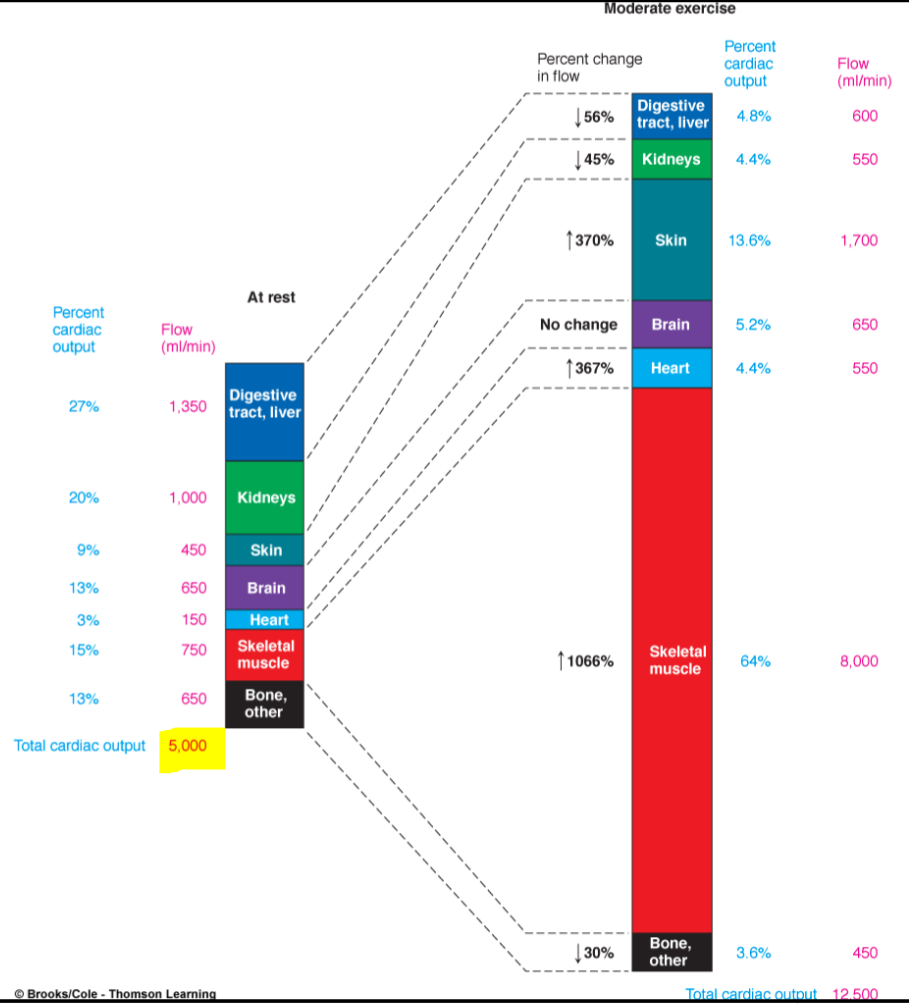
Distribution of CO Rest vs. during Exercise
- Total CO?
- Blood flow to Skeletal Muscle?
- Blood flow to Heart?
- Blood flow to Brain?
- Blood flow to Skin?
- Blood flow to Organs?
- Total CO expands
- Increases by over 1000% (5L/min -> 12.5L/min)
- Increases
- Fixed amount, doesn’t change
- Gets more (so it can dissipate heat so our core temp doesn’t go up)
- Gets LESS
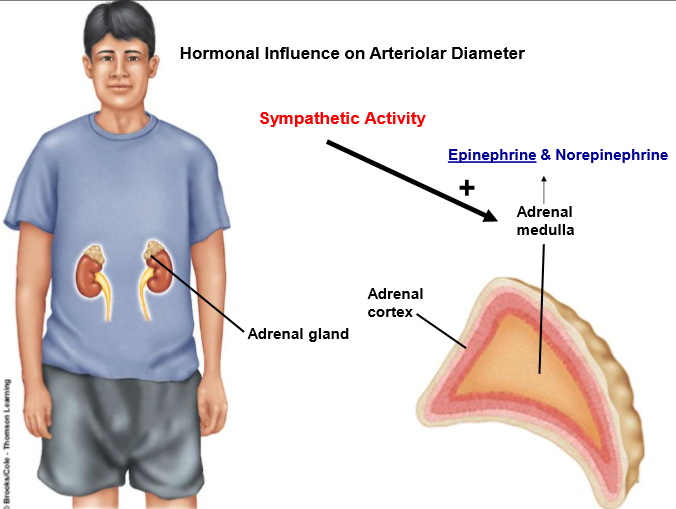
Hormonal Influence on Arteriolar Diameter
______ Activity
Hormones (2)
What gland does it act on?
Sympathetic
Epinephrine and Norepinephrine
Adrenal Gland (Cortex and Medulla)



-
Cellular Basis Of Disease49
-
Cellular Basis of Disease Part 241
-
Normal Function of the Nervous System43
-
Normal Function of the Nervous System Part 257
-
Endocrine System51
-
Human Stress Response, Immune System Part 143
-
Immune System Part 263
-
Cardiovascular Normal Function Part 141
-
Cardiovascular Normal Function Part 249
-
Cardiovascular Patho Part 138
-
HTN/Cardiovascular Patho Pt 280
-
Respiratory System Normal Function60
-
Respiratory Pathophysiology37
-
Renal System Normal Function87
-
Renal Pathophysiology51



