An 8 week old baby boy presents for routine examination to his GP. He is noted to have a murmur.
What history features should you ask about?
- Breathlessness (feeding or exertion)/ colour changes
- Poor feeding +/- weight gain
- Sweating
An 8 week old baby boy presents for routine examination to his GP. He is noted to have a murmur.
What should you look for on examination?
- Tachycardia/ Tachypnoea
- Hepatomegaly
- Peripheral pulses (femorals/ brachials) , Gallop rhythm
An 8 week old baby boy presents for routine examination to his GP. He is noted to have a murmur.
Investigations
- Refer to paediatrics if any uncertainty
- May need Sats, 4 limb BP, Echo, ECG +/- CXR
- Measurements and centiles
Common features of innocent murmurs
- Soft- Grade I to II
- Systolic
- Localized (Left sternal edge common)
- Vary with activity, position and respiration
- Asymptomatic
A 12h old baby girl is noted on routine post delivery examination to be blue (face, tongue and limbs). Peripheral pulses are present. A loud systolic murmur is present.
Differential diagnosis
Transposition of the great arteries (mixing via VSD/ PDA/ PFO)
A 12h old baby girl is noted on routine post delivery examination to be blue (face, tongue and limbs). Peripheral pulses are present. A loud systolic murmur is present.
Transposition of the great arteries - managment
- Admit to neonatal unit and discuss with cardiac centre
- Sats, Gas, 4 limb BP, CXR and Echo
- May need volume expansion, correction of acidosis/ hypoglycaemia, inotropes
- IV Prostaglandins and potential ventilation (specialist use)
What is the cardiac abnormality associated with each of the following?
- Down’s
- Turner’s
- Noonan’s
- William’s
- Down’s: AVSD
- Turner’s: Coarctation
- Noonan’s: Pulmonary Stenosis
- William’s: Supravalvular Aortic Stenosis
A 2y old girl presents to her GP with 2 days of runny nose and cough. She has no fever and no change in appetite or activity.
Examination shows no fever HR 100 RR 25, no chest findings but marked skin pallor.
An FBC shows Hb 5.3 (low), MCV 57 (low), Plt 300, WBC 6.0
Diagnosis and differential?
- Iron deficiency anaemia
- Alpha/ Beta thalassemia’s
- Secondary anaemia
A 2y old girl presents to her GP with 2 days of runny nose and cough. She has no fever and no change in appetite or activity.
Examination shows no fever HR 100 RR 25, no chest findings but marked skin pallor.
An FBC shows Hb 5.3 (low), MCV 57 (low), Plt 300, WBC 6.0
Investigations
- blood film
- serum ferritin
Iron deficiency management
- Increase dietary iron (red meat, green veg)
- Check (and reduce) milk consumption
- Dietician referral
- Oral iron supplementation
A 3y old boy presents with 4 weeks of lethargy, looking pale and recurring fevers.
Examination showed multiple bruises on the legs back and chest, enlarged cervical/ inguinal lymph nodes and hepato-splenomegaly.
Diagnosis and differential?
Acute leukaemia (Likely ALL)
A 3y old boy presents with 4 weeks of lethargy, looking pale and recurring fevers.
Examination showed multiple bruises on the legs back and chest, enlarged cervical/ inguinal lymph nodes and hepato-splenomegaly.
Investigations
- FBC and Film to confirm
- Coag/ U+E/ LFT/ CRP
- Specialist investigations under oncologist guidance
A 3y old boy presents with 4 weeks of lethargy, looking pale and recurring fevers.
Examination showed multiple bruises on the legs back and chest, enlarged cervical/ inguinal lymph nodes and hepato-splenomegaly.
Management
- Admit to hospital
- Urgent referral to paediatric oncologist
Bruises, Purpura and Petechia
Non-thrombocytopenic causes
- Henoch-Schönlein purpura
- Sepsis (meningococcal/ ?viral)
- Trauma (accidental/ non-accidental)
Bruises, Purpura and Petechia
Thrombocytopenic
- Idiopathic thrombocytopenic purpura (ITP)
- Leukaemia
- Disseminated intravascular coagulation (DIC)
A 5y old girl presents with a 24h history of reluctance to walk and difficulty weight bearing. She had a “cold” 3 days ago.
Examination shows Temp 37.50, no swellings, normal perfusion, no skin changes, full range of movement in hips and knees.
Diagnosis and differential?
- Transient synovitis (Irritable hip)
- Reactive arthritis
- Trauma
- ?Septic arthritis
A 5y old girl presents with a 24h history of reluctance to walk and difficulty weight bearing. She had a “cold” 3 days ago.
Examination shows Temp 37.50, no swellings, normal perfusion, no skin changes, full range of movement in hips and knees.
Management and investigation
- Self limiting illness (Rest and analgesia)
- if febrile or doesn’t settle after few days - FBC/ ESR/ CRP/ Blood culture/ Hip X-Ray
Give some medical causes of a limping child
- Septic arthritis
- Osteomyelitis
- Reactive arthritis
- Juvenile Idiopathic Arthritis
- Rheumatic fever
Give some orthopaedic causes of the limping child
- Perthe’s disease (AVN)
- Slipped upper femoral epiphysis (SUFE)
- Congenital hip dysplasia (CDH)
- Fracture
- Trauma
A 3 week old baby boy (born at 29/40w) is on CPAP (21% O2). He develops a rapid rise in his oxygen requirements and respiratory rate.
Examination shows reduced air entry on the left
What is the likely diagnosis?
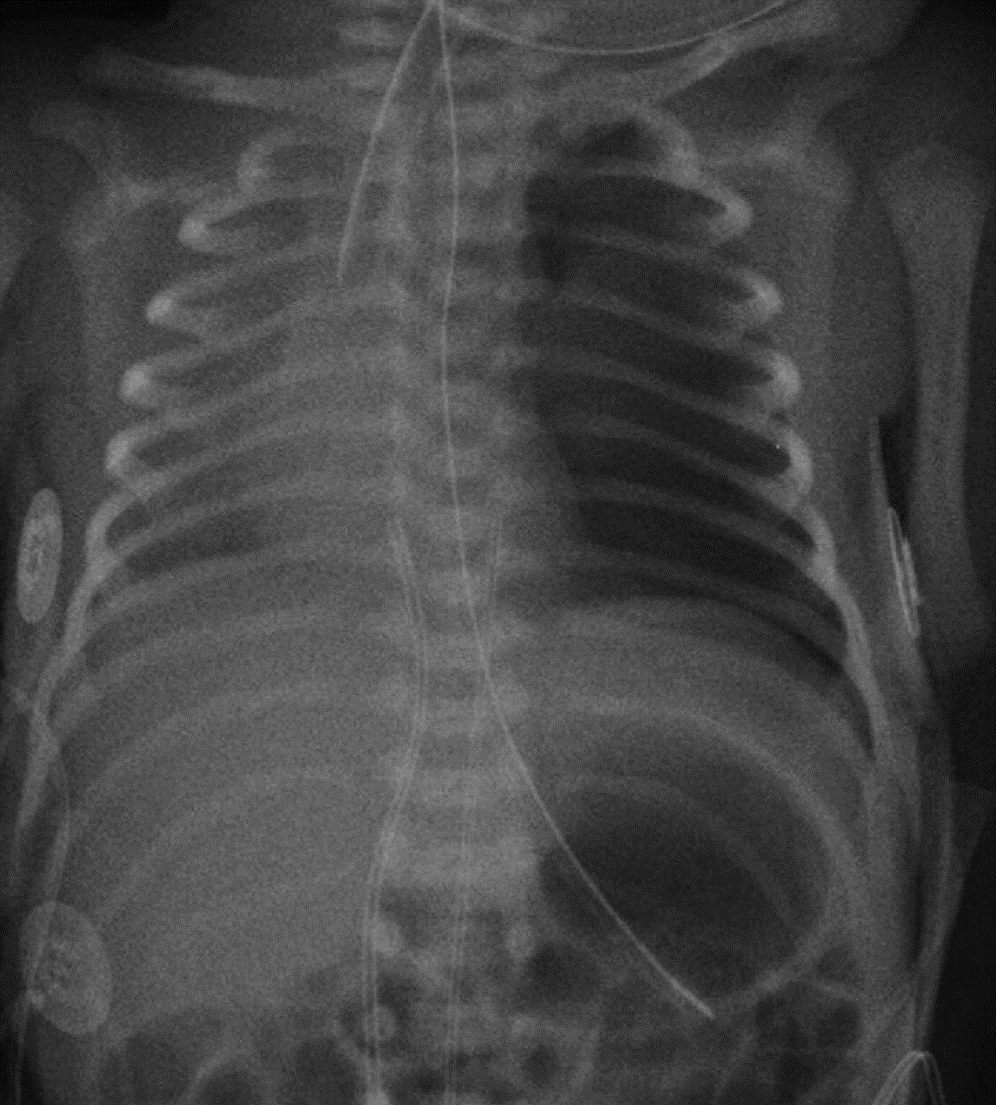
Tension pneumothorax
A 3 week old baby boy (born at 29/40w) is on CPAP (21% O2). He develops a rapid rise in his oxygen requirements and respiratory rate.
Examination shows reduced air entry on the left.
Signs?
- Reduced air entry on left, Low sats
- Tachypnoea
- Heart sounds shifted to right
- Altered perfusion (Tachycardia/ ?Bradycardia)
- Chest Transillumination
A 3 week old baby boy (born at 29/40w) is on CPAP (21% O2). He develops a rapid rise in his oxygen requirements and respiratory rate.
Examination shows reduced air entry on the left.
Tension pneumothorax - management
- ?Intubate, Oxygen, fluids (ABC)
- Needle thoracocentesis
- Chest drain
A 26 day old baby girl is noted by the health visitor to be jaundiced. She is referred in to paediatrics for further assessment.
What history features should you ask about?
- Full birth history (gestation/ delivery/ resus/ wgt)
- Age of onset/ phototherapy at birth
- Mode of feeding/ Weight gain
- Colour of urine/ stools
- Siblings with jaundice
A 26 day old baby girl is noted by the health visitor to be jaundiced. She is referred in to paediatrics for further assessment.
Examination
- Extent of jaundice
- Signs of anaemia or sepsis/ normal activity
- Evidence of increased hepato/splenomegaly
- Measurements and centile

-
Approach to Assessing Children23
-
Growth, Development and Health37
-
Children with Special Needs45
-
Respiratory46
-
Respiratory - Asthma30
-
Nephrology - Nephrotic syndrome26
-
Nephrology - Nephritic syndrome22
-
Nephrology - AKI16
-
Nephrology - CKD25
-
Constipation and IBD22
-
Neonatology33
-
Dermatology27
-
Cardiology60
-
Liver Problems72
-
Growth and Endocrine44
-
Infant Feeding24
-
Neurology37
-
Child Protection and NAI24
-
Surgery44
-
Urology35
-
Children are not small adults8
-
Adolescent Health18
-
Oncology47
-
Approach to the Acute Child13
-
Vomiting and Malabsorption58
-
Infectious Diseases42
-
Rheumatology45
-
Staph, Strep and Kawasaki Disease57
-
Immunodeficiencies and Fungal Infections26
-
Pharmacology48
-
The Injured Child38
-
Common Post-Natal Problems69
-
Term Admisssions39
-
Genetics32
-
Liver Problems COPY70
-
Case studies 126
-
Case studies 246
-
Case studies 334



