why is visual assessment limited in veterinary speices and what are the methods of assessing
because of interence of behaviour
- observation, unfamiliar environment
- ability to track (silent movement, ex. cotton balls)
- visual placing (if small animal)
- menace response (other reasons for failure)
what is the visual pathway
- retina
- optic nerve
- optic chiasm
- optic tract
- lateral geniculate nucleus
- optic radiation
- occipital cortex
what is the visual field
total area in whcih objects can be seen in the peripheral vision as you focus your eyes on a central point
ex. predator –> more forward vision
prey –> more vision towards behind
what is the pathway in the pupillary light relfex (PLR)
- retina
- optic nerve (CNII) –> afferent
- optic chiasm
- optic tract
- pretectal nucleus
- parasympathetic nucleus of CNIII –> efferent
- bilateral pupil constriction
what is the menace response pathway
- retina
- optic nerve (CNII) –> afferent
- optic chiasm
- optic tract
- lateral geniculate nucleus
- optic cortex
- motor cortex
- pontine nucleus
- cerebellum
- facial nerve nuclei (CNVII) –> efferent
what is central (cortical) blindness
amaurosis
blindness without apparent lesion of the eyes
involves processing system
where is the lesions in central (cortical) blindness
- lateral geniculate nucleus
- optic radiation
- occipital cortex
what are the clinical signs of central (cortical) blindness
normal PLR
absent menace response
blind
what is peripheral (subcortical) blindness
involves collection/distribution system
what are the lesions of peripheral (subcortical) blindness
- eye
- optic nerves
- optic chiasm
- optic tract
what are the clinical signs of peripheral (subcortical) blindness
- absent PLR
- absent menace
- blind
what is the pathway of the dazzle reflex
- retina
- optic nerve (CNII) –> afferent
- optic chiasm
- optic tract
- pretectal nucleus
- facial nerve nuclei (CNVII) –> efferent
- bilateral blinking
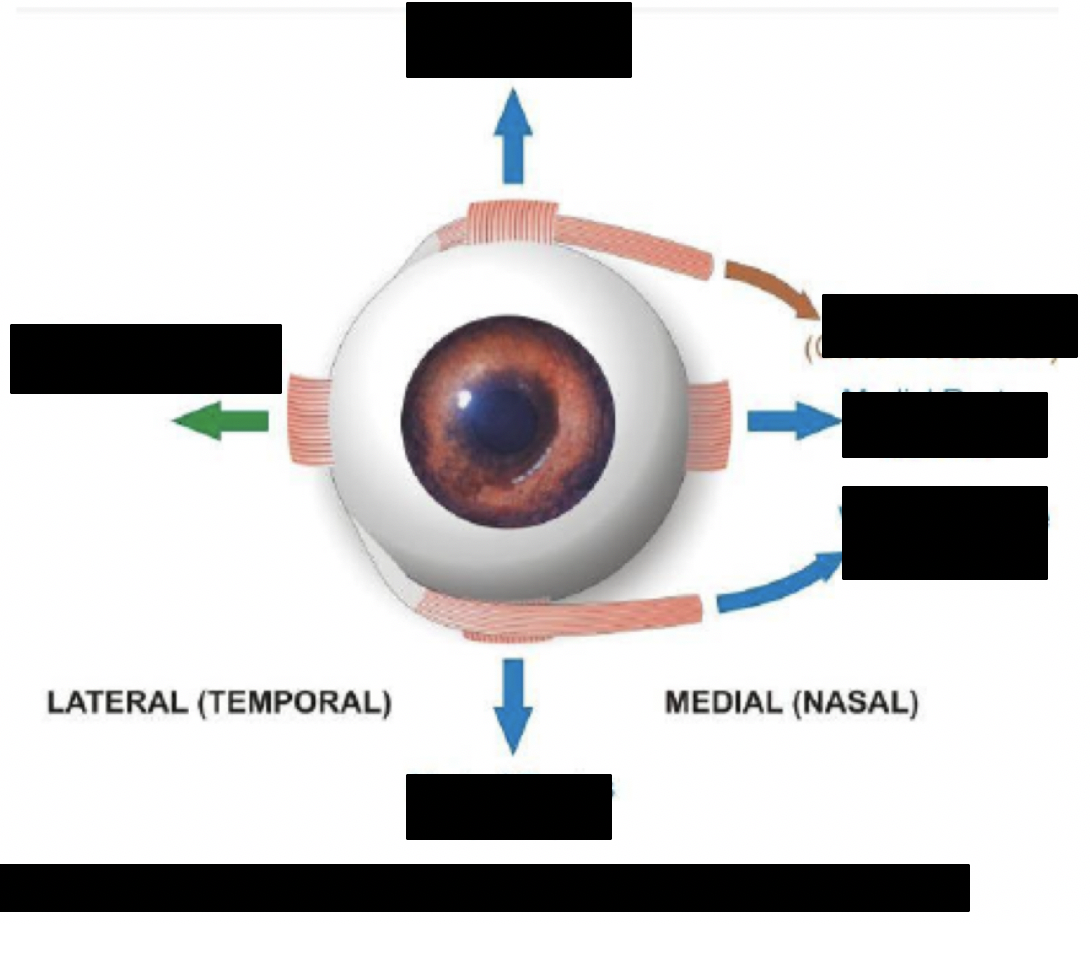
what is the innervation of the extraocular muscles
- dorsal rectus –> CN III
- dorsal oblique –> CN IV - trochlear
- medial rectus –> CN III
- ventral oblique –> CN III
- ventral rectus –> CN III
- lateral rectus –> CN VI - abducens
what are the functional classifications of cranial nerve III (occulomotor)
GSE: dorsal rectus, medual rectus, ventral rectus, ventral oblique, levator plapebrae
GVE: parasympathetic for pupil
what are the functional classifications of cranial nerve IV (trochlear)
GSE: dorsal oblique
what are the functional classifications of cranial nerve VI (abducent)
GSE: lateral rectus
retractor bulbi muscle in the eye
what is strabismus
cross eyed
lateral or medial
what causes lateral strabismus
cranial nerve II affected
what causes medial strabismus
cranial nerve VI
what causes strabismus in both eyes
cranial nerve IV
what causes lateral strabismus and dilated pupil
CN III occulomotor nerve
dilated pupil because CN III innervates pupil
what is eye position controlled by
the vestibular system

-
Bones and Joints of Equine Distal Limb Q's74
-
Bone and Joints of Equine Distal Limb Pics32
-
Bones and Joints of Distal Limb Q's11
-
Muscles & Tendons of Distal Limb83
-
Equine Hoof33
-
Equine Stay Apparatus & Canine & Ruminant Feet37
-
Bone Pathology53
-
Muscle Pathology50
-
Tendon Pathology34
-
Pelvis, Femur and Hip Joint75
-
Stifle Joint & Thigh Muscles95
-
Mediators of Inflammation54
-
Hock & Distal Limb Muscles82
-
Hindlimb Blood, Lymph, Nerve Supply40
-
Orthopaedic Examination & Gait Analysis in Small Animals23
-
Local Anaesthetic Agents17
-
Skin and Immune Mediated Disease1
-
The Integument 132
-
Integument 231
-
Radiography Physics, Health & Safety20
-
Radiography Its Role in Diagnosis21
-
Skin Wound Healing 139
-
Skin Wound Healing 235
-
Equine Wounds43
-
Introduction to Locomotor Anatomy37
-
Bones of the Proximal Forelimb & Shoulder Joint76
-
Recognizing Lameness30
-
Elbow Joint & Muscles of Proximal Forelimb110
-
Bones, Cartilage & Joints 160
-
Bone, Cartilage & Joints 229
-
Skin & Immune Mediated Disease 156
-
Skin & Immune Mediated Disease 252
-
Skin & Immune Mediated Diseases 346
-
Neuromuscular Blocking Agents25
-
Role of Environment of Bovine Lameness24
-
Ectoparasites: Flies of Veterinary Importance40
-
Mites & Ticks of Veterinary Significance25
-
Control of Ectoparasites46
-
Ectoparasites as Virus Vectors32
-
Fungal Infections Mycology90
-
Osteoarthritis & Other Joint Pathology41
-
Cartilage Pathology87
-
NSAIDs27
-
Anti-Fungal Antiviral Agents32
-
Visual Senses26
-
Central Visual Pathways and the Perceived Visual Field22
-
Vestibular System & Control of Posture31
-
Forelimb Nerve, Blood and Lymph Supply35
-
Investigating Lameness13
-
Radiation Safety Practical6



