what are the clinical uses of NSAIDs (5)
- management of inflammatory disorders (osteoarthritis, opthalmological disorders, keratitis, uveitis)
- management of pain (acute pain –> traumatic or surgical, chronic pain –> osteoarthritis, cancer pain, dental pain)
- management of endotoxaemia in large animals (equine colic, bovine toxic mastitis)
- management of prothrombotic states (feline hypertrophic cardiomyopathy)
- management of tumours (some tumours are dependent on COX-2 activity, piroxicam used to treat transitional cell carcinoma of the urinary bladder)
what are arachnidonic acid metabolites (eicosanoids)
COX1 and COX2 –> inhibited by aspirin, NSAIDs, selective COX-2 inhibitors
what are the mechanism of action of NSAIDs
inhibit cyclooxygenase (COX)
COX is the enzyme which is responsible for the production of prostaglandins and thromboxanes
inhibiting COX therefore decreases the production of these mediators
what do endogenous prostanoids have a role in
- immune system
- GI tract
- cardiovascular system
- kidney
- lungs
- reproduction
- brain and spinal cord
what are prostanoids
collective term for the cyclooxygenase metabolites of arachidonic acid and include prostaglandin (PG) D2, PGE2, PGF2alpha, PGI2 and thromboxane A2
what is cyclooxygenase (COX)
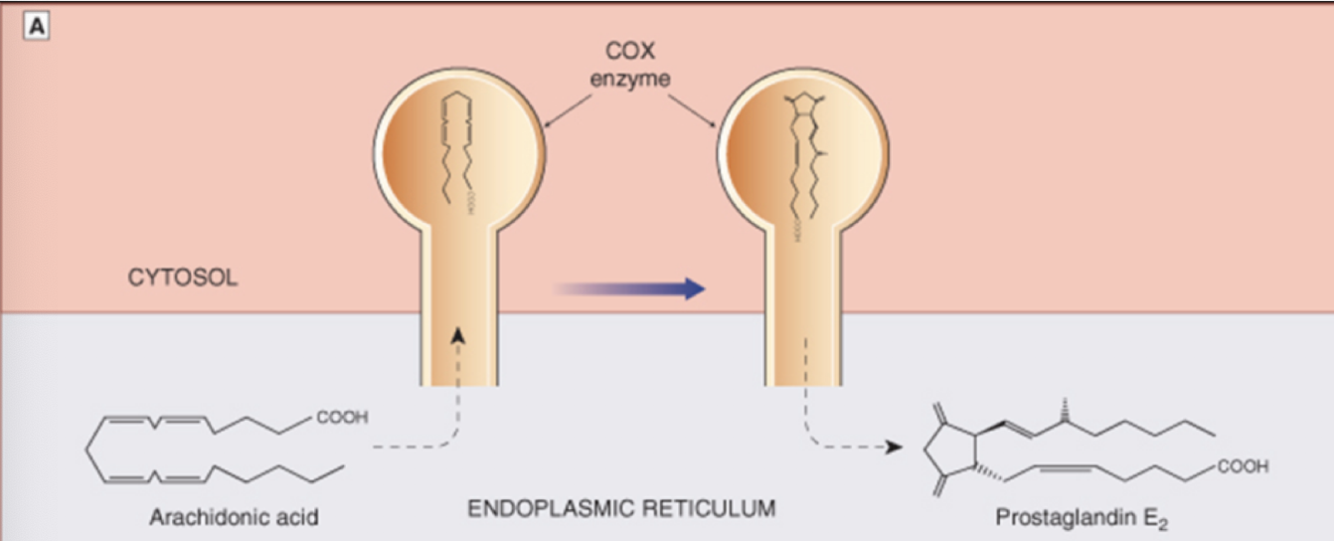
COX is the enzyme which converts arachidonic acid to the prostaglandin precursor PGH2
A: arachidonic acid enters the COX enzyme channel and is converted first to prostaglandin G2 then to prostaglandin H2 (these steps not shown) then into a prostaglandin, the example shown is prostaglandin E2
what is COX-1
constitutively expressed in most tissues
involved in normal homeostasis
many physiological functions - especially maintaining GI tract mucosa
up-regulated under stress conditions (nerve injury)
what is COX-2
constitutively expressed in many tissues, including kidney, testicular ovarian cells and in the CNS
physiological functions: maintaining renal blood flow, nerve function, bone metabolism
induced in response to inflammatory stimuli
how do NSAIDs block COX-1
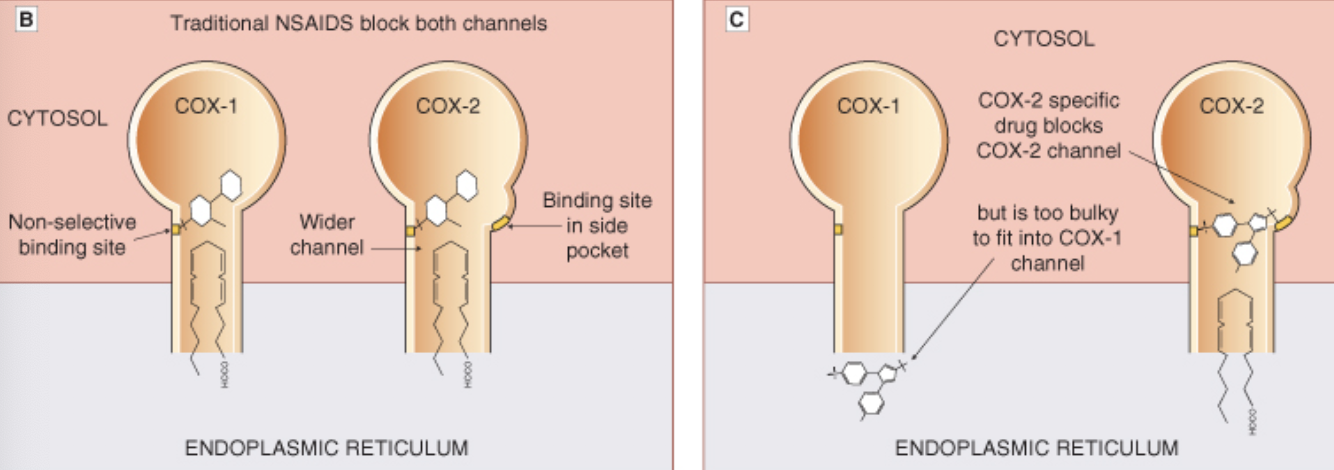
bind to non-selective binding site to block arachnidonic acid from enetering the channel and converted to PG
what is a COX continuum
two distinct genes for COX-1 and 2 may give rise to a number of constitutive and inducible COX proteins with overlapping functions
how can NSAIDs be categorized
- non-selective COX inhibitors (most commonly used ex. flunixin, ketoprofen)
- preferential COX-2 inhibitors (carprofen, meloxicam)
- specific COX-2 inhibitors (firocoxib, robenacoxib)
what are the useful effects of NSAIDs
- analgesic (central/peripheral)
- anti-pyretic
- anti-inflammatory
- anti-thrombotic
- anti-endotoxic
- other uses –> cancer treatment
what are the adverse effects of NSAIDs
- GI –> dyspepsia, nausea and vomiting, ulceration
- renal toxicity
- hepatotoxicity
- injury to articular cartilage
- precipitate asthma
what are the analgesic effects
- peripheral action –> NSAIDs decrease PG production at site of inflammation –> reduced sensitization of nociceptive nerve endings to inflammatory mediators
- central action –> NSAIDs block PG release and neuronal excitation –> reduced central sensitization
reduces hyperalgesia and pain
how do NSAIDs reduce fever
the hypothalamus regulates normal body temperature –> ensures balance between heat loss and heat production
inflammation –> endogenous pyrogen (interleukin-1) –> COX –> PGE2 synthesis –> act on thermoregulatory centre in hypothalamus –> increase body temperature –> fever
what are the anti-pyretic effects of NSAIDs
high concentration of PGE2 are found in CSF during infection
NSAIDs decrease production of PGE2 thus prevent increase temperature associated with fever
no effect on normal body temperature
what are the anti-inflammatory effects
NSAIDs inhibit COX induction and release of prostanoids at site of inflammation to
- decrease vasodilator prostaglandins (reduces edema)
- reduces the inflammatory response (prevent peripheral sensitization)
how do NSAIDS cause anti-thrombotic action
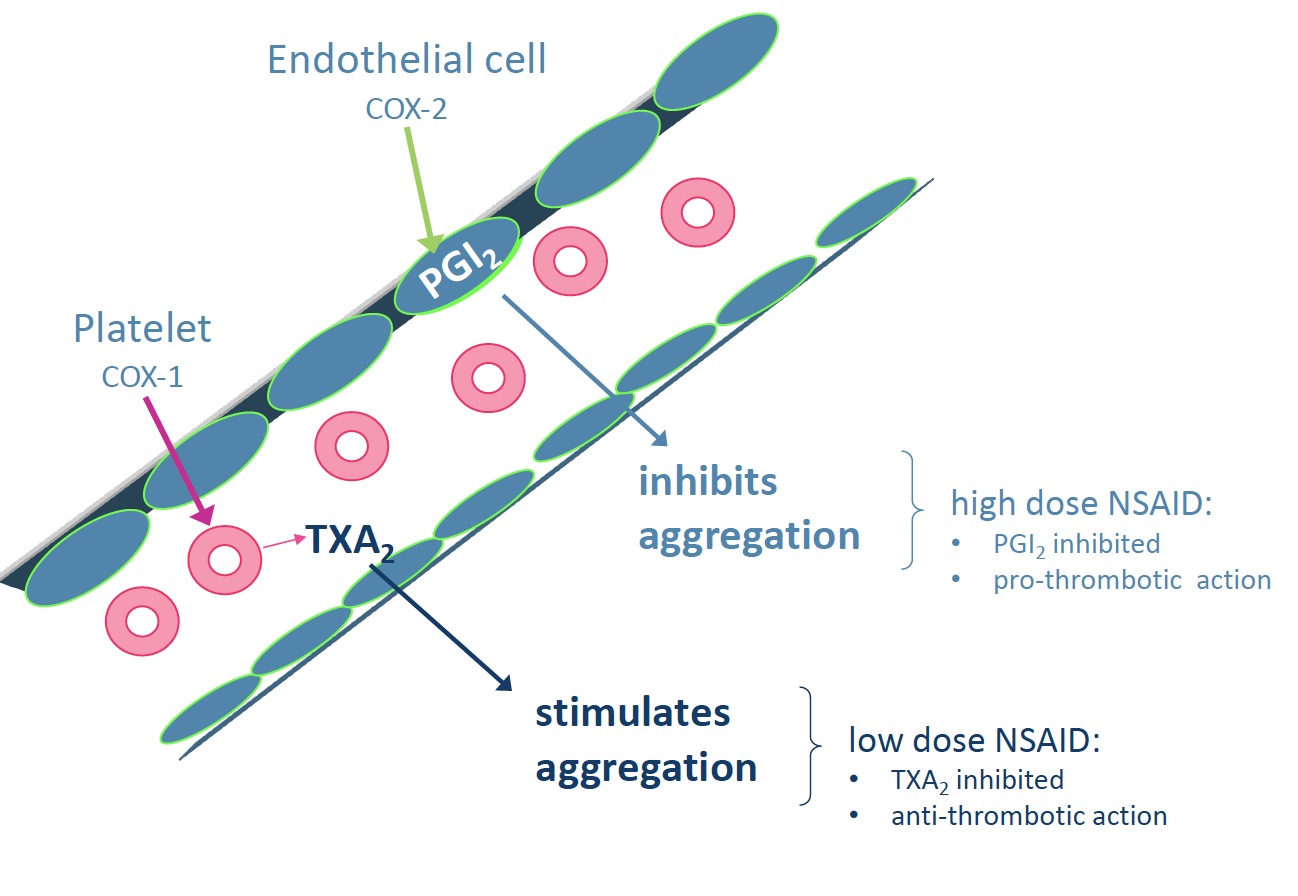
NSAIDs inhibit synthesis of thromboxanes (TXA2) –> inhibits platelet aggregation
more effective as anti-thrombotic agents at low doses
what pathways do NSAIDs inhibit to cause anti-thrombotic action
what are the anti-endotoxic action
endotoxins are lipopolysaccharides generated by gram -ve bacteria
endotoxins damage white blood cells and vascular endothelium thus releasing vasoactive mediators
triggers cascade of events which can result in endotoxemia
NSAIDs can prevent the generation of vasoactive mediators during endotoxemia
what are the adverse effects on the GIT
PGs in the GIT
PGI2 and PGE2 in the gut protect the gastric mucosa by inhibiting gastric secretion, inducing vasodilation and increasing blood flow through gastric mucosa
COX-1 is primary isoform responsible for gastric mucosal PG production
COX-2 absent in normal gastric mucosa but induced rapidly in response to injury/gastric erosions
what are the effects of NSAIDs in the GIT
inhibition of COX-1 –> reduction in PGs –> ulceration
mucosal ischemia
impairment of protective mucus barrier
exposing mucosa to damaging effects of acid
NSAIDs should be given with food to protect gastric mucosa –> contact area of the tablet results in high localized concentration of the drug increasing the potential for ulcer formation
what are the roles of PGs in the kidney
PGE2 and PGI2 synthesized in renal medulla and glomerulus
involved in renal blood flow and excretion of salt and H2O via their vasodilatoru actions
modulate renal hemodynamics and excretion
PGE2 and PGI2 compensatory vasodilation
what are the effects of NSAIDs in the kidney
- inhibition of PGs impairs renal blood flow
- in healthy well-hydrated animals, reduced renal PGs is of little consequence
- can cause acute renal failure in conditions which depend on protective PGs
- significant renal toxicity can occur in dogs and cats if they are volume depleted

-
Bones and Joints of Equine Distal Limb Q's74
-
Bone and Joints of Equine Distal Limb Pics32
-
Bones and Joints of Distal Limb Q's11
-
Muscles & Tendons of Distal Limb83
-
Equine Hoof33
-
Equine Stay Apparatus & Canine & Ruminant Feet37
-
Bone Pathology53
-
Muscle Pathology50
-
Tendon Pathology34
-
Pelvis, Femur and Hip Joint75
-
Stifle Joint & Thigh Muscles95
-
Mediators of Inflammation54
-
Hock & Distal Limb Muscles82
-
Hindlimb Blood, Lymph, Nerve Supply40
-
Orthopaedic Examination & Gait Analysis in Small Animals23
-
Local Anaesthetic Agents17
-
Skin and Immune Mediated Disease1
-
The Integument 132
-
Integument 231
-
Radiography Physics, Health & Safety20
-
Radiography Its Role in Diagnosis21
-
Skin Wound Healing 139
-
Skin Wound Healing 235
-
Equine Wounds43
-
Introduction to Locomotor Anatomy37
-
Bones of the Proximal Forelimb & Shoulder Joint76
-
Recognizing Lameness30
-
Elbow Joint & Muscles of Proximal Forelimb110
-
Bones, Cartilage & Joints 160
-
Bone, Cartilage & Joints 229
-
Skin & Immune Mediated Disease 156
-
Skin & Immune Mediated Disease 252
-
Skin & Immune Mediated Diseases 346
-
Neuromuscular Blocking Agents25
-
Role of Environment of Bovine Lameness24
-
Ectoparasites: Flies of Veterinary Importance40
-
Mites & Ticks of Veterinary Significance25
-
Control of Ectoparasites46
-
Ectoparasites as Virus Vectors32
-
Fungal Infections Mycology90
-
Osteoarthritis & Other Joint Pathology41
-
Cartilage Pathology87
-
NSAIDs27
-
Anti-Fungal Antiviral Agents32
-
Visual Senses26
-
Central Visual Pathways and the Perceived Visual Field22
-
Vestibular System & Control of Posture31
-
Forelimb Nerve, Blood and Lymph Supply35
-
Investigating Lameness13
-
Radiation Safety Practical6



