Observation
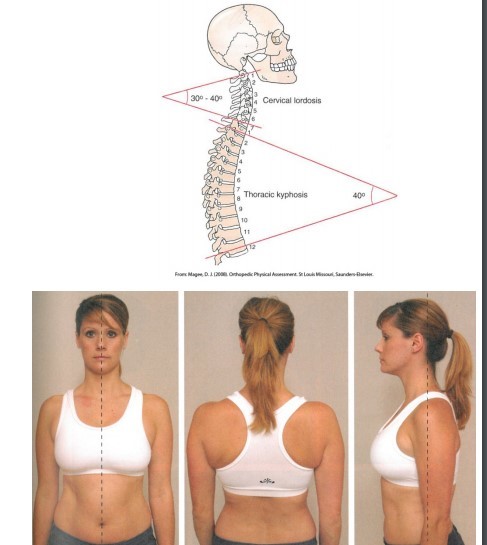
To be done standing:
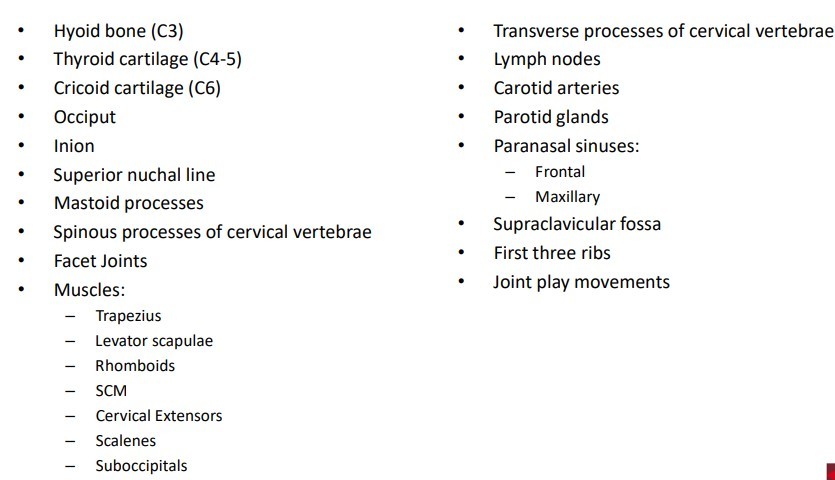
- Head and Neck posture
- Level of shoulders
- muscle spasm or asymmetry
- Bony and soft contours
- Antalgic position
- Normal Spine Curves
- Postural Analysis
Palpation
Cervical Range of Motion (AROM)
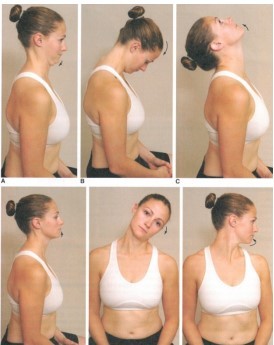
- Be sure to do most painful movements last
Active ROM
- Nodding (variable)
- Flexion (45-50)
- Extension (85)
- Lateral Flexion (40)
- Rotation (90)
Cervical Passvie Range of Motion (PROM)
AROM does not give an accurate impression of end feel.
PROM is recommended to assess for end feel.
Normal End Feeling
- Nodding - Tissue Stretch
- Flexion - Tissue Stretch
- Extension - Tissue Stretch
- Lateral Flexion - Tissue Stretch
- Rotation - Tissue Stretch
Cervical Spine Positions
Resting Position - Slight Extension
Close Packed Postion - Full Extension
Capsular Pattern
- Lateral Flexion and Rotation equally limited
- Extension
Cervical Resisted Isometric Movements
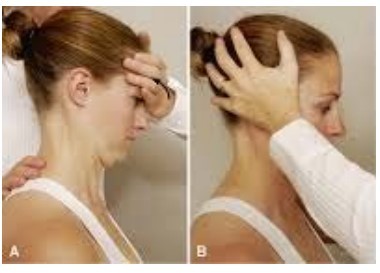
- Flexion
- Extension
- Lateral Flexion
- Rotation
Scanning Examination: Cervical Spine
Scanning involves AROM, PROM and resisted isometric movement assessment of an area that is suspected. Useful when patient experiences multiple sites.
Areas to scan if patient prsents with neck or upper extremity condtions.
- Cervical spine
- Thoracic spine
- TMJ
- Glenohumeural joint
- AC joint
- Sternoclavicular joint
- Scapulothoracic joint
- Elbow joint
- Wrist and Hand joints
Neurological Exam
Screening:
- Dermatomes
- Myotomes (Grading)
- Deep Tendon Reflexes
- Neurodynamic Testing
- Long Tract Signs
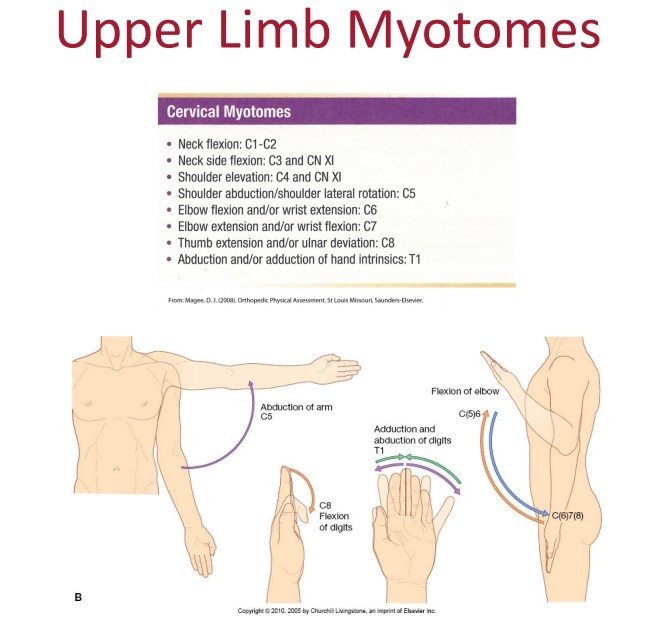
Orthopaedic Assessment of the Cervical Spine
Functional Assessment:
- Activities of daily living
- Sport and recreational specific movements
- Occupation specific movements
Questionnaires
- Neck Disability Index (NDI)
- Neck pain and disabilty questionnaire (NPDQ)
- Visual Analogue Scale (VAS)
Cervical Radiculopathy
Pain in the upper limb that has an electric or shooting quality that is caused by irritation or injury to the cervical spinal nerve.
- Compression
- Tethering
- Overstretching
- Chemical Radiculitis
Symptoms:
- Proximal and axial neck pain
- distal paresthesia in dermatomal patterns
- Muscle weakness in a muscle/s supplied by a single root
- Decreased deep tendon reflexes
- Muscle fasiculations
- Radiating pains that can be aggravated by movements
Radicular pain and or radiculopathy
Degenerative condtions of the neck can often interfere with both the nerve roots and spinal cord. Must look for signs of myelopathy.
Kemp’s Test - Cervical Spine
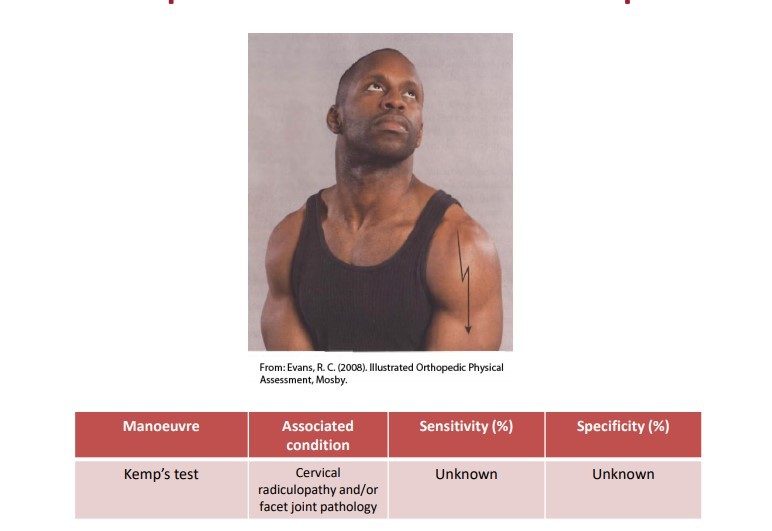
Purpose:
- used to provoke radicular symptoms for suspected cervical radiculopathy
- can be used to stress the I/L facet joints and disc
Procedure:
- Patient sitting and practitioner behind
- Lateral flex and rotate to same same
- Neck extension
- Note for any pain or changes
Positive:
- Production pain that radiates into the arm in a dermatomal distrivution on the side of lateral flexion and rotation
- pain on opposite side may indicate a local mechanical neck pain
Indication of postive:
- Cervical radiculopathy
- Cervical radicular pain
- Transient brachial plexopathy
- I/L Facet pathology
- I/L Disc Pathology
Maximal Foraminal Compressional Test
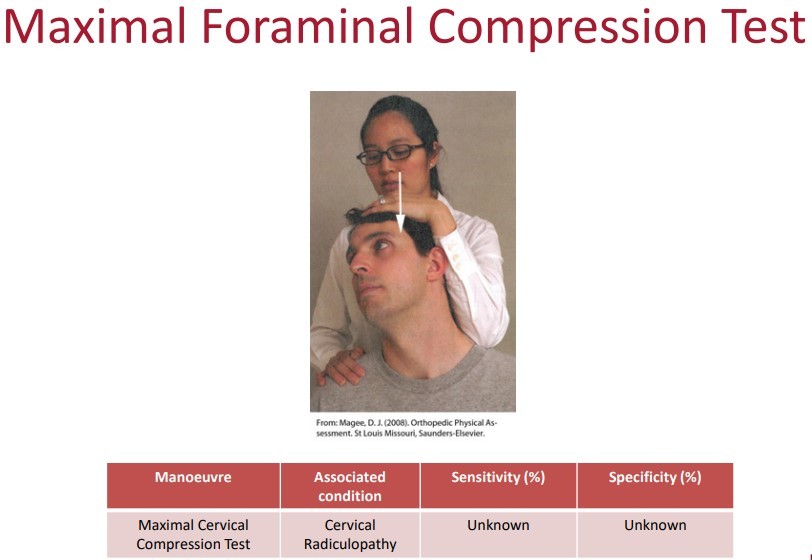
Purpose:
- Provoke symptoms of suspected cervical radiculopathy
Procedure:
- Pt sits and practitioner stands behind
- lateral flex and rotate head to same side
- neck extension and I/L hand goes on head
- secondary on I/L shoulder
- Compressive force down
Positive:
- pain that radiates into the arm in a dermatomal distribution
- pain in the neck with no radiation is not a positive test
- Note any changes or manifestations
Indication of Positive:
- Carvical Radiculopathy
- Transient brachial plexopathy
Notes:
- Test asymptomatic side first
- Second part stresses the IVF and stresses the vertebral artery
Spurling’s Test
also know as Foraminal Compression Test
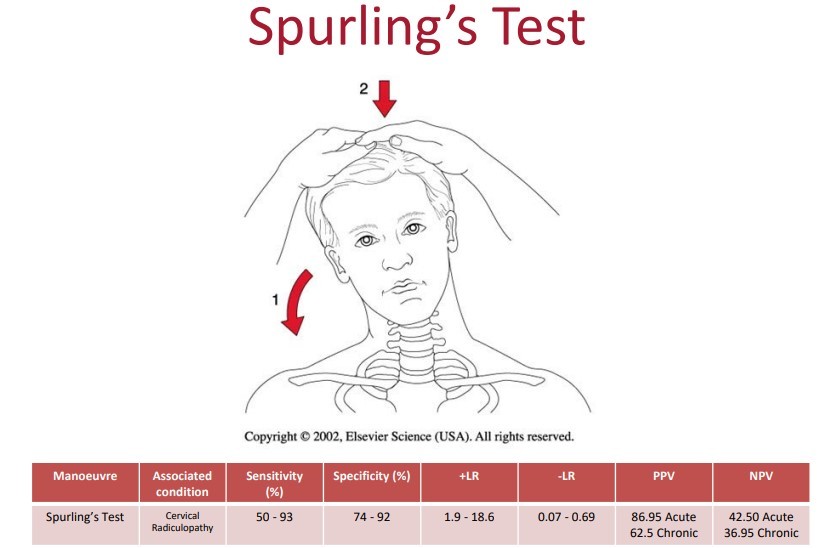
Purpose:
- Provoke radicular symptoms in patients with suspected cervical radiculopathy
Procedure:
- Pt sits and practitioner is behind
- Laterally flex the neck and apply a compressive force through the extended neck
Positive:
- pain production radiates into arm in a dermatomal distribution on the side of flexion
- pain in neck with no radiation is not postitive
- looking for changes or manifestations
Indication of positive:
- Cervical radiculopathy
- Transient Brachial Plexopathy
Notes:
- test asymptomatic side first
- can perform with increasing provocations
- pts can experience on C/L side known as reverse spurlings sign
- B/L can indicate myelopathy
Jackson’s Compression
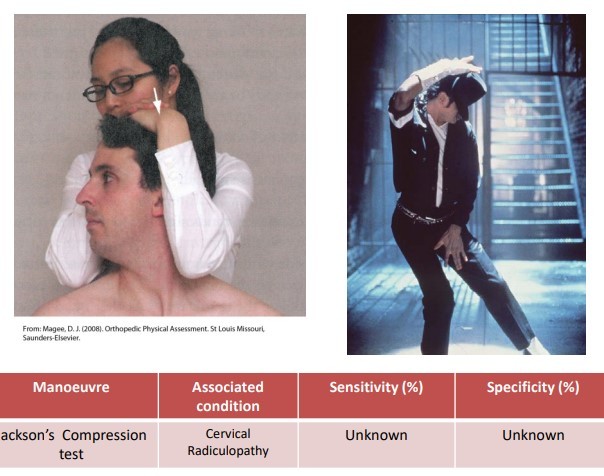
Purpose:
- Provoke radicular symptoms with suspected cervical radiculopathy, important if symptoms are in neck rotation
Procedure:
- Pt sits with practitioner behind
- rotate neck to affected side and practitioner applies gentle compressive force through the cervical spine
Positive
- Production of pain that radiates into the arm into the dermatomal distribution on the side of rotation
Positive Indication
- Cervical radiculopathy
Notes:
- Do the asymtomatic side first
- may experience I/L or C/L facet joint symptoms
Cervical Compression Test
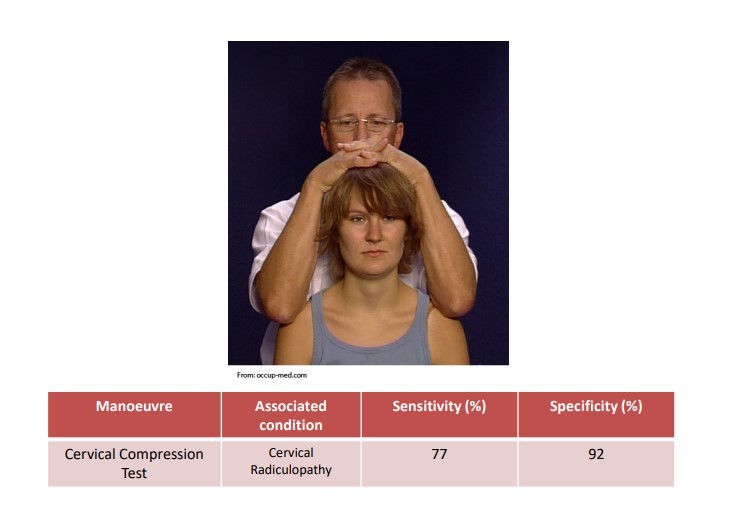
Purpose:
- Provoke radicular symptoms with suspected cervical radiculopathy
Procedure:
- Pt sits with practitioner behind
- head in neutral and place hands on pt’s head
- apply caudal pressure through cervical spine
Positive
- Production of radicular symptoms by compressive force
Positive Indication
- Cervical radiculopathy
Notes
- Apply force slowly and return head to pretest position
- can do test at different degrees to gain more information
- pain on compression can also indicate vertebral body, disc or facet joint pathology
Shoulder Depression Test
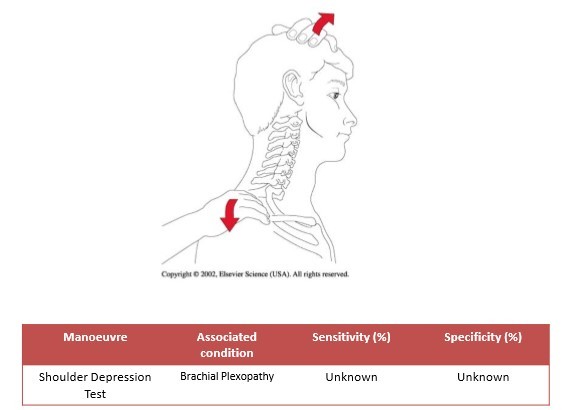
Purpose:
- Indicate a brachial plexus injury ot radiculopathy
Procedure:
- Pt is sitting and practitioner is behind
- Place one hand on head and other on shoulder
- laterally flex to one side while applying pressure on the opposite shoulder
Positive:
- increase pain on compression side can indicate irritation or compression of nerve roots
- increase pain on stretch side can indicate irritation or compression of nerve roots
Indication of positive:
- Brachial Plexopathy
- Transient Brachial Plexopathy
- Radiculopathy
Tinel’s Tap or Doorbell Sign
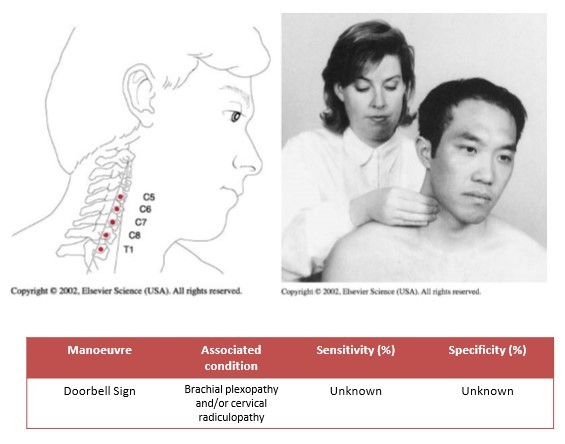
Purpose:
- Test for brachial plexopathy
Procedure:
- Pt sits with neck slighty flexed and practioner is behind
- Tinel’s tap - one finger tap
- Doorbell sign - apply firm pressure
- along the roots and trunks of the brachial plexus
Positive:
- Tingling sensation or pain distal to the contact points along the dermatomal distribution in response to the tapping or pressure
Indication of Positive:
- Brachiel Plexopathy
- Radiculopathy
- Transient Brachial Plexopathy
Cervical Distraction Test
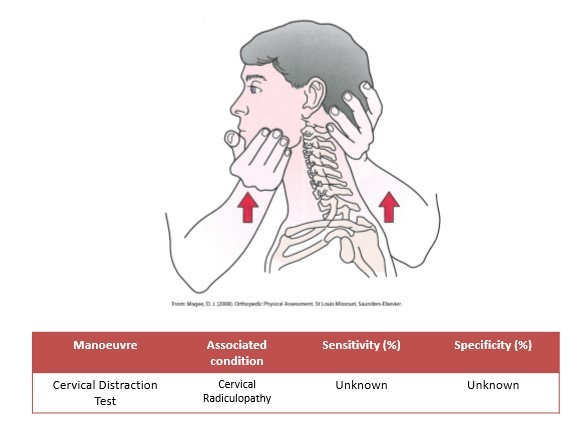
Purpose:
- Test is designed to relieve radicular symptoms in a pt who shows signs o radiculopathy during an examination
Procedure:
- Pt is sitting and practinoer stands to the side
- Place hand under chin and under occiput
- slowly lift head to create traction
Positive:
- Positive test if radicular symptoms are relieved by the traction which indicates pressure on the nerve roots has been removed
Indication of positive:
- Cervical Radiculopathy
Clinical notes:
- increased pain on distraction may occur due to muscle spasm/strain, lig strain, facet joint irritation or disc herniation
- can take a few minutes for symptoms to become less intense
- apply tractions slowly and return head to pretest
Shoulder Abduction Sign
Relief Test
Bakody’s Sign
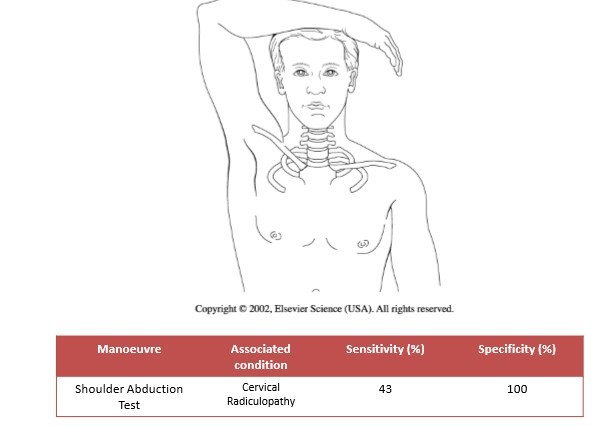
Purpose:
- To Test of radicular symptoms, specifically of the C4,C5 or C6 nerve roots
- Good to test of pt says arm on head relieves
- Used to relieve radicular symptoms during examination
Procedure:
- Pt is sitting and pracitioner is positioned so they can observe the arm abduction
- Pt is arsked to place forearm or hand on head, practitioner can also passively do this
Positive:
- A decrease in or relief of radicular symptoms
Indication of positive:
- Cervical radiculopathy - c4,c5,c6
Clinical note:
- can be done sitting or supine, more effective in sitting




