Active ROM
Passive ROM
Isometric Resisted Movement
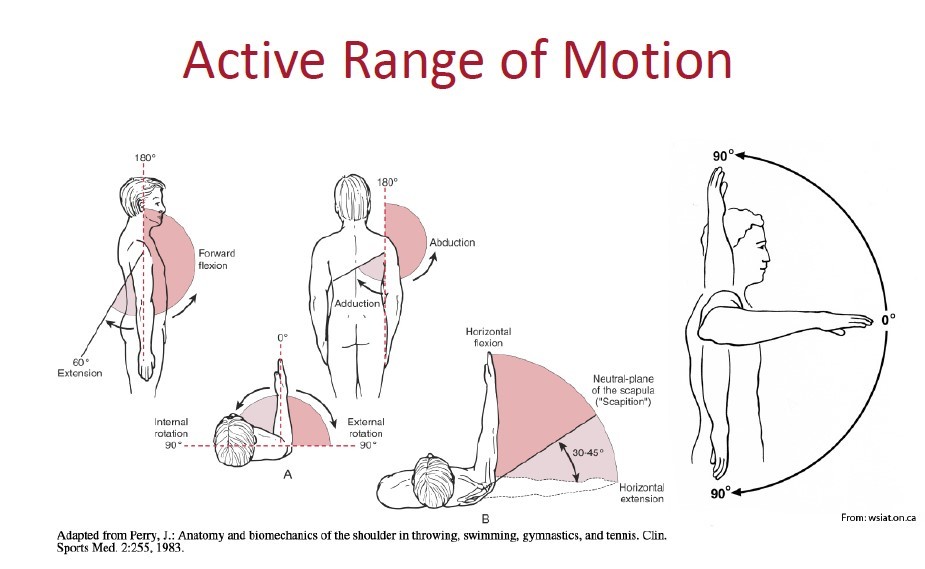
Ranges
- abduction (170-180)
- adduction (50-75)
- flexion (160-180)
- extension (50-60)
- external rotation (80-90)
- internal (60-100)
- horizontal adduction (120 from the coronal page)
- horizontal abduction (30 from coronal page)
Scapula Movements
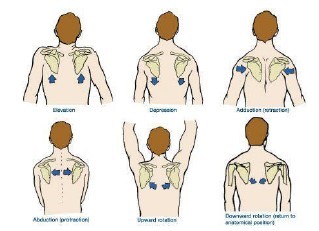
Assess normal scapula movements
- protraction
- retraction
- elevation
- depression
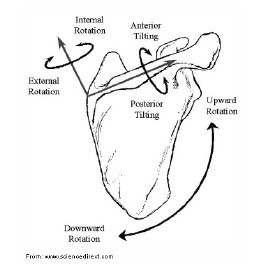
- anterior tilting
- posterior tilting
- upward rotation
- downward rotation
- internal rotation
- external rotation
Testing for Scapula Dyskinesis
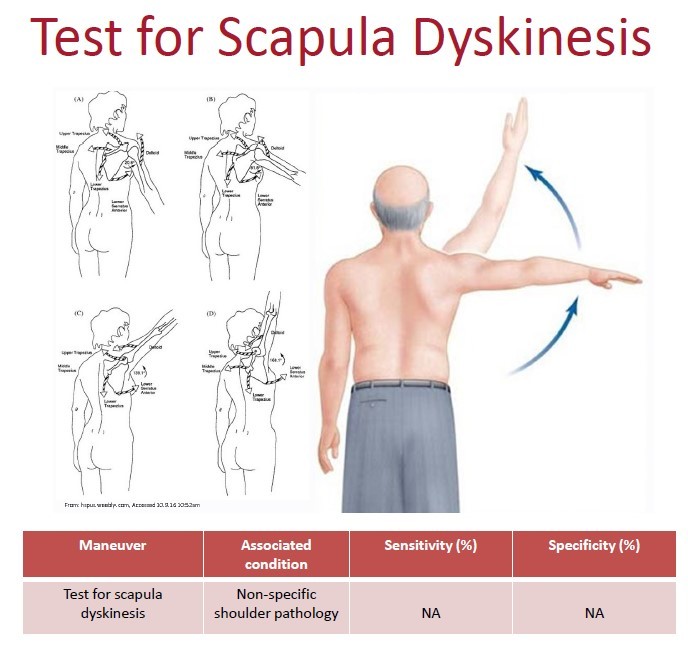
To detect abberant scapula movement or abnormal scapula resting position
Procedure
- sitting with examiner behind to observe shoulder and scapula
- raise hands above the head in the plane of scapula
- observe the scapulohumeral rhytem and any abnormal movment patterns
Positive Test
- abnormal resting position of scapula relative to the spine
- premature or abnormal scapula movements
- differing degrees of movement between left and right sides
Indication of a positive test
- scapula dyskinesis - grades I-III
- non-specific shoulder pathology
Notes
- lights can be used during the abduction analysis
- test should be performed in flexion, abduction and adduction planes
Apley’s Scratch Test
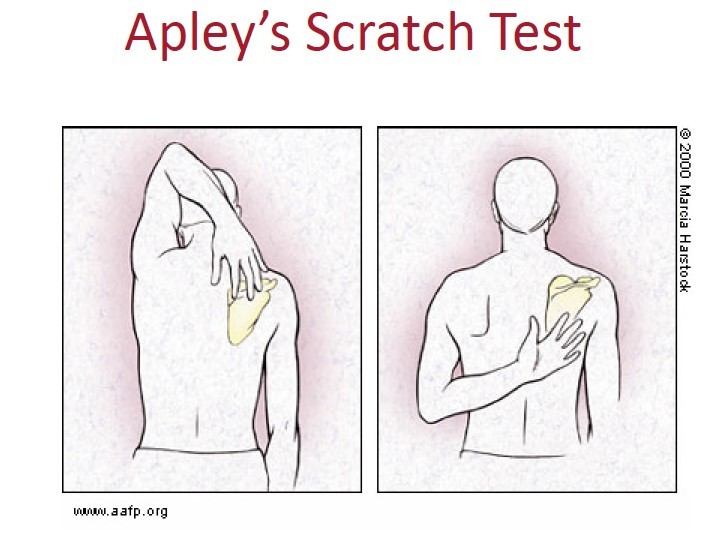
Purpose
- Highlight functional status of pt with combination of GH and scapulothoracic joint movements
- Shoulder screening test
Procedure
- pt sitting or standing, examiner behind to observe
- pt to reach upward and try scratch the mid back
- other hand reaches backwards to try reach lower back
- repeat both sides
Drop Arm Test
(Rotator cuff/supraspinatus)
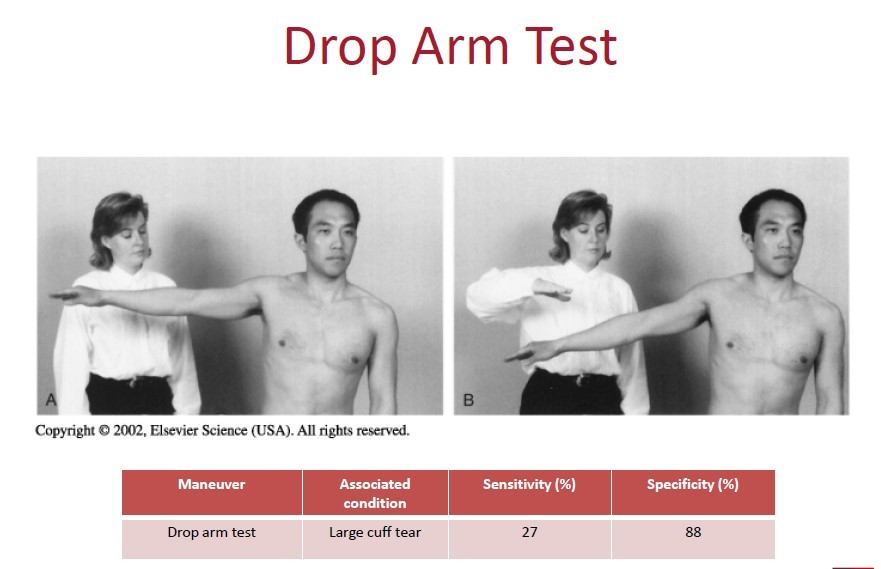
Purpose
- to identify whether there is a rotator cuff tear - supraspinatus
Purpose
- pt is standing and examiner is behind
- preposition the arm to 90 degrees of abduction and the ask patient to slowly lower arm
- repeat test but with a quick and gently tap as a sensitizing procedure
Positive
- if the pt cannot lower arm in a slow and controlled fashion or if the arm drops
Indication:
- Complete tear of cuff (supraspinatus) - 40 plus years
- Partial tear or tendinopathy - younger than 40 years
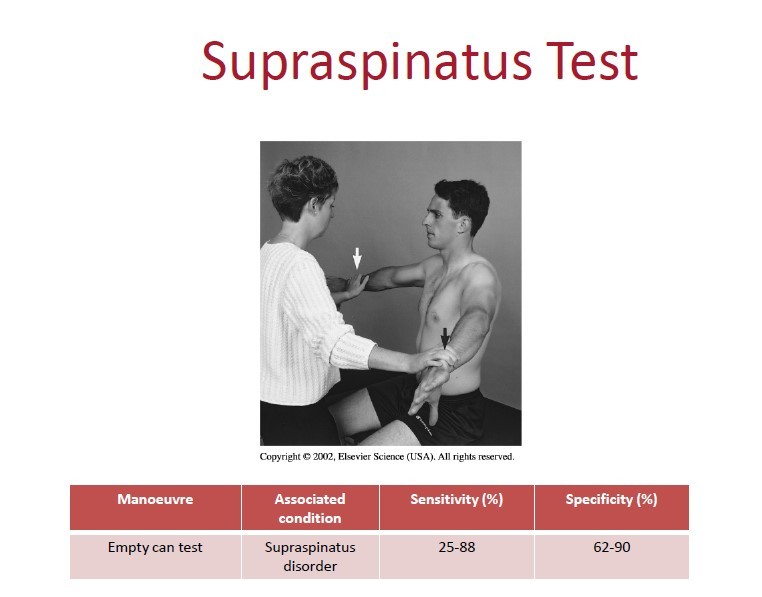
Supraspinatus Test
Empty can or Jobe’s Test
(supraspinatus)
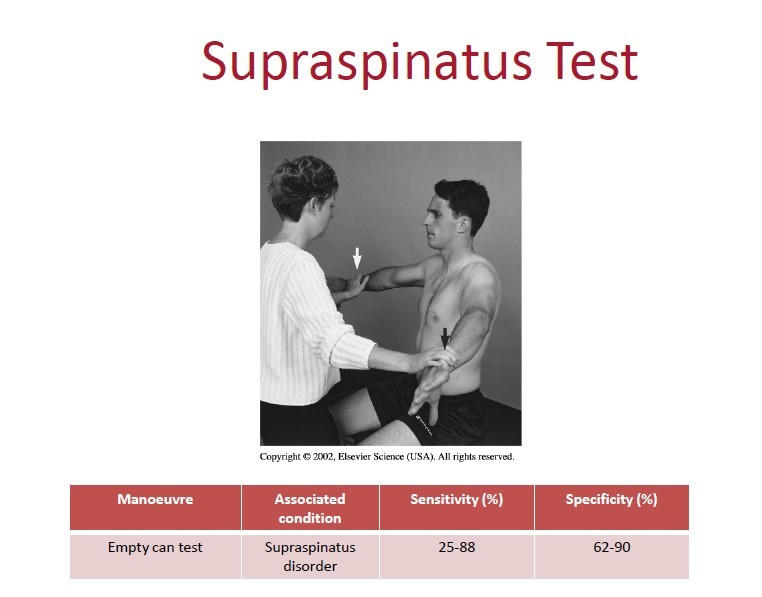
Purpose
Test the integrity of the supraspinatus
Procedure
- pt is standing and practioner is in front
- abduct shoulders to 90 in the plane of the scapula
- arms are internally rotated and the thumbs are points towards the floor (empty can)
- practitioner pushes down agains the arms and the pt resists
- both arms can be assessed at the same time
Positive
- if pt cannot resist the practitioners pressure on the affected side
Indication
- Supraspinatus tendon pathology
External Rotation Lag Sign
(infraspinatus, supraspinatus or teres minor)
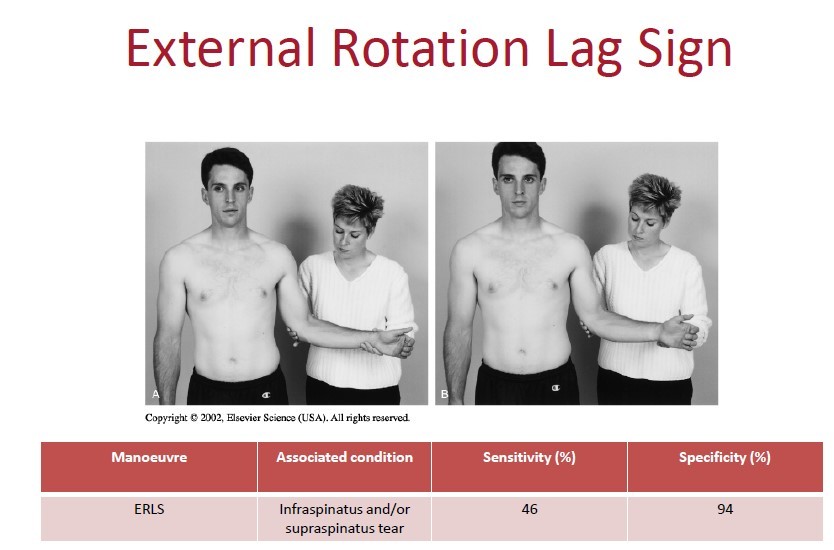
Purpose
Test the integrity of the posterior superior rotator cuff (infraspinatus, supraspinatus and sometimes teres minor)
Procedure
- elbow is flexed at 90 and shoulder is held is 20 degree abduction and externally rotated to end range by examiner
- ot then asked to maintain the active position as the examiner releases the wrist while supporting elbow
Positive
- when a lag or angluar drop occurs
- magnitude of the lag is recorded to the nearest 5 degrees
Indicates
- pain/dusfuction/tearm of the infraspinatus, supraspinatus or teres minor
Note
- testing and interpretation can be affected by pathological chnages in PROM
- reduction in PROM due to capular contracture or increased due to a rupture can give false results
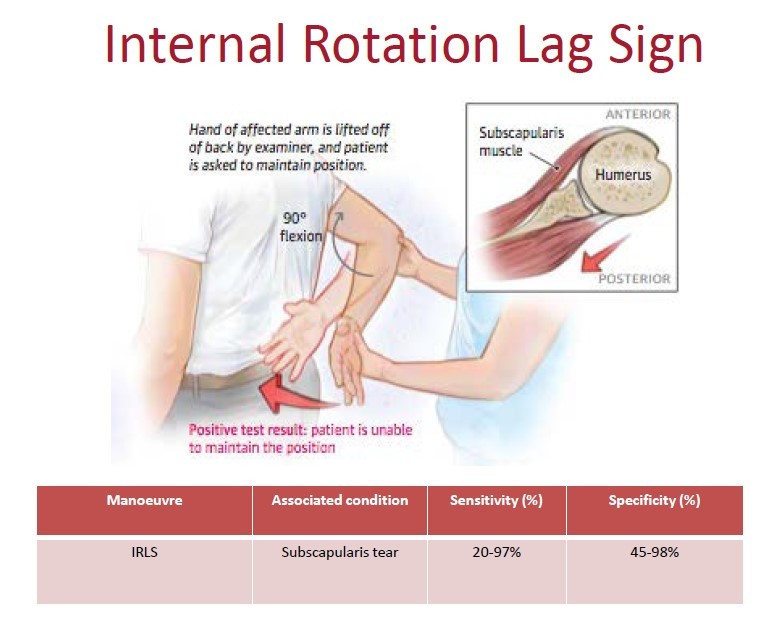
Internal Rotational Lag Sign
(subscapularis)
Purpose
- Test the integrity of the subscapularis muscle
Procedure
- pt is asked to place the back of their hand on the small of their back
- practitioner passivly internally rotates the patients arm to the end range or internal rotation
- pt is asked to matain the position as they release the wrist and support the elbow
Positive
- when a lag or the angular drop occurs
- lag is recorded to the nearest 5 degrees
positive
- pain/dysfunction/tear of the subscapularis
Note:
test and interpretation can be complicated by pathological changes in PROM
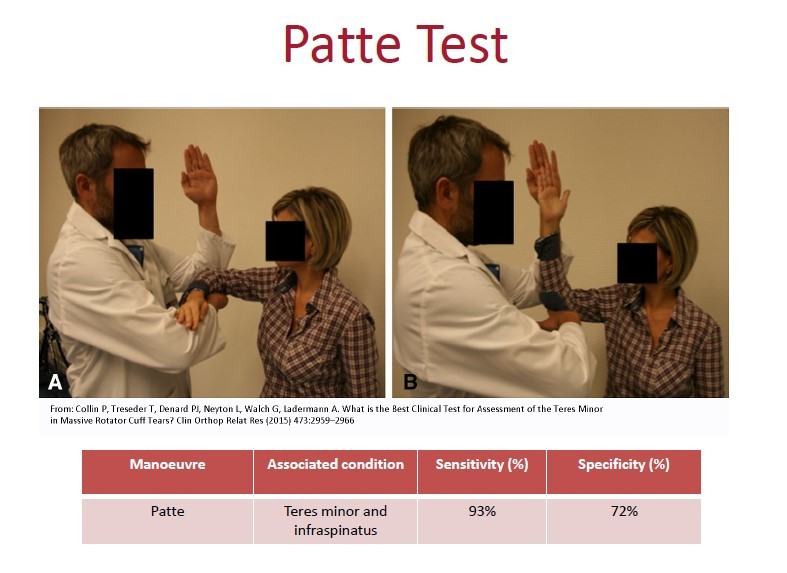
Patte Test
(Teres Minor)
Purpose
Test the integrity of the tere minor muscle
Procedure
- pt’s shoulder is passively abducted to 90 in the scapula plane and elbow is flexed to 90
- examiner supports the pt’s arm and pateint is asked to externally rotate the arm against gravity then against the pracitioner’s resistance
- practitioner notes any weakness and grades muscle strength
- test is held for at least 5 seconds
Positive
- pain or an inability to resist the practitioners attempt to internally rotate arm
indication
- tear or dysfunction of the teres minor
Lift Off Test
(subscapularis)
Purpose
Test the integrity of the subscapularis muscle
Procedure
- pt stands and places the back of hand on their lower back
- practitioner stands behind pt
- practitioner applies pressure in a p-a direction on the pt’s wrist
- pt is then asked to lift their hand away from the back
Positive
inability to lift arm away ot maintain the position in response to pressure
Indication
subscapularis rupture or dysfunction
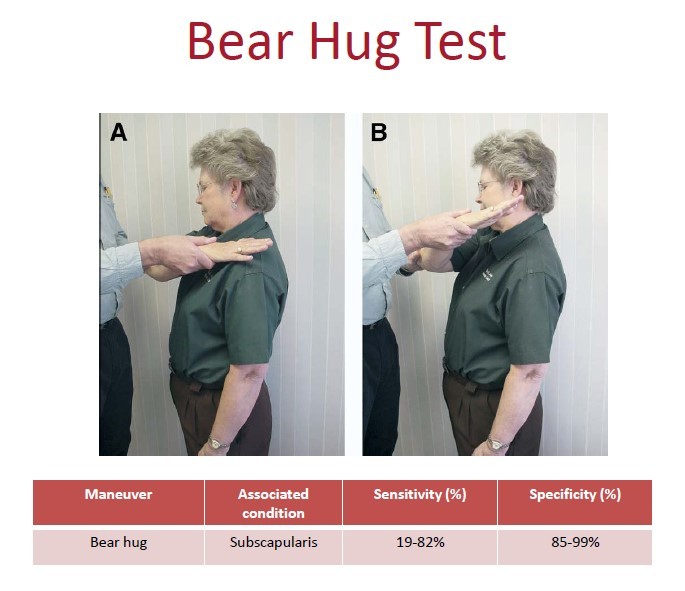
Bear Hug Test
(subscapularis)
Purpose
Assess the integrity of the subscapularis
Procedure
- pt is standing and practitioner is in front
- pt places palm on the opposite shoulder with fingers extended and elbow is anterior
- asked to hold the position and practitioner tries to pull wrist from shoulder in a P-A force
Positive
if pt cannot hold their hand against the shoulder as the examiner applies a P-A force to the wrist
Indicates
- subscapularis tear
Belly Press Test
(subscapularis)
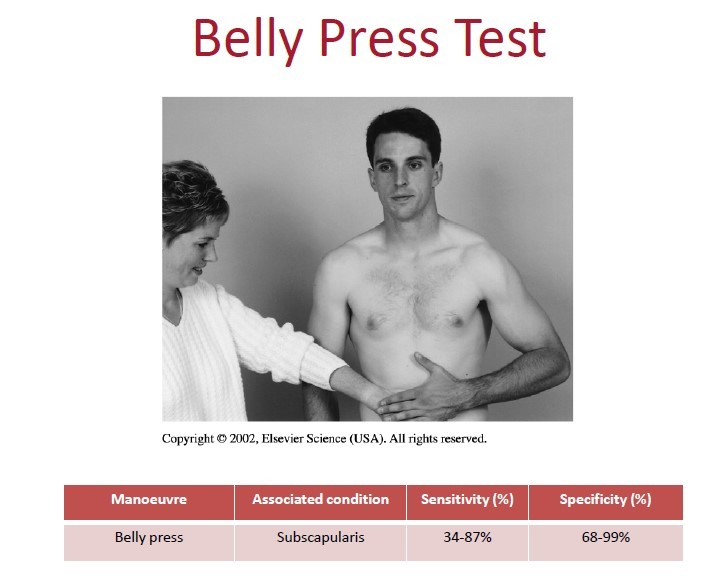
Purpose
- Assess the integrity of the subscapularis
Procedure
- pt is standing and practitioner is in the front
- pt presses palm into the belly with internal shoulder rotation
- obeserve the quality and type of movement
- sensitizing procedure - A-P overpressure on the elbow
Positive
- if pt compensates by dropping elbow behind the trunk and extending the arm in order to maintain pressure against the abdomen rather then internally rotating the shoulder
Indicates
subscapularis tear or dysfunction
Note
reliable when pt cannot perform the lift off test because of pain or limited ROM
Infraspinatus Test
(infraspinatus or teres minor)
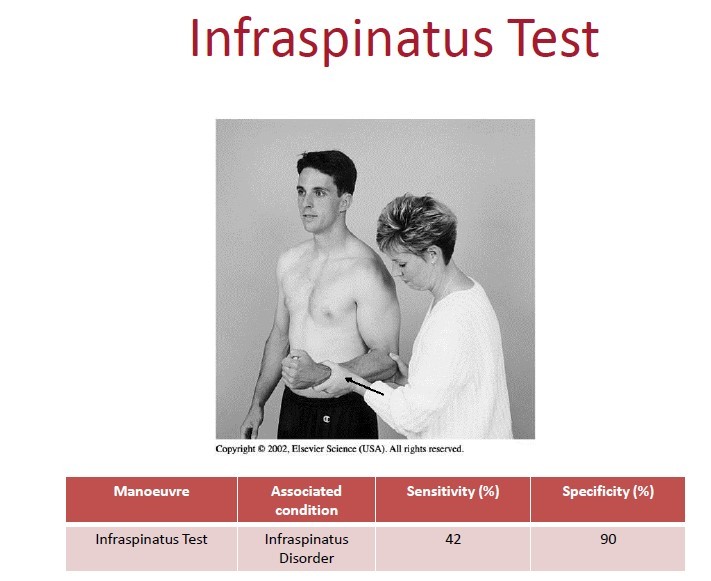
Purpose
- Screening test for infraspinatus dysfunction
Procedure
- seated or standing, pt arm is by their side and elbow is flexed to 90
- practitioner stands next to the shoulder
- practitioner applies force that medially rotates the pt humerus and pt is asked to resist
Positive
pain and weakness compared to contralateral side
Indicates
- infraspinatus or teres minor tendinopathy/strain/tear
- serves as a confirmatory test for impingement
Speed’s Test
(Long head bicep tendon)
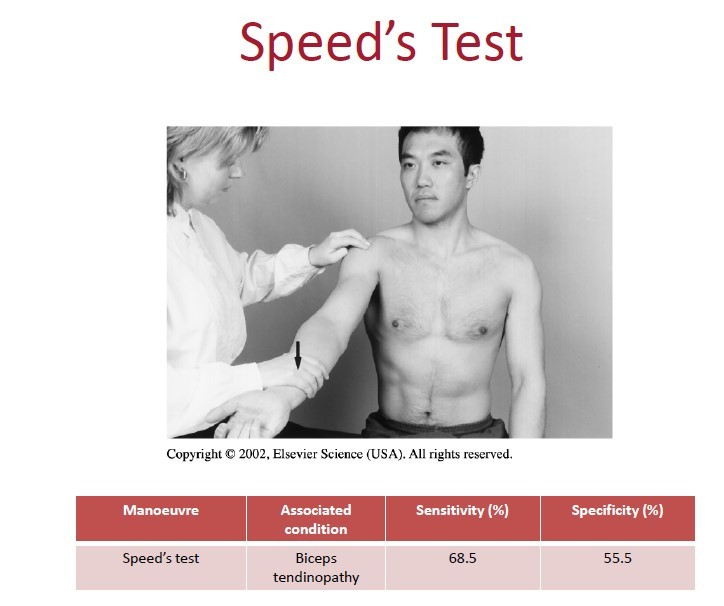
Purpose:
To assess the integrity of the tendon of the longhead of the biccep brachii
Procedure:
- pt is sitting or standing
- practitioner stands adjacent to shoulder
- 90 degree shoulder flexion and full supination and full elbow extension
- practitioner applies downward force in the direction of shoulder extension
- pt to resist the force
Positive:
- pain in the anterior shoulder when pressure is applied
indication:
- bicepital tendinopathy
Yergason’s Test
(long head off biceps tendon and transverse humeral ligament)
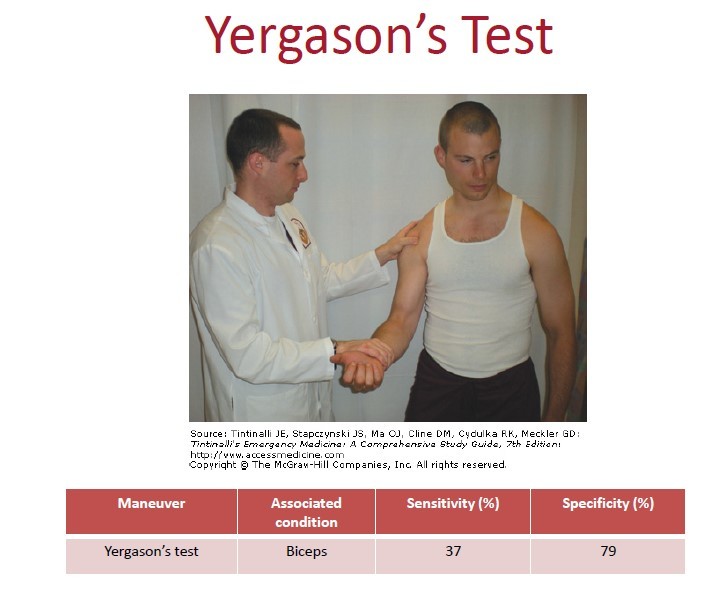
Purpose:
- assess integrity of the long head of the biceps tendon and the transverse humeral ligament
Procedure:
- pt is sitting or standing
- elbow is flexed to 90 and forearm is in the neutral position
- examiner directs the patient to actively supinate the forearm
- examiner palpates the bicepital groove, resists the supination and passively externally rotates the patients humerus
Positive:
- pain in the bicep region
- palpable click/pop in the bicepital groove
O’Brien’s Test
(labral tear or AC joint dysfunction)
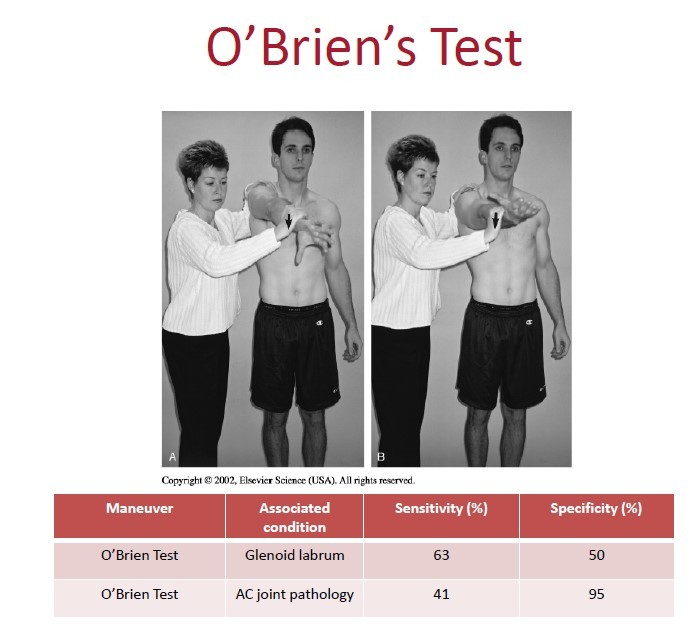
Purpose:
- to find out whether its a labral tear or AC joint dysfunction
Procedure:
- pt standing with shoulder flexed to 90, elbow in full extension and arm is adducted 10-15 and internally rotated so thumb is down
- examiner, standing lateral and applies a caudal force on pt arm
- test is repeated with thumb pointing up
Positive:
- if pain on first test but relived or eliminated with the second procedure
- pain localized to the AC joint or on top is AC joint related. Pain with clicking inside the shoulder is labral
Positive
- either a superior labral pathology or AC joint pathology
Hawkins-Kennedy’s Test
(sub-acromial impingement)
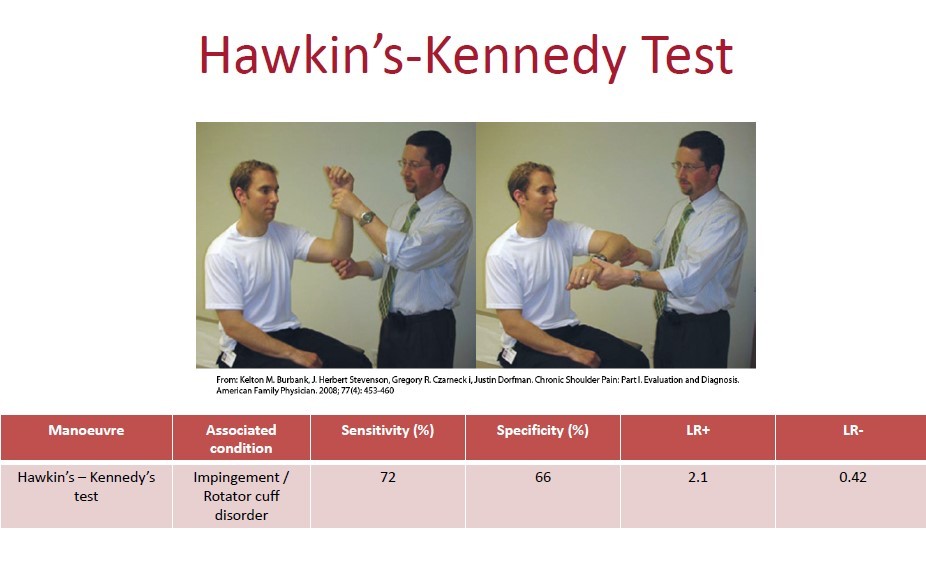
Purpose:
- screening test for sub-acromial impingement
Procedure:
- pt sitting, arm and elbow flexed at 90, support under elbow and wrist
- move arm into internal rotation
Positive
- pain around the sub-acromial space
Indicates:
- external shoulder impingement
- soft tissue contact with inferior of the acromion
Neer impingement Test
(sub-acromial impingement)
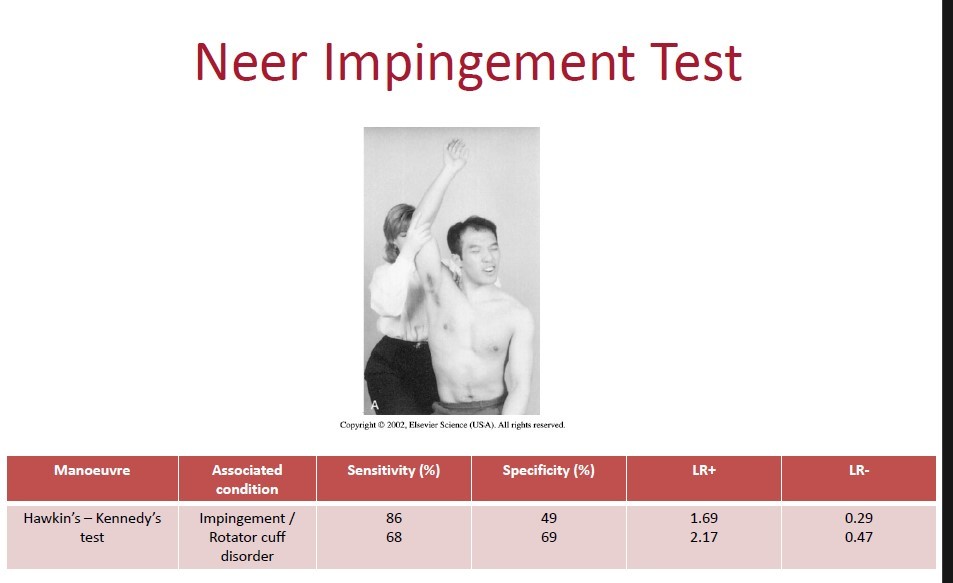
Purpose:
- screening test for sub-acromial impingement
Procedure:
- Stablize scapula to prevent rotation while internally rotating the arm into maximal abduction in the plane of the scapula
- internal rotation is added into the final phase of abduction movement
Positive:
- pain around the sub-acromial space with or without grimace
Indication:
- external shoulder impingement
- soft tissue contact with the inferior ascpet off the acromion
Posterior Internal Impingement Test
(internal impingement)
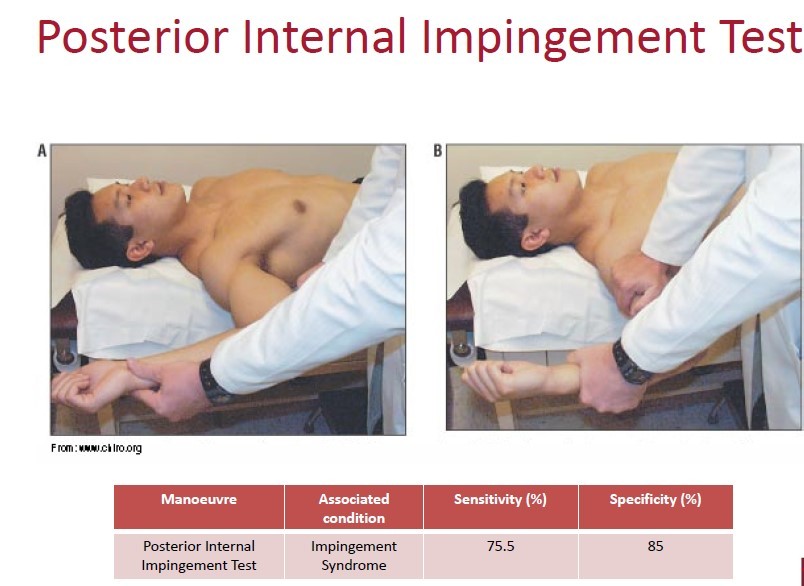
Purpose:
- Test for internal impingement
Procedure:
- Part A - passive abduction of shoulder to 90-110 with 15-20 of horizontal abduction and maximal external rotation
- Part B - place posterior force on the anterior aspect of the GH to relocate the humeral head within the glenoid fossa
Positive:
- Part A - localised pain
- Part B - reduction of pain
Indicates
- Internal shoulder impingement
- rotator cuff impingement between greater tuberosity/humeral head and the posteriosuperior edge of the glenoid
Sulcus Sign
(inferior and multidirectional GH joint stability)
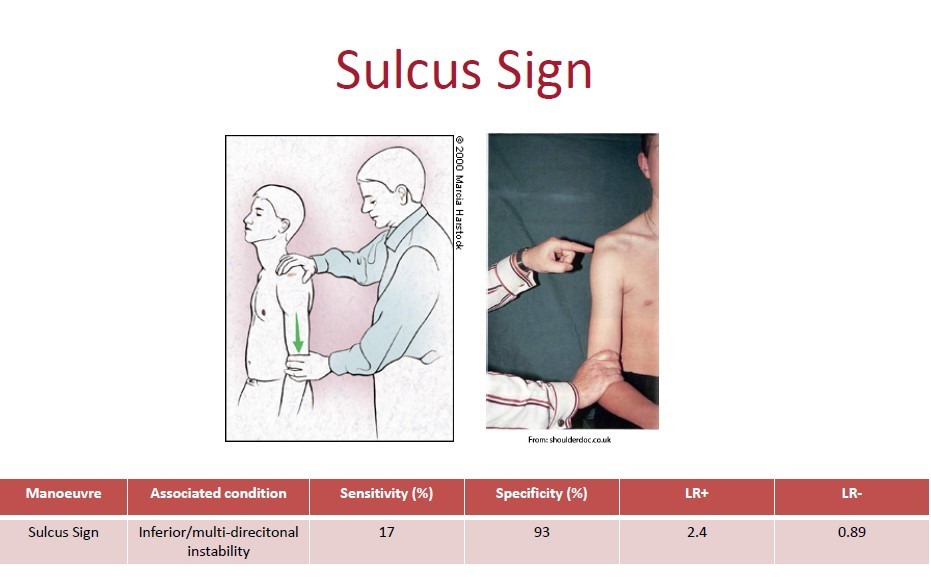
Purpose:
- Assessment of inferior and multidirectional GH joint stability
Procedure:
- Pt arm is by their side and practitioner is beside them
- contact elbow and distract downwards, stablise shoulder
Positive:
- Sulcus sign or dimple around the subacromial region as the humeral head translates
- grades +1, +2, +3
indication:
- inferior or multidirectional GH instability when compared to opposite shoulder
Load and Shift Test
(anterior and posterior instablity)
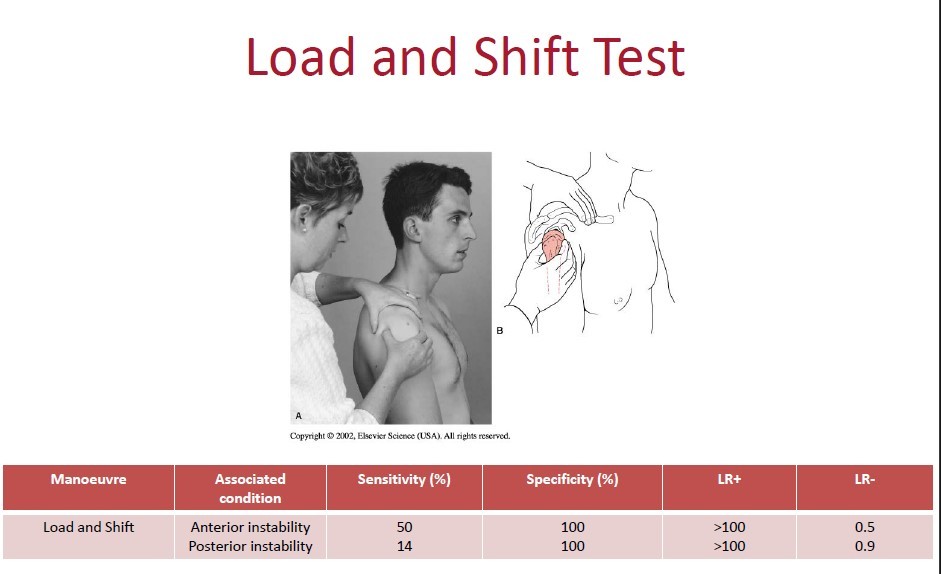
Purpose:
- assess for anterior and posterior GH joint stability
Procedure:
- pt is sitting and shoulder is relaxed, practitioner stablizes the scapula
- practitioner takes the humeral head with a pincher grip, loads and forces to relocate in glenoid fossa
- translate anterior and posterior, humeral head may ride up over the glenoid fossa
- Part 2 - test is done supine with arm grapsed and positioned 45-60 of abduction, humerus is loaded and stressed again
Postive:
- Laxity compared to opposite shoulder
- anterior or posterior GH laxity
note:
- important to assess in other positions
- provides info on glenoid rim
- compare shoulders
Grades
- Normal 0-25%
- Grade 1 - 25-50% - riding up
- Grade 2 - >50% - riding up but reduces
- Grade 3 - remains dislocated
Anterior Draw Test
(anterior GH joint)
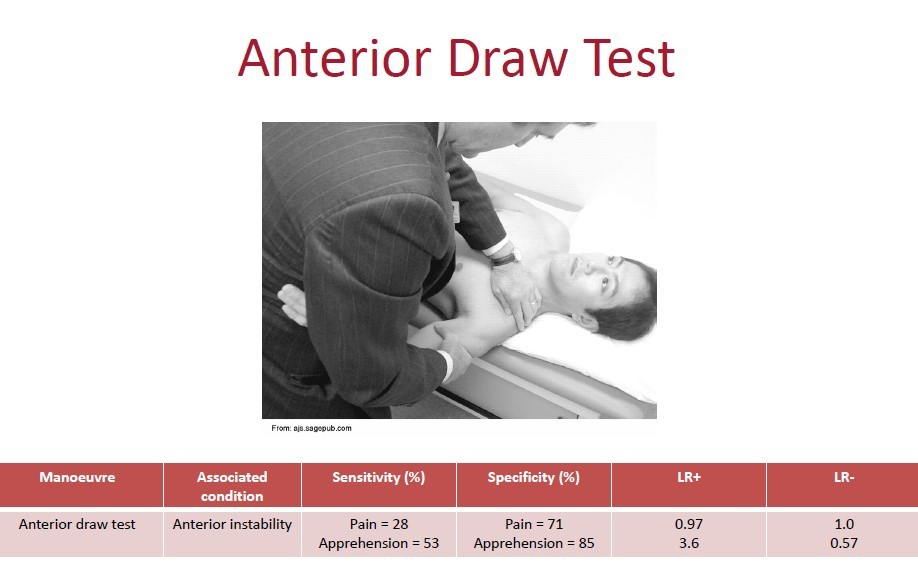
Purpose:
- assess and grade laxity or insuffciency of the anterior GH joint
Procedure:
- pt is supine and practitioner stands facing the affected shoulder
- stablize scapula
- shoulder is held at 80-120 of abduction, 0-20 of horizontal adduction and 0-30 of external rotation
- primary holds humerus via axilla and draws anterior
Positive:
- laxity compared to opposite side
- pain or apprehension
indicates:
- anterior GH laxity or instability
Notes:
can do in different positions to test individual components
Anterior Apprehension (Crank) Test
(Anterior GH stability)
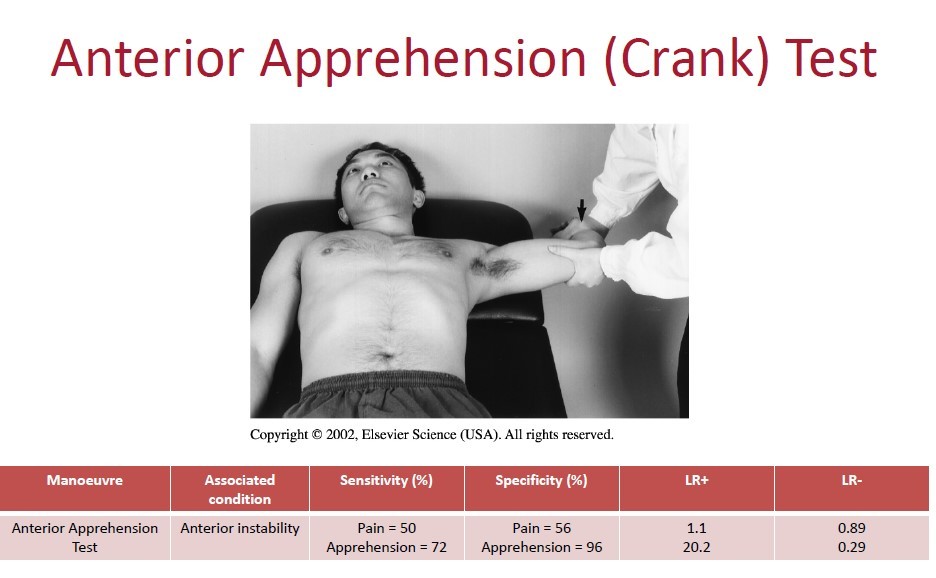
Procedure:
- assessment of anterior GH stability
Procedure:
- pt is supine and prac stands next to affected limb
- support the scapula with edge of the table
- humerus is abducted and externally rotataed by 90 and elbow is flexed to 90.
- apply external rotation at the humerus and watch for apprehension of pt
Positive:
- aprehension in the form of a grimace, muscle guarding, retraction and pain
- pain is not an inidcation of positive
- proceed to relocation of positive
Indicates:
- anterior GH instability
Anterior Relocation Test
(anterior stability)
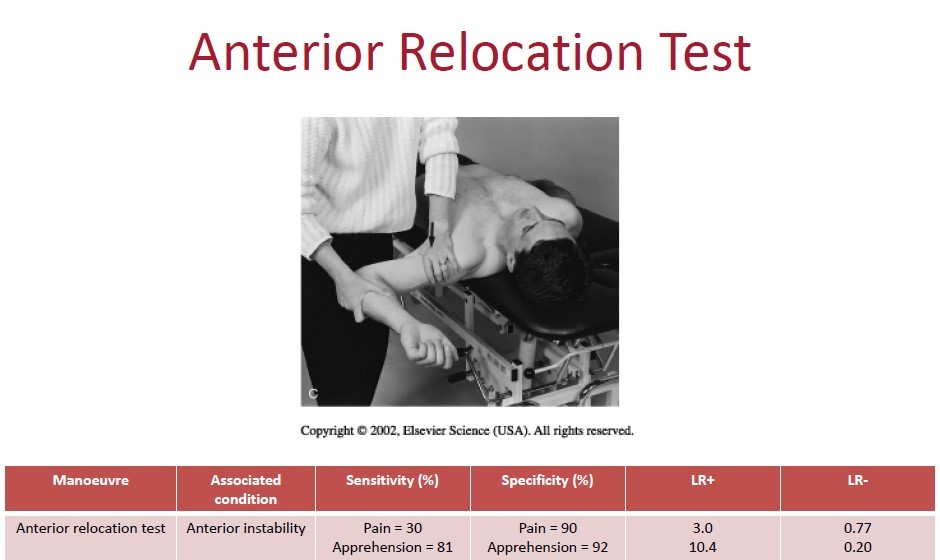
Purpose:
- assess the anterior stability of thr GH joint
Procedure:
- note external rotation before apprehension while performing the crank test
- return to the starting position
- repeat the test but apply A-P force on the humeral head or apply A-P force at the point of apprehension
Positive:
- increase in external rotation before symptom/apprehension reproduction with applciation of the posterior glide on the humeral head
Indicated:
- disappearence of symtpms
- disappearence of apprehension
- disappearence of pain






