Angiogenesis
The growth of new blood vessels from pre-existing vessels.
Science of blood vessels
Angiology = “angio” vessels
Sequence of B.V.
Arteries –> arterioles –> capillaries –> Venules –> Veins
Layers of B.V.
All B.V. have 3 layers except capillaries.
1) Tunica intima
2) Tunica media
3) Tunica externa
Capillaries have:
- 1) Endothelium
- 2) Basement membrane or basal lamina
Types of arteries
1) Elastic 2) Muscular
Elastic Arteries
1) Are closest to the heart. High in elastin
2) Expand during systole acting as pressure reservoir. Very stretchy
3) Recoil during diastole to keep the blood moving
Vascular anastomoses
- “communicating opening” is a connection between two blood vessels.
- Anastomoses serve the same volume of tissue. When one B.V. is damaged the other one suplies blood to the tissue.
- Blood vessels form special interconnections called vascular anastomoses. Most organs receive blood from more than one arterial branch, and arteries supplying the same territory often merge forming arterial anastomoses = alternate pathway called **collateral channels. **
Muscular Arteries
1) Carry blood to specific organs
2) Tunica media is thick (more smooth muscle)
3) Less stretchy than elastic arteries and more active in vasoconstriction and vasodilation.
Artherosclerosis
degenerative vascular disease that decreases the elasticity of arteries.
1) endothelium is injured
2) lipids accumulate and oxidize
3) smooth muscles cells proliferate and a fibrous cap forms (fibrous lesions with core of dead cells = plaque)
4) plaque enlarges and Ca2+ deposites –> rupture.
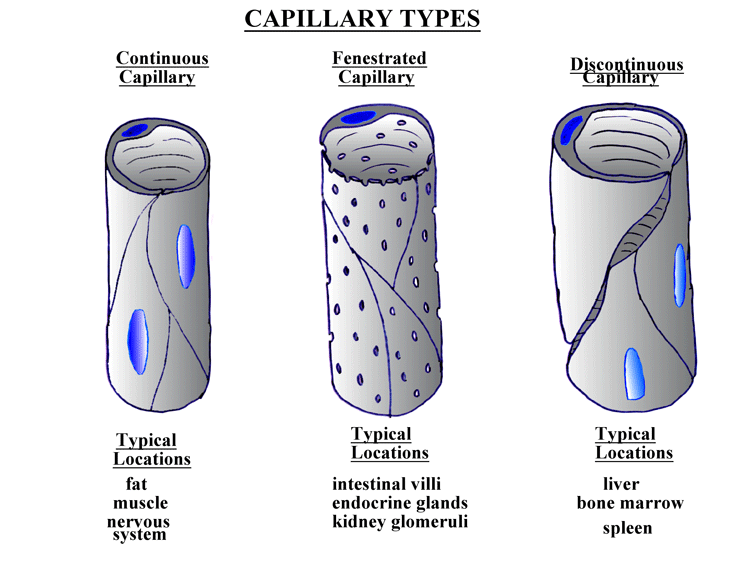
Types of capillaries
1) continuous capillaries
2) Fenestrated capillaries
3) Sinusoid capillaries
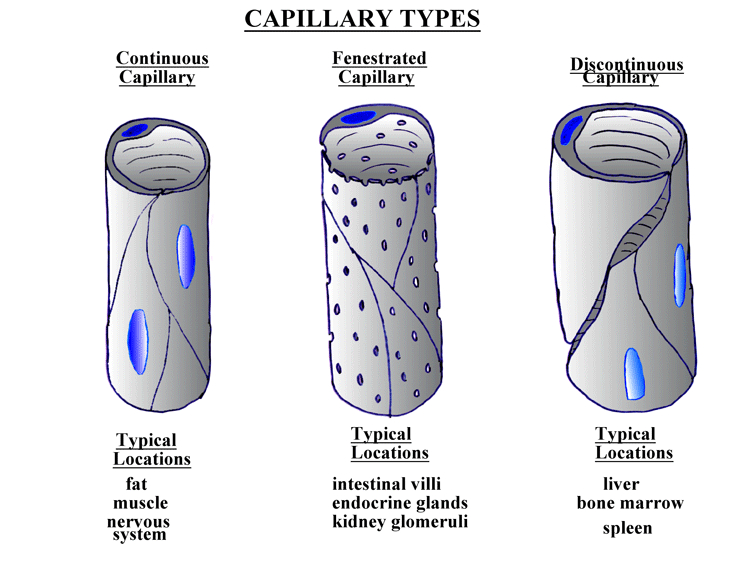
continuous capillary
- Ordinary capillaries without fenestrations
- For the diffusion of water and solutes.
- With tight junctions called intercellular clefts.
- found in muscle, skin, lung, central nervous system, and other tissues,
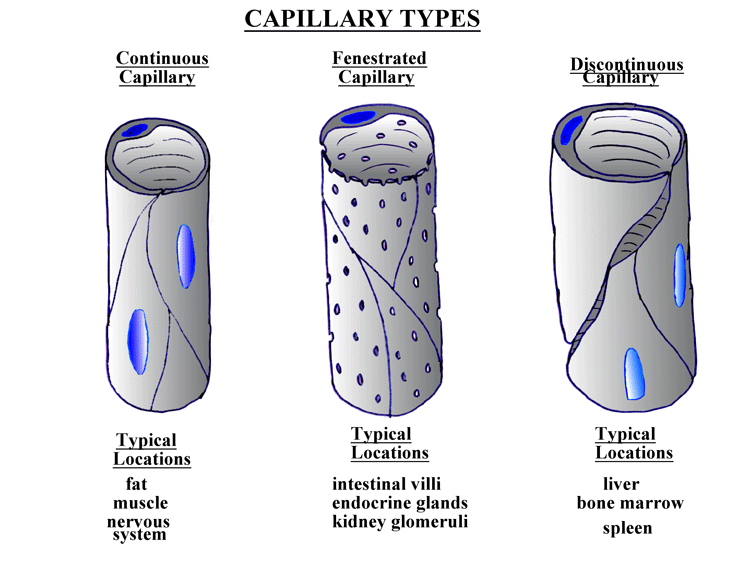
fenestrated capillary
- Have fenestrations.
- Primarily the glomerular capillaries in the nephrons of the kidney.
- “fenestra, for “window” have pores in the endothelial cells that allow small molecules with the exception of medium and large proteins to pass.
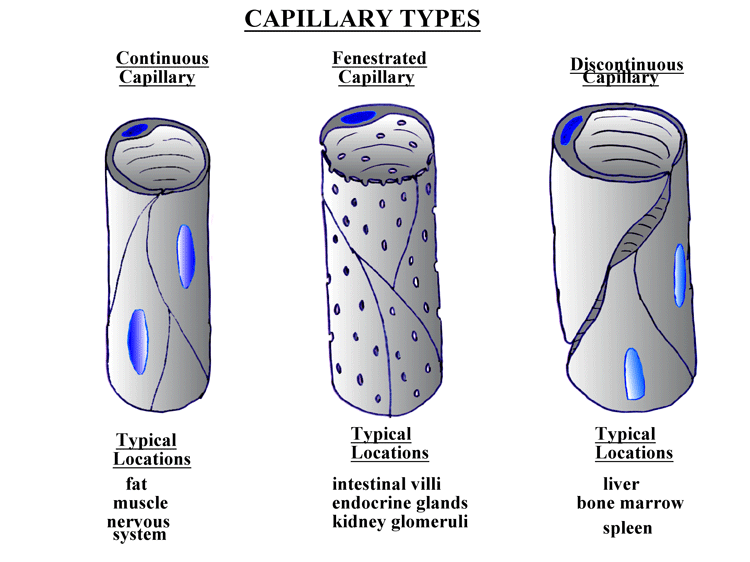
Sinusoidal capillaries (sinusoids)
- have large gaps between endothelial cells that permit the passage of blood cells.
- These capillaries are found in the bone marrow, spleen, and liver.
- Larger irregular shape lumens and fenestrated. Fewer tight junctions and larger intracellular clefts.
Types of blood circulation(5)
- Systemic
- Pulmonary
- Coronary
- Hepatic
- Fetal
Systemic circulation
- Oxygenated blood travels from the left side of the heart to the various areas of the body.
- Gas, nutrient, and waste exchange occurs across the capillary walls into the interstitial fluids outside the capillaries and then into the surrounding cells.
- The deoxygenated blood returns to the right side of the heart.
Pulmonary Circulation
- The blood flows from the right ventricle, through the lungs, to the left atrium, i.e. from the right to the left side of the heart.
- This circulation is responsible for oxygenation of blood.
Coronary circulation
- Is the circulation of blood in the blood vessels of the heart muscle (the myocardium).
- The vessels that deliver oxygen-rich blood to the myocardium are known as coronary arteries.
- The vessels that remove the deoxygenated blood from the heart muscle are known as cardiac veins.
Hepatic circulation
Aorta –> celiac artery (splenic, hepatic, left gastric) –> Hepatic artery –> LIVER <– Hepatic portal veins
LIVER –> inferior vena cava
Hepatic portal veins:
- Superior mesenteric vein: drains the small intestine and stomach.
- Splenic vein: drains spleen, part of stomach and pnacreas
- Inferior mesenteric vein: drains large intestine and rectum
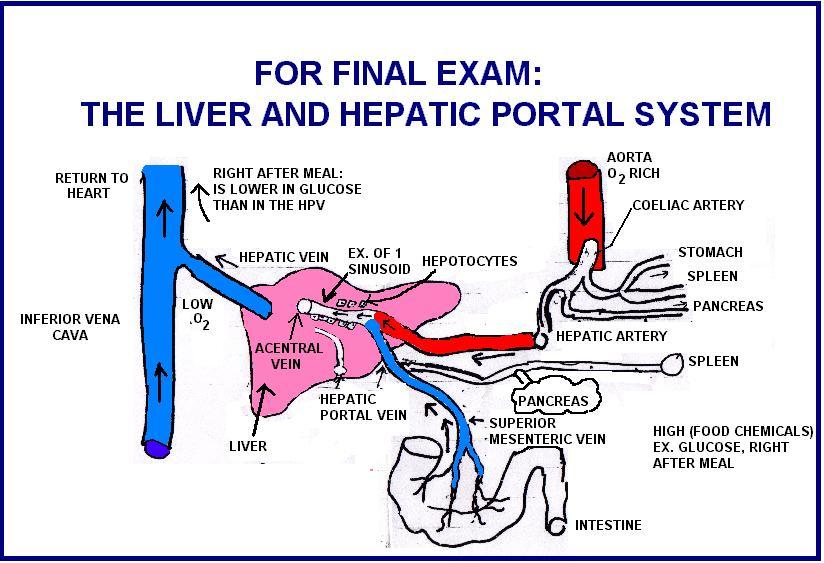
Fetal circulation
- Oxygenated blood from the placenta enters the fetus through the UMBILICAL VEIN
- Most of the newly oxygenated blood bypasses the liver via the DUCTUS VENOSUS and combines with deoxygenated blood in the inferior vena cava
- Blood then joins deoxygenated blood from the superior vena cava and empties into the right atrium
- Since pressure in the right atrium is larger than pressure in the left atrium most blood will be shunted through the FORAMEN OVALE
- Some blood does travel from the right atrium to the right ventricle through the pulmonary trunk but most blood bypasses the pulmonary artery and moves directly to the aorta via de DUCTUS ARTERIOSUS.
- Deoxygenated blood returns to the placenta via the UMBILICAL ARTERIES originating from the internal iliacs near the bladder.

what do the anastomoses do?
Provide alternate pathways
anastomoein “supply with a mouth or opening” from stoma “mouth”
- ana-, a prefix that means “up,” “against,” “back,” “re-”:
- stomoein, to provide with a mouth
- stoma, mouth
vascular anastomoses
- Where vessels unite or interconnect, they form vascular anastomoses (= coming together).
- Most organs receive blood from more than one arterial branch, and nearby arteries often communicate with one another to form arterial anastomoses.
Arterial anastomoses
- Arterial anastomoses provides alternate pathways (collateral channels or collateral circulation) for blood to reach a given body region.
- If one arterial branch is blocked or cut, the collateral channel can often provide the region with an adequate blood supply and thereby, minimizing the damage at tissue level.
- Arterial anastomoses are abundant in abdominal organs and around joints where active body movements may hinder blood flow through one channel.
Venous anastomoses
- Venous anastomoses are much more freely than arteries, therefore, venous anastomoses are more commonly found throughout the body.
- Because of the abundance of venous anastomoses, occlusion of a vein rarely blocks blood flow or leads to tissue death.
Anastomoses
communication between blood vessels by means of collateral channels, especially when usual routes are obstructed.

-
Tejidos63
-
Musculos79
-
Joints31
-
Integumentary System54
-
Tejidos + articulaciones31
-
Muscle Actions37
-
Musculos Cabeza17
-
Musculos Torso5
-
CNS chapter 1236
-
CNS Chapter 1120
-
PNS Chapter 1339
-
Special Senses Chap 1546
-
Cranial nerves20
-
Blood/heart Chapter 1722
-
Endocrine Ch. 1616
-
Brain Lab5
-
Lab 373
-
Ch. 19 B.V.24
-
Ch. 20 Lymphatic System13
-
Ch. 22 Respiratory10



