What explains long run growth in the Solow model?
Capital, which is no longer exogenous (no longer a fixed number and can be accumulated). Capital increases therefore production increases
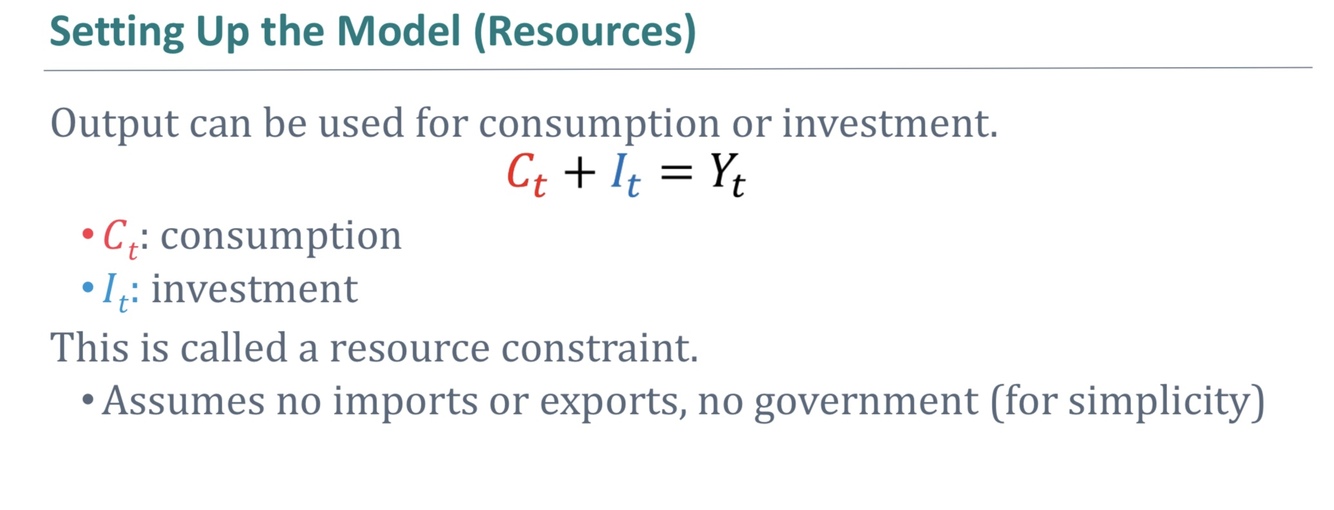
How can output be used?
The resource constraint
Output can be used for consumption or investment (creating new capital)
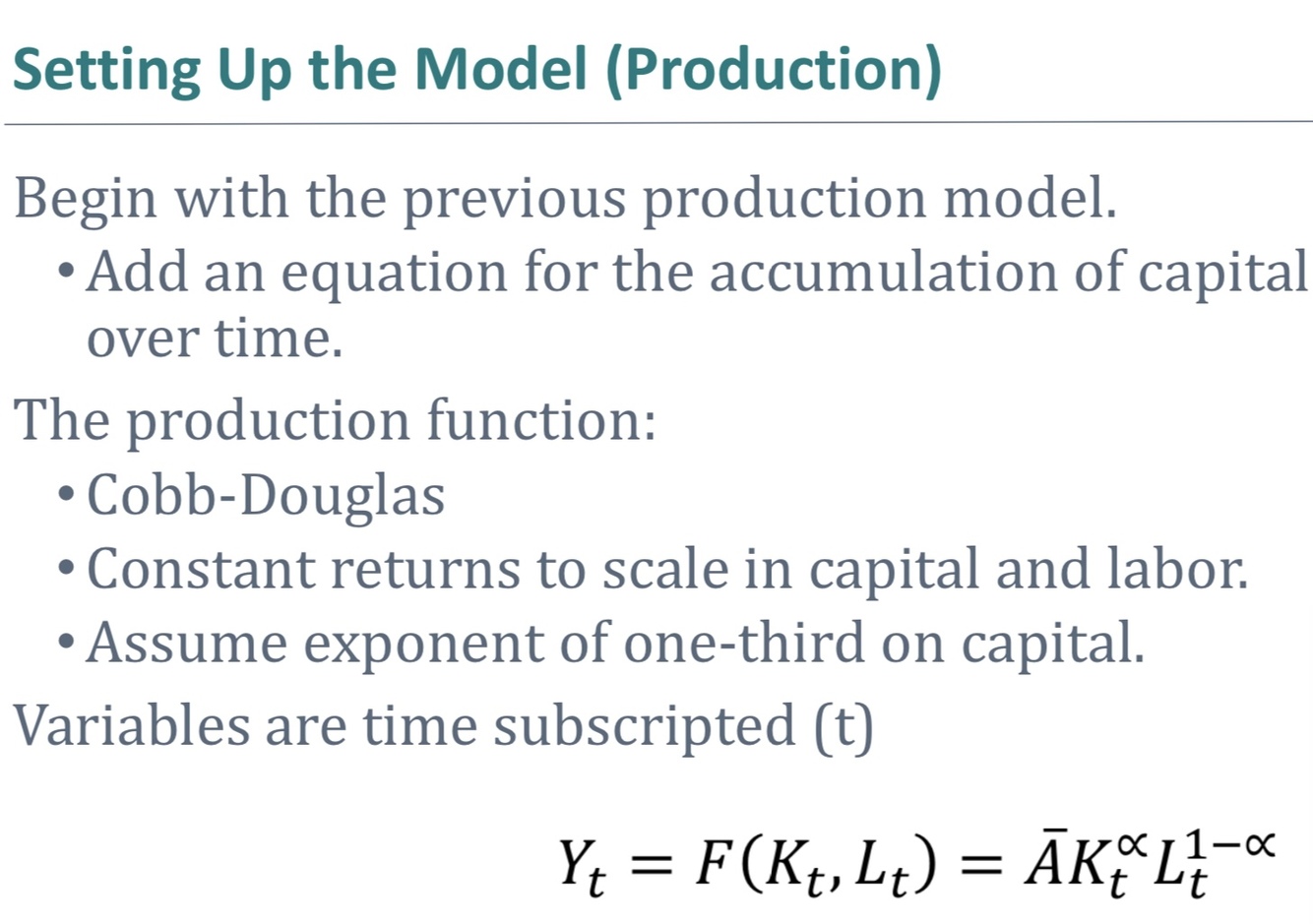
The production function
- Variables are time subscripted
- 1/3 capital exponent
- No government
- Closed economy therefore no net exports
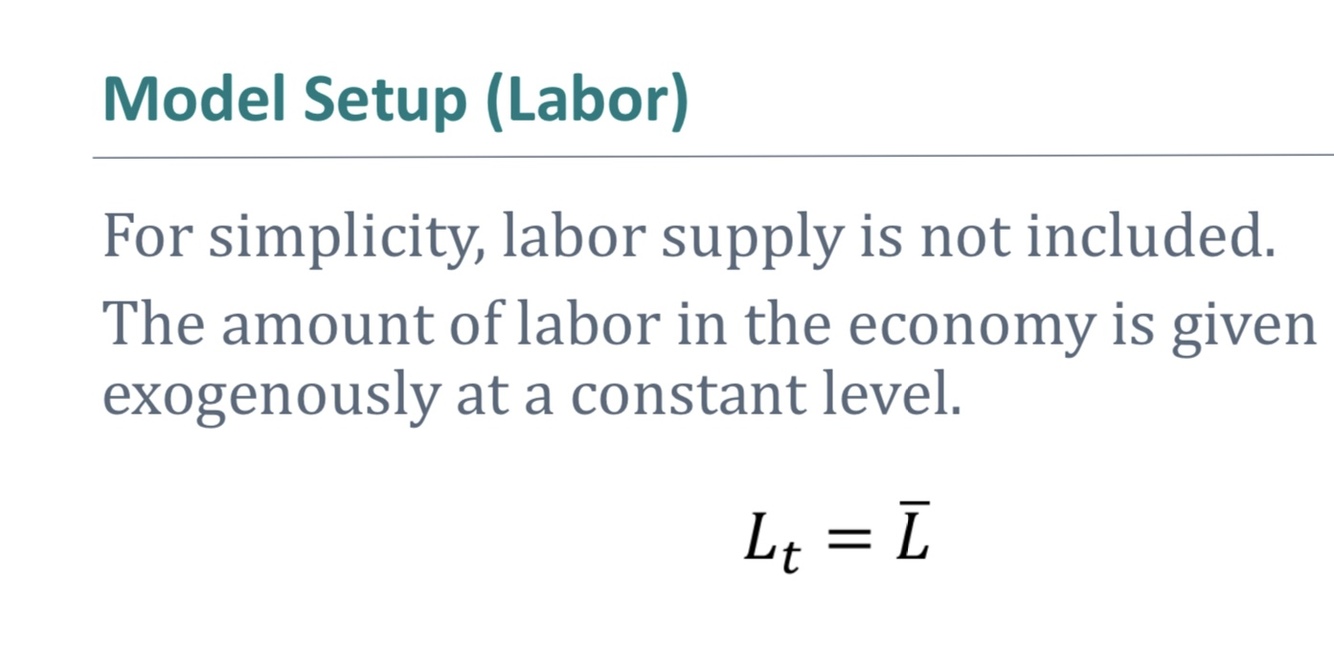
Capital accumulation
- Investment creates new capital
- Depreciation is capital that has worn off and is longer usable (7-10%)
- Creating enough new capital to compensate for depreciated capital means the capital stock should be increasing.
- Capital accumulation allows for an increase in production
- Change in capital is shown by the amount of capital in the next year minus the capital in the current year
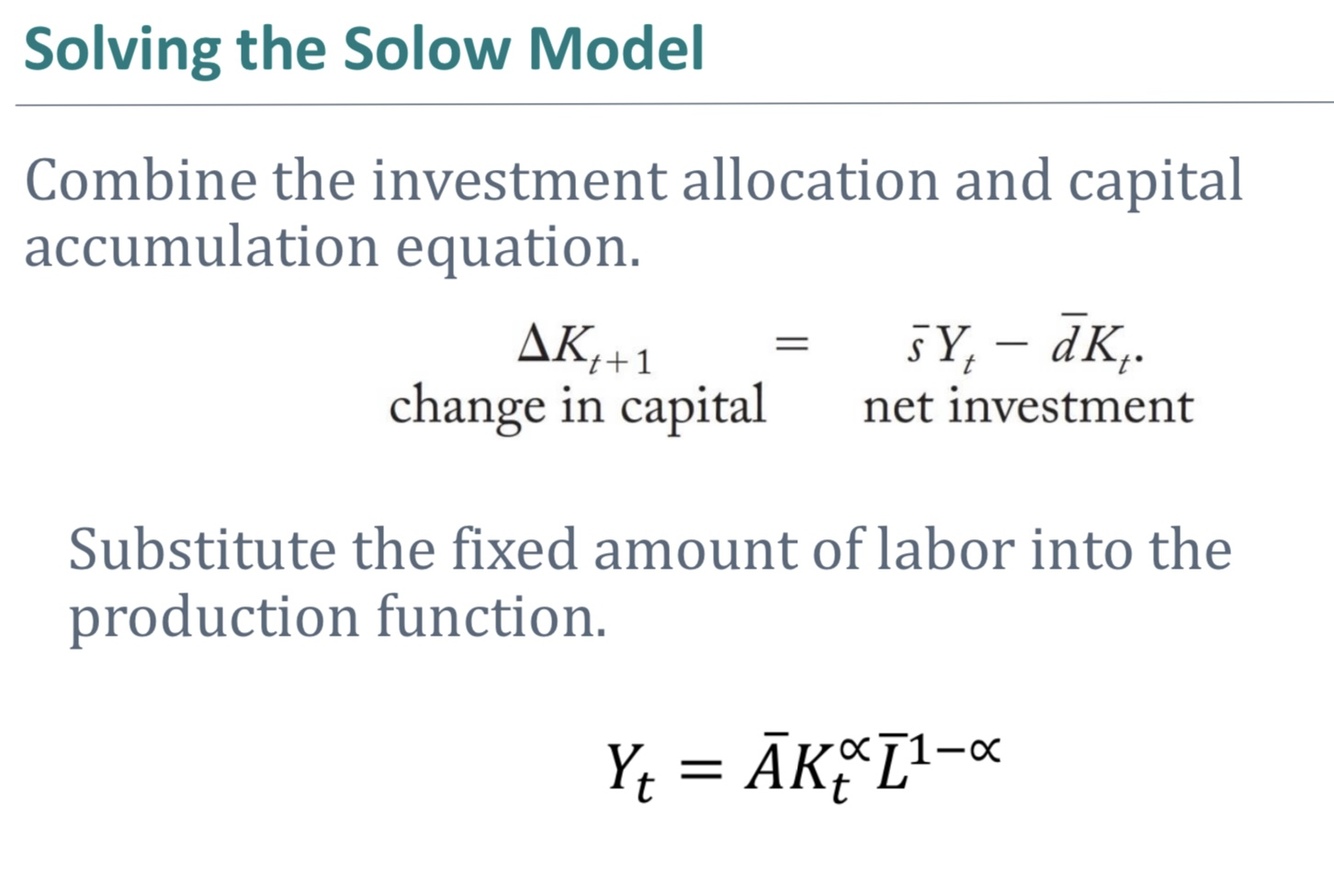
What is labour denoted as?
Constant in order to isolate the main mechanisim
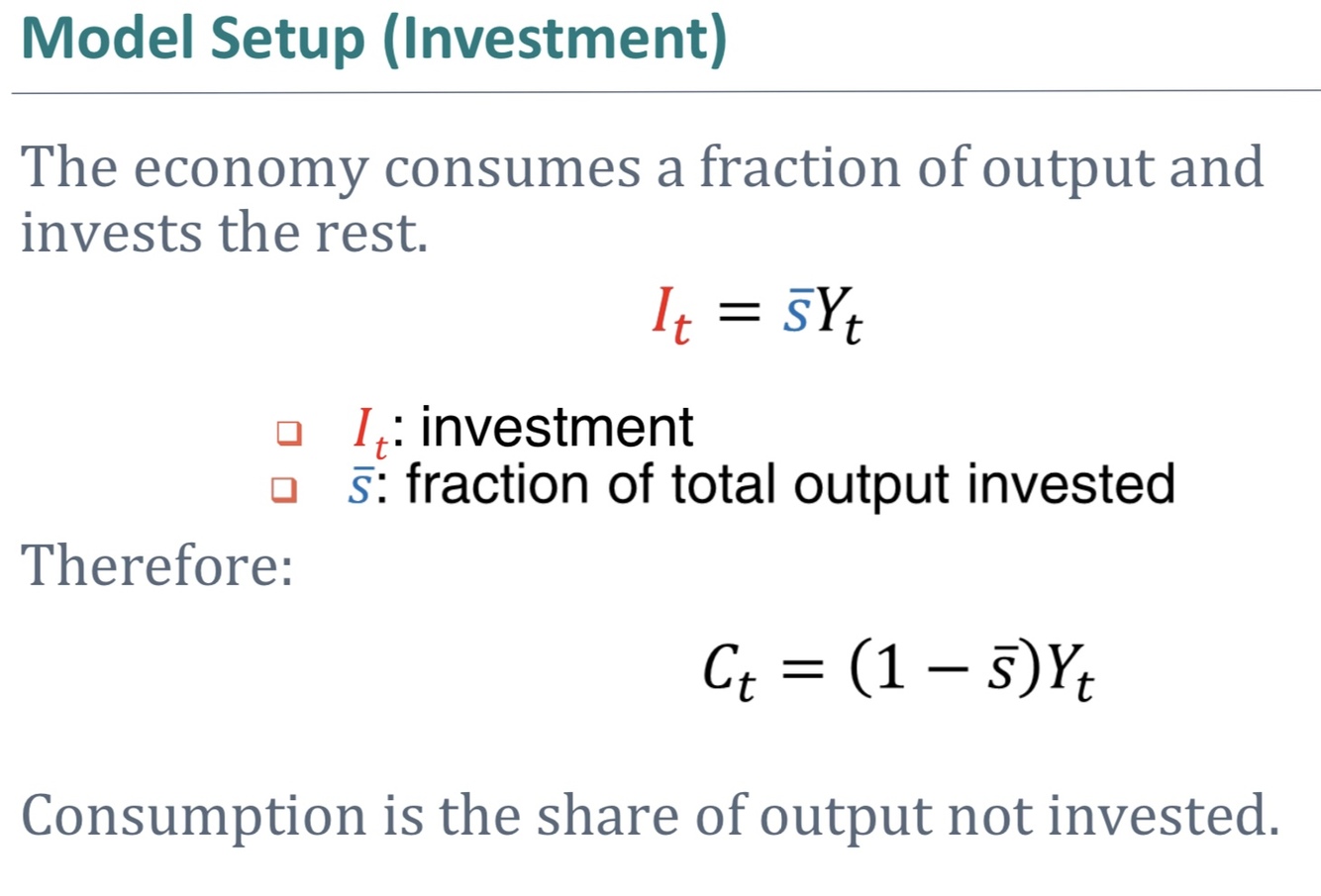
Investment equation
- Yt is the output of the economy/ gross investment in the economy
- Fixed proportion of s is different for every year
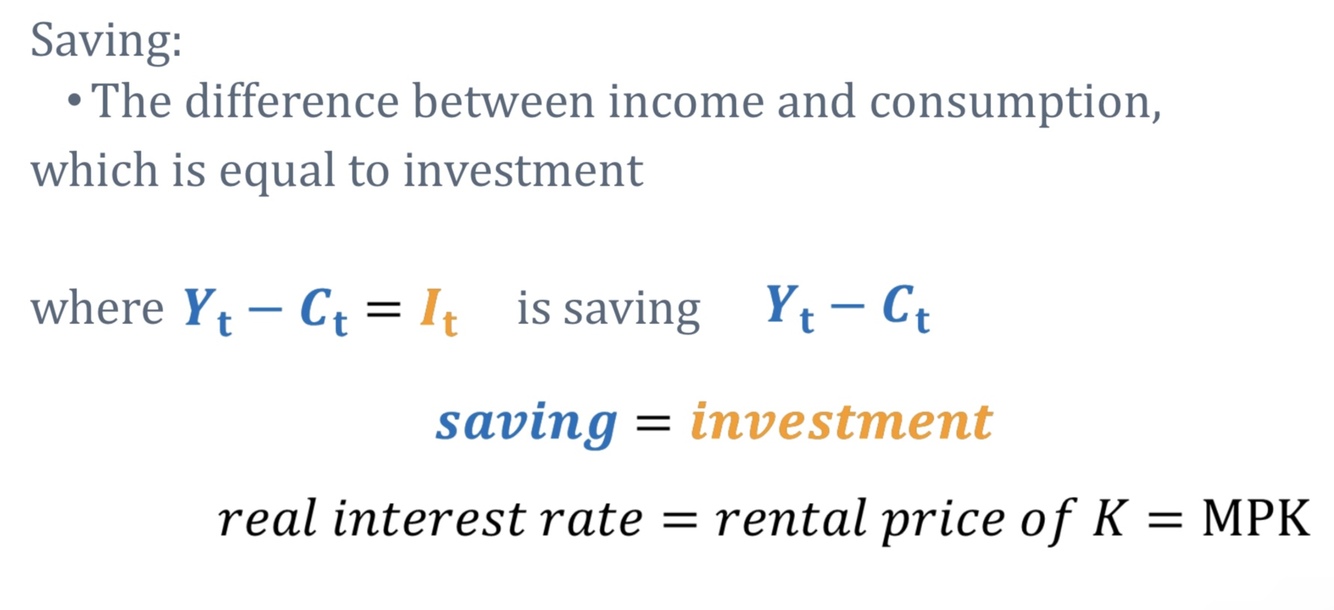
Saving
- Income left after consumption is just saving therefore savings is equal to investment
- Each unit of saving is equal to a unit of investment therefore they are equal.
- Unit of saving can be used as unit of investment and this investment is used to attain a unit of capital.
Return on savings = price at which the unit of capital can be rented
Real interest rate = rental prices of capital= marginal product of capital
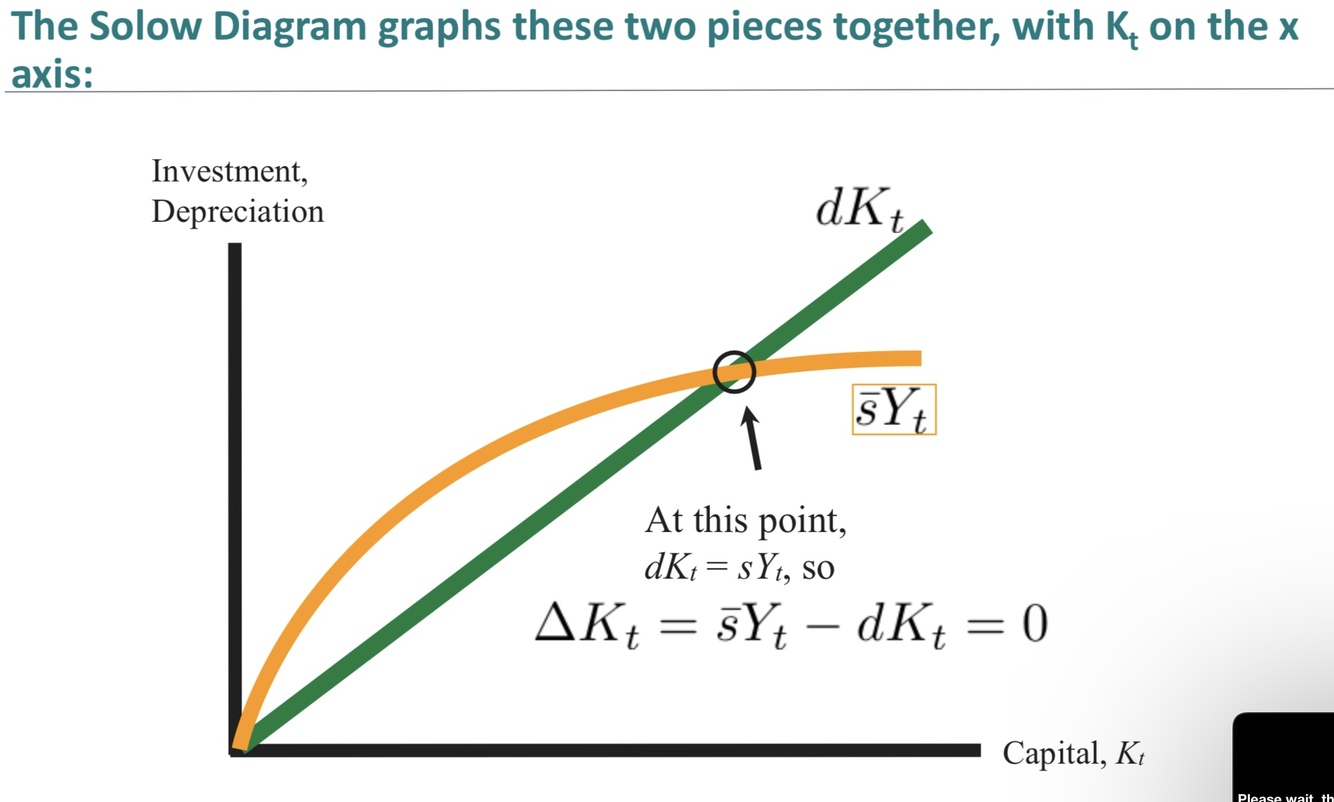
Simple diagram
- Depreciated capital at time t is linear (dKt) where the gradient is depreciation
- Invested capital will follow the graph of a production function (sYt). Follows the assumption in which there is a diminishing returns. Slope becomes smaller as capital increases because it is diminshing (more capital added gains less returns)
- Net investment is the difference between sYt - dKt, which is the vertical difference between investment and depreciation
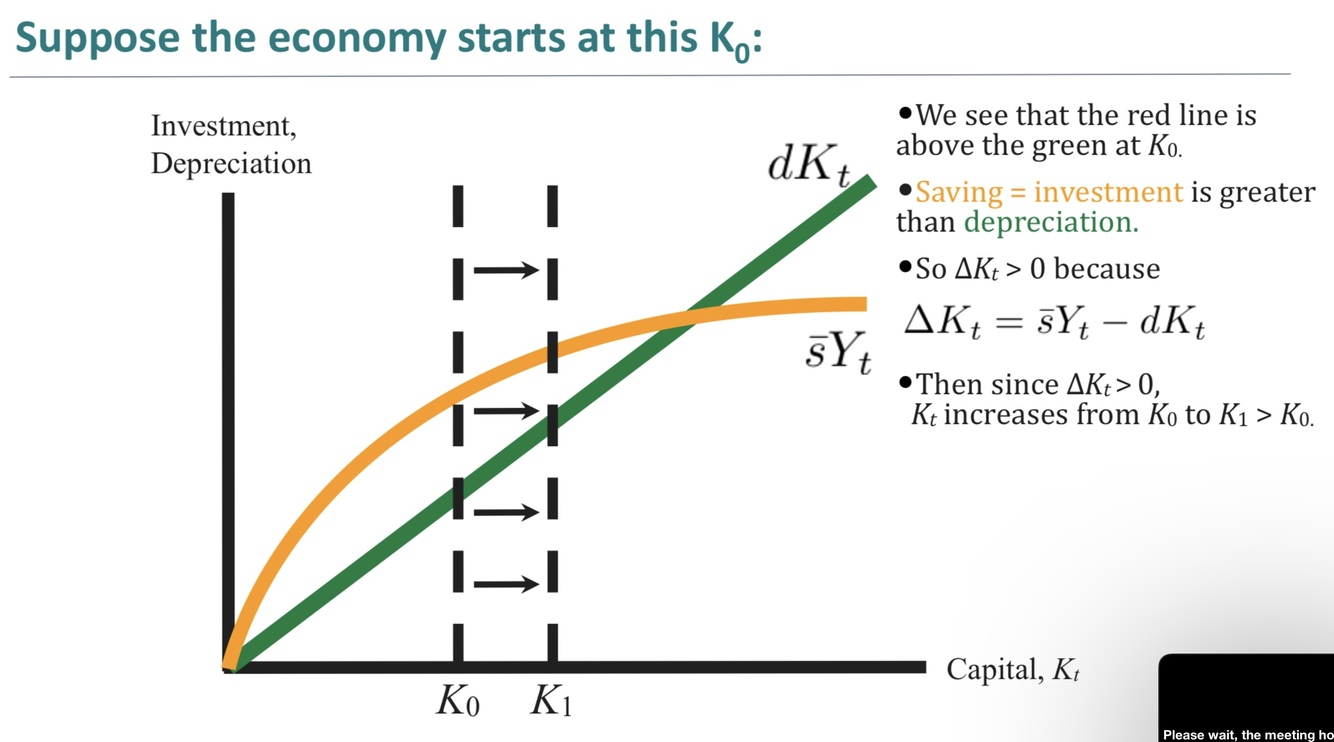
Economy where investment is greater than depreciation
- At the level k0, the investment curve is higher than the depreciation which means that the investment in the economy in this period is more than the capital that has been depreciated. This implies the capital stock will be higher. Gains are higher than the ones that have been destroyed. Then there is a movement to k1. Vertical line between green and orange line shows the change in capital (the increase that will come) from the current period to the next one. Investment > Depreciation so higher capital in the next period.
- In the k1 period, the vertical difference between the orange and green line is different. Orange line is sloped at a decreasing rate and therefore the growth of investment becomes smaller and smaller. Whilst the green curve remains linear
*
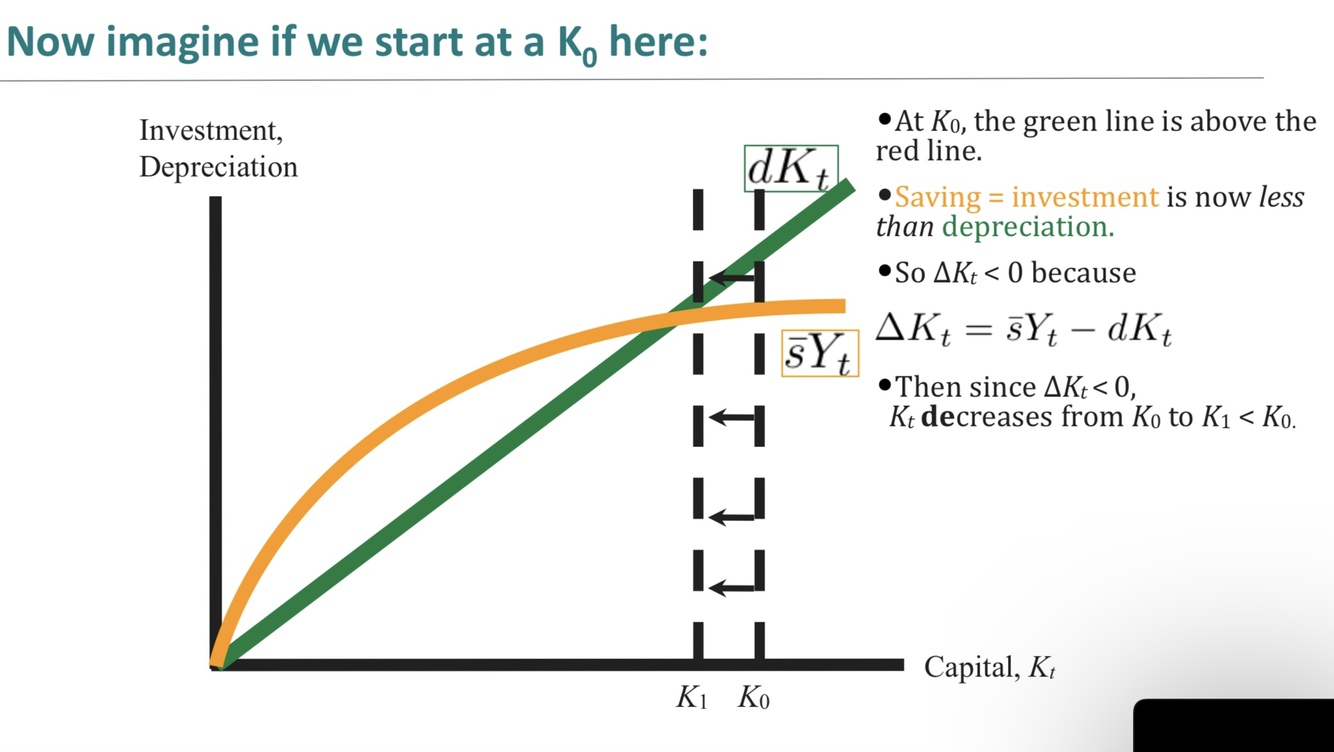
Economy where depreciation is greater than investment
•Capital will decrease by the difference between the orange and the green line
Steady state
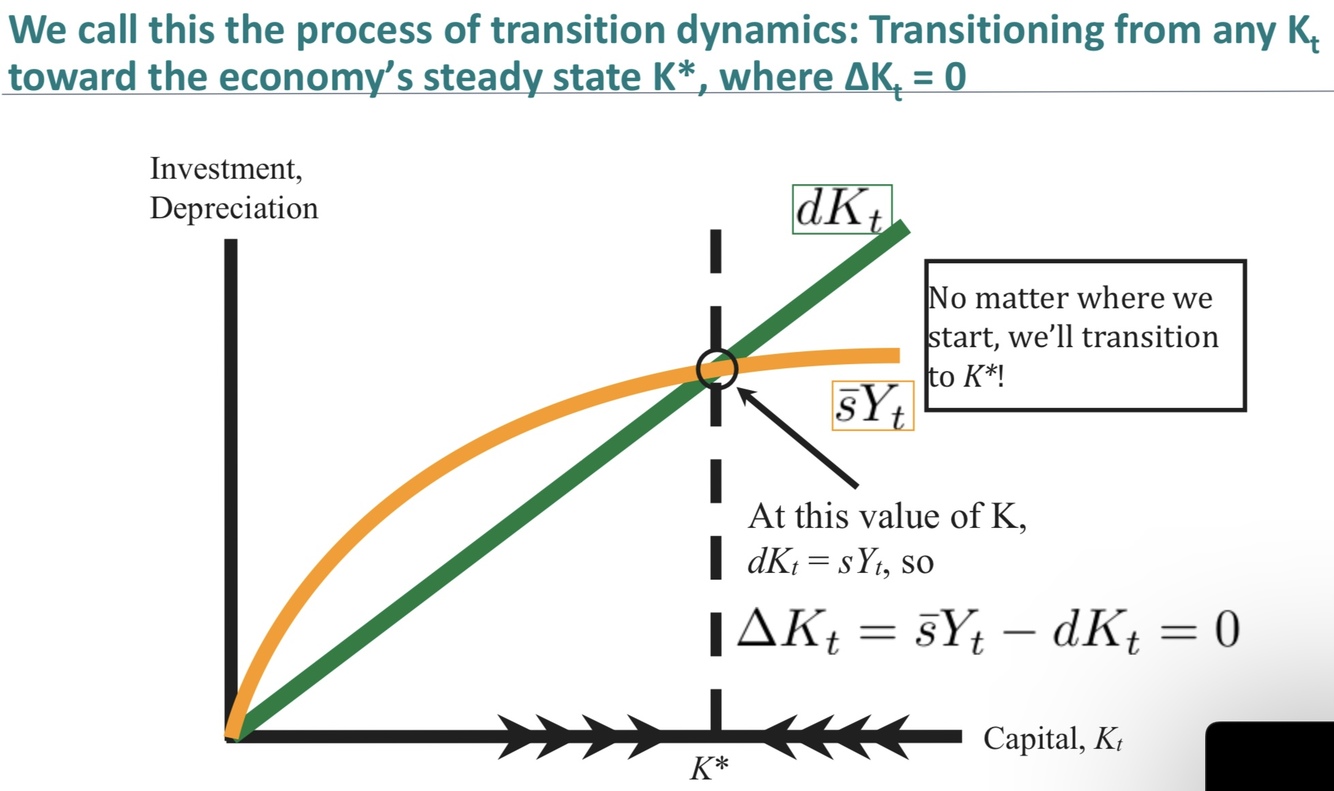
- Economy is going to tend towards a point in the economy where there is an intersection between these two points (called transition period)
- Intersection is called the steady state and capital doesn’t grow but it is constant (K*). Economy will always reach that point and once we reach that point capital doesn’t grow any more
- The capital stock will stay at this value of capital forever.
- Investment = depreciation
Growth stops and the following factors are constant
- output,
- Capital,
- output per person, and
- consumption per person
Transition dynamics
- Transition dynamics take the economy from its initial level of capital to the steady state (k*).
- Point where capital does not grow anymore
- There is growth but it slows down until we reach the steady state
Conclusion of the Solow model
- Growth through capital accumulation, but will stop at a point
- Growth very high but will slow down, due to diminishing returns of investment
- No long run growth
- In the steady state, investment = depreciation
- Capital accumulation is not the engine of long run growth
- When depreciation is greater than investment, there is negative growth and the output tends to a little change
- Higher productivity has additional effects in the Solow model by leading the economy to accumulate more capital.
Solow diagram with output
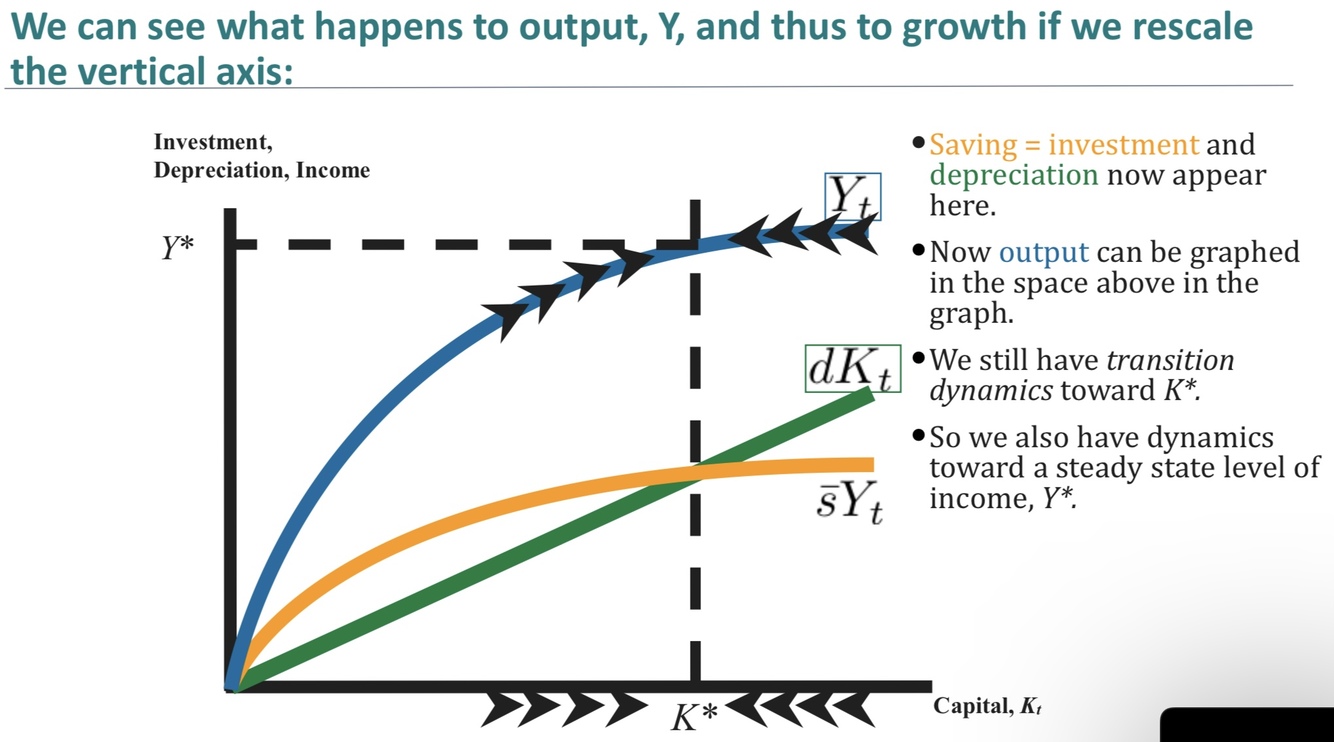
- Diminishing capital means the growth process stops at some point.
- Assumed that population was constant
- Future capital stock depends on current capital stock.
- Whenever the green curve is above the blue, there will be an increase in stock and there is an increase in output
- When the blue curve is above the green curve, there will be a decrease in stock and there is a decrease in output
- Changes in capital reflected in changes in output and growth until we reach the steady state
- Capital will increase/ decrease by the difference between the green and blue line
Solving the steady state mathematically
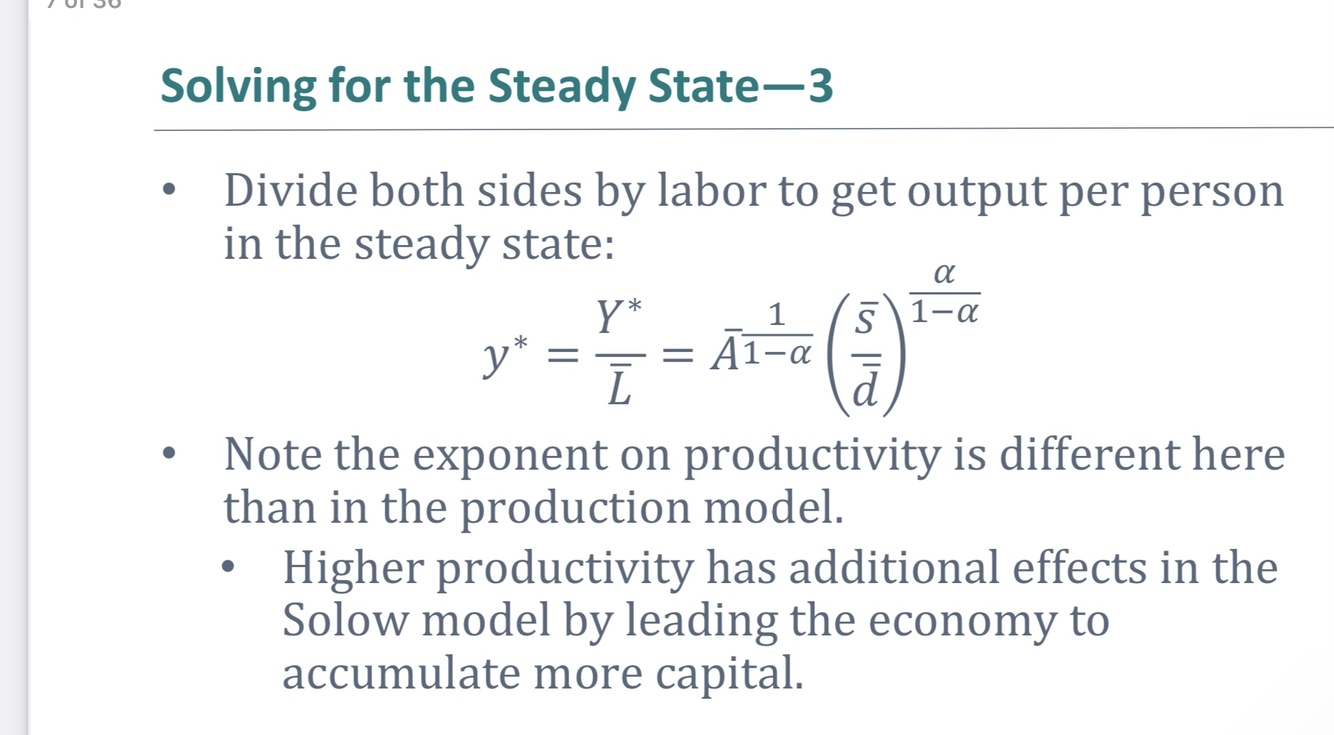
- Alpha is assumed to be 1/3
- •At the steady state, there is no growth
- Exponent of productivity is rgeater than the productivity model
What increases capital/ positively related to?
- Labour
- Investment proportion
- TFP
What decreases capital?
Depreciation rate
What changes the steady state?
- Changing S, A or D changes the steady state
- Increasing s, means higher saving rate therefore less consumption means more goes towards investment therefore steady state increases
- Increases A (TFP) means increases the level of capital in the steady state
- Increasing d means a decrease in the level of capital in the steady state, as more capital is lost due to depreciation
- Living standards is related to output per worker
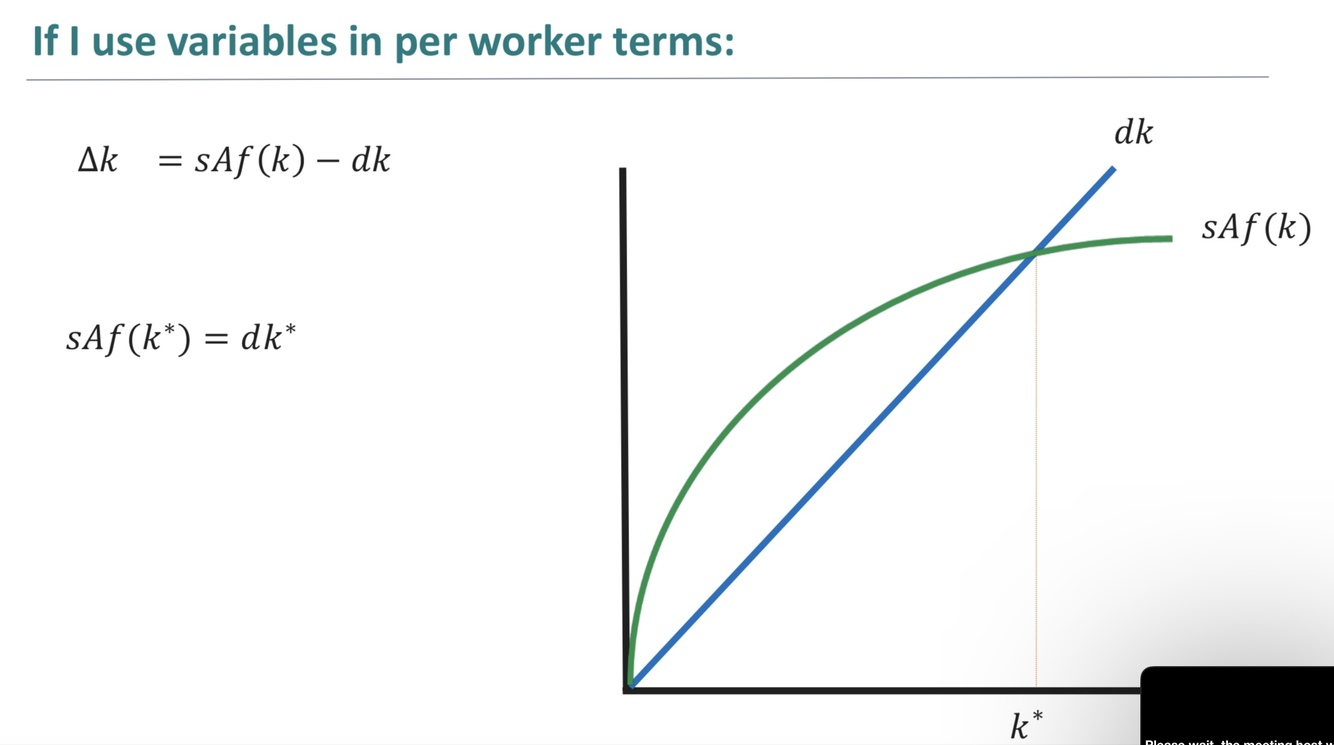
Solow with per worker axis
- Divide equation by labour force in order to find change in capital per worker is the investment per worker minus depreciation
- Because of constant returns to scale, we get an f(k) function
- Steady state is where investment per worker is equal to depreciation per worker
- f(k) is the production function which has been divded by labour to find the per worker
Capital to output ratio
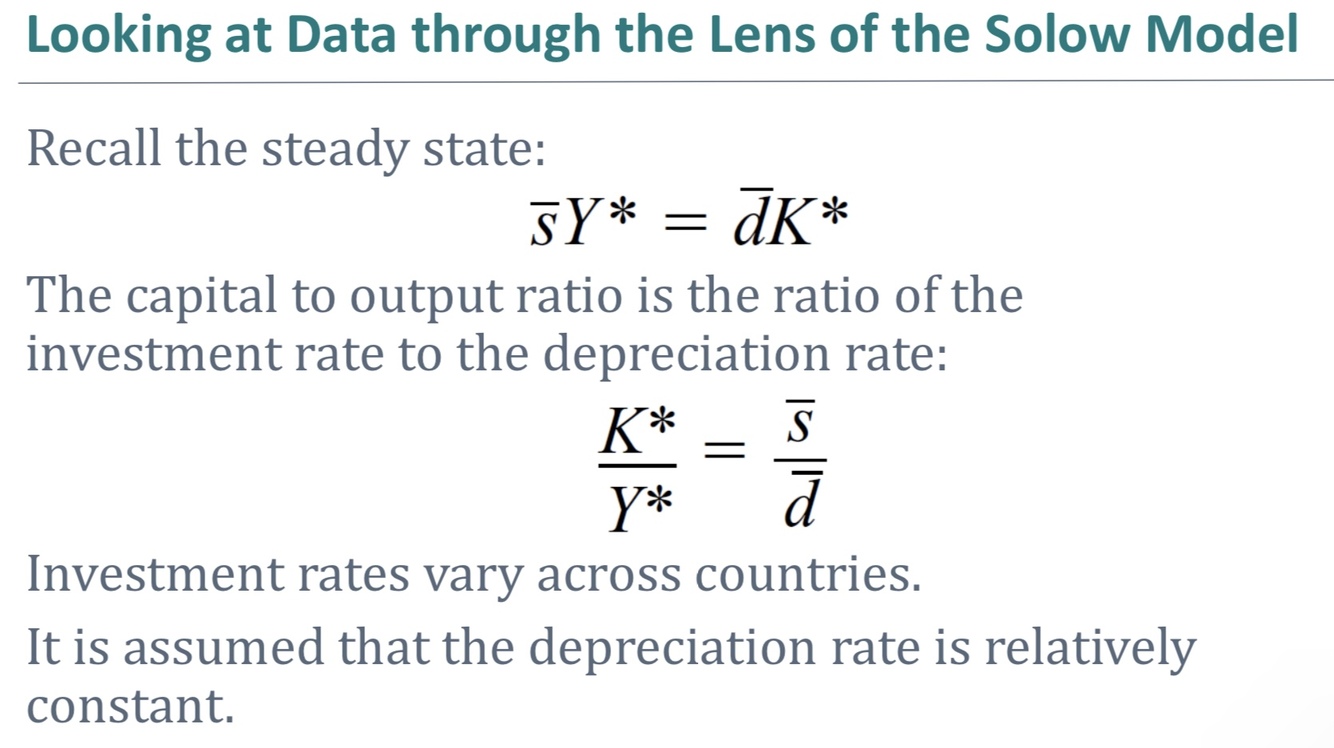
- Capital output ratio should be equal to the ratio of the investment and depreciation rate
- Depreciation rate is said to be similar (7-10%), therefore we can assume it is more or less the same
- Saving/Investing rate is what differs amongst countries
- Countries with a higher s have a high capital output ratio
What is the correlation between capital-output ratio and investment rate?
Positive relationship
Solow model and TFP
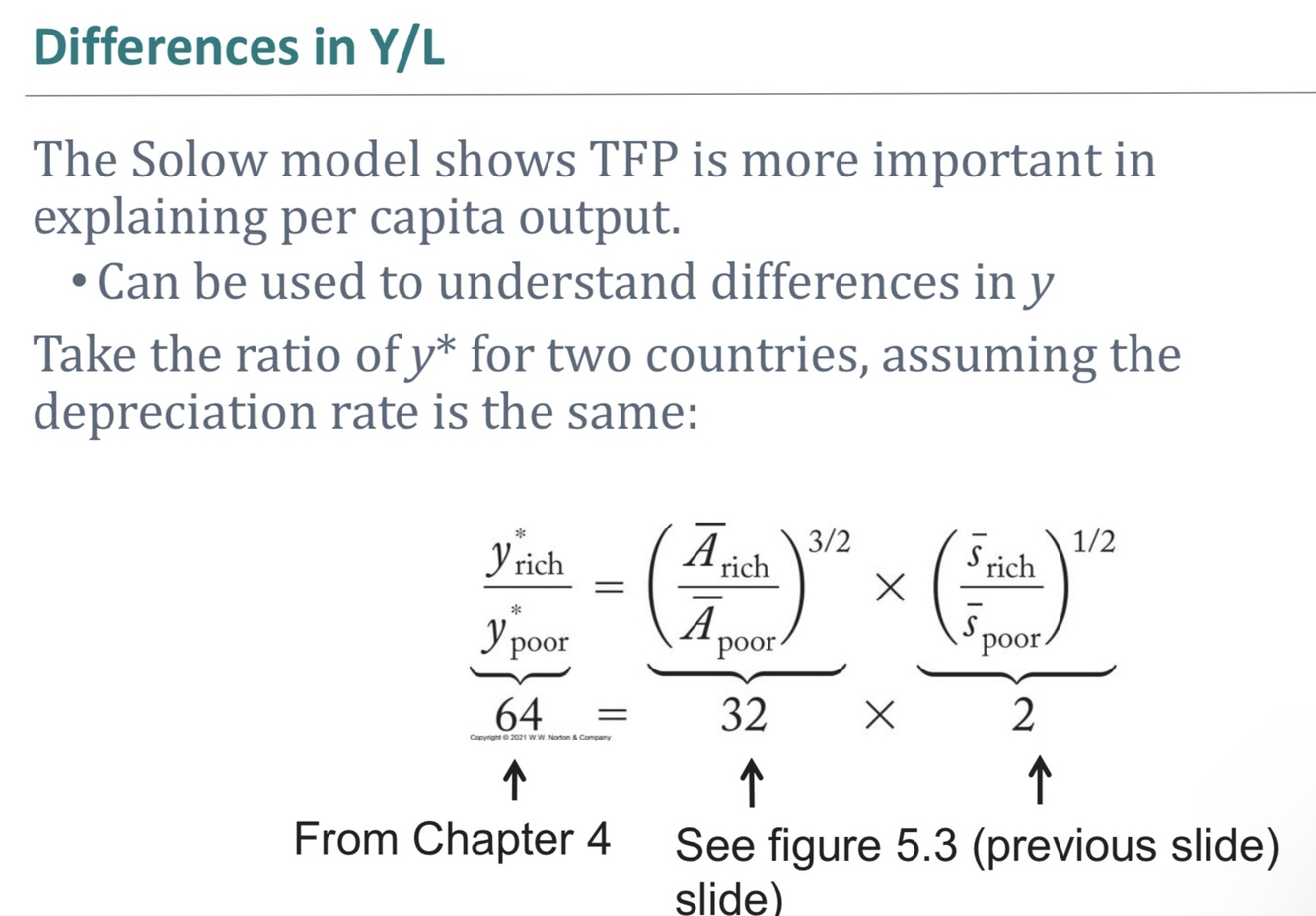
TFP is more important, as the exponent is greater than in the production model, as it is now equal to 3/2
- In the Solow model, a higher productivity parameter raises output directly just as in the production model
- there is an additional effect in the Solow model. The higher productivity level leads the economy to accumulate more capital as well. This explains the larger exponent in the Solow framework.
What is the steady state positively related to (Increase leads to a higher steady state)?
- Investment level
- Size of workforce
- Productivity of workforce
What is the steady state neagtively related to?
Depreciation rate






