What are the assumptions about the model?
- Two period model
- Income is exogenous (no work/ leisure, therefore we can just focus on their consumption decisions)
- Focus on consumption/saving decisions
- Lump sum taxes
- Consumers can be different
- Same interest rate in which consumers can borrow and lend
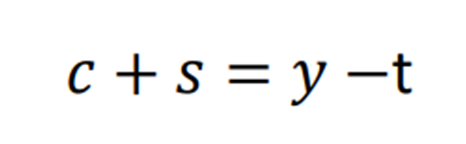
What is the current period equation to show the amount of disposable income?
- c: current consumption
- s: Bond
- y: income
- t: taxes to the government
What does it mean when s<0?
Consumer is a borrower
What does it mean when s>0?
Consumer is a lender
What is a bond?
A promise to pay something in the future in exchange for some consumption goods
- No risk associated and consuemrs never default
- Bought and sold by consumer so no financial intermediaries
- If a consumer lends, then they buy a bond
- If the consumer borrows, there is a sale of bonds
What is the private disposable income?
Income left after tax is taken away
What does a prime (‘) mean?
The future period
What is the relative price of future consumption?
1/1+r
What is an equation for future consumption?
- c’: future consumption
- y’: future income
- t’: future taxes
- (1+r)s : Interest recieved on bonds/savings
- Only two periods so this is the final period and the consumer needs to spend all the disposable income and the earnigns from interest
- If s<0, the consumer pays interets on the bond taken in the first period

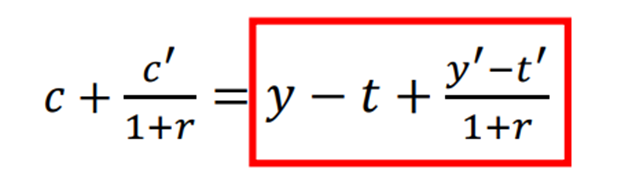
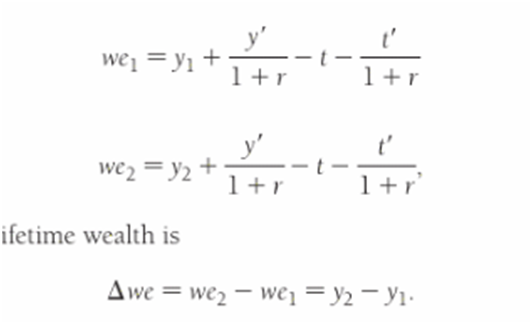
What is lifetime wealth?
Quantity of resourcs available to consumer (in current consumption goods) to spend on consumption goods over their lifetime (2 periods)
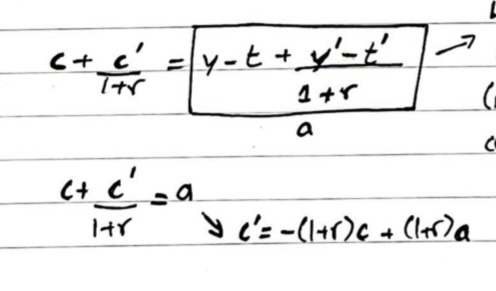
- Present value of lifetime consumption is equal to the present value of lifetime income minus the present value of lifetime taxes
- Red square is lifetime wealth and is denoted by a
- Includes r,y and t
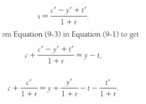
What is the proof for lifetime wealth?
Diagram
- Slope is equal to negative interest rate
- Lifetime goods is multiplied by (`1+r ) for vertical intercept to show the current consumption of goods represented in future terms, and c=0
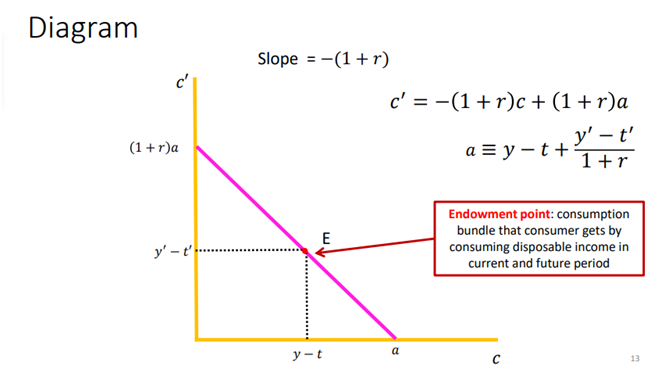
What is the endowment point?
What is the proof for the linear equation of the intertemporal budget constraint?
Lenders and borrowers
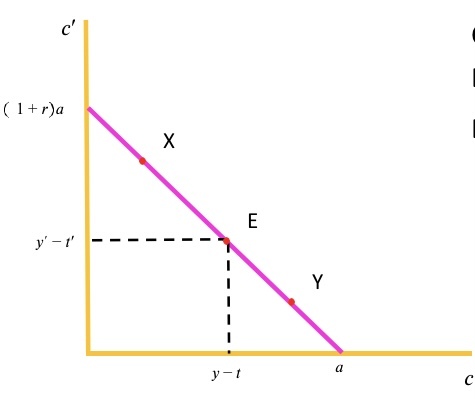
- X is a lender: c
- Y is a borrower: c > y-t: They consume more than their private disposable income, therefore they are taking out a bond and in the future period, they have to pay back the amount borrowed with interest.
Smooth consumption
Smooth transition between periods, therefore no stark differences in the bundles.
As both current and future goods are normal, then when there is a shift in the budget constraint, there is an increase in current and future income
What causes the budget constraint to shift?
Changes in lifetime wealth
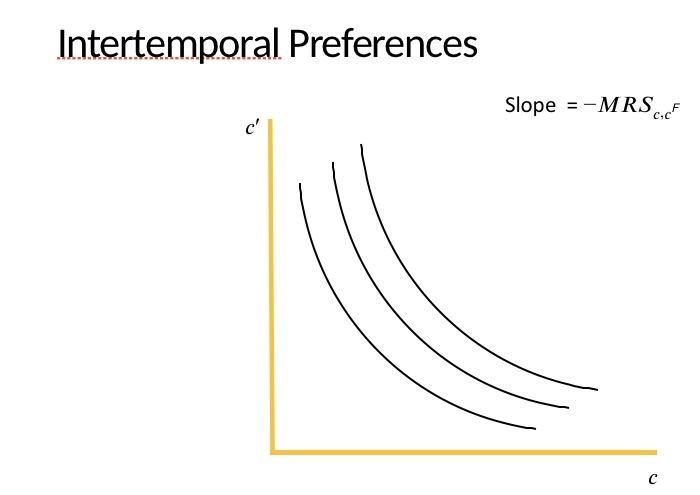
What represents preferences?
Indifference curves
- Utility increases, as the curve shifts to the right
- Slope is the negative marginal rate of subsitution between the current and future consumption
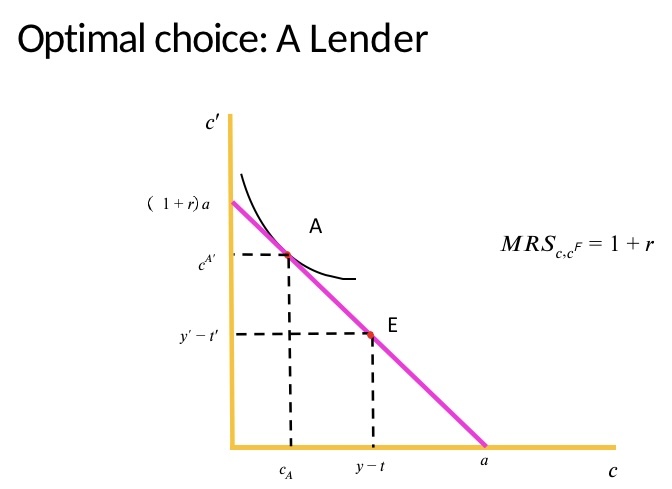
Optimal choice for a lender
- Situated on the left of the endowment point
- Able to consume more in the second period
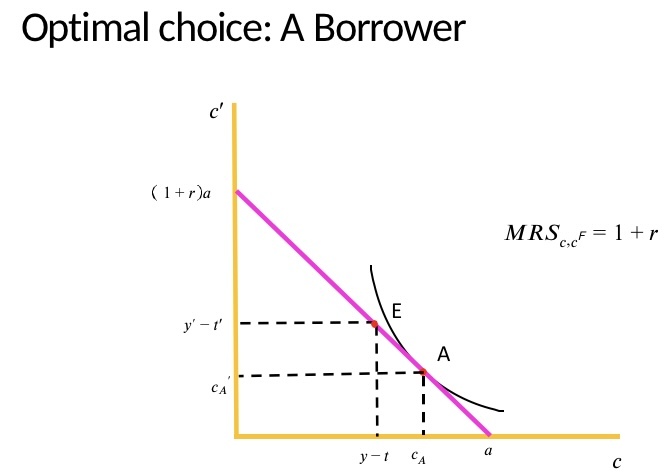
Optimal choice for a borrower
- Borrower is further down as they consume more in the first period and consume less in the second period, as they have to pay back what they lent
Where is the optimal choice?
Where the utility function and budget line meet at one point
Marginal rate of subsitution = 1+r
rate at which he or she is willing to trade off current consumption for future consumption is the same as the rate at which he or she can trade current consumption for future consumption in the market (by saving).
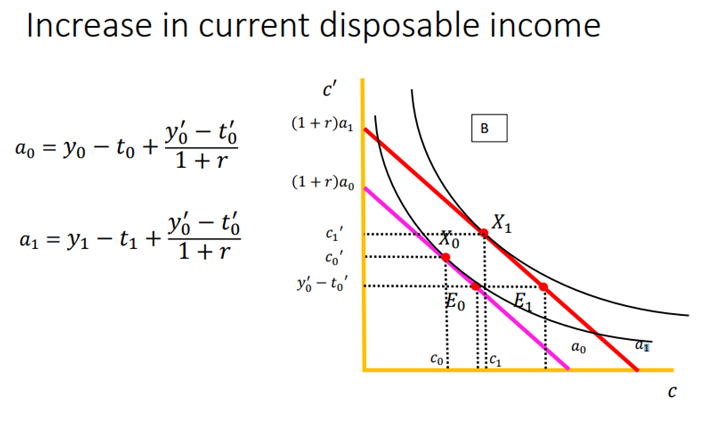
Impact of an increase in current disposable income on the budget lines
- Endowment point moves right
- Curve shifts by the amount y2-y1
- Slope remains unchanged but moves to the right
- Greater disposable income
- Change in taxes
*
Increase in current disposable income on the optimal choice:
- Assuming it is a normal good, therefore when income increases, there is more demand for the good
- Higher lifetime wealth means an increasing current and future consumption with regards to normal goods
- Savings increase
- Change in savings = (Change in savings)- (change in taxes)-(Change in consumption)
*
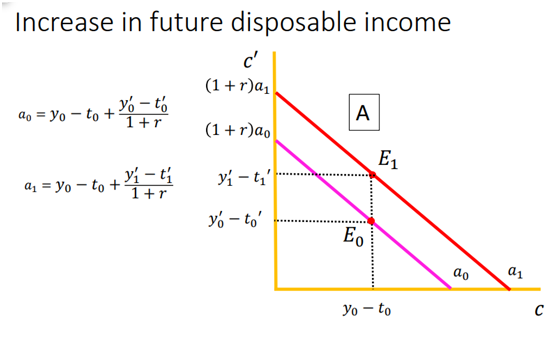
Increase in future consumption on the budget line:
- New endowment allows for an increase in future consumption, therefore it just moves up
- Current disposable income remains the same
- Lifetime wealth increases so there are higher intercepts
- Slope is the same as the interest is the same