Forecast
A general statement about the possibility of something happening/a future event.
Prediction
A more precise statement about the possibility of a future event.
- What is the difference between a forecast and a prediction?
a FORECAST is a general statement about the possibility of something happening, whereas a PREDICTION is a more precise statement about the possibility of a future event.
- What is the relationship between building height, ground oscillation frequency, building oscillation frequency and building damage during an earthquake? (image)
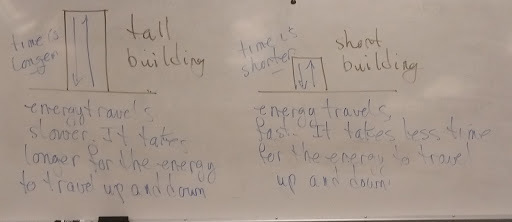
- Is it possible to predict an earthquake? Why?
It is not possible to predict an earthquake because earthquakes take place deep underground where it is impossible to observe them.
- (a) Despite the lack of a reliable way to predict an earthquake, there are some ways that might help with future efforts at forecasting and perhaps even prediction.
FORESHOCKS
Foreshocks are earthquakes, usually smaller ones, that preceed a big one and may be used to indicate another event.
However, for this to work, the earthquake history must be known in detail.
- (b) Despite the lack of a reliable way to predict an earthquake, there are some ways that might help with future efforts at forecasting and perhaps even prediction.
CHANGES IN GROUND WATER LEVELS
The water table and the movement of groundwater may change as stress causes cracks in the ground (porosity and permeability) to open and close.
- (c)
Despite the lack of a reliable way to predict an earthquake, there are some ways that might help with future efforts at forecasting and perhaps even prediction.
RADON GAS
Radon is a naturally occuring radioactive gas.
The rate of gas escape from the ground will depend upon the ground’s porosity and permeability.
Changes in stress that might be related to earthquake activity may change the porosity and permeability and rate of gas escape
Why is a seismic gap significant?
A seismic gap may indicate a change in the earthquake behaviour at a fault. Is the fault no longer active, is stress building up, stress accumulating in a different place? Seismic gaps will help narrow the search for where the next earthquake may occur.
- (d)
Despite the lack of a reliable way to predict an earthquake, there are some ways that might help with future efforts at forecasting and perhaps even prediction.
SEISMIC GAPS
A seismic gap is a section of a fault that has not experienced an earthquake in a significant period of time.
(photo) … is stress still here or even increasing?
Seismic gaps will help narrow the search for where the next earthquake may occur.
Seismic Gaps
A section of fault that has not experienced an earthquake in a significant period of time.
- (d)
Despite the lack of a reliable way to predict an earthquake, there are some ways that might help with future efforts at forecasting and perhaps even prediction.
MIGRATING EARTHQUAKES
Migrating earthquakes are a series of earthquakes that define a pattern of behaviour in time and space.
(see photo)
- (e)
Despite the lack of a reliable way to predict an earthquake, there are some ways that might help with future efforts at forecasting and perhaps even prediction.
EARTHQUAKE REGULARITY
The regular occurance of earthquakes at certain times and places may be useful in predicting their behaviour.
- (f)
Despite the lack of a reliable way to predict an earthquake, there are some ways that might help with future efforts at forecasting and perhaps even prediction.
PALEOSEISMICITY
This not only provides longer term records, it also provides information from other sources and areas not regularly monitored.
- (g)
Despite the lack of a reliable way to predict an earthquake, there are some ways that might help with future efforts at forecasting and perhaps even prediction.
ANIMAL BEHAVIOUR
It’s generally accepted that many animals “sense” things differently than humans.
Example: Elephants in a zoo constantly pacing and suggesting a certain unease.
These different and strange behaviours have been linked to earthquakes, usually after the fact.
NOTE: all these efforts to try and better predict an earthquake are based on historical data.
- There have been notable examples of successful earthquake predictions. Describe one. When was it and on what basis was a successful prediction and warning made?
Feb 1975, China
Because of a series of foreshocks, changes in land elevation, changes in the earth magnetic field, and strange animal behaviour, authorities released a notice that an earthquake was likely to happen.
A warning was issued and people were ordered to remain outside despite it being winter.
Shortly after, a 7.3 magnitude earthquake happened which caused considerable damage but minimal loss of life.
- Seismic Gap
A section of a fault that has not experienced an earthquake in a significant amount of time.
- Why is a seismic gap significant?
A fault segment with few or no historic earthquakes is defined as a seismic gap.
It is very significant because it gives the clue of location of next earthquakes.
Moreover, we can estimate the approximate time of occurence of the earthquake. Experience has shown that seismic gaps are more likely to be the locations of large earthquakes.
A seismic gap may indicate a change in the earthquake behaviour at a fault. Is the fault no longer active, is stress building up, stress accumulating in a different place?
- Blind fault
A blind fault is a fault that does not show on the surface.
- Can earthquakes be triggered by the introduction of fluids such as water into a fault zone? Explain your answer. Give an Example.
In 1960 a series of earthquakes were accidentally triggered in Colorado.
As a result of efforts to dispose of liquid chemical waste underground a series of previously unknown faults were ‘lubricated’.
This reduced the friction between rock bodies which allowed them to move and cause earthquakes. Also, fracking cause earthquakes.
- If earthquakes could be deliberately triggered by injcting fluids (i.e. water) into a fault zone, what are some of the ramifications?
The Colorado event then led to speculation that somehow earthquakes could be managed.
The problem is that all this has to happen deep underground. Not really possible because there are too many unpredictable factors. It isn’t possible to reliably map a fault, predict where the fluid will go or what it will do.
The earthquake you hope for may or may not happen.
It may be the size you expected, and it may take place at a time and location that was not intended.
- Earthquake Hazard in Turkey
In Turkey, the main type of plate margin is a right lateral strike-slip or transform margin.
Along this North Anatolian Fault, earthquake epicentres have been migrating to the west.
This means that more recent earthquakes have hapened towards the west.
Istanbul is a very old city with old buildings close together so this could be a catastrophic event.
- Describe the earthquake hazard in Chile. Why is this area so important to British Columbia?
This west coast of South America includes a continental US oceanic convergent plate margin.
Along this plate margin t here is a long record of large earthquakes. The largest on record anywhere was in 1960 (close to Magnitude 10).
These earthquakes result in significant horizontal and vertical displacement of the crust which has and will cause tsunamis.
This earthquake hazard in Chile is very similar to the hazard in western North America.
Failed Rift
A failed rift is a divergent plate margin that did not open very much.

-
Chapter 130
-
Chapter 355
-
Chapter 429
-
WTG - Chapter 14
-
WTG - Chapter 28
-
WGT - Chapter 312
-
Chapter 55
-
Chapter 6 and 715
-
Chapter 10 - part 130
-
Chapter 10 - part 219
-
Chapter 1717
-
WTG - Chapter 6, Chapter 74
-
Chapter 44
-
Chapter 218
-
MIDTERM CH. 521
-
Tsunami2
-
Floods/Rivers23
-
Chapter 1015
-
Chapter 43
-
Waking the Giant8



