Maintaining Intensity
- The coupling between the strong winds in the boundary layer and the transfer of latent and sensible heat into the air as it spirals into the cyclone.
- Frictional convergence of the tangential winds plays a key role in transporting latent heat into the core of the vortex.
- The stronger the winds,
- the greater the convergence into the core.
- the greater the transfer of latent and sensible heat from the sea surface into the inflowing air.
- The formation of an anticyclone aloft by the heating aids in the upper‐level mass divergence which is necessary to sustain and intensify the cyclone.
- Tropical cyclones can maintain themselves as long as there is sufficient inflow of warm, moist air into the cyclone, and there is adequate outflow aloft.
Factors that can cause a tropical cyclone to fluctuate in intensity (up/down) are:
- Variations in SST
- Interaction with land, which result in less evaporation & latent heat inflow.
- Enhanced or suppressed outflow
- Increased vertical shear
Tropical Cyclone Motion
cumulative effect of the following three influences:
- Environmental steering (high importance)
- The beta effect (second high importance)
- Asymmetrical convection (little importance for long term motion)
- mainly responsible for short term “eye wobble”
Environmental steering:
To a first approximation, the tropical cyclones can be thought of as
merely advected by the mean environmental flow.
The environmental flow can be represented by
various means, either through a single level, or through a mass‐weighted mean flow.
- A deep‐layer mean
- best for intense, mature cyclones.
- A medium‐layer mean or even shallow‐layer mean
- more suited to weak systems, especially if they are highly sheared.
adjustments in order to determine the environmental flow
the cyclone circulation needs to be removed from the wind field
…………………….. important for environmental steering currents.
Synoptic‐scale influences are important for environmental steering currents.
- An approaching trough can alter the steering current
- cyclone recurves, or at least tracks more northerly.
- A strong subtropical ridge
- keep a cyclone entrenched in the trade winds, and
- tracking westward
……………………. can influence the steering flow.
An adjacent tropical cyclone can influence the steering flow.
- this is called Fujiwhara effect:
- can result in some unusual tracks as the cyclones spiral around each other, occasionally even merging
Beta Effect
refers to the tendency of a circulation to move, even in the absence of a mean flow, due to the conservation of absolute vorticity.
linear beta effect
The tendency for the cyclone to move westward in the absence of a mean flow
Though the………………………………………, there are asymmetries in convection.
inner core of a tropical cyclone has large inertial stability
The asymmetrical convection can be due to several factors, including:
- SST gradients
- Differential stress
The asymmetrical convection can lead to:
- local pressure falls in the eyewall
- can displace the eye in the direction of the pressure falls.
- leads to short‐term “eye wobble” often seen in tropical cyclone tracks.
- can displace the eye in the direction of the pressure falls.
Tropical Cyclone Intensity Estimation techniques:
- Dvorak Technique
- Curved Band pattern
- Shear pattern
- CDO (Central Dense Overcast) pattern
- Eye pattern (visible image)
One important key for a successful prediction of the cyclone track and intensity is
an accurate analysis of the current position and intensity of the cyclone.
Location is determined primarily by
- away from land
- satellite imagery
- near land,
- when radar and aircraft
Intensity is determined by (near land)
- Doppler radar observations can be used to estimate intensity.
- In the absence of aircraft observations or Doppler radar observations, the Dvorak technique is the staple for determining intensity.
Dvorak Technique
The Dvorak technique is based on appearance of the storm from IR and visible satellite imagery.
uses patterns and measurements from satellite imagery to estimate the strength of a tropical cyclone.
The Dvorak technique explination:
assigns a T‐number based on the appearance from the satellite imagery.
- The T number scale runs from 0 to 8 in increments of 0.5.
- Minimal Tropical Storm intensity (35 kt) is T2.5
- Minimal Hurricane intensity (65 kt) is T4.0
basic patter types (Dvorak):
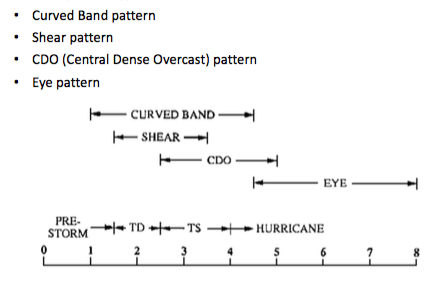
Curved Band pattern
Spiral Arc Distance of Curved Band (continuous deep convective spiral band) surrounding the Center.
• DT number determined by curvature of band around 10 log spiral.
Shear pattern
Shear pattern for weak systems to 50 knots based on distance of Center from Edge of Deep Convective Clouds.
Distance: 1° latitude = 60 nautical miles (n mi.) = 111 km)
Shear pattern more obvious on visible imagery than on IR.
CDO (Central Dense Overcast) pattern
- The CDO pattern is only used with VIS imagery.
- The CDO is a dense overcast mass of clouds that appears within the curve of the curved band axis and covers the cloud system center.
CF number
- The size of the CDO and
- its boundary definition ie irregular or well‐defined

-
Introduction13
-
Chapter 1: Characteristics of tropical regions41
-
Chapter 2: general circulation in the tropics29
-
Introduction (LECTURE)4
-
Chapter 1 (LECTURE)17
-
Chapter 2: (LECTURE)15
-
Chapter2 part 229
-
Chapter 322
-
chapter 427
-
chapter 4 (lecture)12
-
Chapter 3 (lecture)13
-
Chapter 2 part 2 (lecture)22
-
Chapter 524
-
Chapter 617
-
Chapter 7 part A25
-
Chapter 7 part B28



