Define cholecystitis.
Acute cholecystitis is acute gallbladder inflammation, and is one of the major complications of cholelithiasis (the presence of gallstones).
In most cases (90%), acute cholecystitis is caused by complete cystic duct obstruction due to an impacted gallstone in the gallbladder neck or cystic duct, which leads to inflammation within the gallbladder wall
What is the name for gallstone formation?
Cholelithiasis
How common are gallstones?
Cholelithiasis occurs in 10-15% of people and only 1-2% becomes symptomatic each year. Only 10% of those patients get acute cholecystitis.
3 times more common in women than in men up to the age of 50yrs then 1.5 times more common
What is acute acalculous cholesystitis and what percentage of cases are made up by it ?
Acute acalculous cholecystitis (inflammation of the gallbladder without any sign of gallstones) accounts for 5% to 14% of cases of acute cholecystitis
Most common in critically ill patients over 65yrs.
Describe the pathophysiology of acute cholecystitis.
- Fixed obstrcution of gallstones into gallbladder neck/cystic duct –> acute inflammation of gallbladder wall
- Gallstone causes bile to become trapped in the gallbladder –> irritation and increased pressure
- Trauma by gallstone –> inflammatory response
- Secondary bacterial infection can lead to necrosis and gallbladder perforation
What is Mirizzi’s syndrome?
Mirizzi syndrome is defined as common hepatic duct obstruction caused by extrinsic compression from an impacted stone in the cystic duct or infundibulum of the gallbladder. Jaundice in 10% of acute cholecystitis caused by Mirizzi’s syndrome.

How can cholecystitis be classified?
BY TYPE:
- Calculous - 90-95%
- Acalculous - 3-14%
BY PATHOLOGY:
- Oedematous - 2-4days and oedema is ubserosal layer
- Necrotising - 3-5days, oedema with areas of haemorrhage and necrosis(not all layers)
- Suppurative - 7-10days, WBCs within wall, areas of necrosis and suppuration, intra-wall abscesses involving entire thickness of wall. Pericholecystic abscesses present.
- Chronic - after repeated mild attacks, mucosal atrophy and fibrosis of gallbladder wall
- Emphysematous - air in gallbladder wall due to infection with gas forming anaerobes and often in diabetic patients.
What are the clinical features of cholecystitis?
Sudden-onset, constant, severe pain in the upper right quadrant, lasting several hours + tenderness with or without guarding
- RUQ pain - may begin in epigastrium or LUQ and move to the right subcostal region. Most often occurs after eating a fatty meal. Lasts more than 3-6 hours and is severe and steady
- Palpable mass (30-40%)
- Murphy’s sign - palpation causes inspiratory arrest due to pain
- Right shoulder pain
- Anorexia
- Nausea and vomiting
- Fever and chills - seen in complicated disease
Acalculous - difficult to diagnose; often in critically ill on TPN, but usually diagnosis of exclusion.
Where is pain from the gallbladder referred?
Right shoulder
What are the risk factors for cholecystitis?
- Gallstones
- Severe illness
- TPN
- Diabetes
- Physical inactivity
- Low fibre diet
- Trauma/severe burns/infection
- Hepatic arterial embolisation
- Medication- ceftriaxone(secreted into bile), ciclosporin(reduces bile acide secretion)
Why does TPN lead to cholecystitis?
Fasting –> gallbladder hypomobility –> stasis, sludge formation and gallstones due to reduced emptying
Toxic agents build up in gallbladder lumen causing gallbladder mucosa damage
What are the first line investigations for cholecystitis?
Bloods:
- FBC (elevated WBC), LFTs (elevated ALP, GGT and Bil), CRP (elevated >28nmol/L)
Scans:
- RUQ US (fluid around gallbladder, distended gallbladder, thickened wall, positive sonographic Murphy’s sign, gallstones)
- Abdo CT/MRI (gallbladder wall inflammation; linear high-density areas in pericholecystic fat tissue)
How do you manage a patient with cholecystitis?
Diagnosis and simultaneous resuscitation
- Analgesia e.g. paracetamol or diclofenac
- Monitoring
- Fluids
Assess severity - Tokyo guideline grading
Sepsis bundle - take cultures + start antibiotics (ampicillin/cirpofloxacin +/- metronidazole)
Exclusion of CBD stones - ERCP if present
Plan for cholecystectomy - if within 72hrs of symptom onset then do immediate cholecystectomy as not enough time has passed for adhesions/inflammation to occur
If high risk patient unsuitable for GA: percutaneous cholecytostomy to relieve symptoms
What are the complications of cholecystitis and its management?
- Necrosis of the gallbladder wall (gangrenous cholecystitis).
- Perforation of the gallbladder.
- Biliary peritonitis.
- Pericholecystic abscess.
- Fistula (between the gallbladder and duodenum).
- Jaundice (due to inflammation of adjoining biliary ducts — Mirizzi’s syndrome).
- Sepsis.
What is the prognosis for cholecystitis?
If the gallbladder perforates, mortality is 30%.
Untreated acute acalculous cholecystitis is life-threatening and is associated with up to 50% mortality.
About 50% of the people who have had one episode of biliary pain will have another within 12 months.
Without treatment, acute cholecystitis may resolve spontaneously within 1–7 days. However, 25–30% of people will require surgery or develop complications.
What differential diagnoses would you consider?
- Acute pancreatitis
- Acute cholecystitis
- Chronic pancreatitis
- Acute appendicitis
- Coeliac disease
- Perforated duodenal ulcer
- Acute hepatitis
- Acute pyelonephritis
- Renal colic
What three further investigations would you request to help you establish the diagnosis?
- Serum amylase
- Erect chest radiograph
- Supine abdominal radiograph
- Ultrasound abdomen
- Lateral decubitus abdominal radiograph
- Erect abdominal radiograph
1. Acute cholecystitis, acute pancreatitis and perforated duodenal ulcer. - pyelonephritis can cause fever and abdominal pain (classically loin-to-groin) but would be unlikely with the negative urine dip. Renal colic causes loin-to-groin pain but is likely to cause at least blood on the urine dip and wouldn’t explain her fever and level of illness – also the abdomen would usually be soft
2. Serum amylase, erect CXR, US abdomen - musct exclude perforated viscus and pancreatitis. US will show biliary tree. Lateral decubitus films are used to detect small amounts of free intra-peritoneal air otherwise occult, but are difficult often to interpret
An ultrasound image of the gallbladder fossa is demonstrated below. Several structures are indicated by labels A-D. Link the labels on the left with the correct response in the right hand column.
Serum amylase and liver function tests are within normal limits and chest/ abdominal radiographs show no abnormality. Ultrasound has confirmed gallstones in the gallbladder with appearances consistent with acute cholecystitis. The biliary tree is normal with no dilatation. What further investigations are now indicated?
- Computed Tomography (CT) abdomen
- ERCP
- Magnetic resonance imaging with MRCP (magnetic resonance cholangiopancreatography).
- Barium meal
- None at this time
- Nuclear medicine HIDA scan to assess gallbladder function
How would you manage this patient?
- Intravenous fluids, analgesia, nil by mouth
- Intravenous antibiotics
- Arrange gallbladder drainage percutaneously to allow acute inflammation to subside.
- Arrange ERCP and stent insertion to drain biliary tree
- Consider cholecystectomy as an emergency (during this admission)
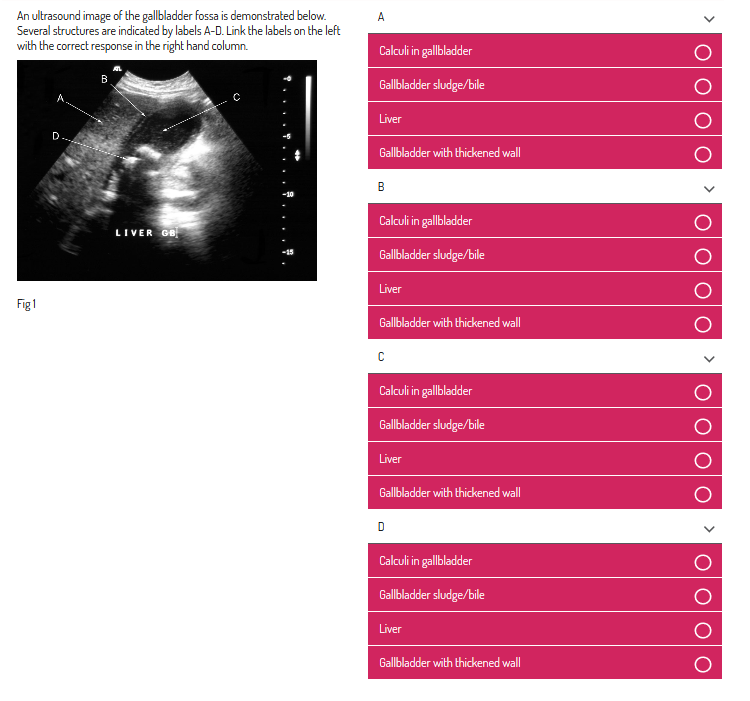
- The gallbladder contains echogenic material – sludge and also calcified stones (hyperchoic – white) which shadow. The gallbladder wall is thickened – these appearances are in keeping with acute cholecystitis.
- A- liver
- B - thickened wall of gallbladder
- C - gallbladder sludge/bile
- D - calculi in gallbladder
2. None at this time - normal LFTs and non dilated biliary tree so CBD stone unlikely. MRCP only indicated if still doubt and HIDA scans assess gallbladder function. CT is for complications of cholecystitis.
3. IV fluids, analgesia, NBM; IV antibiotics and consider cholecystectomy - Cholecystectomy can be performed acutely (consider laparoscopic removal) or at a delay of a few months.
With regard to gallstones which five of the following statements are true?
- 10% are radio-opaque an abdominal radiographs
- 90% are asymptomatic
- They are complication of sickle cell disease
- Late cholecystectomy is associated with fewer complications than early cholecystectomy for acute cholecystitis
- Gallbladder percutaneous drainage may suffice as a treatment for acute cholecystitis in the elderly
- Smoking is a risk factor for gallstones becoming symptomatic
Which six of the following are complications of gallstones?
- Small bowel obstruction
- Gall bladder carcinoma
- Acute pancreatitis
- Bile salt malabsorption
- Pancreatic cancer
- Duodenal ulcer
- Porcelain gallbladder
- Mucocele of the gallbladder
- Cholangitis
1.
- 10% are radio-opaque an abdominal radiographs
- 90% are asymptomatic
- They are complication of sickle cell disease
- Gallbladder percutaneous drainage may suffice as a treatment for acute cholecystitis in the elderly
- Smoking is a risk factor for gallstones becoming symptomatic
There are increased complications associated with late rather than early cholecystectomy. Any condition associated with haemolysis (e.g. sickle cell disease) can cause pigment stone formation.
2.
- Small bowel obstruction - stones can migrate via a fistula into the bowel with impaction and obstruction (gallstone ileus). Duodenal ulcer is not related to gallstones.
- Gall bladder carcinoma
- Acute pancreatitis - if stones in CBD
- Porcelain gallbladder - Porcelain gallbladder is secondary to chronic inflammation secondary to stones and is a risk factor for malignant change – look for gallbladder mural calcification on radiograph.
- Mucocele of the gallbladder
- Cholangitis - stones in CBD
A 78-year-old female presents to the surgical assessment unit with right upper quadrant pain. She has had pain in the right upper quadrant for several years intermittently and the current episode has lasted for 48 hours. She does feel nauseated but has not been sick. She does also complain of intermittent bloating and flatulence. Her weight is steady however she has a history of mild hypertension for which she takes a diuretic but has no other medical or drug history. She smokes 5 cigarettes per day.
On examination, she is mildly overweight but baseline observations are normal and she is apyrexial. Cardio-respiratory examination is normal. She is mildly tender in the right upper quadrant on abdominal palpation but has no guarding and bowel sounds are normal. No masses are palpable. Her abdomen is mildly distended. Bloods are normal except for elevated CRP.
What is the most likely diagnosis?
CHRONIC cholecystitis
Acute cholecystitis would be associated with more pain and systemic upset, a fever and an elevated WCC. LFT’s are normal and no mass is palpable making stones in the duct, liver metastases and hepatitis is unlikely. She is not ill enough to have acute pancreatitis (it would be worth checking serum amylase if you are concerned).
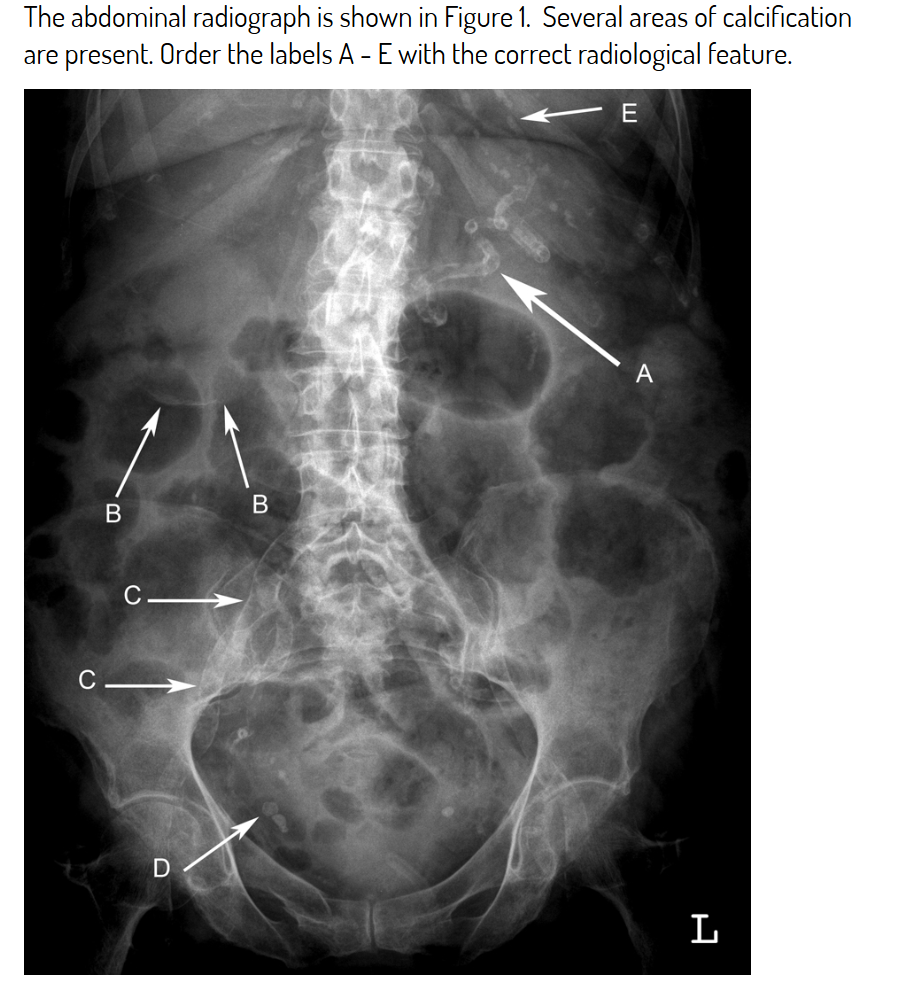
A - splenic artery calcification
B - gallbladder wall calcification
C- right iliac artery calcification
D - phlebolith
E - costal cartilage calcification
Which of these is true?
- The bowel gas pattern is within normal limits
- Dilated loops of small bowel are present in keeping with ileus
- Air is noted in the biliary tree in keeping with gallstone ileus
- There is an abnormal thick-walled structure in the right upper quadrant consistent with a distended gallbladder
- Air is present within the wall of the right upper quadrant structure
- Mottled gas densities are present in the right upper quadrant consistent with a liver abscess.
- Large renal calculus noted in the right kidney
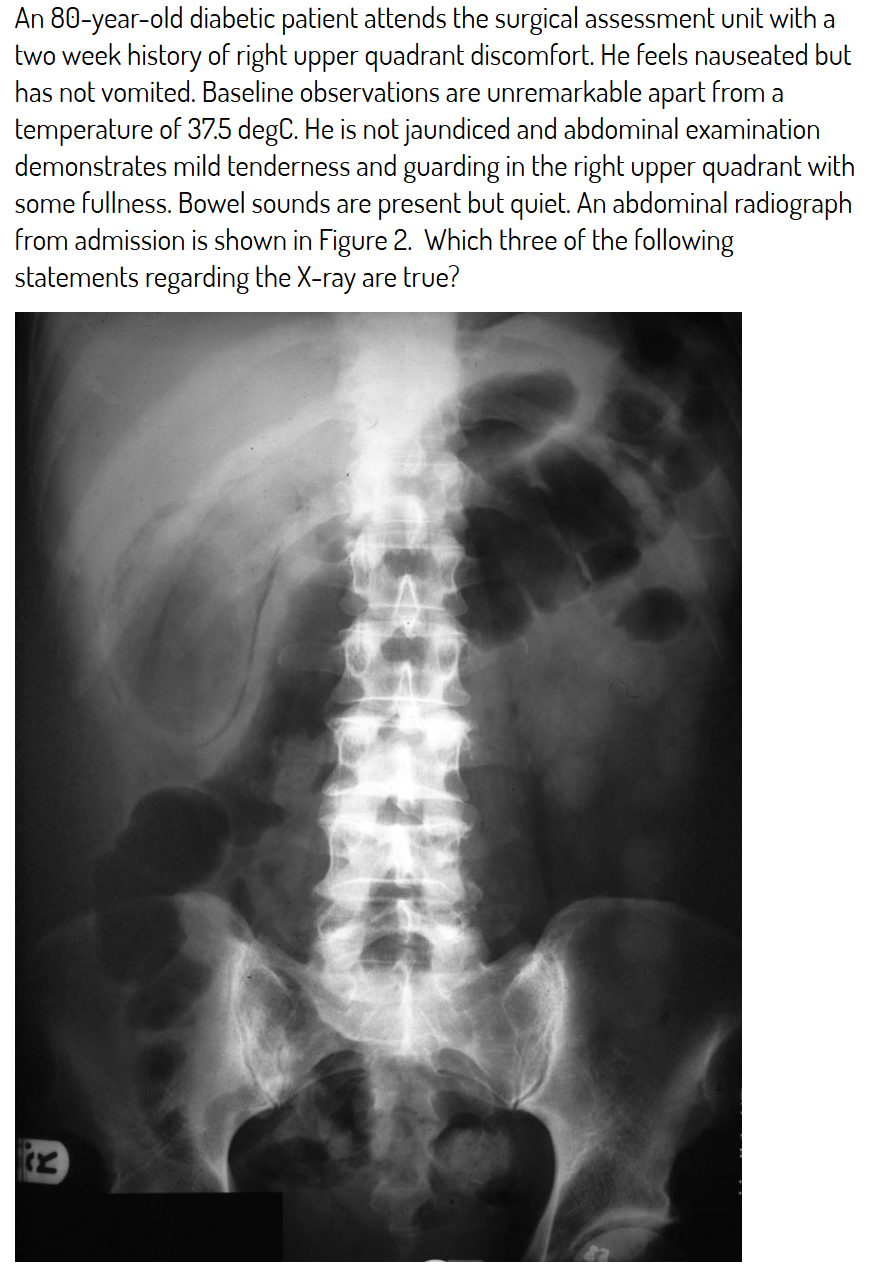
- The bowel gas pattern is within normal limits
- There is an abnormal thick-walled structure in the right upper quadrant consistent with a distended gallbladder
- Air is present within the wall of the right upper quadrant structure
The gallbladder is distended and thick-walled and curvilinear lucency in keeping with gas is seen in the gallbladder wall.
Which of these is true about air in the gallbladder wall?
- If is not usually of clinical significance and occurs often in elderly patients
- It is more common in diabetics
- CT is the ideal modality for further delineation
- ERCP is helpful for further investigation
- It is known as emphysematous cholecystitis
- Air in the wall arises as a combination of gallbladder ischaemia and infection with gas-forming organisms
- Treatment is conservative
- Symptoms and signs are initially minor but mortality is high
More common in diabetics
CT is the ideal modality for delineation and is superior to US
Symptoms and signs are initially minor but mortality is high - Initial symptoms/signs are often minor but mortality due to sepsis is high. Oedema changes obstruct the cystic duct with distension/ischaemia of the gallbladder and sepsis supervenes
It is known as emphysematous cholecystitis
Air in the wall arises as a combination of gallbladder ischaemia and infection with gas-forming organisms
Treatment is surgical.

-
Achalasia22
-
Autoimmune Hepatitis12
-
Cholangiocarcinoma15
-
Gastric cancer16
-
Feeding (enteral and parenteral)11
-
Haemochromatosis12
-
Hepatocellular Carcinoma9
-
Intestinal Ischaemia24
-
Liver abscesses and cysts19
-
Oesophageal Cancer16
-
Pancreatic cancer14
-
Primary biliary cholangitis (previously cirrhosis)15
-
Primary sclerosing cholangitis12
-
Rectal Prolapse11
-
Volvulus18
-
Wilson's disease11
-
Year 3:0
-
Acute Cholangitis16
-
Alcohol Withdrawal16
-
Appendicitis22
-
Acute Pancreatitis22
-
Cholecystitis22
-
Chronic pancreatitis12
-
Cholelithiasis (Gallstones and biliary colic)24
-
Gastro-oesophageal reflux disease (GORD)17
-
Barrett's oesophagus13
-
Hiatus Hernia21
-
Hernias (femoral, inguinal, miscellaneous)39
-
Hernia (anatomy of femoral and inguinal)22
-
Gastroenteritis & infectious colitis35
-
Gastrointestinal perforation23
-
Mallory-Weiss Tear14
-
Peptic ulcer disease and gastritis38
-
Diverticular disease20
-
Intestinal obstruction32
-
Peritonitis22
-
Coeliac disease18
-
Crohn's disease29
-
Functional dyspepsia & irritable bowel syndrome (IBS)20
-
Ulcerative colitis24
-
Vitamin B12 & Folate deficiency30
-
Vitamin deficiency (A, B, C, D, E, K)76
-
Colorectal Carcinoma27
-
Alcoholic Hepatitis14
-
Cirrhosis21
-
Viral Hepatitis (A and E)15
-
Viral Hepatitis (B and D)27
-
Viral Hepatitis (C)23
-
Liver failure22
-
Non-alcoholic steatohepatitis11
-
Portal hypertension26
-
Anal fissure13
-
Haemorrhoids and Haemorrhoidectomy23
-
Perineal abscesses and fistulae16
-
Pilonidal sinus10
-
Pathology of the Acute Abdomen17
-
Twisted Ovarian Cyst, Ectopic Pregnancy15
-
Intestinal Obstruction, Appendicitis16
-
Perforated Diverticulitis, Perforated Peptic Ulcer7
-
Biliary Tract Disease, Pancreatitis, Kidney Stone11
-
Liver Disease CPC Lecture41
-
Acute GI bleed - not finished15
-
Leaking Abdominal Aneurysm, Mesenteric Embolism or Thrombosis9
-
Appendicectomy6
-
Colonoscopy and Endoscopy9
-
Cholecystectomy6
-
ERCP (endoscopic retrograde cholangiopancreatography)7
-
Nasogastric tube insertion12
-
Laparoscopic abdominal surgery and Open abdominal surgery (incl. laparotomy)8
-
Constipation8



