Principle of chromatography
research technique, used to separate different components of a mixture, according to their stationery phase (immobile) and mobile phase (mobile)
Components of a chromatographic method:
- mobile phase: carries components of the mixture, liquid or gas; mobile = in moving
- stationary phase: through which the mobile phase moves, solid or liquid
- the chromatorgraphic column
Types of chromatographic methods
- gel filtration chromatography
- affinity chromatography
- adsorption chromatography
- partition chromatography
- ion-exchange chromatography
Picture of the gel filtration method
organe - pores
red - large molecules
green - small molecules in different sizes
blue - stationary phase
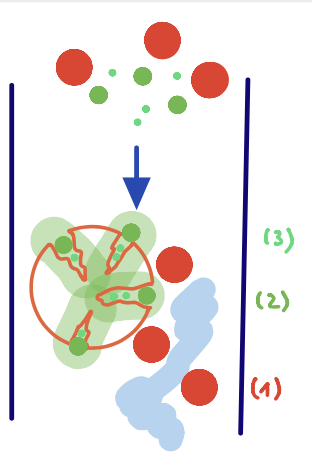
Principle of gel filtration
a chromatographic method used for seperating different components of a mixture according to its size and shape.
- small molecules will penetrate the pores, because their diameter is smaller than the diameter of the pores and will be retained by the stationary phase and so collected later.
- large molecules do not penetrate the pores, because their diameter is bigger than the diameter of the pores and are not retained by the stationary phase. They will move quickly between the gel and so collected first.
Importance of gel filtration (3)
- Seperation of protein molecules
- Purification of proteins (washing)
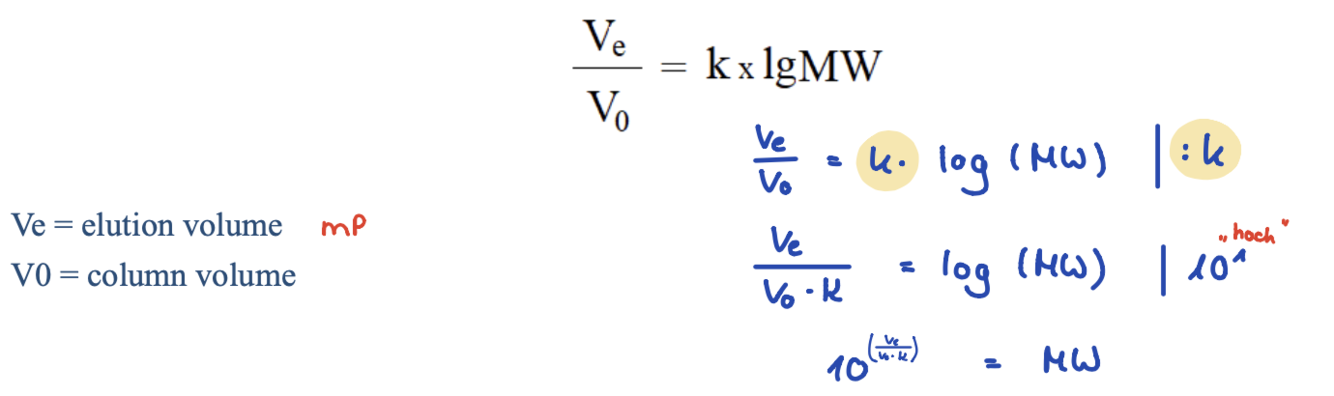
- Molecular weight (MW) determination of an unknown compound
Using the values of the table (gel filtration), calculate the elution volume of each component and the seperation volume.
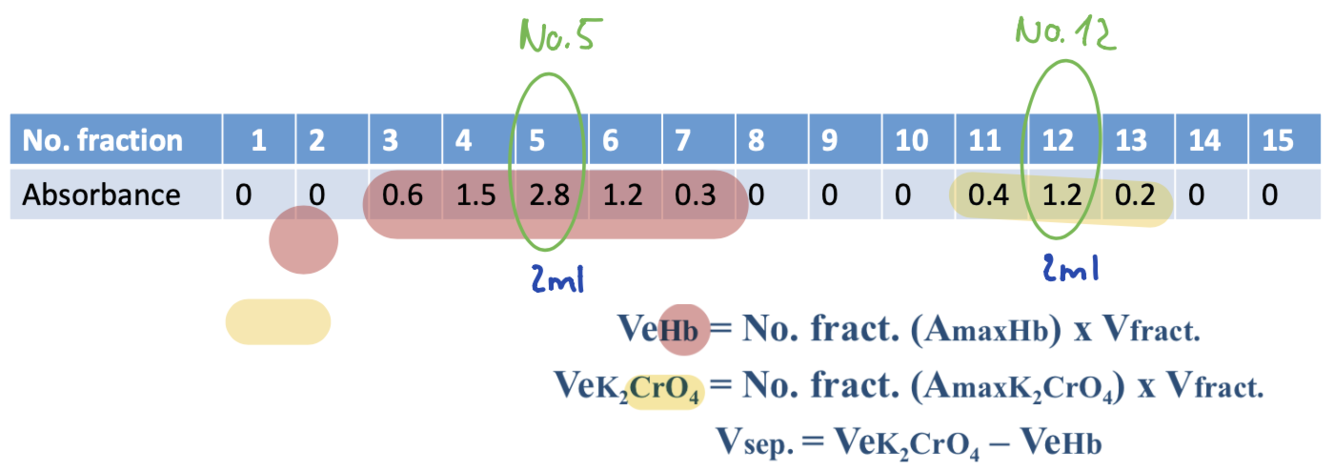
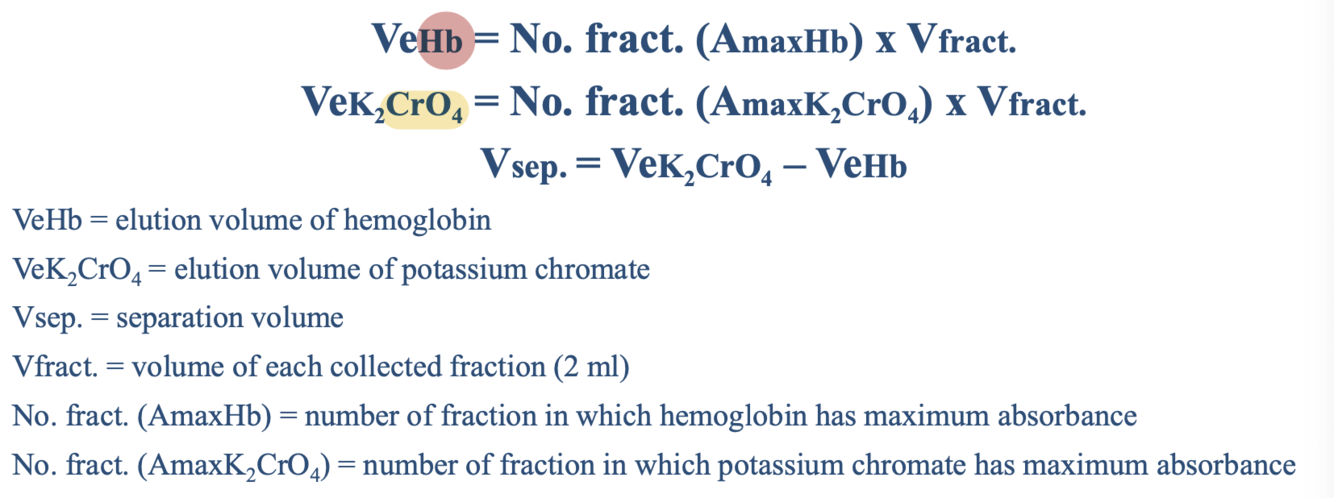
VeHb = 5 * 2 ml = 10 ml
Ve K2CrO4 = 12 * 2ml = 24 ml
Vsep. = 24 ml - 10 ml = 14 ml
Chromatography
chroma = color
graphy = seperate
Porous gel examples for gel filatration chromatography are:
Acrylamide (Sephacyrl)
Agarose (Sepharose)
Dextran (Sephadex)
Principle of affinity chromatogrpahy
- the target molecule (molecule to be seperated, eg protein) is specifically and reversibly adsorbed by a ligand (complementary binding substance) immobilized in a column on an insoluble support (frequently agarose)
=> used the principle that the protein binds to a molecule for which it has specific affinity
Examples of interactions between targeted molecule and ligand
enzyme : substrate analogue
antibody : antigen
nucleic acid : complementary base sequence
hormon : receptor
Choose the correct answer for affinity chromatography:
a) Albumin can not be separated from globulins using affinity chromatography;
b) Affinity chromatography separation is based on molecular size;
c) Electrophoresis can be used to remove the bound substance from the column;
d) In affinity chromatography the molecule to be separated is specifically and reversibly adsorbed by a complementary binding substance;
e) There is only a specific desorption (using a competitive ligand) to remove the bound substance from the column.
d) In affinity chromatography the molecule to be seperated is specifically and reversibly (umkehrbar) adsorbed by a complementary binding substance
Explain the following picture: Affinity chromatography
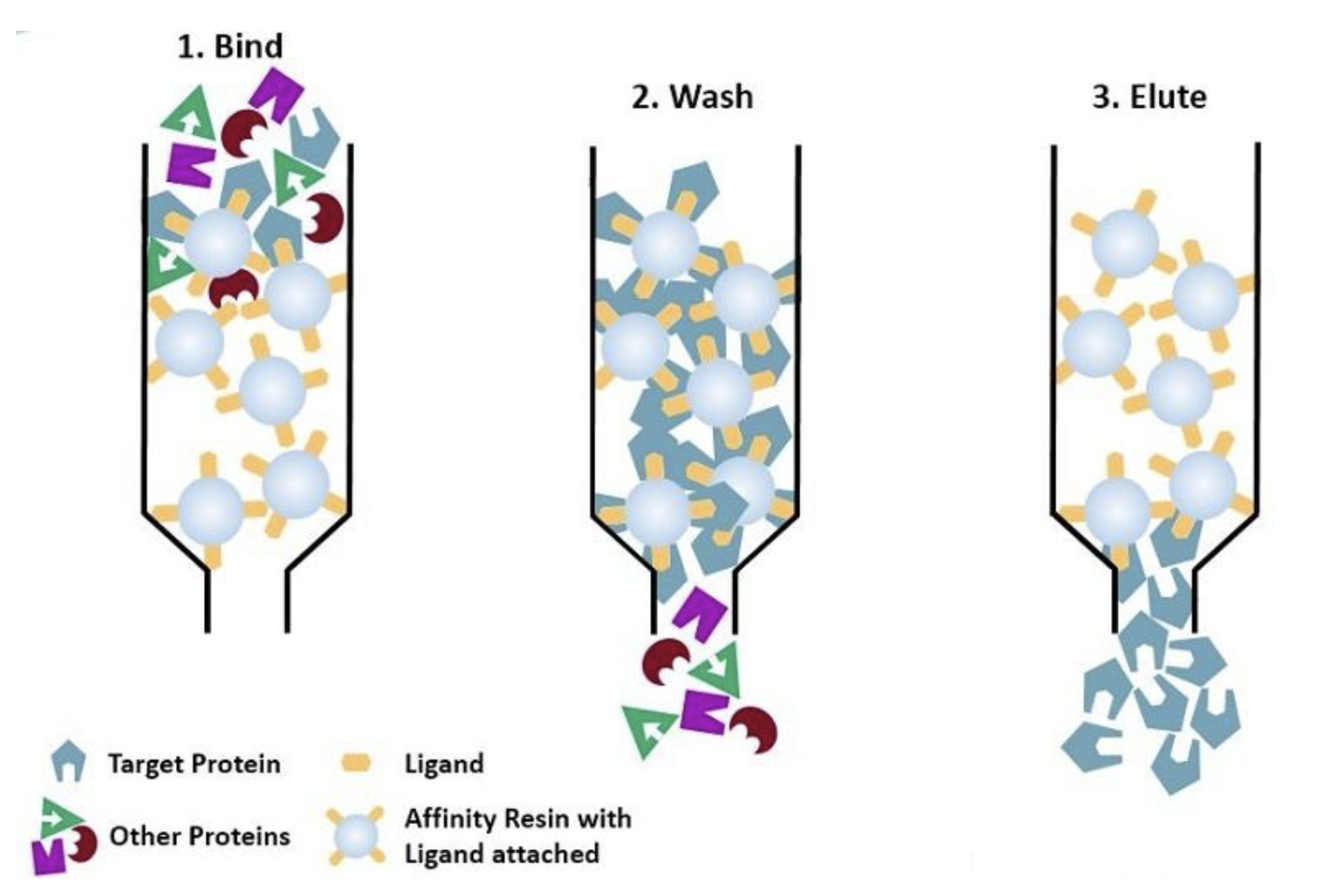
The targeted molecule (protein) to be seperated passes through the column, haveing a specific binding affinitie for the ligand
- Bind: The targeted molecule binds to the ligand and will be retained in the column (fixation phase)
- Wash: The other molecules (proteins) which do not interact with the ligand are washed out by a buffer solution (washing phase)
- Elute: Remove the targeted molecule: specific desorption (by using a competitive ligand = wettbewerbsfähig) or a nonspecific desorption (by changing pH, ionic strength or polarity; example: NaCl)
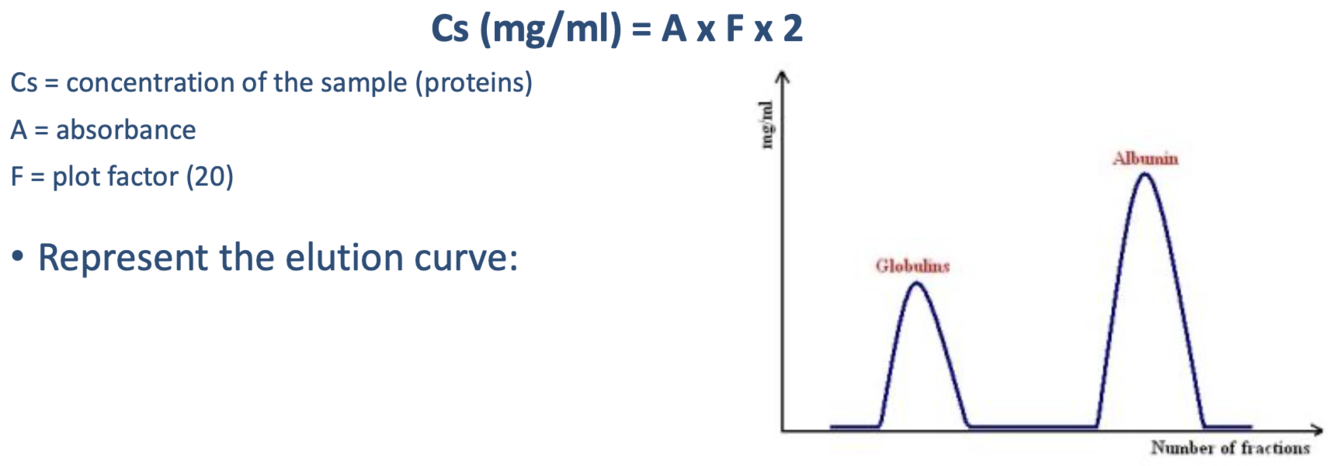
Calculation the concentration of proteins in each fraction by using which formula ?
Principle of the thin layer chromatography
method to seperate components of a mixture due to their different distribution (Verteilung)
between the stationary phase and the mobile phase
- the stationary phase = a thin layer of an adsorbent material (cellulose, silica gel or alumina) immobilized on a glass or plastic plate
- the mobile phase = a liquid, a solvent which travel over the surface of the stationary phase -> the compounds with a higher affinity to stationary phase travel slowly while the others travel faster
Affinity= a substance tends to combine with another (polar-polar)
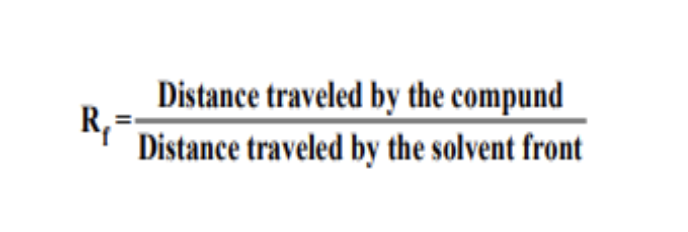
The forumula of the retention factor (Rf)
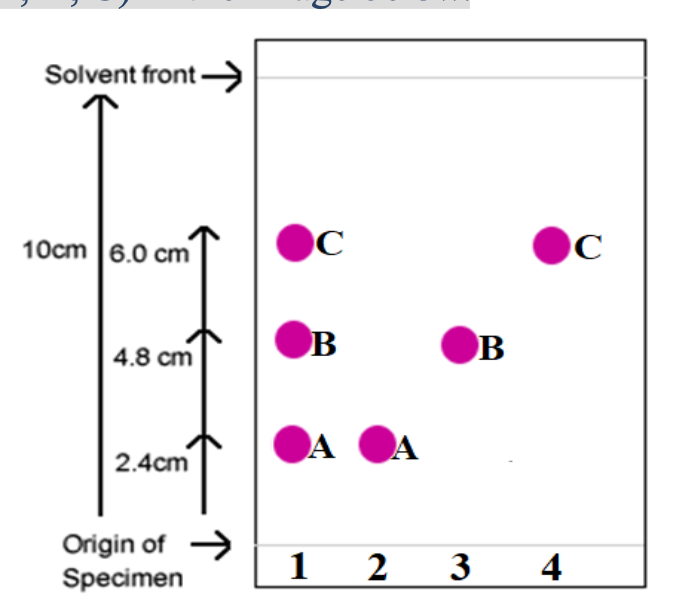
Calculate the value of the retention factor (Rf) for each of the separated components (A, B, C) in the image below.
Rf = distance made by the compound/ distance made by the solvent front
Rf (A) = 2,4cm / 10cm = 0,24 cm
Rf(B) = 4,8cm / 10cm = 0,48 cm
Rf(C) = 6cm / 10cm = 0,6 cm
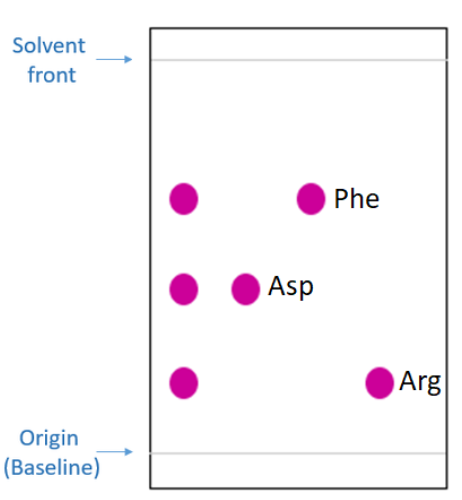
Interperation thin layer chromatography
The compounds of the mixture will make different distances according to their interaction with the stationary phase and the solubility in the mobile phase.
- Cellulose is a polar compound (contains several -OH in its structure)
Phenylanine (non-polar) = interact at least with cellulose
Argininie (most polar) = will be preferentially adsorbed by cellulose - slowest
Aspartic acid (intermediate polarity) = will move more than arginine but less then pheylanine
Compounds with a higher affintiy to stationary phase travel slowly while the others travel faster (polar and unpolar do not mix; polar and polar mix)
Examples of stationary phase in thin layer chromatography
cellulose, silica gel or alumina

-
Spectrofotometry19
-
Chromatography19
-
Isoelectric pH20
-
Amino acids39
-
Electophoresis28
-
General lab rules7
-
Calculations - biochemistry15
-
Buffer solution40
-
Enzyme kinetics16
-
Competitive and Noncompetitive inhibition7
-
Chemical properties of the amino acids - Lecture 312
-
Requierement vitamins9
-
Immunoglobulins - requirement5
-
Metabolism19
-
Biochemistry lab 2nd year71



