What is the incidence of myelomalacia? What are the myelographic signs?
- Cumulative incidence of <1% over 7 years
- Findings:
- Can be normal
- Focal swelling resulting in thinning of the contrast column
- Contrast-staining of the spinal cord; can be subtle or extensive
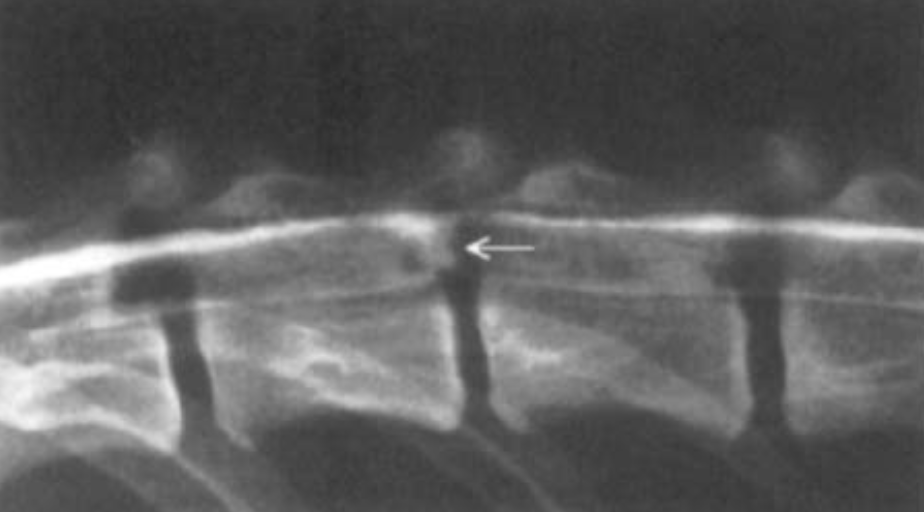
What is the location of this contrast?
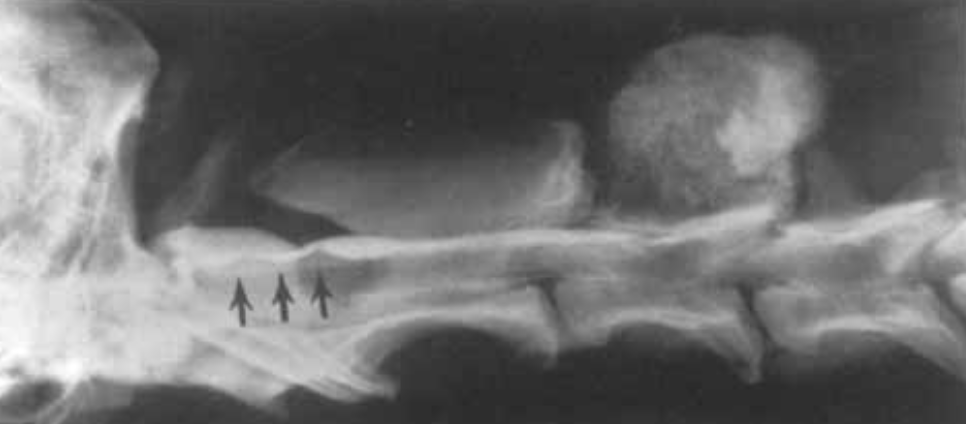
Subdural - characterized by smooth dorsal border and irregular ventral border of the contrast column; tend to accumulate dorsally in the vertebral canal; believed to be within the region of the structually weak dural border cells (subdural space)
Can reduce risk by:
- Use small needle size
- Bevel placed across both levels
During myelography, injection at what location is more likely to result in central canal opacification? What causes this? Is this associated with clinical signs?
- Lumbar punture cranial to L5
- May be due to inadvertent communication between subarachnoid space and central canal, such as with trauma, IVDD, neoplasia, or pressure induced leakage around the needle
- Usually incidental. Could be associated with neurologic deterioration, particularly if injected rapidly
- Dachshunds may be more at risk due to increased size of central canal and narrower subarachnoid space
Is CT, angiographic CT, myelography, or CT myelography most sensitive for diagnosis of acute canine myelopathy?
- CT myelography had highest agreement and sensitivity for identifiction of compression, lesion localization, and lateralization
- No imaging techniques definitively diagnosed spinal cord infarction or meningomyelitis, but both myelography and CT myelography ruled out surgical lesions in these cases
Dennison VRU 2010
What type of IVDD lesion is conventional CT most capable of identifying?
Mineralized Hansen type 1 discs in chondrodystrophic breeds
Hansen type 2 were rarely mineralized
Dennison VRU 2010
In what cases is CT myelography often necessary for diagnosis of acute canine myelopathy?
- If no lesion is identified on conventional or angiographic CT
- The dog is not chondrodystrophic
- Plegia due to extradural compression and concurrent spinal cord swelling
What are the categories of corpus callosal abnormalities? In what portion of the corpus callosum do abnormalities most commonly occur?
- Categories (human lit)
- Hypoplasia - small, but normal shape
- Hypoplasia w/ dysplasia - small with distorted shape
- Agenesis
Rostral portion is most commonly affected; severity and type of abnormality varies
Regarding corpus callosal abnormalities, what other concurrent abnormality can be seen? How frequently is it noted?
Concurrent fusion of midline structures rostral to the corpus callosum; these regions are also involved in regulation of thirst and may be responsible with the clinical sign of adypsia
Seen in most dogs
This appearance of the lateral ventricles is often associated with what condition?
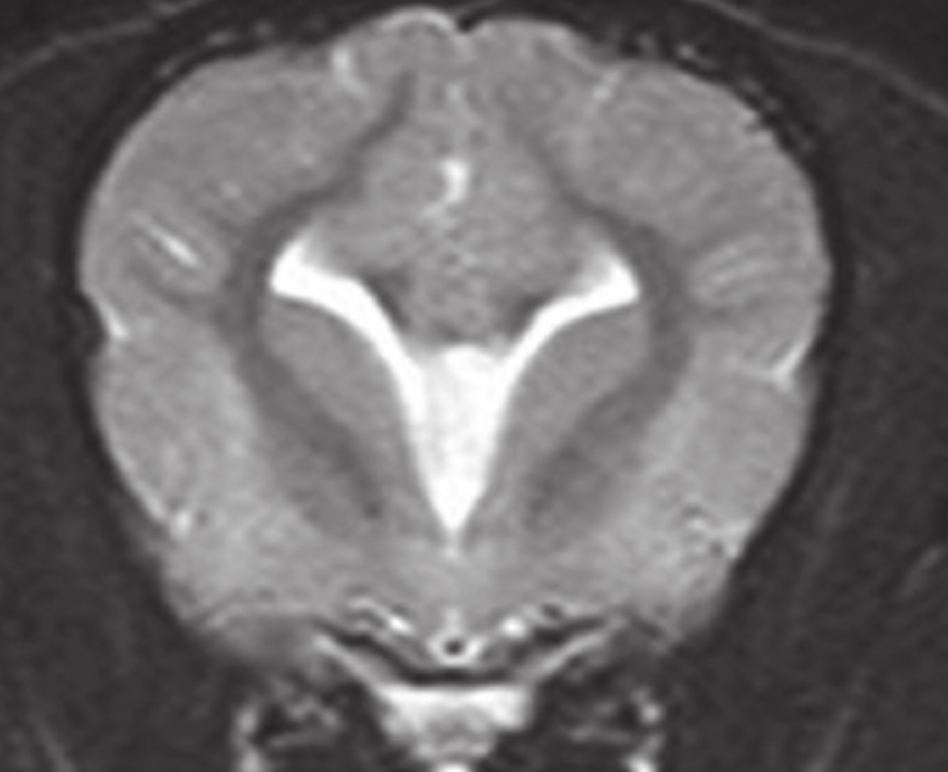
Associated with complete or partial corpus callosal aplasia
“Upturned, pointed dorsal corners of lateral ventricles; bat-wing appearance”
What criteria can differentiate ventriculomegaly from clinically relevant hydrocephalus?
- Ventricle-brain index (>0.6) is discriminator between the two
- Additional findings associated with relevant hydrocephalus
- Elevation of the corpus callosum
- Dorsoventral flattening of interthalamic adhesion
- Periventricular edema
- Dilation of the olfactory recesses
- Thinning of the cortical sulci and/or subarachnoid space
- Disruption of the internal capsule adjacent to the caudate nucleus
Is post-contrast T1w imaging or subtraction imaging better for detection of the meninges? Where (anatomically) was the enhancement predominately located?
Subtraction imaging allows clear visualization of the meninges
Appears as
- Faint, small rounded foci within the sulci
- Large, round foci at dorsal aspect of cerebral cortex
- Thin curvilinear enhancement around the brain
Located in dura
What factor affects visualization of meningeal enhancement in post-gadolinium images?
Fat saturation was most useful (allowed definite diagnosis/characterization of meningeal enhancement in 50%)
Delay of image acquisition did not improve characterization of meningeal enhancement
No imaging features significantly allowed differentiation between neoplasia and inflammatory disease, but:
- Inflammation - enhancement more diffuse, leptomeningeal
- Neoplasia - thicker meninges, increased contrast ratio
What are MRI findings of idiopathic oculomotor neuropathy in dogs?
- Unilateral
- Variable enlargement of the oculomotor nerve
- Variable contrast enhancement (absent, focal, or diffuse)
What clinical signs are associated with oculomotor neuropathy? What is the prognosis?
Signs: unilateral internal ophthalmoplegia and external ophthalmoparesis
Good prognosis - clinical signs do not deteriorate and can improve even without immunosuppressive treatment
What is the sensitivity and specificity for VIBE and post-gadolinium T1w MRI for detecting facial nerve abnormalities in dogs with facial neuropathy?
- VIBE: high sensitivity and specificity
- T1w: low to moderate sensitivity, excellent specificity
MRI was not sensitive for detecting concurrent vestibulocochlear nerve abnormalities
Where is this lesion? What imaging sequence is best for identifying this lesion?
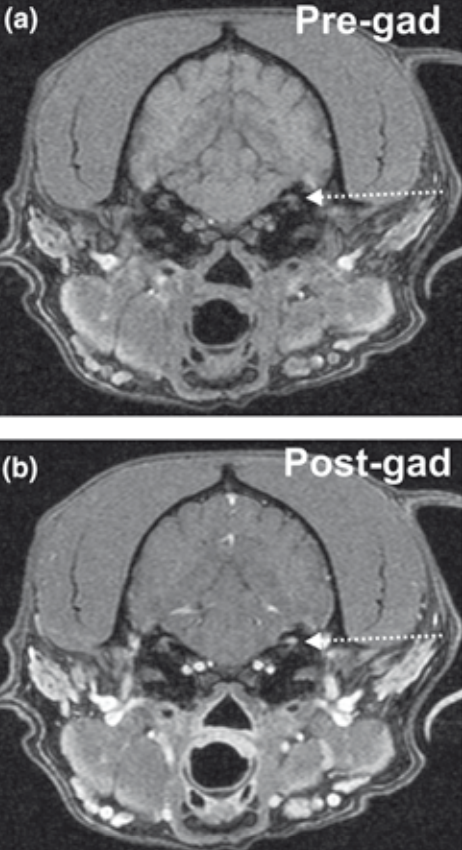
Facial nerve; VIBE was more sensitive than T1w post-contrast for detection of facial neuropathy in dogs
Also - facial nerve can be visualized throughout its length (brainstem to stylomastoid foramen) in VIBE; best visualization proximally
What is the prognosis of return of facial and vestibular nerve function with neuropathy of unknown origin? What CSF finding was seen?
Guarded return to function without tx; complete resolution of signs in 1/3rd and 15% relapsed
Facial and vestibulocochlear neuropathy evolve independently
Albuminocytologic dissociation on CSF - suggests inflammatory etiology
Label the vasculature
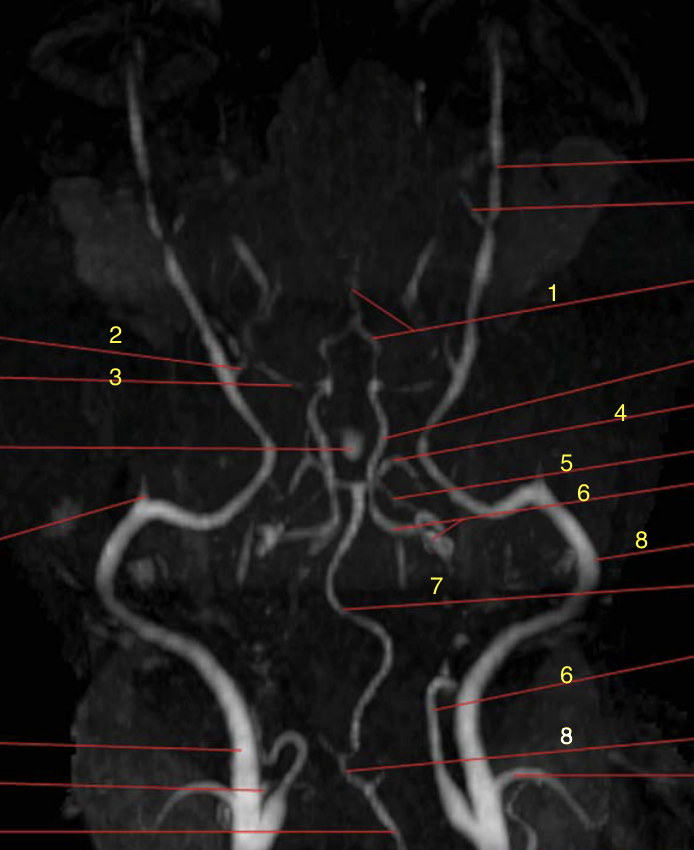
- Rostral cerebral artery
- External ophthalmix artery
- Middle cerebral artery
- Caudal cerebral artery
- Rostral cerebellar artery
- Internal carotid artery
- Basilar artery
- Ventral spinal artery
Is 3D FLASH or 3D TOF better to visualie the cerebral arterial circle (Circle of Willis)?
TOF is better to visualize the cerebral arterial circle (arteries as small as 0.4mm)
Describe the CT appearance of brachial plexus tumors? What is the smallest mass that was identified?
- Vary from well-circumscribed to infiltrative
- Most enhance; rim-enhancement with a non-uniformly enhancing or hypodense center is most common
- Muscle atrophy
- 1 cm was the smallest identified
Do CT appearance and histopathologic findings of brachial plexus tumors correlate?
No. No relationship between appearance and histopathologic relationship
Describe the CT and MRI appearance of carotid body tumors in dogs
- CT: hypoattenuating to muscle, strong heterogeneous enhancement
- MRI: hyperintense to muscle in T1w and T2w images, strong heterogeneous enhancement
What is the biologic behavior of carotid body tumors in the dog?
Locally invasive in 9/16 dogs –> invaded basilar portion of the skull, tymapnic bulla, cranial cavity, internal jugular vein, external jugular vein, maxillary and linguofacial veins
How can carotid body tumors be differentiated from other cervical neoplasms?
Centered on carotid bifurcation
More cranial than thyroid and displaces medial retropharyngeal LN caudally






