Why do oral presentations?
Patient care
- To organize and summarize your patient’s story for yourself and your team.
Consultation
- To seek expert opinion about your patient’s problem
Teaching
- To permit discussion and learning from your patient
Assessment
- To demonstrate to your teachers how well you understand your patient’s case
Listener’s attention
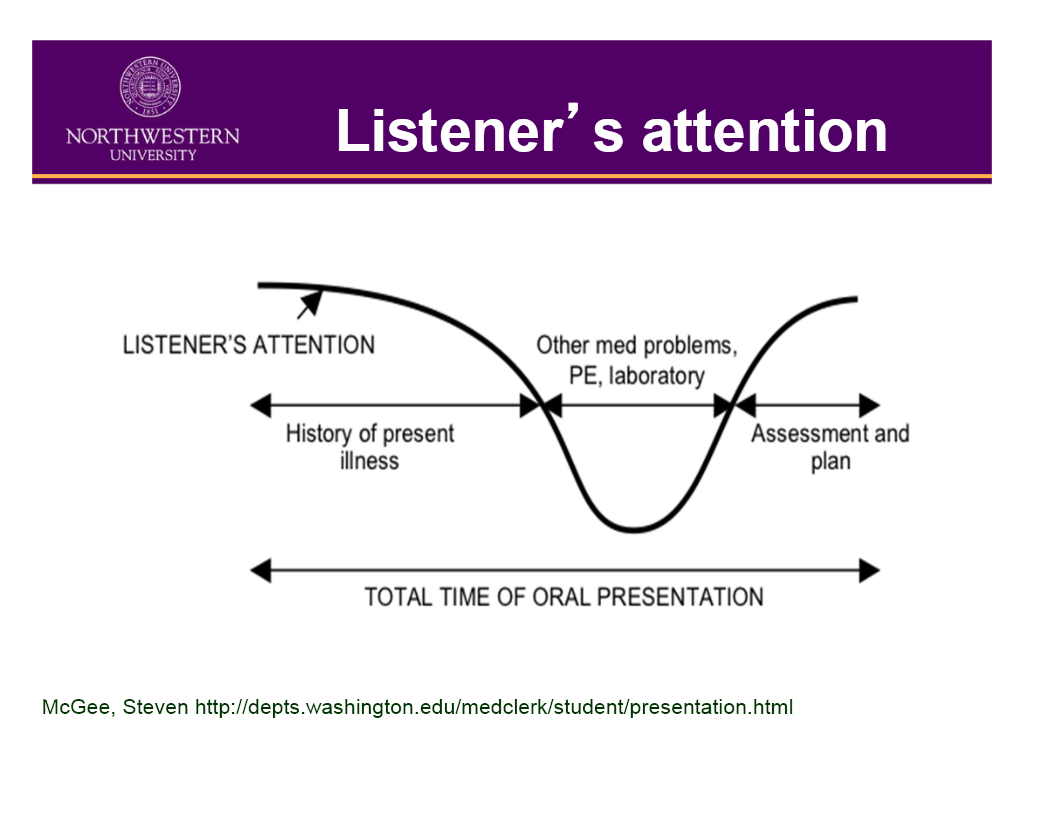
Opening Statement
Patient’s age should always be included
The chief concern should always be included.
- If patient presents multiple CC’s pick at most three to open
- Not the diagnosis, the chief concern!!
Significant medical history or risk factors pertinent for the patients presenting concern should be included
- Exclude minor diagnoses that are not relevant
- Should not be an exhaustive list
Symptom duration is important
HPI
The HPI is your patient’s story
Should be one of the longest parts of the history
Details should create a rich picture of the patient’s illness
Transition into the illness
A good HPI starts with the patient in their usual state of health and follows them into the illness
Chronological
Note times as relative to day of admission
Just the facts, ma’am
Avoid editorializing or making interpretations
Like most good movies, the HPI is
Detailed, creating a rich tableau of the patient’s illness
Onset
Location
Duration, and timing, is it getting better or worse
Character
Aggravating/Alleviating factors
Radiation
Treatment
Significance
As much as possible, include the patient’s perspective
Your HPI is a story, but also an argument for your leading diagnosis/es
After the story,
Choose information from the past, family, and social history, and the review of systems that helps you weigh the diagnostic possibilities
The story and the pertinent positives should come before the negatives.
antecedent care
If your patient has sought medical care for this problem already– in the ED or at an outside location— discuss the details of the symptoms BEFORE you discuss the other providers’ diagnosis and treatment
Your listener needs to decide what she thinks is going on before you tell her the presumed diagnosis and plan of care.
additional medical history
PMH/PSH/Past OB gyne/Past Psych
Meds/Allergies
Family History
Social History
Review of Systems
Your oral presentation should include only what is so important that your listener must hear it
Present in the standard order
Simply leave out sections without relevant information or state “noncontributory”
Avoid repetition
Say, “Family history is as noted in the HPI,” if you went over it already and there is no additional information
past medical history
Choose illnesses and episodes of care that are important and/or relevant
- Major, serious illnesses, like cancer, heart disease or diabetes are nearly always important
- Minor diagnoses like a prior radial fracture may be important if considering symptoms of bone disease or arm pain, but usually will not be relevant and belong only in the write-up
Often you will expand upon an illness you touched on in the HPI
- Avoid total repetition
medications
Ask your listener if they want a full list or just pertinent medications
Most listeners will not want doses
Exclude topical medications if not relevant
allergies
Present all serious, true allergies (anaphylaxis, severe rash, etc.)
Leave out mere intolerances unless they affect this episode of care
family history
Often non-contributory
It’s not necessary to prove you took a detailed FH
social history
Include living situation, occupation, tobacco/alcohol/drug use
Only include other details when relevant and not already mentioned
- Sexual history very relevant for someone with a genital lesion
- Diet history very relevant for a patient with uncontrolled diabetes
Review of Systems
This section should almost always be left out of the oral presentation
- Positive ROS and pertinent negative ROS should have been stated in HPI
If you discover an important new problem during your review of systems interview, you should create a second paragraph within your HPI.
physical examination
The physical examination must be presented in order from head to toe.
- General and vital signs come 1st and are always included
- Be specific about vital signs
Pertinent organ systems should be included even if findings are unremarkable
Abnormal findings should usually be described unless they are very minor, e.g. a benign skin lesion
Describe what you observe. Do not interpret findings in the PE
- 2/6 holosystolic murmur at the apex” NOT mitral regurgitation murmur
labs and studies
Present relevant labs and studies (xrays, CT, EKG etc)
Summarize them
- May present only the BUN and creatinine and not the sodium in some cases
Compare them to previous values
Don’t interpret them
assessment and plan
Requires medical knowledge and clinical reasoning
A summary statement
Problem by problem
- A differential diagnosis, when relevant
- An argument for and against items on the differential
- A plan
summary statement
One or two sentences
Patient’s age
Important risk factors such as medical history
Important information from the history, physical and labs
- not just a repeat of your opening statement
Your leading diagnoses
assessment
Several sentences reasoning through each of your diagnostic possibilities, marshalling evidence from the case
Best to have three or more diagnoses in mind: one may well be right!
No surprises! All case information should have been contained in the presentation already
You can assess several problems
plan
Often divided into diagnostic and therapeutic plans
Will become better as you learn more therapeutics over the third and fourth year
style of speech
Speech: Convey confidence and engagement
- Be clear, enunciate
- Speak loudly enough to be heard, but don’t shout
- Speak slowly and calmly
- Vary your cadence, don’t speak in a monotone
- Avoid vocal tics such as “um, like, so”
body language

-
Introduction to Microbiology33
-
Infectious Agents and the Immune System28
-
HIV Disease Course29
-
Enteric and Respiratory Viruses37
-
Herpesviruses and Latency49
-
Health and Society30
-
Viruses and Human Cancers17
-
Parasitic Infections I - Protozoa37
-
MDM14
-
Parasitic Infections II - Helminths27
-
Bacterial Structure and Function77
-
Gram-Positive Bacteria127
-
Gram-Negative Bacteria86
-
Miscellaneous Bacteria37
-
Antibiotics67
-
Fungal Structure, Diagnosis, Therapeutics25
-
MDM - Biases27
-
Immunology24
-
Ethics28
-
CM20



