What are the THREE factors to gas sterilisation?
- Ethylene oxide
- Factors influencing efficiency
- Control of process
What are the three factors to sterilisation by ionising radiation?
- Ionising radiation
- Factors influencing efficiency
- Control of process
What are the TWO main categories of gaseous sterilising agents? How are they distinguished? Explain in further detail about these agents.
Distinguished by their antimicrobial action
- Alkylating agents are highly reactive compounds and interact with many components, such as amino, sulfhydryl and hydroxyl groups in proteins and purine bases in nucleic acids
> Ethylene oxide is an alkylating agent that is associated with cytotoxic, carcinogenic and mutagenic effects
- Oxidising agents are highly reactive, toxic compounds. Such compounds currently used as sterilising agents include hydrogen peroxide and peracetic acid
For ethylene oxide (alkylating agent);
A) Describe its structure
B) When is it explosive
A)
- Simplest cyclic ether
- A colourless gas at room temperature
- Liquefaction point, about 12°C (becomes a liquid at 12°C or below)
- Water and organic solvents dissolve it readily
B)
- [>3%] in air are highly inflammable
- Explosive when mixed with air over a wide range of concentrations
What are the properties of ethylene oxide? What types of toxicity does it result in?
Non- selective in action so equally toxic to the operator as to the bioburden
Contact toxicity
- oedema, erythema, skin eruptions, allergic reaction
Vapour toxicity
- eye & nose irritation, nausea, dizziness (all below smell detection levels)
What is the action of ethylene oxide?
Alkylates –SH; amines; -COOH; -OH groups occurring on enzymes & nucleic acids
> chemical reaction that inactivates/kill micro-organism (see attached image)
- cyclic ether = very reactive
- Very wide spectrum –> vegetative bacteria; large viruses
- Less reliable when compared to heat sterilisation

For ethylene oxide applications;
A) What types of thermolabile equipment is it used in
B) What type of medicaments is it used in
A)
- plastics
- lensed equipment
- electrical
- Rubber
B)
- thermolabile solids (outside only), rarely use nowadays
- Alkylating agent –> toxic to the operator –> remove EO before opening sterilisation chamber
For gas sterilisation (BP) –> by ethylene oxide;
A) What is gas sterilisation of surfaces used for?
B) What is essential in order for the material to be sterilised?
A)
- It may be used for the sterilisation of primary packaging materials, equipment and some pharmaceuticals
B)
- It is essential that penetration by gas and moisture into the material to be sterilised is ensured
- Followed by a process whereby the gas is eliminated under conditions that have been previously established as sufficient to ensure that any residues of gas or related transformation by-products are below concentrations that could give rise to toxic effects during product use
For factors influencing efficiency: concentration of EO;
A) What does doubling gas concentrations do? (with limiting concentrations)
B) What concentrations are insufficient to achieve sterility within practical process time?
C) What are the usual concentrations in practice?
D) What other factors are interrelated?
A)
- Doubles the rate of inactivation
B)
- Concentrations of less than 300 mg/L are insufficient to achieve sterility
C)
- Concentrations are usually within a range of 500 to 800 mg/L
D)
- Influence of concentration and temperature are interrelated
For factors influencing efficiency;temperature of EO;
A) Under constant conditions and within the range of limiting gas concentrations, what kinetics does ethylene oxide follow?
B) When is rate of inactivation approximately doubled?
C) Why are the upper limits of temperature of less importance?
A)
- Follows first order chemcial kinetics
B)
- Every 10°C rise in temperature
C)
- The whole point of using ethylene oxide is to achieve cold sterilisation
For factors influencing efficiency; relative humidity of EO;
A) When is ethylene oxide ineffective?
B) How would a surface film of water promote contact?
C) What is the optimum humidity?
A)
- Ethylene oxide is quite simply ineffective against dehydrated microorganisms in a dry environment
B)
- A surface film of water would promote contact by dissolving ethylene oxide to form a concentrated solution
C)
- Optimum humidity level is 33 per cent
What are the SIX steps in the process of gas sterilisation by ethylene oxide?
- Remove air from chamber (EO dangerous in presence of air)
- Introduce moisture into chamber
- Introduce EO into chamber
- Once there is enough EO in the chamber (500-800 mg/L) –> sterilisation starts (55OC at 100mins –> double-check from diagram)
- Remove EO
- Air purge –> aeration of the load –> get rid of EO
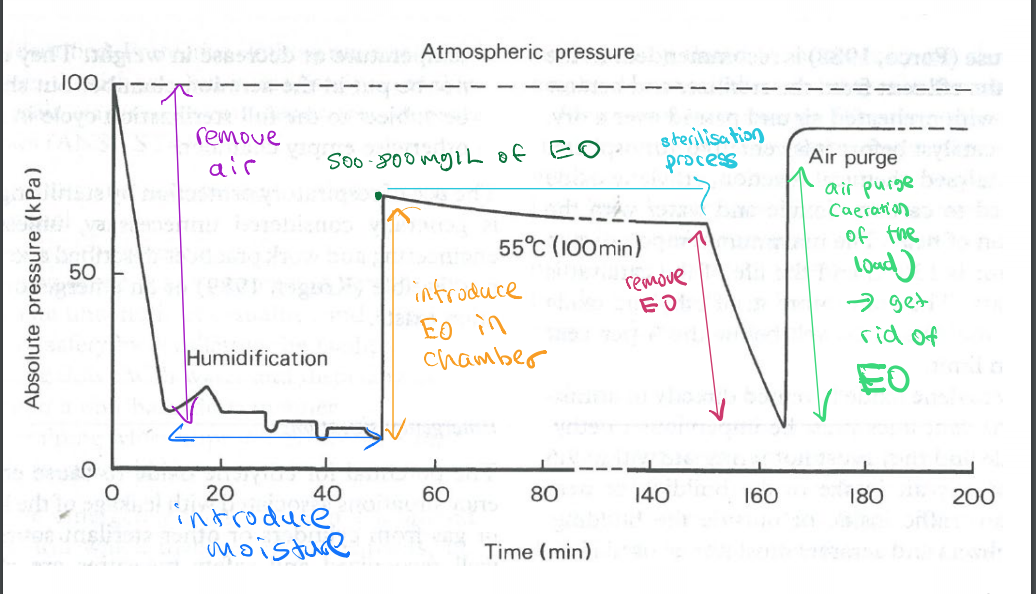
For aeration of the load (get rid of EO);
A) What must all the air used for aeration pass through?
B) What is the aeration time affected by?
A)
- All air used for aeration must pass through a bacterial-retentive filter of 99.97 percent efficiency
B)
The aeration time is affected by
- Composition, thickness, design configuration and weight of the device and wrapping material
- Ethylene oxide concentration and time of the sterilisation process
- Rate and pattern of airflow
- Intended use of the device
For process monitoring of EO;
A) What is specialist equipment required to monitor during validation and routine operation
B) What is the effectiveness of the process dependent on?
C) What type of indicators is necessary for all gas sterilisation procedures, both for the validation of the cycles and for routine operations? What is used specifically for EO?
D) Where are these indicators placed?
A)
- Monitor temperature, humidity and gas concentration
B)
- number of parameters, including gas concentration, temperature, humidity, exposure time, load configuration and characteristics of the product and its packaging materials
- The effect on the process effectiveness of any change in one or more of these parameters shall be investigated
C)
- The use of biological indicators is necessary for all gas sterilisation procedures
- The use of spores of Bacillus subtilis is recommended for ethylene oxide
D)
- The use of spores of Bacillus subtilis is recommended for ethylene oxide
> chemical indicators can also be used
A suitable sample of each batch is tested for sterility, before the batch is released –> this is needed to be done for membrane sterilisation and sterilising material by EO but not for?
Not necessary for dry heat+moist heat sterilisation
> also occupational health and safety is necessary –> need to look after operators
For sterilisation by ionising radiation;
A) What does it mean?
B) What does it exclude?
C) Does it kill all or only certain types of MO
D) Can it penetrate into solids and liquids
E) Are materials wetted or heated in the process
A)
- treatment by gamma rays (penetrate material inside and out), X-rays or accelerated electrons, all of which are ionising radiations
B)
- excludes ultraviolet light, which is a low energy, non-ionising radiation with very poor penetrating power
C)
- Kills ALL types of MO
D)
- Yes, usually has enough energy for useful penetration into solids and liquids
E)
- No, it does not heat or wet materials significantly
For Ionising Radiation Sterilisation;
A) How is sterilisation by irradiation achieved?
B) What are some other uses for ionising radiation
A)
- Sterilisation by irradiation is achieved by exposure of the product to ionising radiation in the form of either gamma rays from a suitable isotopic source (such as cobalt 60), OR beam of electrons energised by a suitable electron accelerator, OR X-rays resulting from bombarding a suitable target with energised electrons
B)
- Ionising radiation may be used for the terminal sterilisation of finished dosage forms, the microbial inactivation of tissues and cells, or the sterilisation of materials or containers to be employed in aseptic processing
- Low-energy electrons may be used for the surface sterilisation of materials upon entry to isolators used in the preparation of sterile product
Provide FIVE applications of radiation sterilisation
- Plastic syringes and catheters
- Hypodermic needles and scalpel blades
- Adhesive dressings
- Single-application capsules of eye ointment and catgut
- Polythene containers
- Aluminium foil and plastic film packaging materials
- Pharmaceutical and biological products
> safety tests needed as chemical changes may inactivate drugs
For the mechanism of biocidal action of ionising radiation;
A) What are the THREE stages
B) what are the two types of DNA damage
A)
- Ionisation
- Radical formation
- Biochemical changes
B)
- Breaks in one or both of the DNA strands
- Lesions in the nitrogenous bases
For absorbed dose of ionising radiation, what is the unit of dose defined as 1 joule of energy absorbed per kilogram of material irradiated?
Gray (Gy) –> SI unit replaces the rad
For sterilising dose (BP) of ionisinf radiation;
A) For this method of terminal sterilisation, what is the reference absorbed dose?
B) Why are these procedures and precautions employed
A)
- Reference absorbed dose is 25 kGy
- Other doses may be used provided that it has satisfactorily been demonstrated that the dose chosen delivers an adequate and reproducible level of lethality when the process is operated routinely within the established tolerances
B)
- The procedures and precautions employed are such as to give an SAL of 10-6 or better
For the sensitivity of microorganisms to ionising radiation; Provide kGy for each answer also.
A) What does sensitive include
B) What does moderately sensitive include
C) What does resistant include
D) What does highly resistant include
A)
- Vegetative bacteria (with some exceptions), 0.5-10 kGy
B)
- Moulds and yeasts, 4-30 kGy
C)
- Bacterial spores (10-50 kGy), most viruses (10-40 kGy)
D)
- Eg. Bacillus spores (contrived mutants), 35-80 kGy
Provide FOUR factors influencing susceptibility in the sterilisation process by ionising radiation. Briefly describe each factor.
Oxygen
- Resistance usually increased 2-5 times if anoxic conditions are maintained during and after irradiation
Temperature
- Increases in temperature shown to reduce D values
- control temp carefully, increase temp but not to the level that defeats purpose of cold sterilisation (thermolabile)
Organic substrates –> absorbs radiation therefore don’t want this in product
- Protective effect (dried serum broth, grease film culture media etc)
Chemical agents –> makes ionising radiation less effective
- Free radical scavenger (glycerol, thiourea, cysteine, dimethyl sulfoxide)
For control of the process for ionising radiation;
A) How is the radiation absorbed by the product monitored regularly during the sterilisation procedure of ionising radiation
B) How to carry out a biological assessment?
C) Occupational health and safety?
A)
By means of established dosimetry procedures that are independent of dose rate
- Dosimeters are calibrated against a standard source at a reference radiation plant on receipt from the supplier and at suitable intervals of not longer than one-year thereafter
B)
- Using a suitable biological indicator
C)
- Handling radioactive material –> look after operators

-
Sterilisation by membrane filtration23
-
Sterility Testing19
-
Colligative Properties 1+255
-
Formulation of eye drops27
-
Cold sterilisation26
-
Parametric Release24
-
CDR and TPN36
-
DDS: Pulmonary23
-
DDS: Implant18
-
DDS: Nasal24
-
DDS: Intraocular26
-
Protein and Insulin38
-
DDS: Transdermal37
-
Drug targeting and nanotechnology 129
-
Drug targeting and nanotechnology 2 + 336
-
Recombinant Pharmaceuticals 1 and 238



